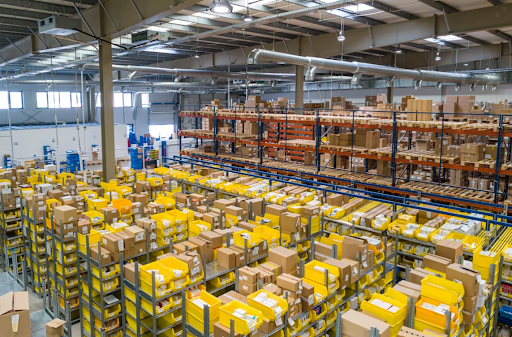

Warehouse performance depends on how efficiently space is organized and used. As complexity grows, warehouses must handle higher volumes and faster fulfillment without expanding, making organization a key performance driver.
Advanced analytics unlocks 7-15% additional capacity and reduces inventory levels by 20-30%. However, poor organization increases travel time, creates congestion, and slows operations.
This blog covers practical warehouse organization ideas across layout, storage, inventory control, daily work, visual management, and technology to improve efficiency and reduce cost.
Evaluate Your Warehouse Before Making Changes
Start by understanding how your warehouse actually performs. A structured assessment reveals the constraints that should be fixed first.
Identify workflow bottlenecks
Find the process controlling output before changing layout, labor, or equipment. Apply the theory of constraints for warehouses by comparing queue time, effective capacity, blocked time, and downstream starvation. Release work only at the constraint’s sustainable rate.
For instance, PepsiCo tested pallet, conveyor, machine, and operator flows through digital twins at selected US facilities. Its initial deployment identified up to 90% of potential issues before physical changes, increased throughput by 20%, and indicated 10-15% lower capital expenditure.
Analyze inventory movement and SKU velocity
Measure order lines, units, cube moved, replenishment frequency, handling time, and demand variation. A moderate-value SKU picked individually hundreds of times can consume more labor than a high-value full-case item. Build separate curves for normal, promotional, and peak demand.
Measure storage utilization
Measure usable cube, location fill, honeycombing, SKU fragmentation, blocked positions, and reserve-to-forward-pick balance. Warehouse space optimization should release capacity without hindering retrieval or replenishment.
For example, Unilever’s factory-to-consumer distribution center in Hefei, China, reported 50% more inventory capacity without expanding its footprint in 2026. It also fulfilled orders 75% faster, cut logistics costs by 24%, and managed over 31,000 daily orders across 400-plus products.
Evaluate receiving, picking, packing, and shipping processes
Create an event timeline for each order type from dock arrival to carrier departure. Useful performance metrics include dock-to-available time, touches per unit, rehandle rate, replenishment-related delays, exception age, and queue time. Review the slowest 10%, not averages alone. Synkrato’s 3D Digital Twin visualizes the complete warehouse flow, helping teams identify bottlenecks before making layout or process changes.
Layout Ideas for Better Warehouse Space Optimization
Make every square foot support faster movement and higher throughput. The right layout increases capacity without expanding the building.
Optimize your warehouse layout
Design for the lowest weighted movement cost, not the shortest route. Warehouse layout optimization should combine distance, movement frequency, equipment type, congestion, and handling effort. Test peak traffic during peak seasons and regular days, replenishment crossings, equipment returns, emergency access, and expansion before moving infrastructure.
Create dedicated storage zones
Create a zone only when products require different equipment, security, temperature, replenishment, or release logic. Every additional boundary can add to consolidation and travel. Compare the control benefit with added handoffs, buffers, and cross-zone movement.
Maximize vertical storage space
Use upper levels for stable reserve stock and ergonomic levels for active picking. Assess structural capacity, sprinkler clearance, lift cycles, and replenishment access together. Height adds little value when retrieval equipment becomes constrained.
Example: Amazon’s Vulcan operates in Spokane, US, and Hamburg, Germany, including hard-to-reach pod levels. In 2025, Amazon said it could pick and stow approximately 75% of item types held in its fulfillment centers at speeds comparable to those of frontline employees.
Upgrade warehouse racking and shelving
Select storage media from the handling unit and replenishment pattern. Carton flow suits frequent unit picks, pallet flow supports controlled rotation, and narrow aisles increase density but consume equipment capacity. Compare cost per productive pick face, not per pallet position.
Improve aisle design and traffic flow
Treat aisles as a capacity-limited network. Separate through-routes from work aisles, create passing points, restrict intersection staging, and measure congestion minutes per operating hour.
Amazon reported in June 2025 that DeepFleet would coordinate one million robots across more than 300 facilities and improve fleet travel time by 10%. Coordinated movement can also release capacity in manual sites.
Use flexible and modular warehouse storage solutions
Use reversible infrastructure for volatile assortments. Adjustable modules, mobile packing cells, removable flow lanes, and configurable staging grids let capacity follow demand. Set sustained volume or cube triggers so temporary areas expand or disappear through rules.
Warehouse Organization Ideas for Better Inventory Control
Better warehouse inventory organization improves visibility, replenishment, and picking accuracy. These practices help keep stock accessible while reducing unnecessary handling.
- Classify inventory using ABC analysis: Replace sales-value-only ABC analysis with multiple criteria. Combine order frequency, margin, cube moved, stockout impact, handling risk, expiry exposure, and supply variability. A critical spare may need A-level control despite low demand, while a costly slow mover may not deserve premium access.
- Optimize warehouse slotting: Use a cost function covering travel, replenishment, congestion, affinity, ergonomics, and relocation effort. Effective slotting optimization does not crowd every fast mover near shipping. Move a SKU only when expected savings exceed disruption and labor cost.
- Standardize bins, totes, and containers: Create a controlled family of container sizes compatible with racks, conveyors, carts, and packing equipment. Assign preferred containers, fill limits, weights, and mixing rules by SKU. Dimensional standards improve cube calculations and prevent half-filled containers from consuming locations.
- Organize inventory by demand and product characteristics: Build a compatibility matrix for weight, fragility, hazard, temperature, security, contamination, dimensions, and order affinity. Use affinity to shorten picking, but let compatibility determine shared positions, containers, or handling paths.
- Create dedicated returns and quarantine areas: Manage returns and quarantine as timed decision queues. Give every unit a reason code, owner, value, ageing clock, and disposition deadline. Separate inspection, repair, recall, return-to-vendor, and scrap so unresolved stock cannot become available.
- Eliminate obsolete and slow-moving inventory: Prioritize removal by cubic cost, not book value alone. Include occupied positions, counting effort, insurance exposure, handling interruptions, and SKU fragmentation. This can reduce warehouse costs by releasing capacity and management attention without changing customer-facing processes.
Warehouse Organization Ideas to Improve Daily Workflows
For warehouse workflow optimization, small process improvements across receiving, picking, packing, and shipping often deliver the biggest operational gains.
Streamline receiving operations
Pre-plan the putaway process from the advance shipment data. Assign docks, inspection paths, staging limits, labor, equipment, and destination zones before arrival. Sequence tasks to protect docks and prevent aisle crowding.
The operational impact of this approach is evident at scale. When FedEx expanded its Taiwan Transshipment Center in 2026, the facility achieved a throughput of 9,000 packages per hour, increasing import warehouse efficiency by 2.5x and export efficiency by 1.2x.
Optimize picking routes
Choose routing and release logic together. Warehouse picking optimization may use wave, waveless, zone, cluster, or batch methods depending on cutoff times, order overlap, congestion, and downstream sorting capacity. Many picking challenges begin with the wrong work combination, not walking choices.
Improve replenishment processes
Calculate forward-pick stock from expected demand during the next replenishment window plus variability protection. Separate planned from emergency replenishment and code every stockout cause. Use temporary promotion minimums instead of enlarging pick faces year-round.
Standardize packing stations
Balance stations by work content instead of giving every packer the same table. Create profiles for parcels, fragile products, multiline consolidation, and regulated documents. Standardize reach zones, consumable triggers, verification, and exception routes so complex work cannot block simple orders.
Reduce employee travel time
Remove travel through task design before asking people to move faster. Interleave compatible tasks, locate consumables at use points, separate replenishment from picking traffic, and place printers or inspection tools near demand. These changes improve efficiency without raising pace or fatigue. Synkrato’s AI Agents dynamically balance tasks and reduce unnecessary travel.
Keep aisles clear and clutter-free
Set explicit work-in-process limits for staging. Every temporary pallet needs a system location, status, owner, reason, and expiry time. When a lane reaches its limit, stop or redirect upstream release. A blockage becomes a capacity signal, not a housekeeping complaint.
Standardize Warehouse Organization with Labels and Visual Controls
Consistent visual standards reduce errors and improve execution across the warehouse. Every location, movement, and process should be easy to identify and follow.
- Create a warehouse labeling system: Build labels from an immutable location master. Keep permanent location identity separate from changing inventory, route, customer, or status data. Use controlled templates and retirement rules so labels, the WMS, maps, and automation reference the same address.
- Use barcode and QR code labels: Design scans around inventory-state changes. A scan should confirm identity, location, custody, quantity, or process completion. Use QR codes where added data or mobile workflows create value. Excess scanning adds labor and workarounds without improving control.
- Color-code warehouse zones: Use color to communicate one controlled attribute, such as hazard, process status, or access restriction. Pair it with text and symbols. Never reuse a color for unrelated meanings; lighting, fading, and color-vision differences weaken decisions.
- Implement rack numbering and location IDs: Create machine-sortable IDs that follow physical travel and remain stable during expansion. Reserve number ranges, use fixed fields, and exclude product attributes. Test digital sorting because visual logic can still create an inefficient WMS task order.
- Install signage and warehouse maps: Treat maps as controlled documents. Show vehicle routes, pedestrian separation, restricted areas, emergency assets, one-way aisles, and temporary changes. Link map updates to layout approval so digital twins, WMS locations, signs, and instructions change together.
Use Technology to Maintain an Organized Warehouse
Technology keeps warehouse organization effective as operations grow more complex. The right systems help optimize decisions instead of simply automating tasks.
Implement a Warehouse Management System
A warehouse management system should actively coordinate warehouse flow instead of simply recording transactions. Unilever’s Mannheim demonstrates this approach by managing over 36,000 pallet locations while achieving a 99.8% customer-case-fill-on-time rate in 2025. To achieve this level of performance, a WMS should:
- Manage capacity-aware putaway, task interleaving, replenishment, release control, and exception ageing.
- Maintain reliable master data for dimensions, pack hierarchies, capacities, and status codes.
Use barcode scanning and RFID tracking
Choose the technology that best fits each warehouse process. An effective tracking strategy should include:
- Use barcodes for controlled confirmations and RFID for high-volume, no-line-of-sight tracking.
- Apply machine vision where automatic movement or condition detection is required.
- Combine technologies instead of relying on a single identification method across the warehouse.
Automate repetitive warehouse tasks
Automation should remove repetitive work without shifting bottlenecks elsewhere. Focus on the following priorities:
- Automate stable, high-volume processes with predictable inputs.
- Re-evaluate the system constraint after every automation project.
- Define manual fallback procedures before deployment.
Improve slotting with AI and analytics
AI-driven slotting should continuously adapt locations as demand changes instead of relying on periodic reviews. For example, Synkrato’s AI Slotting analyzes demand, affinity, congestion, replenishment effort, and labour availability to recommend only high-impact slotting changes. To maximize the results:
- Prioritize moves that deliver measurable labour savings.
- Protect stable zones from unnecessary re-slotting.
Monitor warehouse performance with dashboards
Dashboards should drive operational decisions rather than report historical performance. Monitor a combination of leading and lagging indicators, including:
- Queue growth, blocked locations, and replenishment risk.
- Exception ageing and cycle degradation.
- Business impact and probable root cause.
- Recommended corrective action for each critical alert.
- Recovery time after operational disruptions.
Common Warehouse Organization Mistakes to Avoid
Many warehouse problems result from avoidable planning and execution mistakes. For instance, US transportation, warehousing, and utilities recorded a 2.2% average monthly quit rate in 2025. Repeatable training and visibility are core warehouse management best practices.
- Poor warehouse layout planning: The most serious common warehouse layout mistakes are crossed inbound and outbound flows, undersized buffers, inaccessible replenishment paths, and fixed infrastructure based on average demand. Test peaks, failures, and expansion so the layout works under difficult conditions.
- Ignoring inventory velocity: Treat velocity as dynamic. Track trend, volatility, seasonality, promotional lift, and channel mix. Expire temporary slotting decisions so short campaigns do not retain premium space.
- Inconsistent labeling practices: Prevent inconsistency through central templates, approved materials, controlled printers, and clear location-master ownership. Record damaged, replaced, duplicated, and retired labels as maintenance events. Local fixes often create long-term transaction errors.
- Wasting vertical storage space: Height assignments must reflect access capacity. Model lift cycles per hour, replenishment queues, fragmentation, and safety clearance. Dense upper storage reduces capacity when retrieval equipment is unavailable or overloaded.
- Overstocking inventory: Treat storage as a service constraint in inventory policy. Excess stock increases fragmentation, travel, blocked staging, and emergency moves. Include cube, receiving capacity, and replenishment workload in order quantities so purchasing carries an operational cost.
- Lack of employee training and accountability: Use role certification, skill matrices, transaction audits, and standard exception responses. The hidden cost of turnover includes slower decisions, supervision, location errors, and lost knowledge.
Take Warehouse Organization Beyond Best Practices with Synkrato
Warehouse organization should continuously adapt as inventory, demand, labor availability, and order profiles change. Synkrato helps warehouses maintain an optimized operation by enabling teams to:
- Simulate layout, storage, and workflow changes before implementing them.
- Continuously optimize inventory placement to reduce travel and replenishment effort.
- Detect congestion, capacity constraints, and operational bottlenecks in real time.
- Improve inventory visibility and execution accuracy across warehouse processes.
- Support faster, data-driven decisions using live operational insights instead of periodic reviews.
Book a demo to see how Synkrato can help you build a more organized, efficient, and resilient warehouse.
Frequently Asked Questions
What are the best warehouse organization ideas?
The best warehouse organization ideas improve the flow of inventory, people, and equipment rather than simply creating more storage space. Synkrato helps sustain these improvements by identifying operational bottlenecks and recommending data-driven actions as warehouse conditions change.
How do you organize a warehouse efficiently?
An efficient warehouse is organized around product movement instead of static storage. Analyse inventory velocity, define clear putaway and replenishment rules, optimize pick paths, and regularly review workflow performance. Synkrato continuously evaluates these operations, helping teams maintain efficiency as demand, inventory, and labour requirements evolve.
How can I maximize warehouse storage space?
To maximize storage, reduce honeycombing, remove obsolete inventory, optimize slotting, and use vertical space without compromising accessibility or safety. Synkrato helps warehouses evaluate layout changes and inventory placement to increase storage density while maintaining operational flow.
What is the 5S method in warehouse organization?
The 5S method improves workplace organization through Sort, Set in Order, Shine, Standardize, and Sustain. Synkrato helps maintain these standards by highlighting exceptions, bottlenecks, and process deviations before they impact warehouse productivity.
What technology improves warehouse organization?
A WMS, AI-driven slotting, digital twins, RFID, mobile execution, and analytics all contribute to better control. Synkrato combines these capabilities to help warehouses optimize layouts, inventory flow, labour utilization, and overall operational performance from a single platform.