
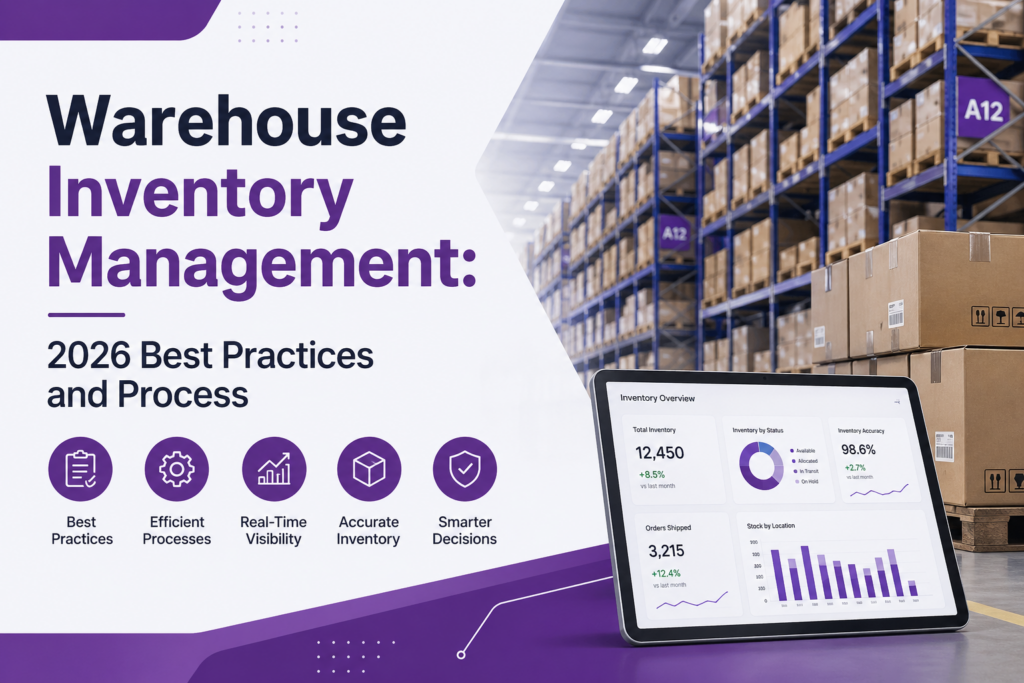
Warehouse inventory management is becoming a strategic priority as AI begins to directly influence cost and working capital. AI reduces inventory levels by 20-30% in distribution operations. At the same time, 71% of supply chain leaders already see AI disrupting operations, with 24% calling the impact transformational.
Operational pressure also increases from visibility gaps and reverse logistics complexity. For instance, about 58% of warehouse leaders plan to deploy radio frequency detection (RFID) by 2028, reflecting the urgency to improve inventory accuracy and availability tracking.
In this blog, we will break down the key processes, strategies, best practices, and challenges shaping warehouse inventory management in 2026.
Warehouse Inventory Management: Best practices checklist
| Best Practice | Why It Matters |
| Capture every movement in real time | It reduces the gap between what the WMS shows and what operators actually find on the floor, which improves replenishment, picking, allocation, and order promise accuracy. |
| Use clear labels and consistent location structures | Standardized labels, zones, aisles, bays, bins, and pick faces reduce search time and prevent misplaced inventory. Synkrato centralizes labeling through a cloud-native platform for real-time synchronization across systems and suppliers. |
| Adopt disciplined cycle counting | Regular counting helps teams identify shrinkage, mis-picks, receiving errors, putaway gaps, and system issues before they affect customer orders. |
| Apply ABC and/or risk-based counting methods | ABC and risk-based counting help warehouses count high-value, fast-moving, regulated, fragile, or shortage-prone SKUs more frequently while using resources efficiently. |
| Strengthen returns and inspection workflows | A disciplined returns workflow separates sellable, damaged, quarantined, repairable, and fraudulent items before they re-enter inventory records. |
| Leverage barcode or RFID tracking | Barcode and radio frequency identification (RFID) inventory tracking in warehouse management reduces manual entry errors and creates a reliable scan history for inventory movement. |
| Keep pick faces replenished predictably | Predictable replenishment keeps fast-moving stock available at the right location, reduces picker delays, and prevents emergency moves during peak execution hours. |
| Review discrepancies for root causes | Each discrepancy should trigger a review of where the error started, such as receiving, labeling, putaway, picking, returns, transfer, or integration failure. |
| Train teams on consistent scanning and storage habits | Training helps teams scan at the right step, store inventory in the right location, follow exception rules, and avoid informal shortcuts that corrupt inventory data. |
| Maintain clean integration between devices and the WMS | Weak integration creates duplicate records, delayed updates, failed scans, and visibility gaps that reduce trust in inventory accuracy. |
Warehouse Inventory Management Processes
Warehouse inventory management works as a closed-loop system where every inventory movement is validated, optimized, and continuously corrected in real time. The objective is not just tracking stock, but ensuring that inventory accuracy, flow efficiency, and decision-making remain aligned across the entire lifecycle. It includes inbound planning, outbound execution, and feedback loops.
Suggested Read: Inventory Management Kpis
1. Inventory Planning and Slotting (Pre-execution Intelligence)
Inventory processes begin before goods arrive, with planning and slotting decisions that define how efficiently the warehouse will operate.
- Demand forecasting and replenishment planning align inbound flow with expected orders
- Slotting strategies position SKUs based on velocity, size, and affinity
- Continuous re-slotting adjusts locations as demand patterns change
This stage reduces future travel, congestion, and inefficiencies before execution even begins.
2. Inventory Receiving (Validation Layer)
Receiving defines what enters the system and ensures that only verified inventory flows downstream.
- Advance shipment visibility, dock scheduling, and document validation
- SKU, quantity, condition, lot, and serial number verification
- Exception handling for mismatches, damages, or missing items
This step prevents incorrect data from entering storage and impacting fulfillment accuracy.
3. Inventory Putaway (Controlled Placement)
Putaway ensures that inventory is placed in the most optimal location based on system-driven logic rather than manual decisions. It uses factors such as SKU velocity, storage rules, and available capacity to assign locations, while separating fast-moving and slow-moving inventory across appropriate zones.
Real-time system updates maintain location accuracy, ensuring that inventory remains visible and traceable. Effective putaway directly improves space utilization and reduces downstream picking effort by minimizing unnecessary movement.
4. Replenishment (Flow Continuity)
Replenishment maintains operational continuity by ensuring that forward pick locations remain stocked at all times. Inventory is moved from reserve storage to pick faces based on predefined thresholds or real-time demand signals, with automated triggers preventing stockouts during active operations.
By aligning replenishment with picking schedules, warehouses avoid delays and disruptions, ensuring consistent execution in high-throughput environments.
5. Inventory Picking and Packing (Execution Core)
Picking and packing determine how efficiently orders are fulfilled.
- Task sequencing based on priority, location, labor, and shipping timelines
- Use of picking methods such as single, batch, zone, or wave picking
- Scan-based validation to ensure SKU and quantity accuracy
The focus is on minimizing travel while maintaining speed and precision.
6. Inventory Shipping (Order Finalization)
Shipping completes the warehouse execution cycle by ensuring that the correct orders are dispatched through the right channels. Orders are consolidated based on routes, carriers, or priority levels, while labeling, staging, and dock assignments are coordinated to enable smooth dispatch.
Final verification scans confirm accuracy, and inventory updates are triggered only after shipment confirmation. This ensures alignment between physical movement and system records while maintaining delivery commitments.
7. Returns and Reverse Logistics (Recovery Loop)
Returns reintroduce inventory into the system while preserving value and accuracy.
- Inspection, grading, and disposition (restock, repair, discard)
- Fast reintegration into available inventory, where applicable
- Alignment with inventory records to maintain visibility
This process is critical for eCommerce-heavy operations.
8. Inventory Audits (Accuracy Control)
Inventory audits ensure continuous accuracy by validating system records against physical stock without disrupting operations. Instead of relying only on periodic full counts, audits combine structured verification methods such as cycle counting, variance checks, and targeted reviews based on SKU movement, value, or criticality. This allows warehouses to focus on high-impact inventory while maintaining control across the entire system.
Discrepancies are identified and corrected early, preventing errors from compounding over time. This approach reduces reliance on full physical counts while maintaining consistently high accuracy levels.
Synkrato’s AI Agents enhance this by analyzing discrepancies in real time, identifying root causes, and providing actionable recommendations through a unified, conversational interface.
9. Inventory Visibility and Exception Management (Control Layer)
Real-time monitoring ensures that operations remain stable and issues are resolved quickly.
- End-to-end visibility into inventory location, status, and movement
- Identification of bottlenecks, delays, and execution gaps
- Structured workflows for handling short picks, damages, or mismatches
This layer enables proactive control rather than reactive fixes.
Suggested Read: What is Virtual Warehousing
Different Strategies for Warehouse Inventory Management
Warehouse inventory management strategies are most effective when they balance cost, availability, and execution speed through continuous, data-driven control. Instead of relying on isolated techniques, leading warehouses combine prioritization, flow optimization, accuracy controls, and real-time visibility to create a system that adapts as demand and operations change.
First In, First Out (FIFO)
FIFO prioritizes older inventory, so it moves out before newer stock. This approach limits ageing, reduces write-offs, and supports products with shelf-life or batch sensitivity.
It depends on structured storage and system logic. Items must be placed or directed in a way that older batches remain accessible. If not, FIFO becomes theoretical rather than operational.
Operational requirements:
- Supports expiry-controlled and batch-sensitive products
- Relies on date tracking and lot visibility
- Uses scan checks to validate correct batch selection
- Prevents value loss from ageing inventory
Last In, First Out (LIFO)
LIFO moves the most recent inventory first. It suits environments where newer stock is easier to access, such as stacked or bulk storage setups.
This method simplifies handling in certain layouts, but it introduces ageing risk. Older stock may remain unused if not monitored properly.
Suggested Read: What is Warehouse Mapping
Execution factors:
- Works well in non-perishable or stable SKU environments
- Reduces handling effort in specific storage formats
- Requires ageing reports to track unused inventory
- Needs periodic rotation to avoid long-term stagnation
Just In Time (JIT)
JIT reduces inventory levels by aligning supply with actual demand. Goods arrive closer to usage, lowering storage costs and freeing working capital.
However, it depends on stable suppliers and clear demand signals. Any disruption quickly creates shortages if buffers are too low.
System dependencies:
- Minimizes excess inventory and storage load
- Requires reliable supplier timelines
- Depends on accurate demand forecasting
- Balances lean stock with risk buffers for critical items
ABC Analysis
ABC analysis prioritizes inventory based on value and operational impact, enabling warehouses to focus effort where it matters most. Instead of treating all SKUs equally, it directs storage, counting, and replenishment decisions toward high-impact items, improving both efficiency and control.
It segments inventory into categories (A, B, and C) and aligns operational intensity accordingly. High-value or high-risk items receive tighter monitoring and more frequent validation, while lower-impact SKUs are managed with lighter controls. This ensures optimal use of resources without compromising accuracy or service levels.
With AI slotting and digital twin, ABC-driven decisions can be simulated and optimized in advance. This way, high-impact SKUs are always positioned for maximum efficiency based on real demand patterns.
Suggested Read: Warehouse Planning
Batch Ordering
Batch ordering groups purchases into planned quantities instead of frequent small orders. It improves purchasing efficiency and reduces inbound complexity.
The challenge lies in selecting the right batch size. Oversized batches increase holding cost, while smaller batches increase ordering frequency.
Planning considerations:
- Reduces ordering and transportation effort
- Aligns with supplier minimum order quantities
- Requires a balance between cost and storage limits
- Connects with dock planning and inbound capacity
Cycle Counting
Cycle counting maintains inventory accuracy through continuous, system-driven checks rather than periodic full audits. It ensures that system records remain aligned with physical stock without interrupting operations.
Counting selected SKUs at defined intervals, based on value, movement, or risk, allows warehouses to focus on critical inventory while maintaining overall accuracy. More importantly, it highlights process gaps by identifying where discrepancies originate, enabling corrective action at the source rather than repeated adjustments.
Vendor Managed Inventory (VMI)
VMI shifts replenishment responsibility to suppliers based on shared data. Vendors track inventory levels and trigger restocking within agreed limits.
This improves availability and reduces manual ordering, but it depends on accurate data exchange.
Collaboration requirements:
- Improves supplier coordination and stock availability
- Reduces internal ordering workload
- Requires real-time inventory visibility
- Operates under defined service levels and control rules
Common Challenges of Warehouse Inventory Management
Warehouse inventory challenges usually come from multiple weak points working together rather than one single failure. Issues in data, visibility, layout, documentation, and emerging risks combine to reduce accuracy and slow execution.
Data Inaccuracy
Data inaccuracy disrupts every warehouse decision because all planning depends on system records. Most errors originate from daily operations instead of system limitations. Once these errors enter the system, they influence purchasing, allocation, and fulfillment decisions.
Suggested Read: Warehouse Management System Cost
Key control actions:
- Use scan-based confirmation for every transaction
- Restrict manual adjustments with approval layers
- Run frequent cycle counts for critical SKUs
- Track variance patterns through dashboards
- Investigate root causes instead of fixing numbers
Lack of Visibility
Lack of visibility limits the ability to track where inventory sits and how it moves. This issue often appears when inventory flows across multiple zones or systems. As a result, decisions are delayed or made with incomplete information.
How to strengthen visibility:
- Assign clear status tags to all inventory states
- Integrate devices directly with the WMS
- Capture movement data at each step
- Build real-time dashboards for tracking
- Align system records with physical flow
Warehouse Layout
Warehouse layout becomes a challenge when storage design does not match how inventory actually moves. An effective layout separates inventory based on movement speed, size, and handling needs. Moreover, layout must also adapt to changing demand. As order patterns shift, storage zones and slotting logic need adjustment to maintain efficiency.
Ways to improve layout:
- Align storage zones with SKU velocity
- Redesign aisles for smoother movement
- Separate inventory by handling requirements
- Update slotting rules based on demand trends
- Review layout performance regularly
Manual Handling of Documents
Manual documentation slows warehouse operations and introduces avoidable errors. These delays make inventory unreliable because the system does not reflect real-time activity. In addition, manual records make it difficult to trace actions, identify responsible users, or audit past transactions.
Suggested Read: Inventory Management vs. Warehouse Management
Steps to digitize workflows:
- Use mobile devices for real-time updates
- Replace paper forms with system-driven tasks
- Record inspections digitally with AI agents
- Automate approval workflows
- Maintain time-stamped transaction logs
Emerging Risks
Demand shifts, returns growth, and system dependencies increase pressure on inventory control. Likewise, advanced tools such as AI, robotics, and RFID improve efficiency but also require high-quality data and stable integration. If data is inconsistent, these systems can amplify errors instead of reducing them.
How to manage these risks:
- Strengthen inspection and disposition workflows
- Maintain clean and consistent master data
- Monitor system integrations regularly
- Build buffers for critical inventory
- Align technology with operational discipline
Move from Static Systems to AI-Driven Warehouse Decisions
Traditional warehouse systems manage transactions, but they do not drive decisions. Synkrato bridges this gap by turning your existing WMS into a warehouse operating system (WOS) that powers real-time, AI-driven decision-making across the entire facility.
By combining a 3D digital twin, simulation, AI slotting, and AI agents, Synkrato allows teams to test operational changes, predict outcomes, and optimize workflows before execution.
This enables faster planning, better inventory positioning, and more accurate decision-making without disrupting live operations. The result is a warehouse that not only executes tasks efficiently but also continuously improves how those tasks are planned and performed.
Suggested Read: Benefits of Warehouse Management System
Book a demo today with Synkrato and start making faster, more accurate warehouse decisions with real-time intelligence.
FAQs
What is warehouse inventory management?
Warehouse inventory management is the system of tracking, storing, and controlling stock across receiving, storage, and shipping. Synkrato enhances this by turning WMS data into real-time decisions through AI, digital twins, and automation.
Why do traditional inventory systems fail to maintain real-time accuracy in complex warehouse environments?
Traditional systems depend on delayed updates, manual inputs, and disconnected tools, which create gaps between physical and system inventory. Synkrato closes these gaps with real-time data capture, AI agents, and integrated mobility workflows.
Why is inventory management important in warehouses?
Inventory management directly impacts order accuracy, working capital, and customer satisfaction by controlling stock availability and flow. Synkrato strengthens this by enabling predictive decisions through simulation, slotting optimization, and real-time visibility.
Why is Synkrato useful for improving inventory decision-making in warehouses?
Synkrato helps warehouses test decisions before execution using its 3D digital twin and AI-powered simulations. This allows teams to evaluate layout, slotting, and workflow changes without risk while improving efficiency and reducing costs.
What are the main processes involved in warehouse inventory management?
The main processes include receiving, putaway, picking, packing, and shipping, each requiring accurate system updates. Synkrato connects these processes with real-time data, automation, and AI-driven recommendations.
Why will AI-driven platforms like Synkrato shape the future of warehouse inventory management?
AI-driven platforms shift warehouses from reactive tracking to predictive execution by analyzing demand, movement, and constraints. Synkrato leads this shift with digital twins, scenario-based optimization, and AI in warehouse inventory management.
What are common challenges in warehouse inventory management?
Common challenges include data inaccuracy, lack of visibility, inefficient layouts, manual processes, and rising operational risks. Synkrato addresses these by digitizing workflows, improving data quality, and enabling real-time, system-led control.