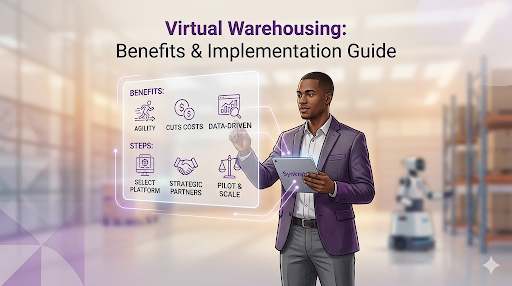
For warehouse leaders, throughput collapse is now the biggest constraint, not storage shortage. As SKU volatility accelerates and labor productivity plateaus, physical expansion delivers diminishing returns. Virtual warehousing, by definition, decouples logical inventory from physical assets, replacing physical constraints with software-driven orchestration.
For COOs and network design leaders, the question is no longer ‘how much space,’ but ‘how fast can we reroute?’ The answer lies in an execution architecture designed to minimize decision latency, not maximize square footage.
To understand how this shift plays out in practice, we first need to examine how virtual warehousing differs from traditional models.
Suggested Read: Inventory Management Kpis
Virtual vs. Traditional Warehousing: Key Aspects
Traditional warehousing treats the four walls as the unit of analysis. The virtual warehouse concept treats the network as the unit of analysis.
| Aspect | Virtual Warehouse | Traditional Warehouse |
| Physical structure | No centralized physical structure. Managed via Distributed Order Management (DOM) and digital twins. | Static, capex-heavy facilities with fixed capacity constraints. Every new product requires a physical bin location. |
| Inventory view | Unified, real-time aggregate across all nodes (stores, 3PLs, DCs, even supplier hubs). Single source of truth. | Siloed. Requires manual login, EDI batch sync, or cross-system reconciliation to view remote stock. Decision latency is often measured in hours. |
| Scalability | Elastic. Add nodes via API integration without operational drag. No construction delays, no lease negotiations. | Linear. Scaling requires construction, leasing, or labor ramp-up. Each new facility takes 12 to 18 months to reach steady-state productivity. |
| Cost structure | Variable (opex). Cost-to-serve shifts to a per-transaction logic. If volume drops, costs drop proportionally. | Fixed (opex + capex). Rent, utilities, and base labor run regardless of volume. Empty space still costs money. |
For decision-makers evaluating transformation risk, the fourth row matters most. Traditional warehouses create a fixed cost floor that becomes dangerous during demand troughs. Virtual warehousing’s variable structure provides network resilience precisely when revenue compresses.
Suggested Read: Warehouse Inventory Management
Benefits of Virtual Warehousing
Virtual warehousing shifts fulfillment from static storage to dynamic network execution.
- Automation: When one warehouse experiences congestion amplification or a labor shortage, automated orchestration reroutes orders to another node. This dynamic rebalancing prevents queue amplification that typically collapses throughput during peaks. Your fulfillment network behaves like a load-balanced system rather than isolated silos.
Synkrato enables this through a simulation-driven automation layer that continuously optimizes decisions across the network, ensuring cost efficiency, agility, and execution stability at scale.
- Reduced Storage Costs via Bypass: By routing orders directly from suppliers, cross-dock points, or even retail stores, virtual warehousing eliminates the “landing cost” of holding inventory before allocation.
Research examining digital warehousing transformation across 2010-2023 found that integrating digital technologies, including IoT, digital twins, and automated systems, achieved a 9.95% decrease in total warehousing costs alongside a 10% reduction in picking time and a 14.8% increase in space utilization.
- Increased Agility and Risk Mitigation: In a virtual fulfillment warehouse model, demand spikes can be managed through inventory pooling. Instead of holding safety stock at five discrete locations (each requiring its own buffer, creating high variance and waste), you hold one logical pool of stock across five physical locations (low variance, high utilization).
This reduces the bullwhip effect without sacrificing fulfillment SLA adherence. Research shows that multi-echelon coordination, central to virtual warehousing, yields a pooled mean cost reduction of 11.4% (95% CI: 6.9–15.9%) while maintaining equivalent service levels through distributional safety stock methods.
- Improved Data Analytics and Visibility: A virtual stock management system enforces a single source of truth. This resolves the classic failure pattern where inventory is technically available in the system but practically lost in inter-warehouse transfer delays.
Real-time visibility reduces the latency between a sales event and the allocation decision from minutes (or hours) to milliseconds. For operations excellence heads, this means picking time per order drops because the system never assigns a task to a node that cannot actually fulfill it.
Suggested Read: What is Warehouse Mapping
Challenges Of Using A Virtual Warehouse
Virtual warehousing introduces challenges such as real-time system dependency, data accuracy issues, complex integrations, higher initial setup costs, and the need for operational change management.
- Technology dependency and system fragility: If your network latency exceeds acceptable thresholds (e.g., 200ms+), your Available to Promise (ATP) calculation becomes unreliable. Virtual warehousing is an always-on system requiring real-time responsiveness. Batch-processing architectures from legacy ERPs break the execution loop entirely.
- Data Security and attack surface expansion: Consolidating inventory data into a cloud hub expands the attack surface dramatically. Every API endpoint, every 3PL integration, every IoT sensor becomes a potential entry point. An analysis of logistics ecosystems identified AI model manipulation and IoT endpoint spoofing as critical risk vectors for digital twin environments. Supply chain leaders must implement zero-trust architecture and continuous penetration testing as non-negotiable prerequisites.
- Integration complexity and dirty data: The “dirty data” problem kills virtual efficiency faster than any other failure mode. If item master data, dimensions, weights, and hazardous material flags differ between a 3PL’s WMS and your OMS, the orchestration layer makes systematically poor fulfillment decisions. Consequences include negative pick confirmations, wrong-node routing, and carrier rejection at dock doors.
Research found that product master data quality has a significant impact on logistics process performance. While managers are aware of the complications, they often lack structured processes to detect and analyze such inaccuracies, creating measurable operational failures in fulfillment execution.
- Change management and workflow fragmentation: Warehouse operators accustomed to fixed zones and predictable pick paths resist the fluidity of virtual allocation. When an order routes to a store associate rather than a DC picker, labor productivity metrics break. You need new KPIs, new incentive structures, and retraining programs. Transformation leaders who skip this cultural layer consistently report months of delays in realizing ROI.
- Initial Setup Costs and integration middleware: While you save on rent and fixed labor, you pay upfront for integration middleware and API development. The cost of retrofitting APIs onto legacy WMS systems, sometimes requiring middleware layers like Boomi or MuleSoft, often constitutes the primary financial barrier. A realistic implementation budget should allocate 40 to 50% of the total project cost to integration, not software licensing.
Suggested Read: Warehouse Planning
Step-by-Step Guide to Implement Virtual Warehousing
Here is a step-by-step guide to implementing virtual warehousing, covering network assessment, technology selection, integration, data governance, and pilot-to-scale deployment.
Assess Current Warehouse Footprint and Demand Patterns
Map all physical nodes: DCs, dark stores, retail locations, 3PL warehouses, and supplier cross-dock points. Identify where you hold the highest inventory turn variance. High-variance nodes (products that turn fast in one location but slow in another) are prime candidates for virtualization.
Also, identify low-volume nodes with high fixed costs; these become candidates for consolidation or elimination. This assessment answers the fundamental question: “Which nodes should stay physical anchors versus become logical satellites?”
Suggested Read: Warehouse Management System Cost
Select the Right Technology Platform
You need a Distributed Order Management (DOM) engine capable of throughput stability under load. The platform must ingest real-time labor capacity at the node level, not just inventory counts, to avoid pushing orders to a facility already experiencing queue amplification.
Evaluate platforms on three criteria: API depth, failover behavior, and simulation capability. Synkrato provides this simulation layer, allowing you to validate orchestration logic on a digital twin before exposing it to live orders.
Develop Strategic Partnerships
Virtual warehousing collapses immediately if your 3PL partners refuse system-level API access or charge prohibitive fees for real-time data sync. Contracts must shift from “storage fees” to “transactional node fees” to align incentives. Renegotiate to performance-based terms: lower storage rates, higher pick-and-pack rates, and mandatory API uptime SLAs of 99.9% or higher.
Suggested Read: Inventory Management vs. Warehouse Management
Implement Inventory Tracking and Data Governance
Deploy barcode or RFID workflows with offline-first capability. Also implement master data governance: a single item master record that all nodes must reference, with automated alerts when discrepancies appear.
Pilot and Scale Implementation
Test with a single velocity tier only, typically “A-movers.” Run the pilot for 30–60 days across a subset of nodes. Scale only when order allocation variance remains below 0.5% for 14 consecutive days.
While the risks are critical, platforms like Synkrato help mitigate them through simulation, validation, and continuous optimization.
Suggested Read: Benefits of Warehouse Management System
Unlocking Network Resilience with Synkrato
Transitioning from physical to virtual warehousing requires shifting from deterministic rules to dynamic intelligence. Without a simulation layer, virtualization often accelerates the propagation of errors rather than solving underlying operational drag.
Ready to turn virtual warehousing from concept into execution?
Synkrato enables an AI-driven orchestration layer that validates throughput stability before scaling.
FAQs
What is virtual warehousing?
Virtual warehousing is an operating model where a software layer unifies inventory across locations into a single pool for fulfillment decisions, removing the need for physical consolidation. Synkrato provides the simulation and optimization engine that makes this model operational at scale.
Why do traditional warehousing models struggle in a virtual warehousing setup?
Traditional models rely on static slotting, fixed pick paths, and deterministic labor allocation. In a virtual setup, inventory shifts dynamically, and legacy WMS systems cannot recalculate in real time. The result is execution instability, with orders routed to nodes that cannot meet SLA. Synkrato solves this through continuous simulation and pre-validation of routing decisions.
How does virtual warehousing work?
An order triggers a network-wide ATP query that evaluates proximity, labor cost, carrier rates, congestion, and pick efficiency. The system selects the optimal node and assigns the task via API in milliseconds. Without simulation, decisions rely on stale data. Synkrato provides a continuous intelligence loop that validates network state before execution.
Why is Synkrato useful for managing virtual warehousing operations?
Most software provides dashboards or routing tables. Synkrato provides the intelligence layer that prevents failure. Virtual models introduce decision complexity beyond static rules, such as choosing between higher labor costs and slower delivery. Static rules break under this complexity. Synkrato uses digital twin simulation to test scenarios before deployment, preventing failures that drive cycle time spikes and SLA breaches.
How is virtual warehousing different from traditional warehousing?
Traditional warehousing optimizes storage density and space utilization. Virtual warehousing optimizes fulfillment speed and network resilience across nodes. The former minimizes holding costs, while the latter minimizes delivery time and cost using the entire network, reshaping decisions across operations and technology.
Why will platforms like Synkrato define the future of virtual warehousing?
The future is predictive virtualization with continuous execution. As demand becomes more volatile, the optimal network state shifts by the hour. Synkrato enables this through proactive planning and continuous optimization.
What challenges exist in virtual warehousing?
The challenges are threefold: data integrity, complex routing rules, and commercial alignment. Inconsistent master data leads to wrong decisions, while over-complex rules create brittle systems. Contracting and invoicing also become difficult when inventory moves logically across entities. Synkrato addresses the first two through continuous validation and simulation-based optimization, while the third requires legal and procurement transformation.