For third-party logistics (3PL) executives, throughput instability isn’t merely an operational metric; it is a direct erosion of margins and the viability of contractual SLAs. When a multi-client facility experiences congestion amplification or labor cost scaling despite standardized processes, the root cause rarely resides in individual workstations.
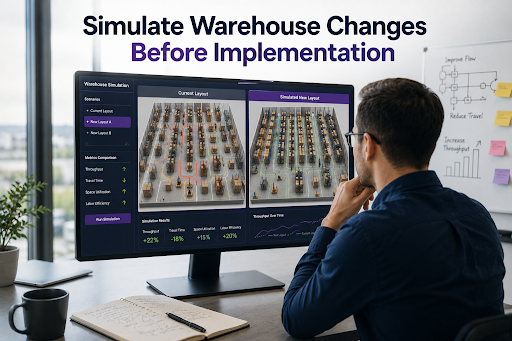
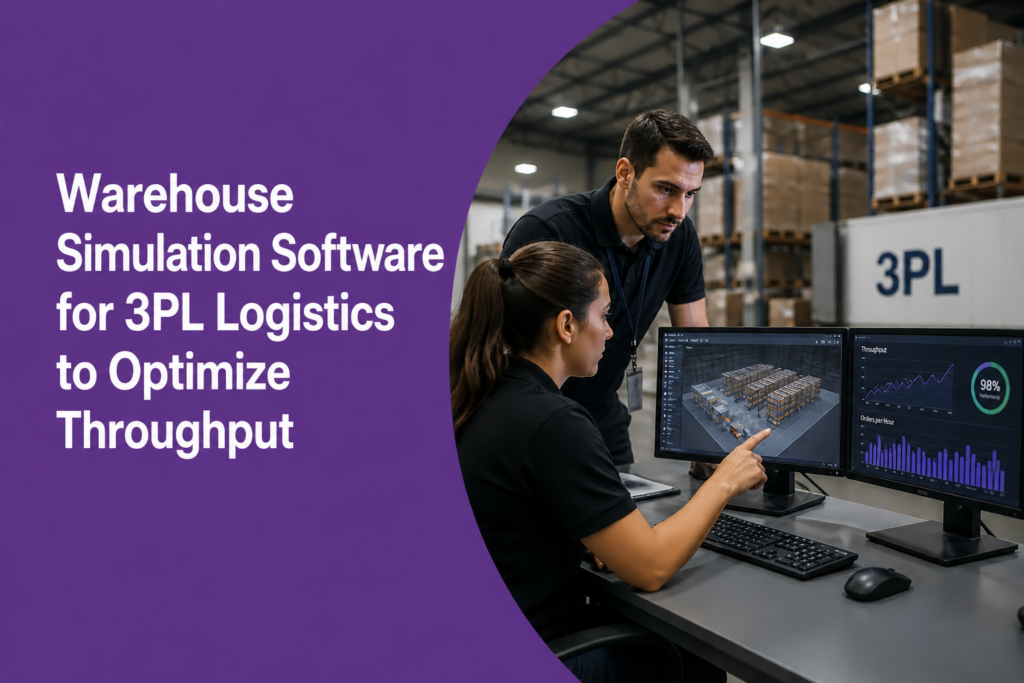
The issue lies in the invisible system interdependencies that traditional WMS logic cannot resolve. To move beyond static capacity planning, operations leaders require warehouse simulation software for 3PL logistics to optimize throughput that models the complex reality of shared logistics networks before capital is deployed or workflows are frozen.
In this blog, we will examine throughput instability, WMS limitations, and how simulation optimizes 3PL operations.
Why Throughput Problems in 3PL Are Often Rooted in System Interdependencies
Unlike dedicated distribution centers, a 3PL node operates as a complex adaptive system where picking zones, dock doors, and equipment pools are shared assets. Recognizing these hidden workflow causes explains how warehouse simulation improves 3PL logistics performance by moving away from linear optimization toward systemic dependency mapping.
How Shared Resource Dependencies Create Hidden Flow Constraints
In a multi-client warehouse, labor is rarely a dedicated asset. When picking paths overlap or lift truck fleets are pooled, a surge in volume for Client A creates a temporary scarcity of horizontal transport for Client B. This dependency misalignment leads to “virtual bottlenecks” – constraints that are not fixed physical locations but emergent properties of resource contention.
Why Multi-Client Complexity Distorts Throughput Stability
Stability deteriorates when client-specific SLAs impose conflicting priorities on a shared execution layer. For instance, a high-priority “ship now” order for an e-commerce giant may preempt a bulk retail order that is already occupying the staging lane.
The 3PL loses predictability because external demand signals constantly disrupt the sequence of work that the WMS treats as exceptions rather than variables.
To avoid operational conflicts, many 3PLs end up managing each client like a separate warehouse within the same facility. While this approach simplifies customer-specific workflows and SLA management, it limits space utilization, labor flexibility, and overall throughput efficiency. Disconnected systems, isolated inventory strategies, and fragmented execution logic reduce the warehouse’s ability to dynamically rebalance resources during demand spikes.
Suggested Read: Warehouse Simulation Software for Ecommerce Fulfillment to Improve Order Accuracy
How Local Improvements Can Trigger Network-Level Performance Losses
Standardizing a pick path for one SKU family might reduce travel distance for that specific wave. If it pushes that work into a congested mezzanine area, it inflates order cycle time for everyone downstream.
Without a digital twin to test these variables, operational excellence heads often find that labor cost per order drops in one sector only to spike in the packing sector due to uneven arrival rates.
Why Traditional Throughput Optimization Often Leaves Bottlenecks Unresolved
Legacy optimization strategies typically rely on historical averages and static capacity logic. However, in a 3PL handling volatile catalog churn and demand spikes, the past is a poor predictor of the next hour’s constraint. Standard WMS modules react to congestion that they cannot predict.
Why Static Capacity Logic Breaks Under Variable Demand Loads
Static logic assumes that if a conveyor can move 200 units per hour, the system holds that capacity. However, variability in demand and operational uncertainty significantly degrade system performance, as shown in research on collaborative distribution network design under demand surges and disruptions.
The study highlights demand spikes of over 300% and collaboration-driven cost savings of around 29% in shared logistics networks. This underscores the need for dynamic, system-level modeling to sustain performance under real-world variability.
How Bottleneck Propagation Reduces End-to-End Flow Performance
A bottleneck at the sorter does not just slow sorting. It creates back-pressure that stalls putaway and forces pickers to stop because there is nowhere to deposit completed totes.
Research shows that variability and disruptions in warehouse operations, such as delays in material flow and handling systems, lead to significant delivery delays and reduced service performance, particularly in high-dependency systems.
Suggested Read: Warehouse Simulation Software for Layout Planning to Improve Picking Speed
Why Conventional Responses Often Treat Symptoms Instead of Causes
When throughput collapses, the conventional response is to add labor or increase expedited shipping. Adding a picker to a zone already constrained by aisle congestion merely adds to the traffic jam.
Simulation-led diagnosis distinguishes between resource utilization, busy time, and flow efficiency value-added time. Without this lens, 3PLs over-invest in labor while ignoring the travel distance inflation caused by poor SKU co-location across clients.
Scenario-Based Analysis of Throughput Tradeoffs in Shared Logistics Networks
To navigate these tradeoffs, the 3PL requires an execution architecture that supports scenario testing without operational disruption. This moves decision-making from reactive heuristics to a validated strategy using 3PL warehouse simulation software to improve throughput.
Testing Resource Scenarios Under Variable Client Loads
Unlike spreadsheets, warehouse simulation tools for third-party logistics operations model the behavior of individual pickers, bots, and chargers.
This allows leadership to visualize whether cross-docking strategies will hold or if the network will hit a throughput cliff. Simulation capabilities enable operators to stress-test the warehouse against “what-if” scenarios.
Modeling Allocation Decisions Before Execution
Every allocation decision involves a tradeoff between storage density and retrieval speed. By deploying a simulation environment, like Synkrato’s simulation and optimization, logistics leaders can pre-validate wave sequencing rules, warehouse layouts, labor, and automation scenarios before capital investment.
Should you batch orders by destination to save shipping costs, or by SKU affinity to save pick travel? The model quantifies the opportunity cost of either decision in terms of picks per hour and zone utilization.
Constraints Revealed Through Throughput Simulation Analysis
Warehouse modeling software for 3PL throughput optimization uncovers the “non-linear scaling” penalties. It reveals the exact point where adding a 10th worker to a zone stops increasing output and actually reduces it due to congestion density.
Suggested Read: Warehouse Simulation Software for Capacity Planning to Reduce Congestion
Response Mechanisms That Influence Flow Stability Under Variable Demand
Once constraints are identified, the 3PL must implement dynamic load decisions. Stability is not achieved by eliminating variability but by managing response speed and adjustment logic.
Dynamic Load Decisions Affecting Throughput Continuity
Rather than operating on fixed waves, high-throughput facilities use dynamic slotting and order release logic. Logistics simulation software for 3PL fulfillment efficiency enables systems to anticipate congestion and adjust workflows proactively.
Synkrato’s AI Agents act on these signals by dynamically rebalancing task allocation across the network. If the packing station backlog exceeds a threshold, the system automatically throttles the release of picking waves. This prevents the “conveyor full” state, where jammed systems require manual purging, a costly event that collapses throughput for hours.
Response Speed as a Factor in Operational Stability
The latency between detecting a bottleneck and resolving it defines the resilience of the operation. Traditional manual overrides take hours. An AI-driven orchestration layer adjusts routing logic in minutes.
Simulation validates these response algorithms, ensuring that automated mitigation strategies such as rerouting AGVs or reassigning pickers do not create secondary bottlenecks elsewhere in the network. Here’s how the mitigation strategies typically operate in practice:
- Dynamic AGV rerouting: Continuously adjusts routes using real-time congestion, queue lengths, and task priority to prevent traffic buildup and idle time.
- Adaptive task reassignment: Reallocates pickers across zones based on workload imbalance, order urgency, and queue pressure, ensuring labor is used where it maximizes throughput.
- Bottleneck prediction and flow control: Identifies downstream constraints (packing, sorting, dispatch) in advance and modulates upstream activity to avoid congestion cascades.
- Priority-driven orchestration: Dynamically prioritizes SLA-critical or high-value orders, redirecting resources without disrupting overall system flow.
- Scenario-based feedback loops: Runs multiple “what-if” simulations to refine decision rules, ensuring local optimizations don’t create new bottlenecks elsewhere.
- Cross-node resource synchronization: Aligns labor, equipment, and inventory movements across the network so that gains in one area don’t overload another.
Adjustment Logic Supporting Sustainable Flow Performance
Sustainable flow requires a feedback loop between execution and planning. The adjustment logic must account for “fatigue factors” and equipment recharge cycles. By modeling these constraints, Synkrato helps 3PLs shift from reactive firefighting to predictive orchestration, ensuring that the facility maintains throughput stability even during the last hour of a shift when human energy wanes.
Operating Conditions That Define Scalable Throughput Performance
Scalability is not about handling more volume. It is about handling volume without a proportional increase in marginal cost per unit. Recognizing the signals of capacity exhaustion is critical for transformation leaders.
Signals That Existing Optimization Has Reached Capacity Limits
Key signals include rising dwell times of trailers at docks. Increasing “touch counts” where items are handled multiple times due to slot saturation, and a widening gap between planned and actual labor hours.
Empirical research indicates that warehouse throughput is tightly constrained by utilization dynamics, with studies showing up to 98% correlation between space utilization and performance, beyond which efficiency gains begin to plateau.
Conditions Requiring Simulation-Led Throughput Planning
Simulation-led planning becomes essential when introducing mixed automation or consolidating inventories, as system interactions become too complex for intuition alone. Only stochastic modeling can accurately predict how these elements impact overall performance.
- Mixed automation complexity: Combining AMRs with manual forklifts creates unpredictable interactions that simple planning can’t capture.
- Shared space conflicts: Human and machine workflows compete for the same aisles, increasing congestion risk.
- Inventory consolidation impact: Merging multiple client inventories changes pick density, travel paths, and slotting efficiency.
- System interaction effects: ASRS and manual zones influence each other’s throughput in non-obvious ways.
- Variability and uncertainty: Demand fluctuations and human behavior introduce randomness that static logic can’t model.
- Simulation necessity: Stochastic modeling tests these scenarios in advance, revealing risks and optimizing layout, flow, and resource allocation.
Factors Supporting Long-Term Throughput Stability
Long-term stability is supported by continuous intelligence loops. This involves regular re-forecasting of SKU velocity and the periodic recalibration of the digital twin. As the 3PL’s client mix shifts, the threshold-based re-slotting rules must evolve. Governance models that mandate quarterly simulation audits ensure that the facility does not drift back into entropy.
Suggested Read: The Theory of Constraints in Warehousing and How Synkrato Solves Bottlenecks
Synkrato: Simulation-Driven Optimization for 3PL Leaders Done With Bottlenecks
Throughput instability costs 3PL operators millions in expedited labor, missed SLAs, and client churn. Yet most teams continue making critical decisions without testing consequences first. Synkrato changes that. Its AI-driven warehouse simulation software for 3PL logistics to optimize throughput lets you model multi-client tradeoffs, validate operational policies, and expose hidden constraints before they disrupt flow.
Start engineering a stable throughput across your shared logistics network with Synkrato’s decision intelligence capabilities. Book a demo now.
FAQs
How can simulation uncover hidden tradeoffs between client prioritization rules and overall throughput performance?
Simulation models the opportunity cost of prioritization. When a scenario favors Client A’s low-latency SLAs, it measures the quantifiable delay imposed on Client B’s bulk shipments. This reveals the price of priority, allowing the 3PL to set contractual SLAs that reflect actual operational feasibility rather than theoretical capacity, preventing revenue loss from SLA penalties.
Why do throughput inefficiencies often persist even after process standardization across multiple 3PL clients?
Standardization fails because the order profiles remain heterogeneous. A standardized pick cart works for small items but fails for bulky items. Using Synkrato for simulation analysis, operators discover that the persistence of inefficiency is usually rooted in the unit load mismatch at the packing station, a structural issue that standardization alone cannot fix without dynamic resource reallocation logic.
How can a simulation evaluate the impact of conflicting SLAs on warehouse flow efficiency?
A simulation model visualizes the collision of workflows at the execution layer. Conflicting SLAs often force the WMS to interleave completely different task types, such as split-case picking vs full pallet retrieval. Simulation tracks the resulting context switching cost on labor productivity and machine time, showing how contract terms directly translate into physical operational drag.
What role does variability in order profiles play in long-term throughput instability?
Variability introduces “entropy” into the system. An order profile dominated by single-line orders flows very differently from one dominated by multi-line complex kits. Synkrato allows 3PLs to stress-test against these statistical distributions, revealing that long-term instability is mathematically linked to the standard deviation of task times, not the average.
How can simulation help assess the impact of warehouse policy decisions on end-to-end flow consistency?
A simulation environment serves as a policy wind tunnel. If a policy requires all putaways before 2 PM, the model reveals the downstream impact on shipping. It shifts focus from compliance to flow consistency. This capability is delivered through platforms like Synkrato, which model policy impacts, quantify downstream effects, and validate flow-based decisions before execution.
Can simulation quantify the cumulative impact of minor delays across interconnected warehouse processes?
Yes. Discrete event simulation reveals the “delay amplification” effect, where a 5-second delay at the induct station can escalate into a 5-minute delay at the outbound dock due to queue saturation. Such system-level visibility, impact quantification, and pre-validation of process changes are enabled by advanced simulation platforms like Synkrato, allowing operators to address root causes before they disrupt throughput.
How does simulation support the validation of operational strategies before deploying them in multi-client environments?
It provides risk-free validation. Before moving a single physical shelf, a digital twin of the multi-client environment is deployed. Operational strategies such as zone reconfiguration or dynamic wave sequencing are validated against 90 days of historical data to ensure they produce a net positive throughput gain without destabilizing adjacent client operations.
What factors influence the reliability of throughput insights generated from warehouse simulation models?
Reliability depends on the fidelity of the logic engine and the granularity of the input data. High-frequency data regarding travel distance, pick face accessibility, and real-time congestion are critical. Synkrato ensures high reliability by using multi-agent orchestration data to calibrate the model against actual warehouse physics, rather than relying on theoretical standard times.