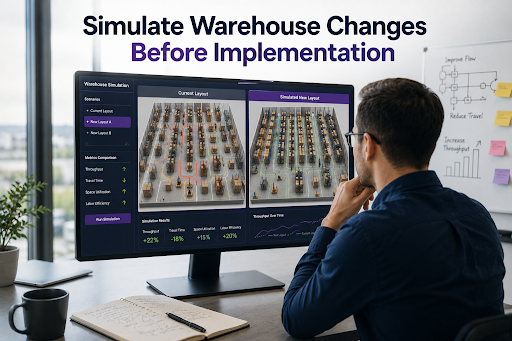

Warehouse labor forecasting for peak season helps warehouses estimate how much work each shift can handle before delays begin. It matches expected demand with available workers, equipment, workstations, and warehouse capacity, helping managers identify where labor is needed and which processes may become bottlenecks.
A good forecast follows the actual warehouse workflow. It estimates labor needs before work starts and compares planned work with actual performance to identify gaps early. This turns labor forecasting into an ongoing process instead of a one-time staffing estimate.
In this blog, learn how to forecast labor accurately, improve workforce planning, and prepare for peak season.
Why Traditional Labor Forecasting Breaks During Peak Season
Traditional labor forecasting often fails during peak season because warehouse demand, workforce availability, and operational conditions change much faster than historical models can capture.
Why Historical Labor Trends Fail to Predict Seasonal Demand
Historical data is valuable for warehouse labor forecasting, but it should not be copied directly into the next peak season labor forecast. Historical trends assume stable order patterns, consistent worker productivity, predictable labor availability, and similar inbound and outbound inventory flows.
Common reasons historical labor trends fail include:
- Temporary worker ramp-up takes time to reach full productivity, reducing throughput during the initial weeks.
- Absenteeism and shift fatigue create labor gaps that historical averages rarely capture.
- Flash sales, social media trends, and promotional campaigns can quickly change order volumes and order profiles.
- Competition for seasonal workers can increase hiring costs and limit staffing capacity.
Instead of relying on last year’s averages, warehouses should continuously validate historical assumptions against current demand patterns. Synkrato’s Simulation & Optimization helps evaluate multiple labor scenarios before peak season. It enables planners to identify capacity gaps and solutions with warehouse labor forecasting for seasonal demand.
How Changing Order Profiles Reduce Forecast Accuracy
Changing order profiles reduces forecast accuracy because historical demand no longer reflects current buying behavior. Warehouses are seeing a shift from bulk B2B shipments to smaller e-commerce orders, more frequent replenishment cycles, and additional value-added services, which makes historical labor patterns less reliable.
This often increases Mean Absolute Percentage Error (MAPE) and Weighted MAPE (WMAPE), which makes labor, inventory, and replenishment planning less reliable.
Key order-profile variables include:
- Lines and units per order
- Pick zones and travel distance
- SKU velocity and special handling
- Kitting or personalization
- Shipping method and carrier cutoff times
These changing order profiles also affect safety stock, replenishment timing, and labor demand.
Why Fixed Workforce Assumptions Create Planning Gaps
Fixed workforce planning assumes stable productivity and labor availability, but peak operations rely on a mix of permanent employees, temporary workers, and new hires with varying performance.
Capacity is commonly reduced by:
- Absenteeism and turnover
- New-hire ramp-up
- Equipment certification requirements
- Indirect tasks and equipment shortages
Instead of forecasting headcount, warehouses should forecast productive hours:
Productive Capacity = Scheduled Hours × Attendance Rate × Utilization Rate × Proficiency Factor
A temporary worker may be scheduled for 8 hours but contribute only 5-6 productive hours initially.
Moreover, fixed workforce assumptions ignore changing labor availability. In May 2026, the U.S. transportation, warehousing, and utilities sector reported 298,000 job openings and a 4% job-opening rate, despite job openings falling by 43,000 from April 2026. This shows that labor supply can change significantly within weeks, which makes fixed peak-season warehouse workforce planning unreliable.
The Hidden Variables That Drive Peak Season Labor Requirements
Peak-season labor demand is influenced by several operational variables that are often overlooked in traditional forecasting models. Here are a few forecast warehouse labor requirements to consider:
Order Mix Changes That Alter Labor Demand
Order mix determines how often inventory is handled, how far workers travel, and how much labor each warehouse process requires.
For example, 10,000 units could represent:
- Ten full-pallet orders with limited picking and packing
- Five hundred case orders requiring more verification and staging
- Eight thousand direct-to-consumer orders requiring individual picks, cartons, and carrier sorting
Although the unit volume is the same, the units per hour (UPH) and labor requirement are not.
Forecasts should segment demand by order size, fulfillment method, handling unit, shipping service, and special handling while accounting for indirect labor such as:
- Carton replenishment and quality checks
- Repacking and exception handling
- Returns processing
- Equipment waiting time
- Peak replenishment activities
This creates a process-level workload forecast instead of a single site-wide labor estimate.
SKU Velocity Shifts That Increase Workforce Complexity
Peak demand can quickly turn medium-velocity products into high-velocity SKUs. Without corresponding slotting and replenishment changes, labor hours increase because of:
- Longer pick paths
- Stockouts
- Emergency replenishments
- Congestion
For example, if a forward-pick location holds 200 units but demand reaches 1,200 units during a shift, the warehouse may require at least five replenishments. If this work is not forecast in advance, pickers may spend valuable time waiting for inventory.
To prevent these delays, Walmart uses real-time AI and automation at its Coyol distribution center to align inventory movement with store demand before operations begin.
Service Level Commitments That Influence Staffing Requirements
Service commitments determine not only how much labor is needed, but when it must be available. Earlier carrier or customer cutoffs create workload compression, which increases pressure on picking, packing, staging, and loading.
Labor demand is influenced by:
- Same-day and next-day delivery promises
- Customer and carrier cutoff times
- Wave-release schedules
- Retail appointments
- Priority and weekend orders
A warehouse may have enough labor for the day but still lack capacity before a major carrier departure. Service-level-weighted forecasting prioritizes time-sensitive work and helps managers reassign cross-trained employees before packing queues, dock congestion, or loading backlogs develop.
Why Forecasting Errors Create Operational Bottlenecks Before Peak Demand Arrives
Forecasting errors create bottlenecks long before order volumes reach their highest levels by disrupting labor allocation across warehouse processes.
Labor Mismatches Across Warehouse Functions
Warehouse labor is not interchangeable. A packing associate cannot immediately replace a reach-truck operator, so forecasting errors create bottlenecks even when overall headcount appears sufficient.
Labor should be forecast separately for:
- Receiving and putaway
- Replenishment
- Picking and packing
- Staging and loading
- Returns
Forecasts should use function-level labor hours based on UPH rather than a single site-wide productivity rate. For example, underestimating inbound volume delays putaway, while incorrect demand timing increases picking congestion and packing queues.
To respond quickly as conditions change, Synkrato’s AI Agents continuously monitor workloads across warehouse functions and recommend labor reallocation before bottlenecks impact throughput.
The Cost of Overstaffing Versus Understaffing
Overstaffing and understaffing both increase costs, but in different ways. Overstaffing creates visible payroll expenses, while understaffing often results in hidden costs such as overtime, missed sales, customer penalties, and burnout. Predictive labor forecasting helps balance both.
| Impact Area | Overstaffing | Understaffing |
| Financial | Higher payroll costs, idle labor, tied-up working capital | Lost sales, overtime (1.5-2× pay), expedited freight, customer penalties |
| Operations | Lower labor utilization and inefficient workflows | Order backlogs, missed carrier cutoffs, SLA breaches, rework |
| Workforce | Employee disengagement | Fatigue, absenteeism, burnout, higher turnover |
The cost pressure is evident in industry data. In 2024, U.S. warehousing output declined 0.2%, while hours worked increased 0.4%. Labor compensation also rose 8.7%, which contributed to a 9.0% increase in unit labor costs.
How Forecast Inaccuracy Reduces Operational Agility
A static labor plan quickly becomes outdated during peak season. Forecast errors force warehouses to shift from proactive planning to reactive execution, reducing operational agility.
Common impacts include:
- Reactive hiring and overtime
- Poor labor allocation
- Dock and storage congestion
- Timing mismatches
- Excess inventory
Forecasts should track labor by process, shift, and skill while measuring volume, mix, productivity, attendance, and timing errors.
For example, a forecast may be accurate within 3% overall, yet packing labor can still be 20% short if multi-line direct-to-consumer orders are underestimated. Leading warehouses improve agility by continuously updating forecasts with real-time operational data and rolling 13-week forecasts.
Building Forecast Confidence in High-Variability Warehouse Environments
Building forecast confidence requires combining demand signals, scenario planning, and operational flexibility instead of relying on a single prediction.
- Identifying Leading Indicators of Workforce Demand
Historical shipped orders are lagging indicators. Better warehouse labor forecasting relies on leading indicators that signal demand before warehouse activity increases.
Key indicators include:
- Purchase order (PO) lines 3-5 days ahead
- Promotional calendars and ASNs
- Carrier appointments
- Order age and dock-to-stock cycle time
- Inventory accuracy with automation
- Planned overtime and rolling 13-week absenteeism
Confirmed purchase orders and supplier shipments should carry greater weight than sales estimates because they provide stronger signals for workforce planning.
- Evaluating Multiple Demand Scenarios Before Peak Season
A single forecast cannot capture peak-season uncertainty. Warehouses should evaluate multiple demand scenarios, including:
- Base: Expected demand
- High: Promotional spikes or higher volumes
- Stress: Demand surges with operational disruptions
Advanced planning uses P50, P80, and P95 forecasts, along with WAPE and Coefficient of Variation (CoV), to measure forecast reliability.
Each scenario should assess labor hours, dock capacity, replenishment, overtime, and temporary staffing. Classifying SKUs by demand variability also improves labor and inventory planning.
- Balancing Forecast Accuracy With Operational Flexibility
Warehouses should combine reliable forecasting with operational flexibility to respond quickly as demand changes.
A flexible strategy includes:
- Cross-trained employees
- On-demand labor
- Flexible shifts
- Scalable automation
Forecasting should reduce forecast bias, use ABC/XYZ segmentation, and test base, +15%, and -15% demand scenarios based on UPH. To support these adjustments during execution, Synkrato’s Enterprise Mobility gives supervisors real-time visibility to quickly reassign labor and maintain service levels during peak season.
Business Signals That Indicate Labor Forecasting Needs Improvement
Recurring capacity issues usually indicate problems with the forecasting model rather than insufficient historical data.
Recurring Seasonal Labor Shortages Despite Advance Planning
Persistent labor shortages suggest the forecast is measuring headcount instead of productive workload.
Common warning signs include:
- Average UPH across all orders
- Missing indirect labor
- Weekly instead of cutoff-based planning
- Outdated SKU slotting
- Overtime treated as normal capacity
Increasing Labor Costs Without Better Peak Performance
When labor spending increases without higher throughput, the workforce plan is likely becoming less efficient.
Monitor metrics such as:
- Productive hours
- Overtime
- Indirect labor
- Rework
Declining Service Levels During High-Demand Periods
Service performance often begins to decline before peak volume reaches its highest level because of poor labor allocation.
Early warning indicators include:
- Order backlog
- Packing queues
- Stockouts
- Delayed unloading
- Frequent labor transfers
How Synkrato Improves Warehouse Workforce Planning for Peak Periods
Peak season labor planning requires more than estimating headcount. Warehouses need to connect demand forecasts with labor availability, warehouse capacity, and operational constraints so the right people are available at the right time.
This requires continuous forecasting that adapts to changing demand, workforce availability, and warehouse conditions throughout the planning cycle. An effective workforce planning strategy should:
- Forecast labor at the process level instead of using one site-wide estimate.
- Continuously compare forecast assumptions with live operational data.
- Test multiple demand scenarios before peak demand arrives.
- Adjust labor allocation as order patterns and priorities change.
With Synkrato, warehouses can improve workforce planning through predictive simulation, AI-driven decision support, and real-time operational visibility. Book a demo to see how Synkrato helps improve labor utilization, increase throughput, and maintain service levels during peak periods.
FAQs
How does Synkrato improve warehouse staffing forecasting for peak season?
Synkrato helps warehouses test labor scenarios, compare demand with operational capacity, and adjust workforce allocation using real-time data. Its simulation & optimization, AI agents, and Enterprise Mobility tools support more accurate peak-season planning.
Why do warehouse labor forecasts often become inaccurate during peak season?
Forecasts become inaccurate when they rely on historical averages, fixed headcount, or one site-wide productivity rate. Changing order profiles, temporary-worker productivity, absenteeism, SKU velocity, and service deadlines can quickly alter labor requirements.
Can Synkrato predict seasonal workforce requirements before peak demand begins?
Yes. Synkrato can help warehouses evaluate base, high-demand, and stress scenarios before peak season. This allows planners to estimate labor requirements by process, shift, workload, and operational constraint.
Why should labor forecasting account for changing order profiles instead of historical averages?
Different order profiles require different levels of labor. A single-item e-commerce order, a case shipment, and a pallet order may contain similar unit volumes but create very different picking, packing, travel, and replenishment requirements.
How does Synkrato help businesses improve labor forecasting accuracy during peak seasons?
Synkrato connects demand forecasts with live warehouse conditions, helping managers identify capacity gaps, test multiple scenarios, and reallocate labor as priorities change. This reduces dependence on static labor plans and last-minute overtime.
Which KPIs should be monitored to evaluate labor forecasting accuracy?
Important KPIs include MAPE, WMAPE, WAPE, UPH, productive hours, overtime, indirect labor, order backlog, dock-to-stock cycle time, and labor hours by process. Tracking forecast errors across volume, mix, productivity, attendance, and timing also helps identify where labor plans need improvement.