Most warehouses chase big fixes, such as automation upgrades, staffing changes, and new systems, yet overlook the tiny decisions happening thousands of times a day. Every misplaced SKU, every extra step, quietly adds up to wasted labor and missed efficiency. What if optimizing inches instead of miles could reshape your entire cost structure?
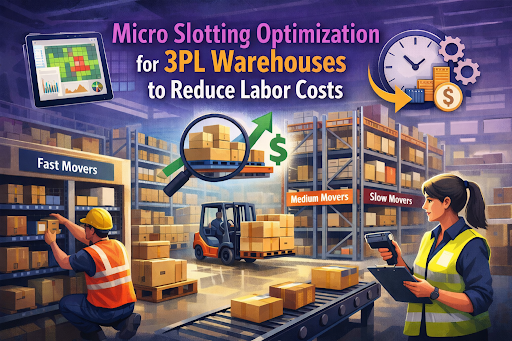
In this blog, we’ll explore how micro-slotting optimization helps 3PL warehouses minimize unnecessary movement, streamline picking paths, and drive down labor costs. You’ll learn actionable techniques and how platforms like Synkrato enable data-driven slotting decisions to turn warehouse layouts into a competitive advantage.
Why Labor Costs Escalate in 3PL Warehouse Operations
Labor costs in 3PL warehouses rise primarily due to inefficiencies in picking, movement, and workload distribution across shared operations. These inefficiencies typically originate from the following operational gaps:
High Travel Time per Pick Across Multiple Clients
In multi-client 3PL environments, SKUs are often distributed across shared zones without considering cross-client velocity overlap. Pickers frequently traverse long distances to complete a single order.
This increases travel time per pick, which can account for up to 50% of total picking labor. Without micro slotting in 3PL warehouses, travel paths remain fragmented and inefficient.
Inefficient SKU Placement Across Shared Storage
3PL warehouses often prioritize space utilization over labor efficiency. High-velocity SKUs from different clients may be stored in separate zones due to ownership or contract boundaries. This leads to:
- Increased picker travel time between zones, reducing overall productivity
- Higher labor costs due to inefficient picking routes and excess movement
- Congestion in high-traffic aisles as pickers cross multiple zones
- Underutilization of prime picking locations for fast-moving SKUs
Order Variability Increasing Picking Effort
3PL operations face unpredictable order profiles across clients. Batch sizes, SKU combinations, and order frequency vary significantly. Static slotting fails to adapt to these changes, resulting in:
- Increased picks per order, driving up handling time
- Longer and more complex picking paths due to scattered SKU locations
- Reduced picking efficiency as slotting no longer matches demand patterns
- Higher labor dependency to manage fluctuating workloads
- Increased likelihood of picking errors under variable order conditions
- Difficulty in optimizing batch or wave picking strategies
This variability directly impacts warehouse labor optimization strategies. High-order variability is a known challenge in 3PL operations, especially with the rise of eCommerce-driven fulfillment complexity.
Unbalanced Workload Across Zones and Pickers
Improper slotting creates uneven distribution of work across zones. Some zones become high-density pick areas, while others remain underutilized. This leads to:
- Picker congestion and idle time
- Labor imbalance across shifts
- Increased overtime in high-demand zones
3PL warehouse slotting optimization must address workload balancing as a core objective.
Suggested Read: Micro Slotting Optimization for Ecommerce to Reduce Picking Time
Why Labor Optimization Problems Often Start With Slotting in 3PL Warehouses
Most labor inefficiencies in 3PL warehouses stem from inventory positioning, which directly influences travel time, picking speed, and overall productivity. Here’s where the problem shows up:
How Poor SKU Placement Increases Labor Waste
Inefficient SKU placement is one of the most common yet overlooked drivers of labor waste in 3PL warehouses. When high-velocity items are placed far from packing areas or scattered across multiple zones, pickers must travel farther for each order.
This leads to:
- Excess walking time per order
- Increased congestion in high-traffic aisles
- Higher physical fatigue and slower picking rates
- Frequent interruptions in pick paths
Over time, these small inefficiencies compound, significantly increasing total labor hours required to process the same order volume.
Why Travel Time Is Often Misdiagnosed as a Staffing Problem
When throughput drops, the immediate assumption is often that more labor is needed. However, in many 3PL environments, the real bottleneck is travel time, not headcount. The following factors explain why travel inefficiencies are misdiagnosed:
- Inefficient Pick Paths: Poor SKU arrangement forces longer routes, increasing travel time regardless of workforce size or skill level.
- Fragmented SKU Placement: Lack of clustering leads to scattered pick locations, making travel unavoidable even with optimized labor allocation.
- Unoptimized Zone Design: Imbalanced zones create bottlenecks in high-activity areas, falsely indicating the need for additional labor.
- Static Slotting Assumptions: Failure to update slotting based on demand changes leads to outdated layouts and unnecessary movement.
- Lack of Data Visibility: Without granular tracking of travel time per pick, warehouses incorrectly attribute inefficiencies to staffing gaps.
Addressing these issues in 3PL warehouses can help reduce travel time without increasing headcount.
How Traditional Slotting Creates Hidden Cost per Order Pressure
Traditional slotting methods typically prioritize storage efficiency or static ABC classifications without accounting for dynamic order behavior across clients. While this may optimize space, it often increases the cost per order in subtle ways.
Common hidden cost drivers include:
- Longer pick paths due to outdated SKU positioning
- Frequent re-handling of SKUs across zones
- Misalignment between SKU placement and real-time demand
- Inefficient batching opportunities due to scattered inventory
These inefficiencies do not always appear in basic warehouse reports, but they directly increase labor minutes per order, driving up fulfillment costs across the operation.
Suggested Read: Micro Slotting Optimization for High Sku Warehouses to Improve Pick Efficiency
Why Traditional Slotting Struggles in Multi-Client 3PL Operations
Traditional slotting approaches are often too rigid for the complexity of multi-client 3PL environments, where demand patterns, SKU behavior, and service requirements constantly shift. Here’s where these limitations become clear:
Fixed Slotting Logic Breaks Under Client Variability
Fixed slotting relies on predefined rules, such as static ABC classification or space-based allocation, that do not adapt to the constantly changing dynamics of multi-client 3PL operations.
In reality, every client has different SKU velocity profiles, order frequencies, product mixes, and SLA requirements. What works for one client can create inefficiencies for another. When a single, rigid slotting logic is applied across all clients:
- High-velocity SKUs from one client may be placed far from dispatch areas because space was reserved for another client
- Frequently co-picked items across clients may be stored in completely different zones
- Seasonal or promotional SKUs may not get repositioned in time to handle demand spikes
This misalignment makes pickers travel farther, switch zones more often, and follow fragmented paths, increasing labor per order and lowering throughput. In a dynamic 3PL environment, fixed slotting quickly becomes outdated, making consistent efficiency hard without frequent manual updates.
Traditional Slotting Often Increases Re-Slotting Disruptions
Traditional slotting typically relies on periodic reviews, monthly, quarterly, or during peak seasons, to reorganize SKU placement, creating reactive, large-scale re-slotting that disrupts daily operations.
These bulk adjustments often involve:
- Physically moving large volumes of inventory across zones
- Temporarily halting or slowing down picking activities
- Re-training pickers on new SKU locations
- Increasing the risk of picking errors during the transition period
Instead of incremental improvements, these changes create operational friction. In fast-moving 3PL environments where demand shifts frequently, infrequent updates fail to keep pace, leading to cycles of inefficiency and disruption instead of consistent optimization.
Why Micro-Slotting Supports Labor Efficiency at Scale
Micro slotting is a data-driven warehouse optimization approach that continuously refines SKU placement at a granular level based on real-time demand, picking behavior, and operational performance.
Unlike static slotting methods that rely on fixed rules, micro slotting makes small, frequent adjustments that collectively reduce travel time, improve picking efficiency, and lower labor effort.
By analyzing SKU velocity, co-occurrence, and zone-level performance, micro slotting ensures that:
- High-frequency SKUs are always positioned in the most accessible locations
- Frequently picked-together items are clustered to minimize multi-item travel
- Pick paths remain short, logical, and uninterrupted
- Workload is evenly distributed across zones to avoid congestion and idle time
This level of precision significantly reduces travel time per pick, which is one of the largest contributors to labor cost in warehouse operations. As a result, pickers can complete more orders in less time without increasing effort.
Suggested Read: Dynamic Slotting Optimization for High Volume Warehouses to Reduce Picking Time
Core Micro Slotting Levers That Reduce Labor Dependency
Reducing labor dependency in 3PL environments requires precise, data-driven slotting decisions that directly minimize picker effort and travel. These core micro slotting levers enable measurable improvements in labor efficiency:
Velocity-Based SKU Placement Across Multiple Clients
Organizing SKUs based on movement velocity rather than ownership ensures faster access to high-demand items and reduces unnecessary travel. Key strategies include:
ABC Analysis
ABC analysis classifies SKUs based on pick frequency and contribution to order volume.
- A-category SKUs generate the majority of picks and must be placed in high-access zones. This category typically follows the Pareto Principle, where ~20% of SKUs account for 80% of picks.
- B-category SKUs are positioned in secondary zones with moderate accessibility.
- C-category SKUs are moved to reserve or low-access storage.
This reduces overall travel distance and improves picks per hour by concentrating high-frequency activity in optimized zones, directly supporting micro-slotting optimization for 3PL warehouses to reduce labor costs.
Dynamic Slotting
Dynamic slotting continuously updates SKU locations in response to changing demand patterns, ensuring optimal placement over time. Key benefits include:
- Adjusts placement during demand spikes
- Aligns storage with changing order patterns
- Prevents inefficiencies from static layouts
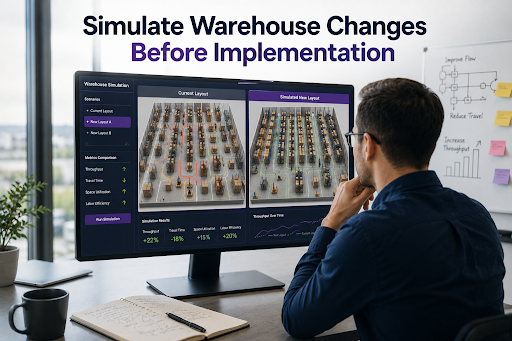
Synkrato combines digital twin simulation with AI slotting to test and optimize SKU placement strategies before applying them in live warehouse operations.
Co-Occurrence Slotting to Reduce Multi-Item Travel
Placing SKUs that are frequently ordered together in proximity minimizes travel during multi-line order picking. This is enabled through:
- Association Rule Mining: Identifies SKU relationships (items often picked together) using historical order data.
- Dynamic Slotting: Dynamic slotting for 3PL logistics updates SKU groupings as order patterns evolve, maintaining efficiency even with demand variability.
- Grouping Strategies: Clusters related SKUs within the same zone or nearby locations to streamline picking paths.
Key benefits include:
- Reduced picker travel time and distance during order fulfillment
- Faster order processing and improved overall throughput
- Increased picking efficiency and labor productivity
- Lower operational costs due to optimized movement and reduced aisle congestion
Golden Zone Optimization to Reduce Picker Effort
The “golden zone” refers to waist-to-shoulder height pick locations. Placing high-frequency SKUs within this area significantly reduces physical strain and improves speed. Key strategies include:
- Prioritized SKU Placement: Assign fast-moving SKUs to waist-to-shoulder height zones for quickest access
- Ergonomic Slotting Design: Minimize bending, stretching, and reaching by aligning slot heights with natural picker movement
- Frequency-Based Rotation: Regularly update which SKUs occupy the golden zone based on changing demand patterns
- Reduced Touch Time: Position items to enable quicker grabs, improving picks per hour and reducing fatigue
This directly improves picks per hour and supports sustainable warehouse labor optimization strategies.
Forward Pick Area Optimization for High-Frequency SKUs
Dedicated forward pick zones ensure that high-demand SKUs are always within easy reach, streamlining order fulfillment. Key strategies include:
- Fast-Mover Allocation: Reserve forward pick areas specifically for high-velocity SKUs to minimize travel distance
- Dynamic Replenishment: Continuously restock forward locations based on real-time demand to avoid stockouts
- Efficient Picking Methods: Integrate zone picking and batch picking to maximize throughput in forward areas
- Layout Optimization: Design forward pick zones near packing or dispatch areas to reduce overall picking time
With Synkrato’s AI slotting recommendations, 3PL operators can continuously refine forward pick zones based on live demand and SKU velocity.
Suggested Read: Dynamic Slotting Optimization for Ecommerce Warehouses to Improve Fulfillment Speed
Minimizing Picker Movement to Cut Labor Costs
Reducing unnecessary picker movement is one of the most effective ways to lower labor costs and improve warehouse efficiency. Here’s how targeted strategies can streamline movement and boost productivity:
Reducing Travel Distance Through SKU Clustering
SKU clustering minimizes picker movement by placing related and high-frequency SKUs closer together based on demand patterns and order behavior. Key strategies that focus on structuring SKU placement to reduce travel distance include:
- Demand-Based Clustering: Group SKUs based on combined velocity across clients to ensure high-frequency items are located within compact, accessible zones.
- Aisle-Level Optimization: Design clusters within specific aisles to avoid cross-aisle movement and reduce congestion in high-traffic warehouse areas.
- Pick Path Alignment: Align clustered SKUs with predefined pick routes to ensure smooth, continuous movement without unnecessary deviations.
- Cluster Density Control: Avoid over-concentration of SKUs in one area to prevent congestion while maintaining proximity benefits for efficient picking.
This approach significantly reduces travel time per order while improving throughput and labor productivity.
Eliminating Backtracking and Redundant Picks
Backtracking and redundant movements increase pick cycle time and reduce overall labor efficiency in 3PL warehouses. Eliminating these inefficiencies ensures smoother and faster order fulfillment. Micro slotting eliminates such inefficiencies by:
- Designing linear, one-way picking paths to avoid revisiting the same locations
- Positioning SKUs in sequence based on common pick routes and order flow
- Grouping frequently picked items to enable continuous, uninterrupted picking
- Aligning slotting strategies with batch and wave picking methods
- Reducing cross-zone movement through better SKU placement
- Continuously updating slotting based on changing order patterns
This results in faster pick cycles, reduced labor effort, and more efficient warehouse operations.
Optimizing Zone Allocation to Balance Labor Load
Unbalanced zones create congestion in high-demand areas while underutilizing others, increasing labor inefficiencies. Optimized zone allocation ensures even workload distribution across pickers. Key strategies include:
- Velocity-based zone distribution
- Workload-based zoning
- Dynamic zone rebalancing
- Capacity-aligned staffing
This ensures balanced operations, improved productivity, and reduced labor costs.
Data Driven Micro Slotting Execution for 3PL Environments
Effective micro slotting relies on data-driven decisions to continuously align warehouse layouts with real operational demand. Here’s how 3PL warehouses can execute micro slotting using actionable insights:
Analyzing Client-Wise SKU Velocity and Order Patterns
Accurate micro slotting depends on understanding SKU behavior across different clients and order profiles. This ensures placement aligns with real demand, not assumptions.
3PL operators must analyze:
- SKU velocity by client
- Order frequency and size
- Seasonal demand patterns
This ensures slotting decisions are based on actual demand rather than static assumptions.
Suggested Read: Dynamic Slotting Optimization for 3pl Operations to Reduce Labor Costs
Identifying High-Cost Picking Zones and Bottlenecks
Certain zones contribute disproportionately to labor costs due to congestion and excessive travel. Identifying these zones enables targeted optimization. Micro slotting identifies these zones using metrics such as:
- Travel time per pick
- Picks per hour by zone
- Congestion frequency
Addressing these bottlenecks allows for more efficient labor allocation and smoother operations.
Reassigning Bin Locations for Labor Efficiency
Bin-level adjustments are critical for maintaining optimal slotting as demand patterns change. Continuous reassignment ensures efficiency is sustained over time.
This ensures:
- High-velocity SKUs remain accessible
- Low-frequency SKUs move to reserve storage
- Pick paths remain optimized
As a result, warehouses maintain consistent picking efficiency while reducing unnecessary labor effort.
Tracking Labor KPIs (Picks per Hour, Cost per Order)
Tracking performance metrics is essential to measure the impact of slotting decisions on labor efficiency. It enables continuous improvement and accountability.
Key metrics to monitor include:
- Picks per Hour: Measure picker productivity to evaluate improvements in picking speed and efficiency.
- Cost per Order: Track labor cost per order to assess overall operational performance.
- Travel Time per Pick: Monitor movement time to quantify reductions achieved through slotting optimization.
- Zone-Level KPIs: Analyze productivity across zones to ensure balanced workload and identify areas for improvement.
Micro slotting directly impacts these KPIs by reducing unnecessary movement and improving pick efficiency.
Scaling Micro Slotting Across Multi-Client 3PL Operations
Scaling micro slotting in 3PL environments requires balancing efficiency with the complexity of managing multiple clients and dynamic demand patterns. Here’s how warehouses can scale these strategies effectively:
Managing Slotting Across Different Client SLAs
Different clients have varying fulfillment priorities, requiring slotting strategies to align with SLA commitments.
Key considerations include:
- SLA-Based SKU Prioritization: Position high-priority client SKUs closer to dispatch areas to meet faster turnaround requirements.
- Order Cut-Off Alignment: Align slotting with cut-off times to ensure efficient picking for time-sensitive orders.
- Priority Zoning: Allocate dedicated or semi-dedicated zones for high-SLA clients to reduce delays and improve service levels.
- Multi-Client Balancing: Ensure slotting decisions optimize overall warehouse efficiency without over-prioritizing a single client.
High-priority client SKUs should be positioned closer to dispatch zones. This ensures faster turnaround without increasing labor. It also strengthens 3PL warehouse slotting optimization by aligning storage strategy with contractual obligations.
Suggested Read: Real Time Slotting Optimization for High Sku Environments to Improve Efficiency
Handling Seasonal Demand Spikes Without Extra Labor
Seasonal spikes increase order volume and SKU velocity by 2-3x, often leading to higher labor dependency if not managed proactively. Key strategies include:
- Pre-Season Slotting Adjustments: Reposition high-demand SKUs in advance based on historical and forecasted demand patterns.
- Dynamic SKU Promotion: Move fast-moving SKUs into forward pick zones during peak periods to reduce travel time.
- Flexible Zone Reallocation: Adjust zone boundaries to handle increased picking activity without creating bottlenecks.
- Demand-Based Clustering: Group seasonal SKUs to streamline picking and reduce movement during high-volume periods.
With Synkrato, 3PL operators can anticipate demand spikes and dynamically adjust slotting and zone allocation using AI-driven recommendations to maintain efficiency without scaling labor.
Reducing Re-slotting Disruptions in Live Operations
Frequent re-slotting can disrupt ongoing warehouse operations if not executed strategically. Micro slotting minimizes disruption by:
- Prioritizing high-impact SKU movements
- Scheduling re-slotting during low-activity windows
- Using incremental adjustments instead of full reconfigurations
This controlled approach ensures operational continuity while improving efficiency. It also enables continuous improvement in micro slotting in 3PL warehouses without downtime.
Common Slotting Mistakes That Increase Labor Costs
Many 3PL warehouses unintentionally drive up labor costs by relying on outdated or oversimplified slotting approaches. Here are the most common slotting mistakes to avoid these inefficiencies:
Treating All Clients with a Single Slotting Logic
Applying a uniform slotting strategy across all clients ignores variations in SKU velocity, order patterns, and SLAs. This leads to inefficient placement and longer pick times for certain clients.
A one-size-fits-all approach ultimately reduces overall warehouse productivity. Effective SKU slotting for 3PL fulfillment requires segmented strategies based on client behavior and demand patterns.
Over-Focusing on Space Instead of Labor Efficiency
Maximizing storage density without considering labor impact often increases picking complexity and movement. This leads to:
- Dense storage layouts with longer pick paths
- Increased picker fatigue
- Reduced throughput
Labor efficiency has a greater impact on operational cost than storage utilization in high-volume fulfillment environments. Micro slotting shifts the focus toward labor-driven optimization.
Static Slotting in High-Variability 3PL Operations
Static slotting fails to adapt to changing demand patterns, especially in multi-client 3PL environments. Without continuous updates, warehouses experience:
- Misaligned SKU placement
- Increased travel time
- Declining pick efficiency
These mistakes highlight the need for continuous, data-driven micro slotting to sustain labor efficiency and operational performance.
Suggested Read: Slotting Optimization for Robotic Fulfillment Centers to Increase Throughput
How Synkrato Enables Smarter Slotting Decisions
Synkrato adds a Decision Intelligence layer on top of warehouse operations, enabling 3PL leaders to move beyond static slotting toward data-driven, continuously optimized decisions. Combining AI, simulation, and operational data, it helps reduce labor costs while improving throughput and execution accuracy.
Key Capabilities
- AI-Driven Slotting Recommendations: Continuously optimize SKU placement using real-time demand, velocity patterns, and co-occurrence insights to reduce travel time and improve picking efficiency.
- Digital Twin Simulation: Test slotting strategies in a virtual warehouse environment to predict labor impact and validate decisions before execution.
- Multi-Client Optimization: Balance slotting across multiple clients by considering SLAs, SKU velocity, and shared storage constraints for maximum efficiency.
- Dynamic Re-Slotting Engine: Automatically adapt slotting layouts based on changing demand patterns, seasonality, and operational performance metrics.
- Labor Cost Visibility: Track the impact of slotting decisions on KPIs such as picks per hour, travel time, and cost per order.
Struggling with rising labor costs and inefficient picking? Book a demo with Synkrato and start making smarter slotting decisions using real-time data and AI recommendations.
FAQs
What is micro slotting in 3PL warehouses?
Micro slotting in 3PL warehouses is a data-driven approach that optimizes SKU placement at a granular level. It focuses on velocity, co-occurrence, and pick frequency across clients to minimize travel time, improve picking efficiency, and reduce labor costs in multi-client environments.
How does micro slotting reduce labor costs?
Micro slotting reduces labor costs by minimizing picker travel distance, eliminating redundant movements, and balancing workload across zones. It improves picks per hour and lowers cost per order, enabling warehouses to handle higher volumes without increasing headcount. Platforms like Synkrato further enhance this by using AI recommendations to refine SKU placement and reduce labor-intensive movement.
What is the difference between slotting and micro slotting?
Traditional slotting focuses on broad SKU placement strategies, often static and space-driven. Micro slotting operates at a granular level, using real-time data, SKU velocity, and order patterns to optimize placement for labor efficiency and picking performance.
How is dynamic slotting different from micro slotting?
Dynamic slotting refers to continuously updating SKU locations based on changing demand. Micro slotting is a more detailed approach that applies dynamic principles at a granular level, focusing on co-occurrence, velocity, and labor optimization within specific warehouse zones.
What data is required for slotting optimization in 3PL?
Effective slotting requires SKU velocity, order history, pick frequency, co-occurrence data, and zone-level performance metrics. Additional inputs include seasonal demand trends and client-specific SLAs to ensure accurate and efficient slotting decisions. AI-driven platforms like Synkrato use this data to generate actionable slotting recommendations and simulate operational impact before implementation.
How often should slotting be updated in 3PL warehouses?
Slotting should be reviewed continuously, with updates based on demand variability and order patterns. High-volume 3PL operations typically require weekly or even daily adjustments to maintain optimal SKU placement and labor efficiency. With platforms like Synkrato, slotting can be continuously optimized using real-time data rather than relying on periodic manual updates.
Can slotting improve warehouse productivity?
Yes, slotting significantly improves productivity by reducing travel time, increasing picks per hour, and optimizing pick paths. Micro slotting enhances these benefits by aligning SKU placement with real-time demand and operational constraints.
What tools are used for warehouse slotting optimization?
Warehouse slotting optimization uses advanced tools such as warehouse management systems (WMS), slotting optimization software, and AI-based platforms. Solutions like Synkrato add a decision intelligence layer with simulation and AI-driven slotting recommendations for continuous optimization.