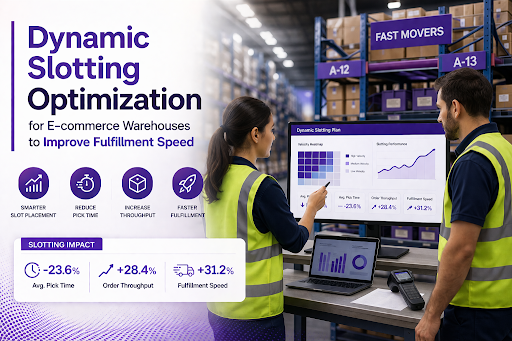
Fulfillment speed directly impacts order cycle time, labor cost per order, and SLA compliance in e-commerce warehouses. The main factor in boosting throughput in high-volume warehouses is picking.
Order picking can account for 55–75% of warehouse operating costs, and a significant portion of that time is spent traveling between locations.
In this blog, we will dive into how dynamic slotting optimization in e-commerce warehouses can reduce execution delays, enhance picking efficiency, and enable faster order fulfillment.
Why Fulfillment Speed Breaks in Static Slotting Environments
Studies show that pickers can spend up to ~50% of their time walking between locations, making slotting efficiency a direct driver of fulfillment speed.
Static slotting struggles because demand patterns shift continuously in e-commerce, while layout decisions remain based on historical averages. This creates a persistent mismatch between SKU placement and real-time order behavior.
Inability to Adapt to Rapid Demand Fluctuations
Slotting updates follow fixed cycles, while e-commerce demand can shift within hours due to promotions, seasonality, or traffic spikes. This delay means high-demand items are often not positioned where they are most needed during peak periods.
Suggested Read: Micro Slotting Optimization for Ecommerce to Reduce Picking Time
SKU Placement Lagging Behind Real-Time Order Trends
Order patterns change dynamically, but slotting is based on historical purchase data. When frequently co-ordered items are often placed far apart, it can increase travel distance and break efficient pick paths.
Congestion in High-Demand Picking Zones
When high-velocity SKUs are not redistributed dynamically, demand becomes concentrated in specific zones, creating localized congestion and slowing down picker movement across those areas.
Slow Re-slotting Cycles During Peak Periods
Re-slotting typically happens in scheduled batches, not in response to live demand changes. During peak order periods, this delay leads to continued inefficiencies when throughput pressure is highest.
Dynamic Slotting Levers That Directly Improve Fulfillment Speed
Dynamic slotting is an execution strategy that continuously aligns SKU placement with real-time demand, order patterns, and warehouse constraints. Its effectiveness depends on how quickly and accurately these changes can be translated into physical warehouse actions.
At scale, this requires a decision intelligence layer that can process live operational data, evaluate trade-offs across demand volatility, storage capacity, labor constraints, and congestion cost, and convert them into executable slotting decisions within WMS workflows.
The objective is:
Minimization of total fulfillment cost under real-time operational constraints
This is typically implemented through an external optimization engine integrated with WMS and OMS via APIs, creating a closed loop of sensing (order + inventory data), decisioning (optimization model), execution (task updates), and feedback (performance KPIs).
Real-Time SKU Repositioning Based on Demand Spikes
Demand spikes are treated as marginal cost reduction problems, not relocation triggers. The system evaluates whether moving a SKU reduces total travel cost enough to justify relocation friction. Decisions are constrained by:
- Bin capacity and compatibility rules in WMS
- Replenishment feasibility from bulk storage
- Disruption cost of moving stable SKUs
Optimization prioritizes SKUs with the highest ratio of demand velocity increase vs. travel cost reduction. Execution is pushed as WMS-directed relocation or putaway overrides, ensuring physical execution remains synchronized with digital decisions.
Impact is measured through a reduction in average pick travel distance per order during demand volatility windows.
Suggested Read: Micro Slotting Optimization for 3pl Warehouses to Reduce Labor Costs
Velocity Shifts Handling (Daily / Hourly SKU Movement)
Instead of static ABC segmentation, modern systems use a rolling velocity and volatility model that recalculates SKU priority continuously using short-term demand windows (1–24 hours) and long-term baselines.
This creates a dynamic classification system:
- High velocity → forward/golden zones
- Stable velocity → fixed anchor zones
- Volatile SKUs → adaptive reposition band
The key governance rule is movement throttling, limiting reposition frequency to avoid excessive slot churn. This ensures gains in responsiveness do not degrade pick stability or increase operational noise.
The outcome is improved pick consistency under fluctuating demand conditions, not just faster reaction time.
Adaptive Forward Pick Area Optimization
Forward pick zones operate as a constrained high-speed execution cache, not static storage. Optimization continuously balances:
- Consumption rate (pick throughput per SKU)
- Replenishment latency (bulk-to-forward transfer time)
- Slot scarcity (limited high-access positions)
The system dynamically allocates forward pick space to SKUs with the highest short-horizon demand acceleration, while ensuring replenishment cycles are triggered before stockout thresholds.
This is coordinated with wave planning systems so that forward pick replenishment aligns with batch execution cycles, reducing mid-wave disruption. KPI impact is measured through a reduction in replenishment-induced pick interruptions per shift.
Auto Clustering of Frequently Ordered SKUs
SKU clustering is modeled as a dynamic graph optimization problem, where SKUs are nodes and order co-occurrence defines weighted edges. The objective is to minimize the graph traversal distance translated into physical pick travel cost. Clustering is continuously recomputed based on live order streams using:
- Co-occurrence frequency decay models
- Batch compatibility scoring
- Zone transition cost matrices
This directly reduces the number of zone transitions per order, which is a primary driver of pick time variability in multi-item fulfillment. Execution is integrated into WMS slotting rules, ensuring cluster stability without manual intervention.
The structural impact is measured via a reduction in average zones visited per order line and improved batch pick density.
Suggested Read: Micro Slotting Optimization for High Sku Warehouses to Improve Pick Efficiency
Eliminating Fulfillment Delays Through Smart Slotting Decisions
Dynamic slotting reduces delays by embedding itself into the execution layer of warehouse operations, ensuring that SKU placement continuously adapts to maintain flow stability under fluctuating order pressure.
At a systems level, the objective is to minimize end-to-end order cycle time variance, not just average pick speed.
Reducing Travel Time During High Order Volumes
During peak-order conditions, travel time increases non-linearly due to path overlap, aisle contention, and fragmented pick routes.
Dynamic slotting mitigates this by continuously recalibrating SKU proximity based on real-time order density maps, ensuring high-frequency SKUs are positioned along high-probability pick corridors. In advanced implementations, slotting engines use:
- Heatmap-based demand intensity modeling
- Zone-level travel cost matrices
- Pick-path simulation outputs from WMS or digital twin layers
The goal is not only shorter distances, but reduced travel variance across orders, which stabilizes throughput during peak load conditions.
Preventing Zone Overload and Picker Congestion
Zone congestion is a structural imbalance problem caused by uneven demand distribution across warehouse nodes.
Dynamic slotting addresses this through load-aware SKU redistribution, where placement decisions are influenced by zone capacity utilization, picker density, and real-time task queue length.
Modern WMS-integrated systems monitor:
- Zone workload per hour
- Picker task accumulation rates
- Aisle-level contention signals
Based on these signals, SKUs are rebalanced across adjacent zones to maintain equilibrium in pick workload distribution, reducing bottlenecks and idle time simultaneously. This shifts the system from reactive congestion management to preemptive workload balancing.
Aligning Slotting with Batch and Wave Picking Strategies
Batch and wave picking performance is highly dependent on SKU spatial alignment with order grouping logic. Static slotting often breaks this alignment, leading to fragmented picks across multiple zones per batch.
Dynamic slotting improves this by synchronizing SKU placement with order grouping algorithms used in wave planning systems.
This involves:
- Aligning SKU clusters with batch formation rules in WMS
- Minimizing inter-zone transitions per wave
- Optimizing SKU adjacency for multi-order picking sequences
In advanced warehouse systems, slotting decisions are directly influenced by wave planning outputs, ensuring that physical SKU layout mirrors digital order batching logic.
Synkrato’s AI slotting recommendations continuously analyze SKU velocity, order patterns, and congestion signals to suggest optimal SKU placement in real time. This shifts slotting from periodic updates to a dynamic, data-driven system that improves pick efficiency and fulfillment speed.
Suggested Read: Dynamic Slotting Optimization for High Volume Warehouses to Reduce Picking Time
Execution Framework for Dynamic Slotting in E-commerce
The dynamic slotting strategy only delivers consistent results when it operates as a closed-loop execution system integrated with WMS, OMS, and real-time telemetry layers. The framework is designed to continuously convert operational data into slotting actions while maintaining execution stability across warehouse workflows.
Continuous Monitoring of Order and SKU Trends
Execution begins with continuous ingestion of real-time operational signals from OMS and WMS layers. These include order inflow velocity, SKU-level pick frequency, inventory depletion rates, and zone-level task accumulation.
Unlike traditional reporting dashboards, this strategy uses a streaming data model, where SKU behavior is evaluated in near real time using rolling time windows. This enables the system to detect demand acceleration, slowdowns, and spatial workload shifts as they happen, rather than after operational lag.
The output is a continuously updated SKU demand state vector, which feeds directly into slotting decision logic.
Trigger-Based Slotting Adjustments (Not Periodic)
Instead of scheduled slotting cycles, modern systems rely on event-driven triggers embedded within warehouse orchestration logic. Typical triggers include:
- Threshold-based SKU velocity shifts
- Zone congestion crossing predefined load limits
- Forward pick depletion risk
- Abnormal order clustering patterns
When triggered, the system runs a constrained optimization cycle that recalculates SKU placement priorities and pushes updates into WMS as actionable tasks.
This shift from periodic to event-driven logic reduces reaction latency between demand change and physical execution, which is a primary driver of fulfillment delays in static systems.
Suggested Read: Dynamic Slotting Optimization for 3pl Operations to Reduce Labor Costs
Minimizing Operational Disruption During Re-slotting
A critical constraint in execution design is ensuring that optimization does not destabilize ongoing warehouse operations. Re-slotting actions are therefore governed by movement cost thresholds and operational stability rules.
This includes:
- Limiting SKU relocation frequency within defined time windows
- Prioritizing high-impact moves over marginal gains
- Scheduling low-disruption execution windows aligned with shift transitions or low-load
- periods
- Ensuring WMS task synchronization to avoid location mismatch errors
Advanced systems incorporate a disruption penalty function, ensuring that slotting decisions account not only for efficiency gains but also for execution overhead introduced by change.
Measuring Warehouse Fulfillment Speed Improvements
Performance validation is embedded directly into the execution loop. Rather than evaluating slotting as a standalone activity, it is measured through system-level fulfillment KPIs.
Key metrics include:
- Order cycle time (end-to-end fulfillment latency)
- Picks per hour (labor throughput efficiency)
- Travel distance per order (path efficiency proxy)
- Zone-level throughput variance (congestion stability indicator)
These metrics are continuously compared against baseline performance to determine whether slotting adjustments are improving system efficiency or introducing instability.
In mature implementations, KPI feedback is directly fed back into the optimization engine, creating a self-correcting fulfillment system where execution performance refines future slotting decisions.
Suggested Read: Real Time Slotting Optimization for High Sku Environments to Improve Efficiency
Common Failures That Slow Down Dynamic Slotting Impact
In e-commerce settings with a lot of SKUs, some mistakes can quickly undo the benefits of optimization. Understanding these failure points is critical to sustaining performance and ensuring long-term warehouse fulfillment speed improvement.
Delayed Reaction to Demand Changes
Even with real-time data available, operational decisions are often put off because of system limitations or the need for manual approvals, leading to:
- The placement of SKUs is behind demand.
- Longer trips for items that are in high demand
- Less efficient picking during busy times
Over-Frequent Slotting Changes Causing Chaos
Being responsive is important, but too many changes to the slots can hurt operations and lower short-term warehouse productivity.
Common issues:
- Pickers are confused because the layout keeps changing
- More mistakes
- More work was done on reslotting
Lack of Integration between WMS and Slotting Logic
Dynamic slotting relies on smooth integration between decision systems and execution platforms. Consequences include:
- The data in the warehouse management system doesn’t match the physical inventory
- Pick paths take longer to update
- More manual work
Bringing Intelligence to Dynamic Slotting with Synkrato
As e-commerce businesses grow, it gets harder to make dynamic slotting decisions because of SKU volatility, order variability, congestion patterns, and replenishment dependencies. Market research shows that AI-driven optimization is increasingly used to reduce picking time and improve warehouse throughput in high-volume environments.
Synkrato is an intelligence layer that sits on top of existing warehouse systems. It uses continuous data processing, simulation and AI-driven decision making to optimize slotting in warehouses.
- Digital Twin Simulation Environment
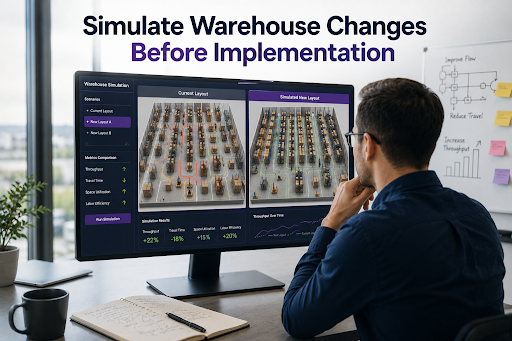
Makes a virtual model of how a warehouse works so that slotting strategies can be tested before they are put into action. Teams can look at how travel distance, traffic and throughput impact without disrupting live workflows.
- AI-Driven Slotting Decisions
Monitor SKU velocity, order patterns, and congestion signals to make accurate placement suggestions that match current demand.
- Scenario-Based Optimization Engine
Runs several slotting scenarios to find the best setup based on key performance indicators like picks per hour, order cycle time, and labor efficiency.
- WMS Integration and Execution Alignment
Ensures that slotting decisions are in sync with picking workflows, restocking, and task allocation, which speeds up execution.
Are you ready to move beyond incremental gains and unlock a structural upgrade in fulfillment performance for faster, more predictable, and scalable operations? Connect with Synkrato.
Suggested Read: Slotting Optimization for Robotic Fulfillment Centers to Increase Throughput
FAQs
What is dynamic slotting in e-commerce warehouses?
Dynamic slotting in e-commerce warehouses means changing the placement of SKUs all the time based on current demand, order patterns, and operational conditions. This makes sure that the way inventory is stored stays in line with current picking needs, which speeds up fulfillment. Synkrato enables this by continuously translating real-time warehouse signals into optimized SKU placement decisions through its AI-driven slotting engine.
How does dynamic slotting improve fulfillment speed?
Dynamic slotting speeds up fulfillment by cutting down on travel distance, making the pick path more efficient, and cutting down on congestion. By putting SKUs in the right places based on how orders are actually being placed, warehouses can pick more items per hour and shorten the time it takes to fill an order. Synkrato strengthens this by aligning SKU placement with live order flow and congestion data, ensuring pick paths remain efficient as demand shifts.
What is the difference between static and dynamic slotting?
Static slotting uses historical data and updates every so often, so it doesn’t respond as quickly to changes in demand. Dynamic slotting changes continuously based on real-time data, which enables faster response and smoother operations. With Synkrato, this shift is operationalized through continuous optimization, where slotting decisions evolve in sync with real-time warehouse conditions.
How often should slotting be updated in e-commerce warehouses?
Updates to slotting should happen based on events, not on time. Changes should be made when demand changes, congestion rises, or SKU velocity changes to keep operations in sync at all times. Synkrato supports this through trigger-based slotting recommendations that activate based on live demand and operational thresholds, not fixed schedules.
What data is required for dynamic slotting optimization?
Dynamic slotting needs real-time information about SKU speeds, order flow, pick frequency, congestion levels, and restocking cycles. These inputs help people make decisions that are correct and on time. Synkrato integrates these data streams into a unified decision layer, converting them into actionable, simulation-backed slotting recommendations.
Can dynamic slotting reduce order processing time?
Yes, dynamic slotting speeds up order processing by making it easier to pick items, shortening travel distances, and eliminating delays caused by poor SKU placement and traffic. Synkrato accelerates this impact by continuously optimizing pick paths and SKU positioning based on real-time execution data.
What tools are used for dynamic slotting?
Dynamic slotting uses warehouse management systems, AI-powered optimization platforms, and simulation tools. Advanced solutions use digital twin environments and real-time analytics to help people make better decisions. Synkrato combines these capabilities into a single platform, integrating AI-driven slotting, simulation, and real-time analytics within existing WMS environments.
Is dynamic slotting suitable for high SKU warehouses?
Yes, dynamic slotting works best in places with a lot of SKUs and demand that changes a lot. It lets you keep optimizing and helps you stay efficient even when your inventory and order patterns change all the time. Synkrato is specifically designed for high-SKU environments, where continuous optimization is required to maintain fulfillment speed and operational stability at scale.