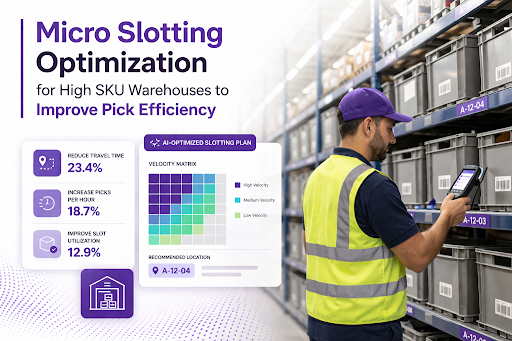
In high-SKU warehouse environments, even marginal inefficiencies in product placement can compound into high operational costs. Traditional slotting approaches often fall short in addressing the dynamic nature of demand variability and order complexity. Micro slotting offers a more precise, data-driven method to align inventory positioning with actual picking behavior.
This blog explores how micro-slotting optimization for high SKU warehouses can improve pick efficiency through advanced, data-driven strategies. It will also provide insight into how platforms like Synkrato enable AI-powered slotting decisions to turn warehouse inefficiencies into measurable productivity gains.
Why Pick Efficiency Breaks Down in High SKU Environments
Pick efficiency often deteriorates as SKU counts rise, introducing complexity that traditional warehouse practices struggle to manage. To understand where the breakdown happens, consider the following key challenges:
SKU Explosion Leading to Increased Search and Travel Time
As SKU counts scale, warehouse layouts fail to maintain logical proximity among high-frequency items. This results in longer travel paths and increased search time per pick. Pickers spend more time navigating and locating SKUs than executing picks, directly reducing throughput and making micro-slotting for high-SKU warehouses essential for efficiency.
Poor Bin Level Organization in High-Density Storage
High-density storage often leads to overcrowded bins with multiple SKUs lacking clear differentiation. This forces pickers to scan through items, increasing dwell time and error risk. Without structured bin logic, bin optimization for high SKU warehouses becomes ineffective, slowing down picking cycles and reducing operational consistency.
Fragmented SKU Placement Across Multiple Locations
Storing the same SKU across multiple bins or zones creates inconsistency in picking decisions. Pickers must choose between locations, increasing hesitation and travel variability. This fragmentation disrupts system-directed picking and complicates high-SKU warehouse slotting optimization, leading to inefficiencies in both single and multi-line order fulfillment.
Increased Cognitive Load on Pickers
High-SKU warehouses require pickers to process large amounts of information quickly, from identifying similar-looking products to navigating complex layouts. This increased cognitive demand can slow decision-making and reduce picking speed. Over time, mental fatigue sets in, increasing the likelihood of errors and inconsistencies. Without clear slotting logic and intuitive organization, the burden on pickers continues to grow, directly impacting overall efficiency.
Suggested Read: Micro Slotting Optimization for Ecommerce to Reduce Picking Time
Pick Efficiency Problems Often Start With Slotting in High-SKU Warehouses
Most pick-efficiency challenges in high-SKU warehouses can be traced to how SKUs are initially positioned and continuously managed. Slotting decisions shape travel distance, search effort, and overall pick path logic, making them a foundational driver of warehouse performance.
How Poor SKU Placement Increases Search Time
When SKUs are placed without considering velocity, order frequency, or picking logic, pickers spend more time searching than picking. Poor placement disrupts spatial familiarity, forcing workers to repeatedly scan bins and aisles to locate items.
This increases dwell time at each pick point and reduces overall throughput. Over time, even small inefficiencies in SKU positioning accumulate into significant productivity losses, especially in high-volume, high-SKU environments where search repetition becomes constant.
Why SKU Density Creates Picking Inefficiencies
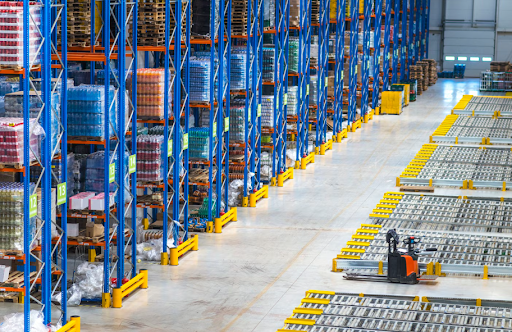
High SKU density within limited storage space often leads to overcrowded bins, overlapping product placements, and reduced visual clarity. While density improves storage utilization, it frequently comes at the cost of accessibility.
In such conditions, pickers must slow down to verify items, increasing both pick time and error probability. Dense environments also amplify physical congestion in high-traffic zones, further reducing movement efficiency and creating bottlenecks during peak order cycles.
How Traditional Slotting Creates Hidden Pick Path Friction
Traditional slotting methodologies are designed to improve warehouse organization using factors such as SKU velocity, product affinity, and order history. While these approaches can initially create efficient layouts, they are typically executed periodically rather than continuously.
In high-SKU warehouse environments, demand patterns, order profiles, and SKU movement change rapidly. As these conditions evolve, previously optimized slotting configurations gradually lose effectiveness. SKUs that were once positioned efficiently may no longer align with actual picking behavior, introducing unnecessary travel, congestion, and fragmented pick paths.
Because large-scale re-slotting exercises are operationally intensive and difficult to execute frequently, many warehouses continue operating with layouts that no longer reflect real-time demand conditions.
This creates hidden pick path friction in the form of:
- Increased travel distance across aisles and zones
- Higher backtracking during multi-line picks
- Congestion in high-activity pick areas
- Reduced picking consistency during demand fluctuations
- Longer search and decision-making time for pickers
Micro-slotting addresses this challenge by enabling more granular and continuously optimized SKU placement strategies that adapt to changing warehouse conditions over time.
Why Traditional Slotting Breaks in High-SKU Environments
Traditional slotting methodologies can create efficient warehouse layouts by considering factors such as SKU velocity, product affinity, and order history. However, in high-SKU environments where demand patterns, order profiles, and inventory movement change continuously, these layouts gradually lose alignment with actual picking behavior.
The challenge is not the slotting methodology itself, but the difficulty of continuously maintaining and updating slotting decisions at scale. Large warehouses often rely on periodic re-slotting exercises that are operationally intensive, time-consuming, and difficult to execute frequently.
As warehouse conditions evolve between optimization cycles, SKU placement can become increasingly disconnected from real-time operational flow, introducing inefficiencies across picking, replenishment, and movement paths.
Suggested Read: Micro Slotting Optimization for 3pl Warehouses to Reduce Labor Costs
Why Static Slotting Logic Loses Effectiveness as SKU Counts Grow
As SKU counts increase, maintaining alignment between slotting layouts and actual demand behavior becomes significantly more complex.
- Space utilization gradually becomes misaligned with changing SKU velocity and order frequency patterns
- Manual slotting updates become increasingly operationally intensive as SKU catalogs expand
- Emerging fast movers may not be repositioned quickly enough to reflect evolving demand shifts
- Previously optimized layouts can contribute to longer travel paths and congestion over time
- Replenishment and picking workflows become harder to balance as SKU movement patterns continuously change
How Static Slotting Layouts Can Lead to SKU Scatter Over Time
In many warehouses, SKU placement evolves incrementally based on replenishment activity, temporary overflow decisions, and changing space availability. Over time, this can result in the same SKU being distributed across multiple bins or zones without continuous optimization of the overall pick flow.
As SKU scatter increases, pickers may need to navigate multiple locations for the same item, increasing travel variability, search time, and routing complexity during order fulfillment.
These inefficiencies become more pronounced in high-SKU environments where frequent demand shifts make it difficult for periodically updated slotting models to maintain optimal placement consistency.
Why Micro-Slotting Supports Dynamic High-SKU Operations
Micro-slotting addresses these challenges by introducing more granular and continuously optimized placement strategies at the bin level. Instead of relying solely on periodic layout reviews, micro-slotting continuously aligns SKU positioning with evolving demand signals, order patterns, and operational flow.
How micro-slotting improves high-SKU warehouse performance:
- Reduces SKU scatter by continuously optimizing placement based on actual demand behavior
- Improves pick path consistency through more adaptive bin-level organization
- Aligns SKU positioning with changing velocity and co-occurrence patterns
- Supports dense storage environments while maintaining accessibility
- Enables ongoing optimization as order profiles and inventory movement evolve
This approach transforms warehouse slotting from a periodic planning activity into a more responsive and continuously optimized operational process.
Suggested Read: Dynamic Slotting Optimization for High Volume Warehouses to Reduce Picking Time
Micro Slotting Levers Built for High SKU Complexity
Micro slotting introduces targeted levers designed to handle the operational complexity of high-SKU environments with greater precision. The following strategies highlight how these levers can be applied effectively:
SKU Velocity Segmentation Beyond Basic ABC (Hyper-Fast vs Long-Tail)
Traditional ABC classification remains a valuable foundation for warehouse slotting by grouping SKUs based on relative movement frequency. However, in high-SKU warehouse environments with rapidly changing demand patterns, ABC segmentation alone may not provide the level of granularity needed to continuously optimize pick efficiency.
High-SKU operations often contain a wide distribution of inventory behavior, ranging from ultra-fast-moving SKUs that drive a large share of picks to long-tail products with low frequency but high catalog complexity. Managing these varying movement patterns requires more adaptive segmentation strategies that reflect real operational flow.
Advanced micro-slotting strategies segment SKUs into more refined movement categories, such as:
- Hyper-fast movers (top velocity SKUs with extremely high pick frequency)
- Fast movers (consistently high-demand SKUs)
- Mid-tier SKUs with moderate movement patterns
- Long-tail SKUs with low pick frequency but high storage diversity
This additional segmentation allows warehouses to align storage locations more precisely with actual picking behavior.
For example:
- Hyper-fast-moving SKUs can be positioned in highly accessible golden zones near primary pick paths
- Medium-velocity SKUs can be distributed to balance congestion and maintain efficient travel flow
- Long-tail SKUs can be consolidated into denser storage areas to improve space utilization without disrupting high-frequency picking activity
Unlike static classification approaches that are updated periodically, micro-slotting continuously adjusts placement recommendations as SKU velocity and order behavior evolve over time.
This creates a more responsive slotting model that supports both storage efficiency and consistent picking performance in dynamic high-SKU warehouse environments.
Co-Occurrence Mapping to Reduce Multi-SKU Pick Complexity
Order patterns in high SKU environments often reveal SKU co-occurrence clusters. These are groups of SKUs frequently picked together. Mapping these relationships allows warehouses to colocate related SKUs, reducing multi-item travel distance.
For example, instead of slotting based on SKU attributes alone, clustering based on order history significantly improves pick path efficiency. This approach is a core component of high SKU warehouse slotting optimization, especially in e-commerce and omnichannel operations.
Slotting for High-Density Bins Without Increasing Search Time
High-density bins are unavoidable in large SKU catalogs. However, their design must minimize search time. Effective strategies to maintain accessibility and picking accuracy within dense storage environments include:
- Structuring bins using logical SKU grouping based on velocity, size, or category to reduce visual clutter
- Implementing clear, standardized labeling and visual cues to help pickers quickly identify items
- Limiting the number of SKUs per bin to avoid excessive crowding and confusion
- Positioning high-frequency items in the most accessible sections within each bin
- Using dividers or compartmentalization to create distinct, easy-to-navigate sections
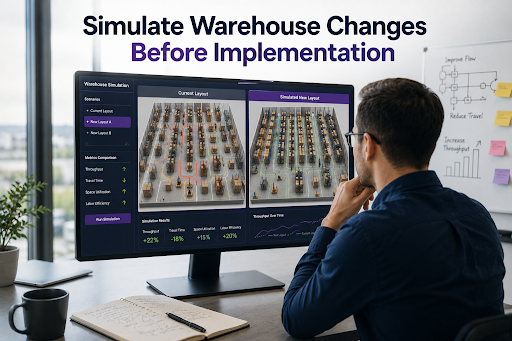
Using Synkrato’s Digital Twin, warehouses can visualize and refine high-density bin structures and golden zone allocations before operational rollout.
Prioritizing Golden Zones for Ultra Fast Moving SKUs
Golden zones are the most ergonomically efficient storage locations in a warehouse, typically between waist and shoulder height, and along primary pick paths. When high-velocity SKUs are not placed in these zones, pickers are forced into unnecessary movement, slowing down order fulfillment. To optimize golden zone allocation effectively:
- Identify ultra-fast-moving SKUs using real-time and historical order frequency data
- Reserve golden zone capacity strictly for top-tier velocity items, avoiding dilution with low-impact SKUs
- Continuously rebalance placements as demand shifts across seasons or campaigns
- Align replenishment processes to ensure golden zone SKUs remain consistently in stock
This approach ensures maximum productivity gains by minimizing picker travel for the most frequently accessed items.
Reducing Search Time and Decision Fatigue for Pickers
Search time and cognitive overload are two of the most overlooked drivers of inefficiency in high-SKU warehouse environments. The following micro slotting strategies focus on reducing ambiguity, improving visibility, and enabling faster, more predictable execution:
Structuring Bin Locations for Faster SKU Identification
When bin layouts lack structure, pickers spend unnecessary time visually scanning and verifying items before selection. This slows down the entire picking cycle and increases the likelihood of errors.
To improve identification speed and accuracy:
- Group SKUs logically within bins based on product family, size, or velocity
- Use consistent bin labeling formats across all zones to reduce interpretation time
- Position high-frequency items in predictable, easily visible locations
- Implement clear visual cues such as color coding or zone markers
Reducing search time at the bin level directly improves pick cycle time, especially in high SKU warehouses.
Suggested Read: Dynamic Slotting Optimization for Ecommerce Warehouses to Improve Fulfillment Speed
Minimizing SKU Scatter Across Aisles and Zones
When a single SKU is spread across multiple aisles or storage zones without clear logic, pickers must constantly adjust their routes. This fragmentation increases travel time and creates unnecessary complexity in order fulfillment.
To reduce SKU scatter effectively:
- Consolidate high-velocity SKUs into primary pick zones wherever possible
- Limit secondary storage locations to controlled overflow scenarios only
- Align replenishment rules to prevent uncontrolled dispersion of inventory
- Regularly audit SKU distribution to eliminate inefficient placement patterns
Fragmented SKU distribution is typically caused by reactive replenishment and inconsistent slotting rules, increasing picker travel time and routing complexity. Sykrato’s AI-driven solutions add a continuous decision layer that addresses this by re-optimizing SKU placement across zones to reduce dispersion and maintain efficient pick paths.
Standardizing Slotting Logic for Predictable Picking
Inconsistent slotting rules create variability in picker performance. Standardization ensures predictability.
Key principles include:
- Uniform slotting criteria across zones
- Consistent bin sizing logic
- Defined rules for SKU relocation
Standardization reduces training time and improves execution consistency, both critical for optimizing high SKU warehouses.
Designing Efficient Pick Paths in High SKU Warehouses
Efficient pick path design in high SKU environments requires aligning SKU placement with real order behavior and minimizing non-value-added movement. The following strategies focus on structuring movement flow in high SKU warehouses:
Clustering Related SKUs to Reduce Multi-Item Travel
When related SKUs are stored far apart, pickers are forced to traverse multiple zones for a single order. This increases travel time and disrupts picking flow. To improve clustering efficiency:
- Group SKUs that frequently appear together in orders using co-occurrence data
- Place complementary products within the same or adjacent pick zones
- Continuously refine clusters based on evolving order patterns
- Prioritize high-frequency combinations for tighter proximity
This reduces back-and-forth movement and shortens overall pick paths.
Suggested Read: Dynamic Slotting Optimization for 3pl Operations to Reduce Labor Costs
Eliminating Redundant Movements Across Dense Storage Areas
Dense storage layouts often create overlapping pick paths. Without optimization, pickers revisit the same aisle multiple times within a single order cycle.
Advanced high SKU warehouse slotting optimization eliminates these redundancies by:
- Designing unidirectional pick flows
- Aligning SKU placement with logical path progression
- Reducing cross-aisle backtracking
The objective is to ensure that each pick path is continuous, with minimal reversal or deviation.
Balancing Pick Density Across Zones
Uneven pick density creates bottlenecks. High-velocity zones become congested, while other areas remain underutilized. Balancing pick density requires redistributing SKUs to ensure an even workload across zones without compromising accessibility.
This involves:
- Spreading fast-moving SKUs across multiple high-access zones
- Avoiding over-concentration in golden zones
- Aligning slotting with labor allocation
Balanced zones improve throughput consistency and reduce picker idle time, a critical factor in dynamic slotting for large SKU catalog environments.
Synkrato enables Simulation & Optimization capabilities that allow warehouses to test and refine pick path designs for improved flow efficiency and reduced travel time.
Data Signals Required for High SKU Micro Slotting
High SKU environments require continuous, data-driven decision-making to sustain slotting accuracy and operational efficiency. The following data inputs are critical for driving informed slotting strategies:
SKU Velocity Distribution and Long-Tail Analysis
High-SKU environments typically follow a skewed distribution, where a small percentage of SKUs drive the majority of picks, while a long tail contributes to storage complexity.
Segmenting SKUs beyond basic ABC classification allows warehouses to:
- Identify ultra-fast movers that require prime pick locations
- Isolate long-tail SKUs for compact, high-density storage
- Continuously adjust placement as demand patterns shift
- Monitor seasonal or campaign-driven shifts in SKU movement
This enables more precise space allocation and prevents over-prioritization of low-impact SKUs.
Suggested Read: Real Time Slotting Optimization for High Sku Environments to Improve Efficiency
Order Line Complexity (Items per Order)
Order profiles in high-SKU environments often vary significantly in terms of line count and SKU combinations. Higher order complexity increases the need for optimized SKU proximity and efficient pick path design.
Analyzing items per order helps:
- Identify common SKU groupings and co-occurrence patterns
- Design slotting strategies that reduce multi-item travel
- Improve overall pick path efficiency for complex orders
Aligning slotting decisions with order structure is key to minimizing travel time and improving throughput. This is especially relevant in e-commerce operations, where basket sizes fluctuate dynamically.
Pick Frequency vs Storage Density Trade-offs
Balancing storage density with accessibility is critical in high-SKU warehouses. Over-optimizing for space can slow down picking, while over-prioritizing accessibility can waste valuable storage capacity.
To strike the right balance:
- Place high-frequency SKUs in low-density, high-access locations
- Use high-density storage for low-frequency and long-tail SKUs
- Avoid overcrowding bins in high-activity pick zones
- Define maximum SKU thresholds per bin based on pick frequency
- Align storage type (shelving, bins, pallets) with SKU velocity and size
- Continuously rebalance based on changes in pick frequency
This ensures efficient use of space without compromising pick speed.
These trade-offs can be optimized through AI-driven decision intelligence layers such as Synkrato’s AI Slotting Recommendations to balance storage density and accessibility based on real-time SKU behavior.
Bin Utilization and SKU Accessibility
Efficient bin utilization goes beyond maximizing storage capacity—it directly impacts how quickly and accurately SKUs can be identified and picked. Poor bin structure increases search time, reduces accessibility, and contributes to picker inefficiency in high-SKU environments.
Key data signals used to evaluate bin efficiency include
- Bin occupancy rate
- SKU count per bin
- Pick frequency per bin
- Average pick time per bin
- Pick accuracy rates
Together, these signals provide visibility into how effectively space is being used and how easily SKUs can be accessed during picking operations.
These insights help identify overcrowded bins, underutilized space, and high-friction picking locations, enabling more precise slotting decisions that improve both speed and accuracy.
How Synkrato Enables Intelligent Micro Slotting
Modern high-SKU warehouses require a continuous decision system that adapts to demand shifts, order complexity, and space constraints in real time. Synkrato acts as a decision intelligence layer that enables this transformation.
It combines key warehouse signals such as SKU velocity, order patterns, and bin utilization to continuously optimize slotting decisions, replacing static planning with dynamic, data-driven placement.
Suggested Read: Slotting Optimization for Robotic Fulfillment Centers to Increase Throughput
From Static Slotting to AI-Driven Continuous Optimization
- Digital twin modeling enables warehouses to test slotting strategies in a virtual environment before deploying changes in live operations.
- Simulation and optimization engines evaluate multiple slotting scenarios, identifying the most efficient configuration based on real demand patterns.
- AI slotting recommendations dynamically adjust SKU placement using velocity, co-occurrence, and pick frequency data in near real-time.
- Enterprise mobility and labeling integration ensure execution consistency, enabling pickers to follow optimized paths with minimal confusion or delay.
Still relying on static slotting? Book a demo with Synkrato and explore how AI-driven slotting can reshape your warehouse performance.
FAQs
What is micro slotting in high SKU warehouses?
Micro slotting in high SKU warehouses refers to granular, data-driven SKU placement strategies. It optimizes bin-level positioning based on velocity, co-occurrence, and accessibility to reduce travel time, search effort, and improve overall picking efficiency.
How does micro slotting improve pick efficiency?
Micro slotting improves pick efficiency by minimizing travel distance, reducing search time, and aligning SKU placement with order patterns. It ensures faster picking cycles and lower cognitive load, directly increasing picks per hour in high SKU warehouse environments.
What is the difference between slotting and micro slotting?
Traditional slotting operates at a broader zone or category level. Micro slotting focuses on bin-level precision, using detailed data such as SKU velocity, co-occurrence, and order patterns for optimized placement in complex, high SKU warehouses.
How do you manage slotting in warehouses with thousands of SKUs?
Managing slotting at scale requires continuous analysis of SKU velocity, order patterns, and space utilization. In high-SKU environments, static slotting becomes inefficient due to frequent demand shifts. Synkrato helps manage this complexity by acting as a decision intelligence layer that continuously optimizes SKU placement based on real-time warehouse data.
What data is needed for slotting optimization?
Key data includes SKU velocity, order history, co-occurrence patterns, pick frequency, bin utilization, and storage constraints. These inputs enable precise high SKU warehouse slotting optimization and support continuous improvement in picking efficiency. Synkrato processes these data signals in real time to generate continuous slotting decisions that improve space utilization and picking performance.
How often should slotting be updated in high SKU environments?
Slotting should be reviewed continuously or at regular intervals, depending on demand variability. High SKU warehouses benefit from dynamic updates driven by real-time data rather than static, periodic re-slotting approaches. Synkrato enables continuous slotting optimization by dynamically updating SKU placement as warehouse conditions change in real time.
Can micro slotting reduce picking errors?
Yes, micro slotting reduces picking errors by improving SKU visibility, minimizing confusion within bins, and standardizing placement logic. Reduced cognitive load and clearer organization lead to higher picking accuracy.
What tools are used for slotting optimization?
Slotting optimization typically uses warehouse management systems, analytics tools, and optimization engines to evaluate demand patterns and improve SKU placement decisions. Synkrato provides an integrated platform that combines AI-driven optimization, simulation, and real-time decision-making to enhance slotting accuracy and warehouse performance.