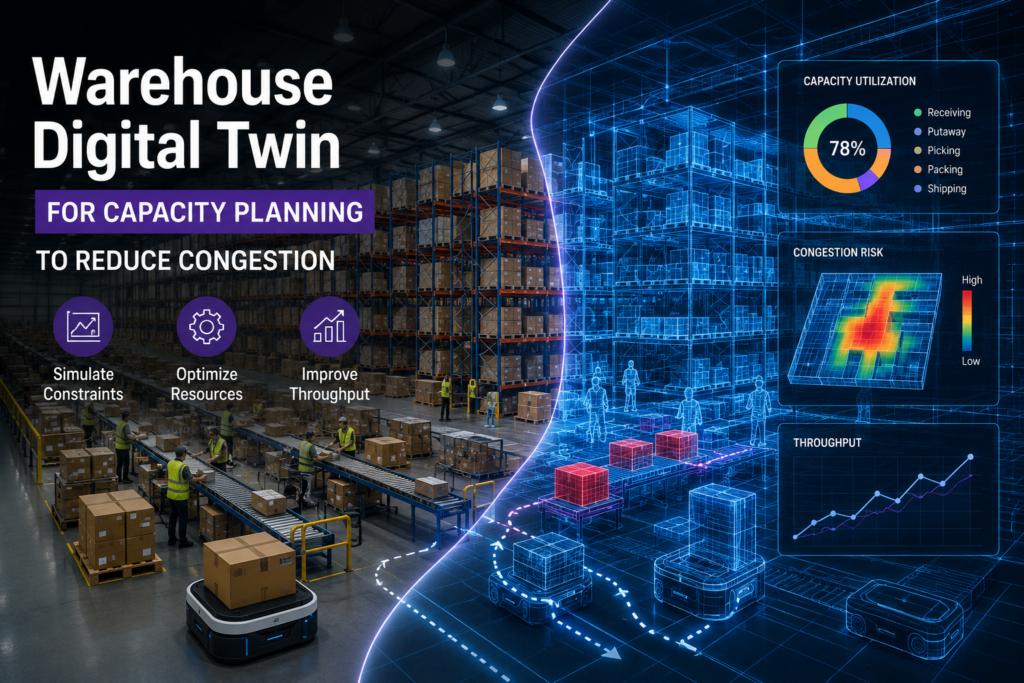
As fulfillment operations become increasingly complex, traditional capacity planning methods often fail to predict how localized bottlenecks evolve into widespread warehouse congestion. A warehouse digital twin provides warehouse leaders with the ability to simulate capacity constraints, evaluate operational interdependencies, and proactively optimize resource allocation before performance deteriorates.
The warehouse digital twin market is projected to grow from USD 0.9 billion in 2025 to USD 4.4 billion by 2036, reflecting increasing adoption of digital twin technologies to improve operational visibility and decision-making.
This article explores how digital twins help organizations anticipate congestion risks, balance throughput, and strengthen capacity planning in high-volume warehouse environments.
Why Congestion Problems Often Start With Limited Capacity Visibility
Warehouse congestion often stems from limited visibility into how capacity constraints develop across interconnected operations. While traditional systems track individual activities, they rarely provide a unified view of how labor, equipment, inventory flow, and process dependencies influence overall warehouse performance. This makes it difficult to identify emerging bottlenecks before they affect throughput and service levels.
How Fragmented Capacity Signals Create Hidden Congestion Risks
Most warehouse environments rely on multiple systems to monitor execution activities. WMS, LMS, and transportation platforms provide valuable operational data. However, these systems typically operate independently, creating fragmented capacity insights.
As a result, downstream constraints such as packing station saturation or dispatch delays may remain undetected while upstream processes continue releasing work. This disconnect leads to queue buildup, work-in-progress accumulation, and delayed responses to congestion risks.
Why Interdependent Processes Expose Control Constraints
Warehouse processes are highly interdependent. Constraints in packing can affect picking productivity, while dispatch delays can create staging congestion and slow upstream execution. These dependencies expose control constraints that isolated performance metrics often miss, including:
- Shared labor resources across functions
- Limited equipment and buffer capacities
- Variable order profiles affecting workload intensity
- Static order release practices misaligned with available capacity
How Digital Twin Intelligence Addresses Visibility Gaps Traditional Systems Miss
Traditional reporting tools explain what happened but provide limited insight into emerging operational risks. Digital twins replicate warehouse states by integrating data streams from execution systems. This real-time representation enables organizations to monitor capacity utilization across interconnected process stages simultaneously.
Advanced digital twin intelligence supports:
- Detection of emerging queue formation patterns
- Identification of hidden capacity bottlenecks
- Evaluation of resource contention across zones
- Assessment of workload distribution effectiveness
- Simulation of corrective interventions before execution
Unlike static dashboards, digital twins evaluate system behavior under changing conditions, allowing warehouse leaders to test operational responses against evolving demand patterns without disrupting live operations.
Capacity Saturation Dynamics Driving Congestion Formation
Congestion develops when workload demand consistently exceeds the effective processing capacity of operational resources. Understanding how saturation emerges across warehouse systems is essential for proactive capacity planning.
Throughput Limits Across Picking, Packing, and Dispatch Nodes Under Peak Load
Every warehouse process stage operates within finite throughput boundaries determined by labor availability, equipment performance, physical infrastructure, and operational complexity.
Under normal conditions, modest capacity buffers absorb execution variability. During peak periods, these buffers rapidly disappear. Factors that accelerate saturation:
- Increased order line complexity
- Higher SKU diversity within order profiles
- Reduced labor flexibility due to specialized tasks
- Transportation schedule compression
- Equipment downtime reducing effective capacity
Exceeding throughput thresholds creates nonlinear performance degradation. Small increases in workload often produce disproportionate increases in queue formation and cycle times.
Warehouse capacity planning using digital twin simulation helps identify these thresholds and evaluate corrective actions before bottlenecks impact service levels.
Accumulation of Work-in-Progress Inventory Across Constrained Process Stages
Work-in-progress (WIP) inventory is a key indicator of emerging congestion. When downstream processes cannot keep pace with upstream output, inventory accumulates between stages. While initially manageable, persistent imbalances increase operational complexity.
Excessive WIP leads to:
- Longer travel distances for associates
- Reduced staging space
- More search and handling activities
- Lower process visibility
- Greater prioritization conflicts
Queueing theory shows that high utilization combined with system variability sharply increases waiting times. Digital twins continuously monitor WIP across process stages, enabling early intervention before localized buildup becomes system-wide congestion.
Resource Saturation Leading to Queue Buildup and Execution Delays
As labor, equipment, or dock capacity approaches full utilization, queues grow rapidly, and execution slows. High resource utilization leaves little flexibility to absorb demand fluctuations or operational disruptions.
A digital twin for warehouse throughput and capacity balancing predicts these saturation points, enabling warehouse leaders to rebalance resources and reduce congestion before delays spread across operations.
Congestion Propagation Across Interdependent Warehouse Processes
Warehouse congestion rarely remains confined to one process. Because fulfillment operations are tightly interconnected, a localized bottleneck can quickly affect upstream and downstream activities, disrupting throughput across the entire warehouse.
Understanding these propagation mechanisms is critical for effective digital twin-based warehouse congestion reduction initiatives.
Upstream Downstream Coupling Effects Amplifying Localized Capacity Constraints
Warehouse processes operate as a connected flow rather than isolated functions. When one node experiences reduced processing capability, connected processes adjust their behavior accordingly.
For example, reduced packing throughput affects multiple upstream functions:
- Picking operations continue releasing completed orders into staging buffers.
- Sortation systems experience increased dwell times.
- Replenishment priorities become distorted as pick demand shifts.
- Available staging space gradually decreases.
Similarly, downstream disruptions can also create upstream bottlenecks.
Transportation delays at outbound docks can create dispatch bottlenecks, restricting packing output, despite sufficient labor. These effects intensify at high utilization, where small disruptions can cascade through interconnected processes.
Digital twins help organizations quantify these dependencies by simulating:
- Flow restrictions between operational zones
- Buffer capacity limitations
- Resource competition across interconnected processes
- Delay amplification across execution stages
- Recovery timelines following disruption events
This helps identify and address root capacity constraints before localized disruptions impact overall warehouse performance.
Spillover of Delays Across Zones Due to Imbalanced Workload Distribution
Uneven workload distribution can cause congestion to spread across warehouse operations. When one zone becomes overloaded, delays often propagate to adjacent processes.
Common causes include:
- SKU concentration in specific pick zones
- Batch releases driven by shipping deadlines
- Labor allocation mismatches
- Uneven replenishment
- Seasonal demand shifts
Localized overload can result in:
- Overflow inventory in shared staging areas
- Associates diverted to constrained zones
- Higher equipment utilization
- More prioritization conflicts and exceptions
A digital twin for workload distribution and capacity utilization continuously monitors workload and capacity across zones, enabling proactive redistribution of work before localized bottlenecks escalate into system-wide disruption.
Synkrato extends these capabilities by combining digital twin modeling with AI-driven simulation and operational intelligence, helping warehouses identify congestion risks early, evaluate alternative execution strategies, and optimize capacity before bottlenecks impact throughput.
Digital Twin Modeling for Capacity Constrained Environments
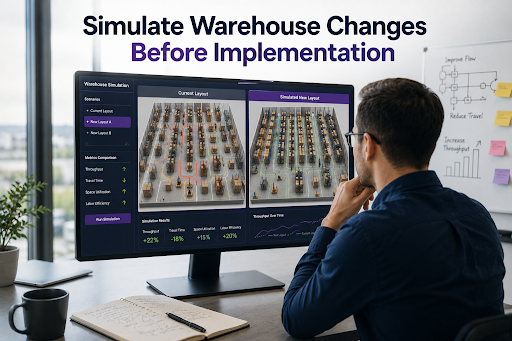
Effective capacity planning requires more than historical reporting. A digital twin continuously models warehouse operations by simulating process interactions and synchronizing with live operational data. This enables warehouse leaders to evaluate how capacity constraints develop, test operational changes, and make informed decisions before congestion impacts execution.
Event-Level Simulation of Process Flow, Resource Allocation, and Queue Formation
Discrete-event simulation is the foundation of most warehouse digital twins. It models operations as time-based events, with each event updating resource availability, queues, and process flow.
Typical modeled events include:
- Order releases into fulfillment queues
- Inventory replenishment completion
- Picker task assignments
- Packing station availability changes
- Equipment downtime occurrences
- Trailer arrivals and departures
Event-level modeling enables organizations to evaluate:
- Resource utilization across functional areas
- Queue formation under varying workloads
- Cycle time variability throughout execution stages
- Labor productivity under alternative staffing models
- Impact of operational disruptions on throughput
Unlike static capacity models, discrete-event simulation captures real-world variability, providing a more accurate view of warehouse performance. Advanced models also include task-time distributions, equipment reliability, shift constraints, dynamic prioritization, and facility movement restrictions, improving capacity planning and operational decision-making.
Real-Time State Replication of Workload Distribution and Capacity Utilization
Simulation alone provides planning insights. Digital twins extend these capabilities through real-time operational synchronization. State replication involves continuously updating digital representations using live execution data from operational systems.
Data sources commonly include:
- Warehouse Management Systems (WMS)
- Warehouse Control Systems (WCS)
- Labor Management Systems (LMS)
- ERP platforms
- Transportation Management Systems (TMS)
- Industrial IoT devices and sensor networks
Real-time synchronization enables digital twins to reflect:
- Current order backlogs
- Zone-specific workload distribution
- Resource utilization levels
- Queue lengths across process stages
- Inventory movement patterns
- Equipment operational status
This transforms digital twins into operational intelligence platforms, enabling teams to monitor system health and evaluate corrective actions before disruptions escalate. The capability is especially valuable during demand spikes, labor shortages, transportation delays, and equipment failures.
Why Scenario Engineering Improves Capacity Planning Decisions Under Stress
Warehouse operations rarely fail under normal conditions. They fail when demand spikes, resources become constrained, or unexpected disruptions expose hidden capacity limitations.
Scenario engineering enables warehouse leaders to evaluate these conditions in a digital twin before they affect live operations, improving the accuracy of capacity planning decisions.
Simulation of Peak Order Volumes and Resource Constrained Execution Scenarios
Peak periods reveal the true resilience of warehouse operations. Promotional events, holiday seasons, product launches, and unexpected demand spikes frequently push facilities toward capacity thresholds.
Conventional planning methods typically estimate peak requirements using historical averages. However, these approaches often overlook nonlinear interactions that emerge under stress.
Digital twins support simulation of scenarios such as:
- Sudden increases in order release volume
- Reduced labor availability across shifts
- Equipment failures within automated systems
- Transportation network disruptions affecting dispatch schedules
- SKU mix changes increasing fulfillment complexity
Simulation outputs provide insight into:
- Expected throughput degradation rates
- Queue growth trajectories
- Resource utilization thresholds
- Potential service level impacts
- Recovery requirements following disruptions
These insights enable proactive capacity planning, allowing leaders to validate contingency plans before peak demand or operational disruptions affect performance.
Evaluation of System Behavior Under Varying Staffing, Layout, and Process Configurations
Capacity planning decisions often involve major investments in labor, layout, and process design. These include staffing strategies, cross-training, facility redesigns, automation, and revised order release policies.
Digital twins enable safe experimentation through scenario engineering, allowing organizations to test multiple configurations without disrupting live operations. Scenario engineering enables comparative analysis across multiple configurations, including:
Staffing scenarios
- Flexible labor pools versus specialized assignments
- Alternative shift structures
- Cross-functional resource allocation models
Layout scenarios
- Modified pick path designs
- Expanded staging areas
- Reconfigured packing station placement
- Revised dock allocation strategies
Process scenarios
- Dynamic order release methodologies
- Alternative batching logic
- Priority sequencing adjustments
- Inventory flow control mechanisms
Decision-makers can compare projected outcomes using metrics such as:
- Throughput performance
- Queue reduction effectiveness
- Resource utilization balance
- Order cycle time improvements
- Service level achievement rates
This approach supports evidence-based capacity planning under uncertainty and helps organizations manage congestion without unnecessary capital expansion.
Strengthen scenario engineering by combining Synkrato’s AI-powered simulation with real-time operational data, helping warehouse teams identify the most effective capacity planning strategy for changing business conditions.
Why Capacity Rebalancing Strategies Improve Congestion Control
Identifying capacity constraints is only part of congestion management. Warehouse leaders must also rebalance workloads continuously to prevent localized bottlenecks from disrupting end-to-end operations. Digital twins enable data-driven rebalancing by evaluating system conditions in real time and recommending corrective actions before throughput declines.
Dynamic Redistribution of Workload Across Operational Zones
Workload in high-volume warehouses fluctuates due to changing order profiles, SKU demand shifts, labor variability, and equipment downtime. Without adaptive balancing, these fluctuations quickly create localized bottlenecks.
Digital twins continuously assess workload intensity across warehouse zones by analyzing:
- Order backlog accumulation rates
- Labor utilization across functions
- Queue growth velocity at transfer points
- Zone-specific throughput performance
- Equipment capacity availability
Based on this visibility, they support proactive redistribution actions such as:
- Shifting labor to constrained zones
- Smoothing order release timing
- Adjusting replenishment priorities
- Reassigning tasks across cross-trained teams
Unlike reactive interventions, digital twins enable rebalancing before congestion impacts performance, helping maintain steady flow across warehouse operations.
Real-Time Adjustment of Picking, Packing, and Dispatch Sequencing
Sequencing decisions strongly influence how congestion forms in warehouse operations. Traditional wave-based methods often prioritize shipping cutoffs or service agreements, but fixed sequencing can worsen bottlenecks when capacity conditions change.
Digital twins continuously align workload release with available processing capacity, enabling dynamic adjustments to:
Picking sequences
- Prioritization based on downstream processing availability
- SKU clustering to minimize travel congestion
- Wave size optimization aligned with packing constraints
Packing sequences
- Redistribution of high-complexity orders
- Adjustment of processing priorities based on dispatch readiness
- Synchronization with dock scheduling requirements
Dispatch sequences
- Trailer assignment optimization
- Dynamic dock utilization management
- Outbound consolidation adjustments
By continuously matching workload flow to execution capacity, digital twins help prevent accumulation at constrained nodes and support more balanced warehouse throughput.
Inventory Flow Control to Prevent Accumulation in Constrained Areas
Uncontrolled inventory movement can quickly intensify congestion in warehouse operations. When upstream processes continue without regard for downstream capacity, work-in-progress (WIP) builds up rapidly.
Excess inventory leads to:
- Reduced floor space availability
- Increased material handling requirements
- Extended search and retrieval times
- Declining execution visibility
- Higher exception management complexity
Digital twins enable controlled inventory flow through dynamic release mechanisms that adjust movement based on real-time conditions, such as:
- Buffer capacity availability
- Queue length thresholds
- Resource utilization rates
- Downstream processing capabilities
Rather than maximizing localized output, this approach prioritizes end-to-end flow efficiency. Research in flow management consistently shows that controlled release improves throughput stability under high utilization.
By applying these principles, organizations using a warehouse digital twin for capacity planning optimization can maintain smoother operations while reducing congestion-driven variability.
Why AI Strengthens Predictive Congestion Control in Digital Twin Environments
Digital twins provide visibility into current operational states. Artificial intelligence extends this capability by forecasting how those states may evolve. The combination of AI and digital twins transforms congestion management from descriptive analysis into predictive decision support.
Forecasting Capacity Overload Conditions Before Congestion Occurs
Traditional congestion management depends on lagging indicators such as growing queues, falling productivity, and rising cycle times, often identifying issues only after performance has already degraded.
AI-driven digital twins shift this approach by detecting early warning signals before congestion forms. Machine learning models analyze patterns across:
- Historical throughput variability
- Order arrival distributions
- Seasonal demand fluctuations
- Labor productivity trends
- Equipment reliability patterns
- Transportation schedule adherence
These predictive models estimate the probability of future capacity overload events. Forecast outputs may identify:
- Zone-level saturation windows
- Labor or resource shortfalls during peak demand
- Increased queue formation risk across process stages
- Potential service level exposure under current configurations
By anticipating these conditions, organizations can take preventive action instead of reactive correction. This significantly strengthens congestion management by giving teams time to adjust staffing, sequencing, or flow control strategies before customer impact occurs.
Continuous Recalibration of Resource Allocation Based on Live Demand Signals
Static labor plans often struggle to keep up with changing warehouse conditions. Demand shifts continuously due to order mix changes, transportation disruptions, inventory variability, and customer priority updates. AI-enabled digital twins address this by continuously recalibrating resource allocation using live operational data.
They dynamically evaluate:
- Staffing requirements by zone
- Equipment deployment priorities
- Order release timing adjustments
- Replenishment scheduling modifications
- Cross-functional labor reallocation opportunities
As new data flows in, predictive models update recommendations in real time, adjusting operational plans to match current conditions. This continuous recalibration improves:
- Resource utilization efficiency
- Throughput stability
- Operational consistency
- Congestion prevention during peak demand
By integrating AI with digital twin simulation, warehouse planning shifts from periodic adjustments to adaptive, continuously optimized decision-making.
Why Certain Capacity Thresholds Indicate It’s Time for Digital Twin Deployment
Digital twins become essential when warehouse complexity exceeds the capabilities of traditional planning tools. Persistent congestion, rising order volumes, and diminishing returns from incremental improvements often indicate that capacity constraints are systemic rather than isolated. A digital twin provides the visibility needed to model these constraints, predict their impact, and evaluate corrective actions before execution.
Persistent Congestion Despite Incremental Process Improvements
Continuous improvement efforts typically focus on localized inefficiencies such as labor productivity gains, slotting optimization, process standardization, and equipment utilization improvements. While these initiatives can deliver short-term gains, recurring congestion despite repeated interventions often signals deeper systemic constraints.
Key indicators include:
- Repeated queue formation in the same zones
- Ongoing cycle time variability despite process changes
- Increased reliance on overtime to maintain service levels
- Rising exception management workload
- Limited throughput improvement from isolated optimizations
These patterns suggest that congestion is driven more by interactions between processes than by individual activities.
Digital twins help uncover these system-level dependencies by providing end-to-end visibility into how flows interact across the warehouse. This enables organizations to move beyond siloed improvements and optimize overall capacity and throughput performance.
Increasing Order Volume Exceeding Existing Operational Capacity Limits
As order volumes grow, operational complexity often outpaces traditional planning. This leads to SKU proliferation, higher variability, tighter customer expectations, and stronger process interdependencies, while reducing tolerance for disruption.
Key warning signs include:
- Sustained utilization above planned thresholds
- Declining service levels during normal demand increases
- Longer recovery times after disruptions
- Rising labor needs without proportional throughput gains
- Increased manual coordination
These signals suggest existing operational models may no longer scale effectively.
Digital twins help determine whether constraints can be resolved through optimization or require strategic investment. Early adoption supports scalable growth, rather than reactive fixes after performance degradation.
Why Digital Twin Performance Depends on Execution Discipline
Digital twins are not standalone technology solutions. Their effectiveness depends heavily on the quality of operational execution, data integrity, and continuous optimization practices supporting the underlying models. Organizations that achieve sustainable value treat digital twins as components of broader operational excellence frameworks.
Integration of Real-Time Operational Data Across Process Stages
Digital twins rely on accurate and timely data to maintain alignment with physical operations. Effective implementations integrate data from:
- Warehouse Management Systems
- Warehouse Control Systems
- Labor Management Systems
- Transportation Management Systems
- Enterprise Resource Planning platforms
- Automation equipment controllers
- IoT-enabled operational assets
This integration provides a real-time view of inventory flow, queue lengths, labor utilization, equipment availability, and throughput across every execution stage. Without synchronized operational data, predictive congestion analysis quickly loses accuracy.
Construction of Simulation Models Reflecting Actual Capacity Constraints
Simulation models should replicate real warehouse behavior rather than theoretical process flows. This includes incorporating labor productivity variations, equipment reliability, replenishment delays, travel times, buffer capacities, routing logic, and operational policies. Validated models allow organizations to evaluate how localized constraints propagate through interconnected warehouse processes under varying demand conditions.
Continuous Optimization Cycles Driven by Congestion and Performance Metrics
Warehouse operations constantly evolve as order profiles, SKU velocity, staffing levels, and customer demand change. Digital twins should support iterative optimization cycles informed by performance measurement.
Key metrics include:
- Throughput by operational zone
- Queue length trends
- Order cycle times
- Capacity utilization rates
- Work-in-progress inventory levels
- Resource productivity measures
- Service level attainment
Regular monitoring of these indicators helps detect congestion risks early, before they impact fulfillment performance.
Predict bottlenecks before they disrupt operations with Synkrato’s Digital Twin. Schedule a demo to discover smarter capacity planning and congestion control.
FAQs
How does a digital twin model capacity constraints in warehouse operations?
A digital twin replicates warehouse processes using real-time operational data and simulation. It models labor, equipment, inventory flow, and process dependencies to identify capacity bottlenecks, queue formation, and throughput limitations before they impact execution.
What are the primary causes of congestion in high-volume warehouses?
Congestion typically results from workload imbalances, resource saturation, insufficient buffer capacity, delayed replenishment, poor order release strategies, equipment downtime, and limited visibility into how constraints propagate across interconnected warehouse processes.
How can simulation identify congestion triggers before they impact operations?
Simulation evaluates different demand, staffing, and equipment scenarios to predict where capacity limits will be exceeded. It identifies bottlenecks, queue growth, and throughput degradation before operational performance and customer service levels are affected.
What data is required to build a capacity-focused digital twin model?
A capacity-focused digital twin requires order volumes, SKU data, inventory movements, labor productivity, equipment utilization, process cycle times, queue lengths, layout information, and real-time data from WMS, WCS, LMS, and TMS.
How does digital twin help reduce queue formation across process stages?
Digital twins monitor workload distribution, resource utilization, and downstream capacity in real time. They recommend dynamic workload balancing, optimized sequencing, and controlled inventory flow to prevent excessive queue buildup across warehouse operations.
Can digital twins improve throughput without increasing physical capacity?
Yes. Digital twins improve throughput by optimizing resource allocation, balancing workloads, reducing idle time, refining order release strategies, and eliminating hidden process constraints, allowing warehouses to maximize existing operational capacity.
What KPIs should be tracked to measure congestion reduction?
Key KPIs include throughput, queue length, work-in-progress inventory, order cycle time, labor utilization, equipment utilization, dock dwell time, order fulfillment lead time, and on-time shipment performance to measure congestion reduction effectively.
How quickly can congestion reduction be achieved using digital twin?
Initial improvements in visibility and resource allocation can appear within weeks, while significant congestion reduction typically occurs over several months as simulation models mature and continuous optimization practices become embedded in operations.