Order inaccuracy in e-commerce fulfillment is rarely a picking problem; it is a propagation problem. When an error enters the fulfillment workflow, most quality management systems catch it at packing. Still, the operational cost has already been incurred: wasted travel distance, absorbed labor hours, and throughput capacity consumed by exception handling.
For high-velocity operations, the financial drag of order inaccuracy manifests not in isolated chargebacks but in systemic throughput collapse.
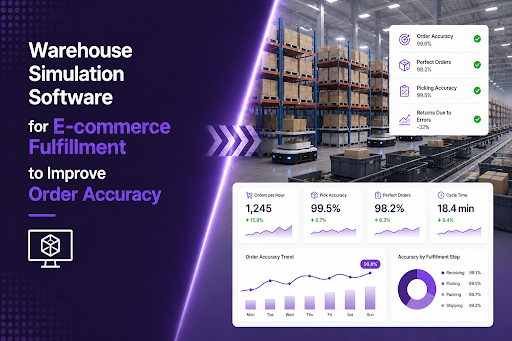
In this blog, we explore how we can use warehouse simulation software for e-commerce fulfillment to improve order accuracy, uncover hidden logic failures, and reduce error propagation.
Why Order Accuracy Problems in E-commerce Are Often Misdiagnosed
When fulfillment accuracy degrades, the immediate response is typically retraining pickers or adding inspection checkpoints. This diagnostic shortcut overlooks a fundamental reality: most errors are encoded into process design before the first pick is executed.
Traditional forecasting and static inventory policies fail to adapt to market volatility, creating hidden accuracy risks that manifest as order errors only after deployment.
The latency between cause and effect (like a slotting decision made three months ago triggering an error today) makes root-cause identification nearly impossible without simulation-based decomposition.
Suggested Read: Warehouse Simulation Software for 3pl Logistics to Optimize Throughput
Why Fulfillment Errors Often Stem From Process Design Rather Than Picker Mistakes
Picker error rates are remarkably stable across experience levels when process logic is coherent. What operators perceive as human error is typically a workflow failure: ambiguous bin labeling, illogical pick sequences, or exception logic that forces pickers into unverified decisions.
E-commerce warehouse simulation software for order picking optimization reveals this distinction by modeling picker behavior as a function of interface design and decision complexity, not attention span. When the same error pattern appears across multiple shifts and teams, the cause is structural. This pattern is consistently reflected in empirical research:
- ~6% picking error rate observed in real warehouse studies, highlighting non-trivial baseline inaccuracies.
- Up to 8.8% error rates were recorded prior to process redesign, showing how poorly structured workflows amplify errors.
- Human-system interaction failures are identified as a primary source of picking errors, rather than isolated human mistakes.
How Inventory and Order Logic Misalignment Creates Accuracy Failures
Order accuracy depends on three aligned states: inventory record accuracy, slot-level location fidelity, and pick instruction clarity. Misalignment between these layers compounds nonlinearly.
A single inventory misallocation can trigger substitution errors across dozens of orders, while slotting logic that ignores order affinity forces pickers into fragmented travel paths that increase cognitive load and error probability.
Research on simulation-based order picking optimization confirms that picking method selection, batch, zone, or wave, directly impacts processing time and error incidence, yet most facilities select these parameters statically.
Why Traditional Accuracy Improvements Often Miss Root Causes
The most common accuracy interventions are double-checking, scale verification, barcode scanning, treating symptoms, and not system dynamics. They add inspection points without addressing why the error was generated. By the time an order reaches quality control, the upstream failures remain active, generating new errors for every one they catch.
Why Conventional Fulfillment Models Struggle to Prevent Error Propagation
Static fulfillment models assume stable conditions: predictable order profiles, consistent inventory positions, and reliable picker behavior. E-commerce volatility invalidates each assumption within hours.
How Process Variability Amplifies Accuracy Drift
Process variability – in order composition, staffing levels, or inventory availability – creates conditions where standard operating procedures no longer fit the actual task. When pick density drops due to order fragmentation, pickers compensate by deviating from prescribed paths.
These deviations are rational responses to inefficient design, but each deviation introduces unvalidated decisions that increase error probability. Over a shift, accuracy drift follows the same nonlinear trajectory as queue amplification. This is not an isolated effect, as this variability is structurally embedded in how most warehouses are designed and operated:
- Order picking alone accounts for over 50% of total warehouse operating costs, making inefficiencies disproportionately expensive.
- Most optimization models fail to capture real-world complexity, often ignoring workload imbalance, item variability, and picker differences.
- Workload imbalance becomes critical under high order volumes, directly impacting consistency and increasing error risk.
- Differences in picker capacity, item characteristics, and equipment create planning gaps, forcing deviations from optimal workflows.
- Many systems assume stable demand and fixed conditions, limiting their ability to adapt to real-time operational variability.
Why Static Operational Logic Fails Under E-commerce Volatility
Most WMS deployments use deterministic logic: if SKU A is in bin B, pick from bin B. This breaks when demand shifts, inventory repositions, or order profiles change. Static logic has no adaptive mechanism.
Without dynamic reconfiguration, the system continues executing against outdated assumptions, generating errors that no inspection layer can fully intercept. This represents a class of operational logic failure that simulation-based scenario testing identifies before deployment.
Suggested Read: Warehouse Simulation Software for Layout Planning to Improve Picking Speed
How Error Conditions Cascade Across Fulfillment Stages
An error rarely remains contained. A pick error triggers packing exceptions, which consume sorter capacity, which delays downstream order waves. The cascade effect transforms a localized accuracy failure into a system-wide throughput constraint. This dependency misalignment is invisible to standard KPI dashboards that report accuracy and throughput as separate metrics.
Scenario Modeling as a Diagnostic Layer for Fulfillment Error Risk
Scenario modeling using warehouse modeling software for e-commerce operations transforms fulfillment error management from reactive inspection to pre-execution validation. By simulating thousands of operational variations before physical deployment, operators can identify which policy configurations generate error conditions.
How Scenario Testing Exposes Failure Conditions Before Execution
A well-constructed simulation environment tests not just the happy path but the boundary conditions: extreme order profiles, simultaneous exception events, or resource constraints. Digital twin implementations using warehouse simulation software like Synkrato for e-commerce fulfillment to improve order accuracy and reduce implementation risk by exposing failure modes before commissioning.
For accuracy, this means identifying which order types, pick sequences, or inventory states trigger error conditions. Synkrato functions as this simulation-driven intelligence layer, modeling decision logic and operational variability to surface accuracy risks before execution.
Evaluating Operational Assumptions Behind Accuracy Decisions
Every accuracy strategy embeds assumptions: that pickers will follow the sequence, that inventory records match physical locations, and that exception handling will be consistent.
- Pick sequence adherence often breaks under real-time pressure or routing inefficiencies
- Inventory records frequently drift from physical reality due to delays, misplacements, or updates lagging behind
- Exception handling varies across shifts, creating inconsistent decision outcomes
- Assumptions hold in theory but fail under variability in demand, labor, and inventory states
E-commerce warehouse simulation software to improve order accuracy validates these assumptions by modeling variance. When an assumed condition fails in simulation, operators can redesign decision logic before the failure occurs in production. It falsifies bad assumptions at zero operational risk.
Risks Revealed Through Simulation Beyond Traditional Visibility
Traditional visibility tools show what happened. Simulation reveals what could happen under conditions that have not yet occurred. For accuracy risk, this forward-looking visibility identifies error propagation paths before they manifest.
The ability to simulate cascading exception events across fulfillment stages is unavailable to any static analytics tool. But Synkrato’s simulation and optimization solution operates as this forward-looking intelligence layer, modeling interdependent workflows to uncover how errors propagate before they impact live operations.
Decision Structures Governing Accuracy and Stability in Fulfillment Systems
Accuracy stability is not a function of inspection rigor but of decision logic coherence. The resource allocation rules, exception flow logic, and control variables that govern fulfillment operations determine the system’s inherent error rate.
Resource Allocation Effects on Accuracy Performance
How labor is allocated across picking, packing, and exception handling directly shapes accuracy outcomes.
- Under-allocation to exception handling leads to queue buildup and rushed decisions
- Over-allocation to inspection results in higher costs without reducing error generation
- Uneven labor distribution causes workflow inconsistency and elevated error risk
- Static allocation limits the ability to respond to demand and process variability
Fulfillment center simulation software for reducing errors identifies the optimal allocation balance, minimizing total error cost while maintaining throughput.
Suggested Read: Warehouse Simulation Software for Capacity Planning to Reduce Congestion
Exception Flow Logic Influencing Fulfillment Reliability
Exception handling, the logic guiding what happens when a pick fails, an item is missing, or a scan mismatches, is the most accuracy-critical and most neglected decision layer. Poor exception logic forces pickers into unstructured decisions, each carrying elevated error risk.
Well-designed exception flows route anomalies to controlled resolution paths. Simulation tests exception logic under realistic frequency distributions, revealing which exception types need redesigned handling.
Control Variables Shaping Long-Term Accuracy and Stability
The control variables, minimum pick thresholds, wave release timing, and replenishment triggers operate as a control system for accuracy. When these variables are set without dynamic testing, the system drifts toward instability.
This is where Synkrato’s simulation intelligence replaces static parameter guessing with dynamic validation before drift occurs. Synkrato tests your control variable decisions against the volatility they must survive.
Threshold Conditions That Signal the Need for Structural Accuracy Redesign
Incremental optimization eventually reaches diminishing returns. Recognizing the threshold where marginal improvements cease, and structural redesign becomes necessary distinguishes high-performing fulfillment organizations.
Indicators That Incremental Optimization Has Reached Its Limits
When additional inspection points no longer reduce error rates, when retraining produces no measurable improvement, and when exception volume remains stable despite process standardization, the system has reached the performance ceiling of its current design. Further improvement requires structural changes to decision logic, slotting architecture, or workflow sequencing.
Research shows that beyond a certain complexity threshold, static systems fail, while reinforcement learning delivers ~15-25% cost reductions and up to ~22% lower processing costs.
Conditions Where Simulation Becomes Operationally Necessary
Simulation becomes essential when operational complexity, demand variability, and strict accuracy requirements converge. At this scale, traditional trial-and-error approaches break down, as real-world testing cannot capture the full range of possible scenarios or interactions within the system.
- High SKU count increases combinatorial complexity
- Order volatility creates unstable operating conditions
- Tight accuracy targets leave minimal margin for error
- Physical pilots limit scenario coverage
- Decision space becomes too large for trial-and-error testing
Only simulation can explore this space comprehensively, making it a core planning capability for fulfillment operations at scale.
Suggested Read: The Theory of Constraints in Warehousing and How Synkrato Solves Bottlenecks
Requirements Supporting Sustainable Accuracy Improvement
Sustainable accuracy improvement requires closed-loop governance: measurement of error generation, diagnosis of structural cause, redesign of decision logic, and revalidation through simulation.
Without this loop, accuracy gains decay as operating conditions shift. Order accuracy improvement through warehouse simulation functions as the testing environment that enables continuous redesign without operational disruption.
Synkrato – From Insight to Simulation-Driven Accuracy
While static analytics report past errors, Synkrato’s simulation engine models your slotting logic, exception flows, and wave release rules to expose where accuracy failures will generate, before they reach pack stations.
- Digital Twin Visibility: Synkrato builds a real-time warehouse digital twin to visualize operations, detect bottlenecks, and test changes before implementation.
- AI-Based Slotting Optimization: It dynamically optimizes SKU placement based on demand, velocity, and order patterns to reduce travel time and improve throughput.
- Scenario Simulation: Teams can simulate layout, labor, and workflow changes in a virtual environment before applying them in real operations.
- Predictive Decision Intelligence: AI agents analyze historical and real-time data to recommend continuous improvements in flow, labor, and efficiency.
Ready to validate operational decisions without throughput risk? Book a demo with Synkrato now.
FAQs
How can simulation expose hidden interactions between fulfillment policies and order error rates?
Simulation models the full decision chain from order release to final packing, capturing how policy choices at each stage influence error probability at subsequent stages. For example, wave release timing affects pick density, which influences picker path adherence, which impacts verification effectiveness. These second-order interactions are invisible to static analysis but directly measurable in simulation.
Why do order accuracy issues often persist even after warehouse process standardization efforts?
Standardization fixes execution variance but does not address design logic errors embedded in the standardized process. If the standard process contains flawed decision rules – ambiguous exception handling, illogical pick sequences, misaligned slotting – standardization simply makes those flaws repeatable.
How can simulation help evaluate tradeoffs between fulfillment speed and order accuracy?
Speed-accuracy tradeoffs are nonlinear. Simulation quantifies the actual shape of this tradeoff under specific operating conditions, enabling evidence-based decision-making rather than guesswork. Synkrato delivers by modeling real-world variability to help operators optimize both speed and accuracy with confidence.
What role does stochastic variability play in modeling accuracy risks within e-commerce operations?
Stochastic variability creates the conditions where deterministic rules fail. Simulation incorporates realistic variability distributions to test whether accuracy controls remain stable under expected variance or collapse under stress. Synkrato’s simulation engine models variability across wave releases, exception paths, and slotting to identify assumptions driving error risk.
How can digital experimentation reveal failure conditions that traditional root-cause analysis may overlook?
Traditional root-cause analysis works backward from observed errors. Simulation works forward from decision logic to identify potential failure conditions, even those not yet observed. Synkrato enables this forward-looking analysis by simulating real-world variability across workflows, resource allocation, and exception scenarios.
How does simulation support the evaluation of exception-handling logic?
Simulation generates realistic exception scenarios, allowing operators to test whether exception flows resolve issues or create new risks. Synkrato models your actual exception logic to reveal which failure paths are design-driven, not picker-driven. This enables targeted redesign of exception handling before issues scale in production.
Can simulation quantify the downstream impact of small accuracy deviations?
Yes. Even low mispick rates can amplify into high operational costs. Simulation tracks this amplification over time. Synkrato quantifies this impact by modeling how small errors propagate across picking, packing, and downstream workflows. It translates minor accuracy deviations into measurable cost, delay, and throughput impact before they occur in live operations.
How can simulation improve confidence before process changes?
Simulation replaces intuition with quantified prediction, enabling operators to validate changes before implementation. It allows testing across multiple scenarios, including edge cases that are difficult to replicate in real operations. This reduces implementation risk by revealing potential failures and performance tradeoffs before deployment.