According to the 2025 MHI Annual Industry Report, supply chain leaders are rapidly increasing investments in orchestration technologies, predictive analytics, and AI-driven operational systems as operational complexity and workforce pressures continue to intensify.
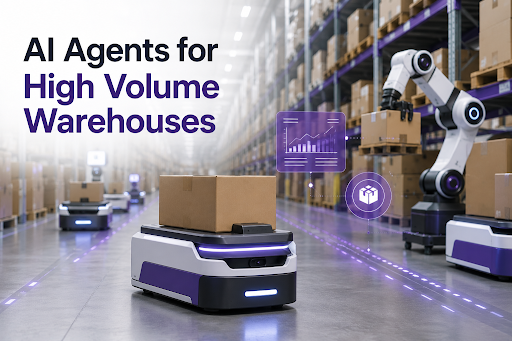
AI agents are changing this model by continuously evaluating operational conditions, identifying emerging constraints, and adapting execution decisions in real time. Instead of reacting after inefficiencies appear, AI agents help warehouses stabilize throughput, improve resource utilization, and reduce systemic operational waste across high-volume environments.
This blog explores how AI agents improve warehouse efficiency in high-volume operations by optimizing execution decisions across picking, replenishment, labor allocation, slotting, and workflow orchestration.
Why Traditional Efficiency Optimization Often Leaves Structural Waste Unresolved
In high-volume fulfillment environments, efficiency losses rarely come from a single failure point. Most emerge from coordination gaps between replenishment, picking, labor allocation, and staging workflows. As throughput pressure rises, small execution delays compound across connected processes, reducing throughput stability and increasing congestion across the warehouse network.
How Process Interdependencies Create Hidden Efficiency Losses
Warehouse workflows operate as interdependent execution layers, where delays in one process quickly disrupt adjacent workflows. A replenishment lag can stall active picking zones, while aisle congestion may simultaneously reduce packing throughput and dock flow.
According to the MHI Annual Industry Report, operational orchestration is becoming critical as fulfillment complexity and throughput variability continue increasing. AI agents for warehouse productivity optimization help reduce this coordination friction through real-time workflow balancing.
Suggested Read: AI Agents for 3pl Logistics to Optimize Fulfillment Accuracy
Why Resource Contention Distorts Flow Performance
High-volume warehouses continuously compete for shared resources such as labor, dock space, forklifts, and automation assets. Static operating rules often fail to rebalance these resources dynamically during demand spikes, creating localized bottlenecks and uneven throughput.
Synkrato’s AI Agents in high-volume warehouses continuously adjust task allocation and workflow prioritization using live execution conditions instead of fixed thresholds.
How Execution Friction Propagates Across High-Volume Operations
High-throughput operations run with minimal buffer capacity, so even small execution delays can rapidly affect downstream workflows. Delayed picks disrupt dock staging, inventory mismatches increase exception handling, and replenishment gaps create forward-pick stockout risk.
According to Deloitte Supply Chain Research, organizations increasingly rely on AI-driven operational intelligence to improve execution agility and maintain throughput stability under growing warehouse complexity.
Adaptive Control Responses That Shape Efficiency Outcomes
Operational visibility alone does not improve warehouse performance. The real differentiator is how quickly execution systems respond once congestion, labor imbalance, or replenishment delays begin affecting flow stability. In high-volume facilities, static rules often fail because warehouse conditions change continuously throughout the day.
AI agents for real-time warehouse efficiency improvement help operations adapt execution logic dynamically instead of reacting after throughput degradation occurs.
Suggested Read: AI Agents for Ecommerce Warehouses to Improve Operational Decision-making
Dynamic Response Logic Affecting Resource Utilization
Modern orchestration systems continuously adjust execution priorities based on live warehouse conditions rather than fixed operating rules. As congestion, labor imbalance, or replenishment pressure builds, AI agents for workflow automation in high-volume warehouses dynamically rebalance workflows to protect throughput stability and resource efficiency.
Common adaptive responses include:
- Re-sequencing wave releases to prevent pick-zone congestion
- Redirecting labor toward overloaded fulfillment areas
- Delaying lower-priority replenishment during peak pick windows
- Adjusting pick paths based on live aisle traffic density
- Reallocating automation assets to high-throughput workflows
Control Adjustments Influencing Throughput Stability
Throughput instability often emerges when overlapping workflows compete for the same operational capacity simultaneously. Aggressive wave releases can overwhelm pick zones, replenishment surges may interrupt active fulfillment activity, and uneven labor distribution can create downstream bottlenecks across staging and packing operations.
AI agents continuously moderate workflow intensity using live execution feedback instead of relying on fixed operating thresholds.
Suggested Read: AI Agents for Real-time Inventory Management to Improve Accuracy
Continuous Optimization Effects on Operational Efficiency
Traditional warehouse optimization often relies on periodic reviews:
- Weekly labor planning,
- Monthly slotting adjustments,
- Quarterly process redesigns.
Continuous orchestration allows warehouse operations to respond faster as conditions change throughout the day. Over time, this helps reduce operational lag, improve execution consistency, and minimize the accumulation of small inefficiencies that gradually affect throughput performance.
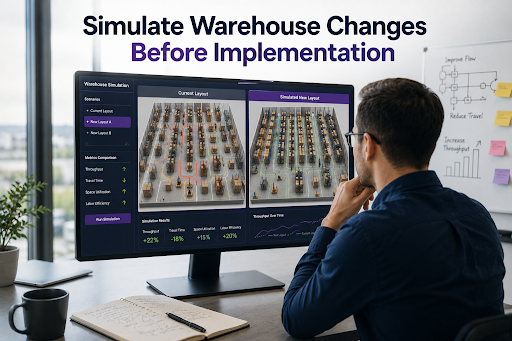
Synkrato’s Simulation & Optimization helps warehouses model workflow conditions, evaluate operational constraints, and optimize execution strategies before congestion propagates across the facility.
As warehouse operations scale, inefficiencies increasingly emerge from coordination gaps across labor, replenishment, inventory movement, and warehouse automation workflows rather than from isolated process failures. Many facilities continue adding labor or automation capacity, yet still experience throughput instability because static execution systems cannot adapt fast enough to changing operational conditions.
Indicators That Existing Optimization Logic Has Reached Limits
Operational friction usually becomes visible before throughput failure appears on KPI dashboards. Common indicators include:
- Rising congestion despite stable order volumes
- Declining picks-per-hour as SKU complexity grows
- Labor costs increasing faster than throughput
- Higher exception handling during peak cycles
- Throughput instability across interconnected workflows
Conditions Requiring Agent-Led Efficiency Control
AI agents for high-volume warehouses to improve efficiency become increasingly important in environments with dense automation, multi-channel fulfillment, large SKU catalogs, and continuous throughput variability.
Instead of relying on static workflows, intelligent agents to improve warehouse efficiency continuously rebalance labor, replenishment, wave priorities, and automation utilization using live operational conditions.
Suggested Read: AI Agents for Operational Scenario Analysis to Optimize Workflows
Factors Supporting Sustainable High-Volume Performance Gains
Long-term efficiency gains depend on coordinated execution infrastructure, not automation alone.
| Operational Foundation | Strategic Impact |
| Real-time operational visibility | Faster disruption response |
| Cross-system orchestration | Better workflow coordination |
| Adaptive execution control | Stable throughput under variability |
| Reliable execution data | Higher-quality operational decisions |
| Simulation-driven optimization | Lower-risk workflow optimization |
Conclusion
As fulfillment environments become more interconnected, warehouse efficiency is increasingly determined by how quickly operations can adapt to changing execution conditions, not by how many isolated optimizations are deployed. AI agents for high volume warehouses to improve efficiency help organizations stabilize throughput, reduce coordination friction, and improve decision responsiveness across labor, inventory, replenishment, and automation workflows in real time.
Ready to improve fulfillment efficiency at scale? Schedule a demo with Synkrato to see how AI-driven orchestration helps optimize warehouse execution in real time.
FAQs
How can AI agents reveal hidden tradeoffs between throughput targets and operational efficiency performance?
In high-volume environments, one operational decision can quickly affect multiple workflows. For example, prioritizing a large outbound wave may improve shipping speed while increasing congestion in active pick zones. Synkrato’s AI Agents help evaluate these downstream effects in real time.
Why do efficiency losses often persist even after continuous process improvement initiatives?
Many warehouse inefficiencies are caused by coordination gaps between connected workflows rather than one isolated process problem. Even after improving picking, replenishment, or labor planning individually, operational friction can remain across the broader execution flow.
How can AI agents evaluate the downstream impact of prioritization decisions on warehouse flow efficiency?
In high-volume environments, one operational decision can quickly affect multiple workflows. For example, prioritizing a large outbound wave may improve shipping speed while increasing congestion in active pick zones. AI agents help evaluate these downstream effects before operational slowdowns spread across the facility.
What role does execution variability play in long-term efficiency instability within high-volume operations?
Warehouse conditions change continuously throughout the day. Variability in labor availability, replenishment timing, order volume, and congestion levels can gradually reduce throughput consistency if workflows are not coordinated effectively. Over time, these small disruptions accumulate and affect overall operational stability. Synkrato’s Simulation & Optimization allows operations teams to model execution tradeoffs and test workflow decisions before deploying them live.
How can AI agents assess whether policy-level operating decisions may introduce systemic performance drag?
AI agents continuously monitor how scheduling rules, replenishment policies, labor allocation strategies, and workflow priorities affect operational performance over time. This helps identify operating policies that may unintentionally increase congestion, idle time, or execution delays across the warehouse.
What role does execution variability play in long-term efficiency instability within high-volume operations?
In high-volume warehouses, even small operational delays can create larger downstream disruptions because workflows are closely interconnected. Variability in replenishment timing, labor availability, congestion levels, or order volume can gradually reduce throughput consistency and create instability across picking, staging, and fulfillment operations.
Over time, these small disruptions compound, making it harder to maintain predictable warehouse performance during peak demand periods.
Can AI agents quantify the cumulative effect of small execution deviations on overall warehouse efficiency?
Yes. AI-driven orchestration systems can track how repeated small delays affect labor productivity, travel time, throughput consistency, and fulfillment performance across the operation. This makes it easier to identify patterns that may not be visible through standard warehouse reporting alone. Additionally, Synkrato’s Digital Twin supports continuous operational analysis by simulating workflow interactions and evaluating execution impact across connected warehouse processes.
How does agent-driven analysis support validation of alternative efficiency strategies before live deployment?
AI-based simulation and predictive analysis allow warehouse teams to evaluate operational changes before applying them live. This helps reduce implementation risk by identifying possible bottlenecks, congestion points, or workflow disruptions in advance.
What factors determine whether AI agent outputs are reliable enough for enterprise efficiency decisions?
Reliable AI-driven decision-making depends on several factors, including accurate real-time data, strong system integration, well-calibrated operational models, and ongoing performance monitoring. The better the operational visibility and data quality, the more dependable warehouse orchestration decisions become.