Fulfillment centers face constant volatility as order spikes, labor shifts, and delivery pressure overwhelm traditional rule-based systems. Rising travel distances and zone imbalances reduce throughput and compress margins across omnichannel operations.
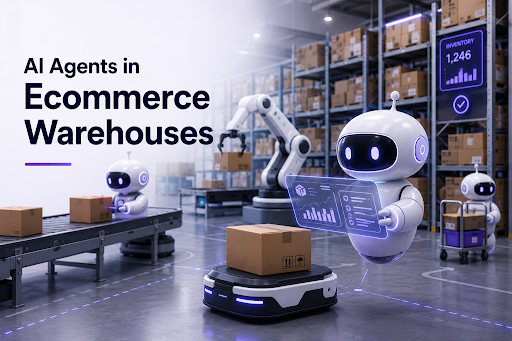
But AI agents for e-commerce warehouses are replacing rigid execution models with adaptive, self-correcting operational intelligence to help improve operational decision-making.
In this blog, we examine the failure points of traditional execution systems, explore the reasoning layers behind autonomous agent networks, and show how supply chain leaders optimize throughput stability.
Why Operational Decisions in E-commerce Often Break Down Under Volatility
Operational decisions in e-commerce warehouses often fail under volatility because traditional systems rely on manual intervention and static workflows. Sudden demand spikes and high exception volumes overwhelm rule-based processes, slowing order cycles, reducing throughput, and increasing fulfillment costs.
McKinsey Global Institute reports that supply chain disruptions can erase 40-45% of one year’s profits over a decade, highlighting the financial impact of operational instability.
How Demand Variability Distorts Decision Quality
Unpredictable order spikes disrupt warehouse workflows and overwhelm pre-scheduled picking plans. When intraday demand rises sharply, static systems cannot dynamically adjust picker routes or labor allocation, creating operational inefficiencies across fulfillment zones.
- Limited inventory visibility creates replenishment delays and stock mismatches
- Poor picking accuracy increases fulfillment errors during demand spikes
- Inefficient pick routing raises travel distance and labor inefficiencies
- Slow replenishment workflows disrupt high-velocity order processing
- Weak inventory monitoring reduces stock accuracy across warehouse zones
- Traditional WMS limitations reduce productivity and operational efficiency under volatility
Why Exception Density Weakens Execution Consistency
High error rates in stock counts, damaged items, and missing inventory items create a complex web of workflow exceptions. A 2026 warehouse simulation study found that operator travel accounts for nearly 50% of total order-picking time, while order picking itself represents 60-70% of overall warehousing costs. The study also showed that free-navigation warehouse layouts increased congestion rates to 66.27%, severely impacting operational efficiency.
How Decision Delays Amplify Operational Instability
When supervisors take hours to spot an aisle congestion bottleneck, dock delays quickly compound across the facility. This management latency increases total order cycle times and causes immediate carrier service level agreement (SLA) failures. Waiting for batch updates instead of acting on real-time operational signals prevents facilities from scaling up throughput.
Suggested Read: AI Agents for High Volume Warehouses to Improve Efficiency
Why Conventional Decision Models Struggle in Dynamic Warehouse Environments
Traditional warehouse systems rely on static rules and batch-based calculations that cannot adapt to real-time shifts in order volume, labor availability, or fulfillment priorities. In high-velocity environments, this creates congestion, delayed workflows, and growing dependence on manual intervention.
Common failure points include:
- Fixed picking logic that breaks under demand spikes
- Static labor allocation that limits workforce flexibility
- Delayed workflow adjustments that slow fulfillment speed
- Limited real-time responsiveness across warehouse zones
Conventional models also underestimate operational dependencies. A receiving delay can disrupt replenishment, picking, packing, and outbound dispatch simultaneously, yet rule-based systems often treat each workflow independently. As a result, most responses address symptoms instead of root causes.
For example, adding labor to a congested picking zone may temporarily increase capacity but often worsens aisle density, travel inefficiency, and throughput instability if slotting and batching logic remain unchanged.
Synkrato’s Enterprise Mobility helps reduce execution delays by connecting warehouse tasks, labor movement, inventory updates, and workflow decisions in real time across dynamic fulfillment environments.
Decision Intelligence Layers Built on AI Agent Reasoning
AI agents for operational decision making in warehouses use real-time reasoning to improve execution accuracy, workflow coordination, and operational responsiveness. These multi-agent systems analyze continuous warehouse data, simulate operational scenarios, evaluate trade-offs, and automate complex fulfillment decisions without constant manual intervention.
Context-Aware Decision Analysis Across Warehouse Conditions
Intelligent agents for warehouse decision automation continuously parse live feeds from cameras, scanners, and inventory systems to build a complete digital model of the facility. The system identifies aisle congestion and pick-face depletion before throughput declines. By evaluating live warehouse conditions, the reasoning engine shifts picking tasks to open lanes and maintain throughput stability.
Priority Logic Influencing Response Quality
Unlike rigid WMS platforms, autonomous systems use advanced priority logic to balance shipping deadlines, operational efficiency, and labor costs in real time.
- Dynamic Order Prioritization: Adjusts picking priorities based on SLA urgency and warehouse conditions
- Cost Impact Analysis: Evaluates labor and congestion costs before changing workflows
- Real-Time Workflow Balancing: Prevents overloaded picking zones during demand spikes
- Carrier Penalty Prevention: Reduces late shipment risks through predictive decision-making.
- Adaptive Resource Allocation: Optimizes labor distribution across warehouse zones
Decision Path Evaluation Beyond Traditional Visibility
Autonomous systems track multi-tier operational data to predict how decisions will impact downstream warehouse workflows before execution. This:
- Simulates packing and shipping workloads before releasing picking waves
- Detects workflow bottlenecks before throughput declines
- Evaluates the downstream impact of operational changes
- Supports faster and more accurate fulfillment decisions
Feedback Mechanisms that Improve Decision Performance over Time
Modern AI agents to improve warehouse operational decisions use closed feedback loops to learn from every workflow exception and system adjustment. This adaptive learning model ensures the warehouse software grows more accurate, resilient, and responsive the longer it runs.
Suggested Read: AI Agents for 3pl Logistics to Optimize Fulfillment Accuracy
Adaptive Learning Effects on Operational Responsiveness
Every time an agent reroutes a picker or triggers a replenishment order, it logs the resulting change in throughput. Research published in 2025 showed that reinforcement learning frameworks reduced warehouse processing times by up to 60% compared to traditional operational methods, improving real-time warehouse responsiveness and task optimization.
Continuous Signal Interpretation Supporting Better Decisions
By tracking inventory movements, picker speeds, and equipment performance, the system converts operational data into actionable warehouse decisions. Gartner predicts that by 2031, 60% of supply chain disruptions will be resolved without human intervention as AI-enabled autonomous systems improve real-time operational decision-making and execution responsiveness.
| Operational Signal | Decision Impact |
| Inventory movement data | Improves replenishment timing |
| Picker performance tracking | Optimizes labor allocation |
| Equipment utilization metrics | Reduces workflow delays |
| Real-time operational insights | Supports faster decision-making |
Response Refinement Logic Improving Execution Stability
As the software processes thousands of daily workflow exceptions, its optimization models continuously adapt to the facility’s operational patterns and constraints. The system refines batching, slotting, and workflow recommendations over time, improving long-term execution stability and cost predictability.
- Continuously improves order batching accuracy
- Refines slotting strategies based on workflow patterns
- Reduces recurring operational friction points
- Helps maintain predictable labor costs over time
Synkrato’s AI Agents support this adaptive execution model by continuously learning from operational patterns and optimizing warehouse decisions in real time.
Threshold Conditions Signaling the Need for Agent-Led Decision Support
Understanding how AI agents improve e-commerce warehouse decision-making helps logistics leaders identify when traditional rule-based systems can no longer manage operational complexity effectively.
Indicators That Existing Decision Models Have Reached Limits
Facilities often recognize system limitations when supervisors constantly override wave plans. When travel distance per order climbs by more than 20% during peak seasons, static slotting rules can no longer support catalog growth. These structural system blind spots lead to missed shipping windows, high employee turnover, and rising fulfillment costs.
Suggested Read: AI Agents for Real-time Inventory Management to Improve Accuracy
Conditions Requiring AI-Driven Decision Augmentation
Warehouses require autonomous AI agents for warehouse workflow optimization when managing complex fulfillment environments with volatile demand, dynamic inventory movement, and changing labor conditions.
- Multi-zone picking workflows with high travel complexity
- Rapidly changing product assortments and inventory movement
- Fluctuating labor availability across warehouse shifts
- Large SKU catalogs with volatile order patterns
- Increasing pressure on picking speed and space utilization
- Rising workflow dependencies between warehouse zones
Factors Supporting Sustainable Decision Quality Improvement
Building a reliable, automated warehouse requires clean enterprise data, integrated workflows, and a flexible execution platform. Synkrato’s Simulation & Optimization platform integrates directly into existing WMS and ERP systems, transforming fragmented operational data into structured, real-time execution intelligence.
A 2026 McKinsey supply chain analysis found that companies using dynamic capacity optimization increased shipments by 8-20%, reduced expedited-service costs by 30–50%, and improved inventory turns by 15-20% through better operational visibility and network coordination.
- Live WMS/ERP feeds: Stream real-time inventory, labor, order, and warehouse data to improve visibility and operational decision-making.
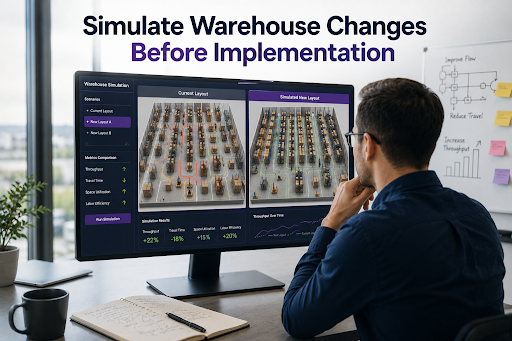
- Digital Twin Technology: Builds a live simulation environment for testing workflows, constraints, and fulfillment scenarios before execution changes are deployed.
- Autonomous Multi-Agent Brain: Uses AI-driven decisioning to optimize picking, replenishment, labor allocation, and warehouse workflow coordination.
- Continuous intelligence loop: Continuously analyzes execution data and operational feedback to improve adaptability and long-term execution stability.
- Optimized pick paths: Dynamically adjusts routing and task execution to reduce travel time and improve throughput efficiency.
Revolutionize Your Logistics Engine & Elevate Your Operational Intelligence with Synkrato
Standard warehouse software cannot handle the speed, volatility, and complexity of modern omnichannel fulfillment operations. Rigid workflows, manual interventions, and delayed batch processing increase costs, create bottlenecks, and reduce execution efficiency. Synkrato’s Enterprise Mobility platform improves operational coordination through real-time workflow visibility and adaptive execution management.
Suggested Read: AI Agents for Operational Scenario Analysis to Optimize Workflows
Synkrato’s AI Slotting Recommendations platform integrates with existing WMS and ERP systems to deliver predictive optimization, intelligent workflow orchestration, and self-correcting execution intelligence. Its real-time decision engine helps fulfillment teams scale efficiently under changing demand conditions. Book a demo now.
FAQs
How can AI agents reveal hidden tradeoffs between service-level priorities and operational decision quality?
Autonomous systems run real-time simulations to measure how rush orders impact picking efficiency, aisle congestion, and labor productivity. Unlike standard WMS platforms, intelligent agents for warehouse decision automation evaluate operational trade-offs before prioritizing shipments. Synkrato helps supply chain leaders balance delivery performance, warehouse efficiency, and fulfillment costs with data-driven decision support.
Why do poor warehouse decisions often persist even after process standardization and rule-based controls?
Static warehouse rules cannot adapt to rapidly changing operational conditions like sudden order spikes or inventory inaccuracies. Rule-based systems manage routine tasks but fail to resolve real-time workflow imbalances, forcing supervisors to rely on manual fixes that increase operational friction. Synkrato replaces rigid controls with adaptive, continuously updated decision intelligence.
How can AI agents evaluate the downstream impact of prioritization decisions on execution consistency?
Intelligent agents for warehouse decision automation use predictive simulations to measure how picking priorities affect downstream packing and shipping workflows. By analyzing workflow dependencies in advance, the system prevents bottlenecks, dock congestion, and throughput instability. Synkrato validates operational adjustments before execution to maintain smooth product flow.
What role does operational uncertainty play in long-term decision instability within e-commerce warehouses?
Volatile order patterns, catalog changes, and fluctuating labor availability create continuous operational instability in e-commerce warehouses. Legacy batch-processing systems cannot respond fast enough to real-time disruptions, leading to manual overrides, inaccurate labor planning, and rising costs. Synkrato stabilizes workflows through continuous real-time operational analysis.
How can AI agents assess whether policy-driven decisions may introduce systemic execution risk?
Autonomous AI agents for warehouse workflow optimization test operational policy changes inside a digital twin environment before applying them to live workflows. The system simulates demand patterns, replenishment changes, and slotting adjustments to identify bottlenecks or execution risks early, preventing costly operational disruptions.
Can AI agents quantify the cumulative effect of small decision deviations on overall warehouse performance?
Yes, AI agents to improve warehouse operational decisions track minor delays, path deviations, and replenishment inefficiencies that traditional reporting systems often miss. While individual delays appear small, accumulated workflow friction can significantly reduce throughput. The system helps operators identify hidden productivity losses.
How does agent-driven analysis support validation of alternative operational decisions before live execution?
AI agents for operational decision making in warehouses use digital twin simulations to compare multiple operational strategies before deployment. The system evaluates labor allocation, picking efficiency, replenishment timing, and shipping performance simultaneously, allowing managers to choose the most efficient and cost-effective workflow confidently.
What factors determine whether AI agent outputs are reliable enough for enterprise decision-making?
Reliable AI agent outputs depend on accurate real-time data, integrated workflow visibility, and continuous validation against live warehouse conditions. Synkrato strengthens enterprise decision reliability by combining predictive simulation, adaptive execution intelligence, and integrated WMS and ERP connectivity. This helps fulfillment teams make faster and more consistent operational decisions under changing demand conditions.