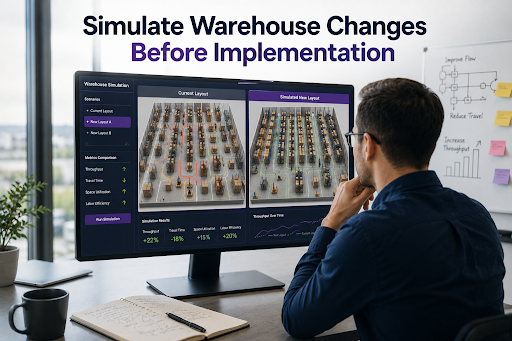
Simulating warehouse changes before implementation allows organizations to evaluate how layout modifications, inventory repositioning, labor adjustments, and process changes will affect throughput, capacity, and warehouse flow before disrupting live operations. Instead of relying on assumptions, teams can validate operational decisions in a virtual environment and identify bottlenecks, resource constraints, and unintended downstream impacts before deployment.
In this blog, we cover why simulation is essential, which warehouse changes carry the greatest risk, and how validating decisions before deployment supports better warehouse performance.
Why Warehouse Changes Often Fail After Implementation
Warehouse changes often fail after implementation because warehouse processes operate as an interconnected system. A change that improves one workflow can unintentionally create constraints elsewhere, causing actual operational outcomes to differ from expectations.
Understanding these dependencies before implementation is essential for reducing operational risk and making more predictable warehouse decisions.
A typical warehouse process follows these steps:
- Receiving
- Putaway
- Storage
- Replenishment
- Picking
- Packing
- Shipping
Why Operational Dependencies Are Difficult to Predict
Operational dependencies are difficult to predict because warehouse processes share labor, equipment, inventory, and storage resources. A change in one workflow can quickly affect several others.
For example, increasing receiving capacity without expanding putaway resources can create staging congestion that slows downstream operations. As these interactions span multiple workflows, they are difficult to identify using departmental reports or isolated KPIs alone.
How Small Process Changes Create Unintended System-Wide Effects
Small warehouse process changes create unintended system-wide effects because every workflow is connected. Improving one process without evaluating the entire operation can shift bottlenecks instead of eliminating them.
Common examples include:
- Adding more pickers may improve picking speed, but replenishment may not keep pace, leading to stock shortages at pick faces.
- Relocating fast-moving SKUs can reduce travel distance while increasing forklift traffic and aisle congestion.
- Increasing receiving speed without additional putaway capacity can simply move the bottleneck downstream.
Warehouse simulation helps organizations evaluate these trade-offs across the complete warehouse workflow before implementation, reducing the risk of unintended operational disruptions.
Why Live Testing Introduces Operational and Financial Risk
Testing changes in a live warehouse exposes customer operations to unnecessary disruptions. Warehouse change management simulation provides a safer way to validate decisions before deployment.
| Live Testing | Warehouse Simulation |
| Affects active customer orders | No disruption to live operations |
| Issues are discovered during execution | Risks are identified before implementation |
| May require a costly operational rollback | Multiple scenarios can be evaluated safely |
| Temporary productivity losses | Operational performance remains stable |
Synkrato’s enterprise mobility enables organizations to warehouse process validation before implementation, virtually before introducing them into live operations.
Types of Warehouse Decisions That Carry the Highest Implementation Risk
Warehouse decisions involving layout, labor, and inventory carry the highest implementation risk because they affect multiple interconnected warehouse processes. Even localized changes can influence material flow, resource utilization, and fulfillment performance across the operation.
The highest-risk decisions include:
- Layout modifications that change travel paths, increase congestion, and affect receiving, putaway, picking, and shipping.
- Resource allocation decisions that shift labor or equipment between functions, potentially creating new bottlenecks when workloads become unbalanced.
- Inventory strategy changes to slotting, replenishment, or stocking policies that influence inventory availability, picking efficiency, and fulfillment performance.
Layout Modifications That Affect End-to-End Material Flow
Organizations can use warehouse layout optimization strategies to evaluate alternative layouts before making physical changes. Synkrato’s Digital Twin capabilities in Synkrato allow warehouse teams to compare alternative layouts before making physical changes.
Resource Allocation Changes That Shift Operational Bottlenecks
Resource allocation changes can shift operational bottlenecks because labor is shared across multiple warehouse processes. For example, adding pickers may improve order processing, but without additional replenishment capacity, pick locations empty faster than they can be refilled. Evaluating labor across the complete workflow helps balance capacity across interconnected warehouse processes.
Inventory Strategy Changes That Impact Fulfillment Performance
Inventory strategy changes affect fulfillment performance because slotting, replenishment, and storage policies determine inventory availability, picking efficiency, and order cycle times. Effective inventory policies help organizations balance stock availability, replenishment frequency, and service levels across the supply chain.
For example, moving fast-moving SKUs to forward pick locations can reduce travel time but increase replenishment frequency, while lowering safety stock may reduce carrying costs but increase stockout risk. Evaluating these trade-offs before implementation helps prevent fulfillment disruptions and improve warehouse-wide performance.
Key KPIs to validate include:
- Throughput
- Order cycle time
- Inventory accuracy
- Labor utilization
- Fill rate
- Cost per order
Warehouse simulation and real-time inventory management capabilities help teams evaluate inventory policy changes before deployment, improving inventory visibility while reducing replenishment and fulfillment risks.
Why Simulation Improves Decision Confidence Before Execution
Warehouse simulation improves decision confidence by allowing teams to evaluate operational changes in a virtual environment before implementing them in live operations.
Rather than relying on assumptions, organizations can compare scenarios, measure warehouse-wide performance, and identify potential constraints before committing operational resources.
Evaluating Multiple Scenarios Without Disrupting Live Operations
Simulation allows warehouse teams to compare multiple improvement scenarios in a virtual environment before implementation. By testing alternative layouts, labor models, and inventory strategies under the same operating conditions, organizations can identify the most effective approach without interrupting live operations.
This enables warehouse leaders to make evidence-based decisions while reducing implementation risk.
Measuring System-Wide Impact Instead of Isolated Process Changes
Simulation evaluates how proposed changes affect the warehouse as an interconnected system rather than individual processes. It measures the impact on material flow, labor utilization, equipment capacity, inventory movement, and fulfillment together, helping organizations avoid decisions that optimize one function while creating constraints elsewhere.
Synkrato evaluates warehouse-wide interactions instead of isolated operational activities, providing a more complete view of implementation outcomes.
Identifying Hidden Risks Before Operational Rollout
Simulation helps identify hidden operational risks before rollout by revealing capacity constraints, congestion, resource conflicts, and workflow imbalances that conventional planning may overlook. By testing proposed changes under conditions such as peak demand, labor shortages, equipment limitations, and fluctuating order volumes, warehouse teams can refine implementation plans before deployment.
Simulation is particularly valuable for validating:
- Warehouse layouts to improve material flow and reduce congestion.
- Labor allocation to balance workloads and prevent bottlenecks.
- Inventory policies to optimize replenishment and fulfillment performance.
- Equipment utilization to identify capacity constraints before implementation.
- End-to-end workflows to improve throughput and overall operational efficiency.
Synkrato’s simulation and optimization help warehouses identify these risks early and implement warehouse improvements with greater confidence and fewer operational disruptions.
The Business Value of Validating Warehouse Changes Before Deployment
Validating warehouse changes before deployment helps organizations reduce implementation risk, improve investment decisions, and accelerate continuous improvement without disrupting live operations.
Reducing the Cost of Failed Operational Decisions
Warehouse changes often involve significant investments in automation, labor, storage, and infrastructure. If a decision creates new bottlenecks after deployment, the cost extends beyond capital expenditure to include lost productivity, service disruptions, and delayed ROI.
According to McKinsey, digital twins allow warehouse teams to design, simulate, and test operational changes virtually before modifying existing facilities, reducing implementation risk while improving decision quality.
Simulation helps organizations validate whether proposed changes will:
- Improve throughput without transferring congestion to receiving, replenishment, or shipping.
- Support projected business volumes under different demand scenarios rather than average conditions.
- Deliver measurable operational improvements before capital and labor resources are committed.
Accelerating Continuous Improvement with Lower Risk
Continuous improvement should be driven by experimentation, not operational disruption. Warehouse change simulation allows organizations to evaluate incremental improvements without exposing customer operations to unnecessary risk.
This enables warehouse teams to test:
- Alternative slotting strategies
- Labor allocation models
- Inventory positioning policies
- Automation configurations
By shortening the decision-validation cycle, organizations can implement operational improvements more frequently while maintaining stable warehouse performance.
Building Greater Confidence in Strategic Warehouse Investments
Large warehouse investments require evidence that operational improvements will scale beyond a single process or department. Simulation provides quantitative comparisons between alternative layouts, automation strategies, labor models, and inventory policies before implementation.
McKinsey also notes that digital twins help organizations evaluate new warehouse designs and process changes virtually before deployment, enabling faster, more informed investment decisions.
When Simulation Becomes Essential for Warehouse Change Management
Simulation becomes essential as warehouse operations grow more interconnected and historical decision-making becomes less reliable. Effective warehouse operational change planning now requires data-driven validation to evaluate operational impacts before deployment, reducing implementation risk and improving decision confidence.
Operations Are Becoming More Complex Than Historical Decision-Making Can Support
Automation, omnichannel fulfillment, and changing demand patterns have made warehouse operations too complex for historical decision-making alone. Organizations need a forward-looking approach that evaluates how proposed changes will perform under different operating conditions instead of relying solely on past performance.
Major Warehouse Investments Require Evidence Before Approval
Major warehouse investments require evidence before approval because they involve significant capital, operational resources, and long-term business commitments. Decision-makers need confidence that proposed changes will deliver measurable value.
Simulation provides quantitative evidence of expected impacts on throughput, labor utilization, fulfillment performance, and resource capacity, enabling leadership teams to compare alternatives, evaluate trade-offs, and approve investments with greater confidence.
This allows leadership teams using Synkrato to support investment decisions with measurable operational evidence.
Performance Improvements Depend on Predictable Implementation Outcomes
Performance improvements depend on predictable implementation outcomes because warehouse changes that are validated before deployment are less likely to create unexpected bottlenecks, delays, or resource conflicts.
Warehouse change management simulation is particularly valuable for warehouse expansions, automation projects, labor model changes, inventory strategy updates, and major process transformations. Validating material flow, labor utilization, throughput, and order cycle time before deployment helps identify operational issues before they affect live warehouse performance.
How Synkrato Enables Confident Warehouse Change Decisions
Synkrato enables warehouse change management simulation by creating a digital representation of warehouse operations. Teams can evaluate layout, labor, inventory, and automation changes before implementation, compare scenarios, identify operational constraints, and reduce implementation risk with greater confidence.
Ready to validate your warehouse changes before deployment? Book a personalized demo with Synkrato to help make more confident operational decisions.
FAQs
How does Synkrato simulate warehouse changes before implementation?
Synkrato creates a digital representation of warehouse operations to evaluate proposed changes before deployment. By modeling workflows, material flow, labor allocation, inventory strategies, and resource utilization, organizations can compare scenarios, measure operational performance, and identify bottlenecks without disrupting live operations.
Why should warehouse changes be simulated before implementation?
Warehouse processes are highly interconnected, so a change in one area can affect multiple downstream operations. Simulating warehouse changes before implementation helps organizations validate decisions, uncover hidden dependencies, reduce implementation risk, and improve confidence before resources are committed.
Can Synkrato evaluate multiple warehouse improvement scenarios without disrupting operations?
Yes. Synkrato enables organizations to compare multiple warehouse improvement scenarios in a virtual environment. Decision-makers can evaluate layout changes, labor strategies, inventory policies, and process improvements under the same operating conditions before selecting the most effective approach.
Why is simulation more reliable than testing changes in live operations?
Live testing can disrupt warehouse operations through lower productivity, shipment delays, increased labor costs, and service issues if changes do not perform as expected. Simulation provides a controlled environment to evaluate outcomes, identify risks, and refine implementation plans before deployment.
How does Synkrato reduce implementation risk through warehouse simulation?
Synkrato supports warehouse change management by identifying operational constraints before deployment. It evaluates how proposed changes affect material flow, labor utilization, equipment capacity, inventory movement, and fulfillment performance, enabling organizations to address issues during planning rather than after implementation.
Which KPIs should be evaluated before implementing warehouse changes?
Organizations should evaluate KPIs that reflect end-to-end warehouse performance, including throughput, order cycle time, labor productivity, labor utilization, inventory accuracy, replenishment efficiency, equipment utilization, dock-to-stock time, order accuracy, fill rate, On-Time In-Full (OTIF), and cost per order. Monitoring these metrics helps validate whether proposed changes are likely to improve operational performance before implementation.