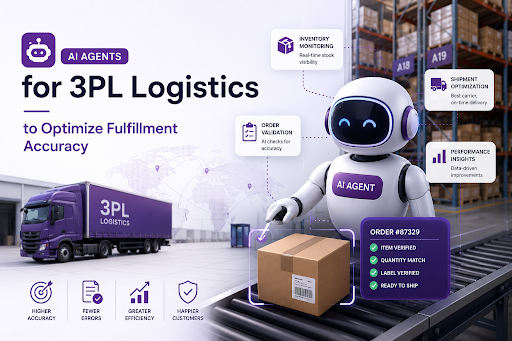
In third-party logistics, fulfillment accuracy determines client retention. Yet most 3PLs operate with fragmented visibility. This leads to persistent order errors. AI agents for 3PL logistics to optimize fulfillment accuracy are emerging as the solution.
They move beyond static rules. They diagnose decision failures and act autonomously. They also help warehouses respond faster to operational variability and exception-driven disruptions.
In this blog, we explore how AI agents resolve accuracy instability in complex, multi-client environments.
Why Fulfillment Accuracy Failures in 3PL Often Stem From Decision Fragmentation
A 3PL manager sees an error. The wrong item was shipped. The instinct is to blame the picker. But root cause analysis often reveals a different truth. Accuracy failures rarely happen in isolation. They happen because decision-making is broken across systems.
How Multi-Client Exceptions Distort Accuracy Outcomes
Each client brings unique rules, packaging, and system fields. When an exception occurs, say, a barcode mismatch, the system doesn’t know which client’s logic to follow.
Without intelligent agents, the default is often a manual override. This introduces human variance. Multi-client environments distort accuracy because standard WMS logic cannot prioritize competing rules in real time.
Why Disconnected Execution Decisions Increase Error Exposure
When receiving logs into System A, inventory updates in System B, and shipping validates in System C, error exposure multiplies. A product scanned at receiving might clear customs in a separate portal. The picker never sees the hold. Traditional integration middleware passes data but lacks the intelligent agents for reducing fulfillment errors across disconnected workflows.
Suggested Read: AI Agents for High Volume Warehouses to Improve Efficiency
How Fulfillment Variability Weakens Accuracy Stability
A 3PL might process single-piece orders in the morning and multi-line retail replenishment in the afternoon. This variability breaks fixed pick paths.
It confuses static slotting. Research indicates that operational variability and lead time fluctuations significantly affect long-term fulfillment stability and operational performance. This variability often forces warehouses to rely on temporary operational workarounds that weaken process consistency over time.
Why Traditional Rule-Based Controls Often Miss Accuracy Risks
Rules are linear. Warehouses are not. A rule says: “Scan barcode to confirm.” But what if the barcode is correct, but the product in the bin is wrong due to a previous mispick? Traditional controls miss this.
Static Logic Limitations Under Dynamic 3PL Conditions
Conditions change, a conveyor jams, and a temporary worker arrives. A rush order jumps the queue. Static logic cannot re-optimize on the fly. According to research published in MDPI, conventional rules-based systems frequently fail to account for the complex interdependencies between procurement and logistics, leading to significant resource misallocation.
Error Conditions Conventional Controls Often Fail to Detect
Consider the “switch error.” Two similar SKUs for different clients sit side by side. The picker scans the correct barcode but reaches into the wrong bin because the bin label was damaged. The system says “Scan OK.”
The customer received the wrong product. Conventional controls cannot detect a mismatch between the scanned ID and the physical geometry of the pick.
- Shared storage zones increase cross-client execution complexity
- Manual bin recovery processes slow exception traceability
- Static validation workflows struggle during high-volume fulfillment periods
- Repeated scan confirmations can create false operational confidence
Why Reactive Exception Handling Leaves Root Causes Unresolved
Most 3PLs fix the error (return, refund) but not the reason for the error. Reactive handling closes the ticket. It does not tell you why the bin label was damaged or why the SKUs are adjacent. Recurring exceptions often reappear because traditional workflows lack visibility into the sequence of operational conditions that triggered the original failure.
Suggested Read: AI Agents for Ecommerce Warehouses to Improve Operational Decision-making
Cognitive Decision Modeling for Diagnosing Fulfillment Risk Conditions
Before an agent acts, it must think. Cognitive decision modeling replicates how a human expert diagnoses a problem, but at machine speed.
Scenario-Based Evaluation of Accuracy Decision Paths
Cognitive modeling runs thousands of “what if” scenarios. What if the system routes this exception to the senior picker vs. the automated sorter? AI agents for multi-client 3PL fulfillment operations simulate the outcome.
AI agents for order accuracy in third-party logistics help warehouses evaluate exception-handling decisions before fulfillment errors propagate downstream. They evaluate which decision path results in the highest accuracy score, not just the fastest speed.
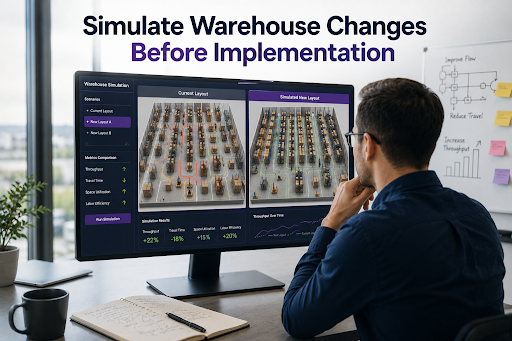
Synkrato’s simulation & optimization enables warehouses to test these decision paths before execution. They evaluate which decision path results in the highest accuracy score, not just the fastest speed.
Decision Dependencies Influencing Fulfillment Reliability
Operational decisions inside warehouses are highly dependent on one another. Research highlights several hidden risks:
- Changes in inventory flow can unintentionally disrupt picking and replenishment efficiency
- Process dependencies increase the risk of fulfillment delays across connected warehouse activities
- Studies show that supply chain variability can amplify operational disruption effects by 20% to 30% in interconnected systems
A simulation layer enables warehouses to test operational dependencies and identify downstream disruption risks before workflow changes are implemented.
Hidden Risk Patterns Revealed Through Agent-Led Analysis
Agents analyze unstructured operational data across logistics environments. Key patterns include:
- Repeated exception patterns hidden inside emails, support tickets, and shift notes
- Workflow inconsistencies caused by manual overrides across different supervisors
- Unstructured voice logs and operational comments containing early indicators of fulfillment instability
- Knowledge gaps are created when critical operational decisions remain undocumented
- Recurring anomaly patterns that traditional dashboards fail to detect because the data exists outside structured WMS records
Recent research found that AI-driven analysis of unstructured supply chain data improved helpful decision responses by 48.74% while reducing ineffective responses by 77.4%.
Autonomous Response Structures That Influence Accuracy Outcomes
Knowing the risk is not enough. The system must act. Delayed response timing can allow small execution errors to spread across multiple fulfillment stages before detection.
Adaptive Decision Responses Affecting Exception Control
When an agent detects a potential mispick (e.g., weight variance at the pack station), it can trigger an adaptive response. It might flash a light on the original bin. It might pause the conveyor. It might request a photo verification. How AI agents improve 3PL fulfillment accuracy is by moving from reactive to predictive. They identify that errors spike when two specific SKUs are within 3 feet of each other. They recommend a move.
Suggested Read: AI Agents for Real-time Inventory Management to Improve Accuracy
Response Prioritization Logic Shaping Fulfillment Accuracy
Not all errors are equal. Sending a $10 item to the wrong address is different from sending a hazmat item. Synkrato’s AI agents prioritize responses based on impact. AI agents for fulfillment accuracy in 3PL operations resolve this by applying client-specific decision trees per transaction. They fix high-risk errors first.
Continuous Learning Effects on Accuracy Stability
Every decision is data. Every correction is a lesson. Agentic AI systems retrain weekly. Research indicates that continuous machine learning adaptation improves decision consistency and anomaly detection performance over time in dynamic logistics environments.
Operating Signals That Define Scalable Accuracy Optimization
You cannot scale manual oversight. You need signals. As fulfillment complexity increases, operational stability depends on the ability to detect execution risk before errors propagate across workflows.
Indicators Traditional Controls Have Reached Limits
You know you have hit the limit when accuracy flatlines at 99.5% despite increased audits. The cost to catch the remaining 0.5% exceeds the value of the goods. Traditional controls cannot justify the ROI of friction. AI agents can reduce the audit labor to near zero.
Conditions Requiring Agent-Led Decision Support
Agent-led support is necessary when the “exception rate” exceeds human capacity. If your team spends more than 2 hours daily on “firefighting” system mismatches, you need agents. According to C.H. Robinson’s deployment of AI agents, automating 95% of exception checks reduced manual work by 350 hours daily.
- Exception escalation often increases during peak fulfillment variability
- Manual intervention creates slower response cycles across connected workflows
- Repetitive exception handling reduces operational visibility into root causes
Synkrato’s enterprise mobility supports faster operational coordination by improving real-time visibility across warehouse execution workflows.
Factors Supporting Sustainable Fulfillment Accuracy Gains
Sustainability requires three factors: data hygiene (clean SKU data), integration depth (APIs to WMS/TMS), and change management (trusting the agent). Without these, even the best AI fails.
Suggested Read: AI Agents for Operational Scenario Analysis to Optimize Workflows
Maximize Accuracy with Synkrato: Beyond the Warehouse Management System
You have invested in a Warehouse Management System (WMS). You have trained your staff. Yet, the errors persist at a specific, frustrating rate. This is the ceiling of traditional software. To break through, you need a system that thinks.
Synkrato converts your warehouse data into actionable intelligence. By using AI agents alongside 3D digital twin technology, Synkrato tests every decision before you make a move. The 3PLs winning tomorrow are not working harder.
Book a demo with Synkrato today to streamline warehouse operations, reduce inefficiencies, boost supply chain visibility, and unlock AI-powered logistics performance tailored to your business growth goals.
FAQs
How can AI agents identify hidden tradeoffs between client service priorities and fulfillment accuracy performance?
AI agents analyze the tradeoff between fulfillment accuracy and service impact. For example, delaying a shipment for a missing label may be acceptable for a high-value client but not for a low-margin, high-volume account. Synkrato’s AI agents evaluate these client-specific tolerances in real time to support faster operational decisions.
Why do fulfillment errors often persist even after process standardization across multi-client 3PL operations?
Standardization works for routine flows but often fails during exceptions. When issues like damaged barcodes occur, human improvisation introduces operational variance. Synkrato’s AI agents reduce this disruption by automating exception handling through computer vision and intelligent rerouting logic.
How can AI agents evaluate the impact of exception-routing decisions on downstream accuracy outcomes?
AI agents use scenario modeling within digital twins to evaluate pack station workload before routing pending orders. If congestion increases the risk of mix-ups, the system redirects the order to a lower-risk station. Synkrato’s simulation layer supports this preemptive decision-making process.
What role does operational variability play in long-term fulfillment accuracy instability?
Operational variability is the primary driver of accuracy decay. As order profiles change, the optimal pick path changes. If the WMS does not update the path, pickers take shortcuts. Shortcuts lead to bins being skipped or mis-picked. Synkrato’s AI agents monitor variability indicators (e.g., order size spikes). They trigger slotting or path adjustments before human error occurs. Ignoring variability means accepting a permanent 1-2% error baseline.
How can AI agents assess whether policy-level decisions may introduce systemic fulfillment risk?
Policy changes (e.g., “consolidate all slow movers to Zone F”) can have accuracy impacts if Zone F is too far from packing. Synkrato agents assess this by running a “shadow mode” simulation. They replay historical orders against the proposed policy change. If the simulation shows a 15% increase in travel time (leading to rushed picks), the agent flags the policy as high-risk. This allows the 3PL to change the policy before implementation.
Can AI agents quantify the cumulative effect of minor execution deviations on order accuracy performance?
Yes. A single scan-beep where the scanner beeps but the picker didn’t look is a minor deviation. But over 1,000 picks, it results in 10 errors. Synkrato’s analytics track micro-deviations. They correlate micro-deviation frequency with error spikes. By quantifying that a 5% increase in scan speed leads to a 20% increase in mispicks, the agent justifies investment in ergonomic pick stations or different scan hardware.
How does agent-driven analysis support validation of alternative fulfillment strategies before live deployment?
Live deployment of a new strategy (e.g., “zone vs. wave picking”) is expensive. Synkrato’s digital twin allows agent-driven stress testing. The AI agent takes the new strategy as code and runs it against 90 days of historical data. It measures the theoretical accuracy. It also tests edge cases (e.g., “Black Friday surge”). Only when the agent validates the strategy as “accuracy stable” does Synkrato recommend deployment.
What factors determine whether AI agent outputs are reliable enough for enterprise fulfillment decisions?
Reliability is determined by confidence scoring. A good agent does not just answer; it gives a probability. For standard barcode scans, confidence is 99.9%. For predictive recommendations (e.g., “move this SKU”), confidence might be 85%. Synkrato uses these confidence scores to determine when decisions should be automated or escalated to a human operator.