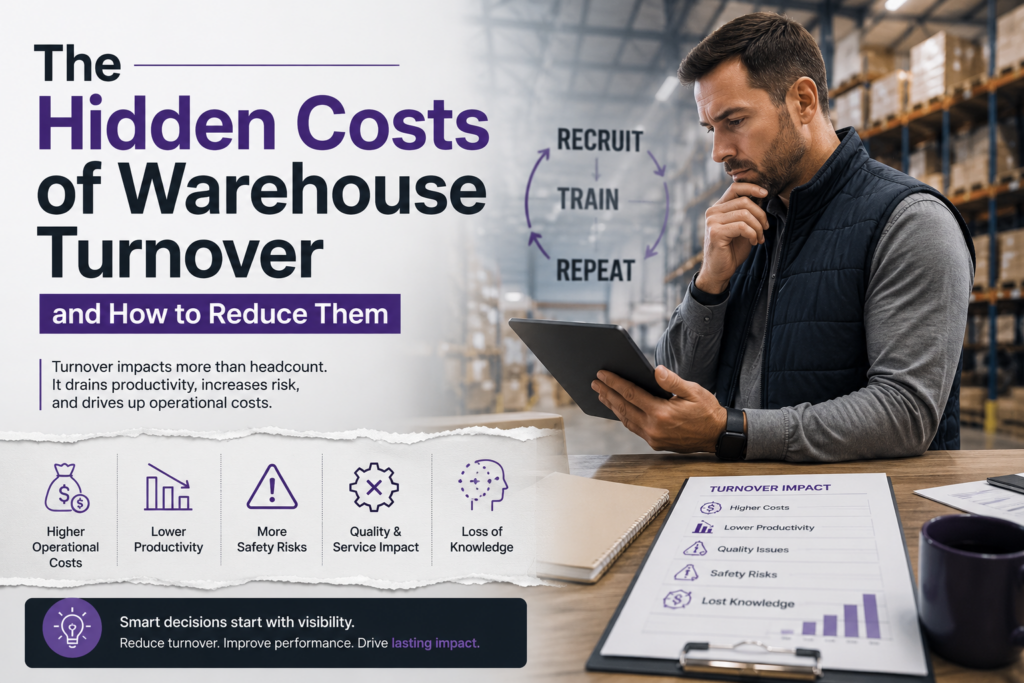
Warehouse turnover is the hidden cost created when labor instability disrupts daily warehouse performance. It increases labor spend, weakens safety, slows throughput, reduces order accuracy, and pulls leaders away from higher-value improvement work.
The impact is especially high in distribution-heavy businesses because frontline labor represents more than 70% of a distributor’s direct investments. When attrition, absenteeism, and chronic vacancies rise, turnover becomes more than an HR issue. It becomes a productivity, cost, and service-level risk across the warehouse network.
This blog breaks down warehouse turnover cost analysis and how better operational design and data-driven decisions can reduce its impact.
Suggested Read: Warehouse Layout Optimization
Cost of Warehouse Turnover: More Than Just Hiring Expenses
The cost of warehouse turnover builds in layers, starting with hiring expenses and quickly expanding into operational disruption. While it begins as a recruitment and onboarding cost, it spreads into slower ramp-up, higher supervision needs, increased error risk, lower engagement, and weaker service reliability across the network.
Direct vs. hidden turnover costs
Direct costs are the most visible. They include recruitment, screening, orientation, onboarding, and the initial wage cost of bringing a replacement into the operation. In the U.S., the average nonexecutive cost-per-hire is $5,475 in 2025, while total replacement cost can reach 50% to 200% of annual salary, depending on the role.
However, the larger impact comes from hidden costs. As new hires take time to stabilize, warehouses experience slower picking, weaker slotting discipline, more quality checks, increased supervisor intervention, and reduced team consistency.
Short-term vs. long-term financial impact
Warehouse turnover creates immediate cost pressure, but its larger impact appears over time as performance weakens and inefficiencies compound. In the short term, costs show up in vacancy coverage, agency labor, overtime, training, and recruiting spend.
Synkrato quantifies these short- and long-term impacts by simulating labor scenarios and identifying process inefficiencies, while enabling teams to reduce cost and stabilize performance proactively.
Why most businesses underestimate turnover costs
Businesses often underestimate turnover because they measure hiring activity instead of operational impact. Most organizations track cost-per-hire and vacancy rates, but they do not capture the full effect on manager time, retraining effort, slower productivity curves, or quality loss during workforce churn.
Suggested Read: Warehouse Putaway Process
Breakdown of Hidden Costs Caused by High Warehouse Turnover
High warehouse turnover creates a cascading impact across productivity, cost, quality, and operational stability. Instead of isolated issues, it triggers interconnected disruptions where each gap in labor consistency amplifies inefficiencies across the entire operation.
Loss of Productivity and Operational Efficiency
Turnover reduces operational speed by disrupting workforce stability and execution consistency. New or temporary workers require more supervision and take time to understand layouts, slotting logic, and exception handling, which slows throughput even before errors increase.
Productivity is closely tied to workforce stability. Business units with stronger engagement show 14% higher productivity and 78% lower absenteeism, highlighting how quickly performance declines when turnover rises.
In warehouse operations, fewer stable teams mean more time spent fixing disruptions instead of improving processes. Even AI-driven operations rely on consistent execution, so unstable labor can limit the impact of automation and optimization efforts.
Increased Recruitment and Hiring Costs
High warehouse turnover increases hiring costs by forcing the business to replace labor more often, under more pressure, and with less room to hire selectively.
The visible expense includes advertising, screening, interviews, pre-employment checks, onboarding coordination, and the time supervisors spend helping HR close urgent gaps. Moreover,
- Frequent rehiring shortens the time available to assess long-term fit, which increases the risk of filling vacancies with candidates who may not stay.
- A constantly open hiring cycle makes workforce planning less accurate because labor demand starts to reflect churn, not true growth.
- Repeated vacancies can force operations teams to accept slower ramp-up periods as normal, which raises cost tolerance across the site.
Suggested Read: Warehouse Performance Metrics
Training and Onboarding Costs
Organizations spend a median of $0.05 per $1,000 revenue on onboarding and workforce deployment. Additionally, research shows that employees with structured onboarding reach productivity faster and are more likely to feel prepared and effective in their roles.
In warehouse environments, weak onboarding creates additional operational strain. Experienced workers and supervisors are pulled into informal training, which reduces available labor for core tasks and slows overall output. As turnover rises, this cycle repeats, increasing hidden labor costs.
For instance, DHL frames employer-led training and employee-centric skill development as central to attracting and retaining logistics talent. With this, it doesn’t treat onboarding as a transactional first-week exercise.
Safety Risks and Workplace Incidents
High turnover increases safety risk by introducing more inexperienced workers into high-speed, equipment-heavy environments. New employees are more likely to miss cues, rush tasks, or misuse equipment due to limited familiarity with workflows and safety protocols.
In 2024, warehousing and storage recorded:
4.8 total recordable cases per 100 full-time workers, with 4.1 cases involving days away from work, job restriction, or transfer. The sector also reported 32 fatalities in the same year. Separately, forklift-related incidents caused more than 7,700 serious injuries and 54 fatalities, with training gaps identified as a recurring issue.
Suggested Read: How to Reduce Warehouse Costs
Knowledge and Experience Loss
When experienced employees leave, the business loses more than task familiarity. It loses route optimization habits, exception-handling judgment, and informal problem-solving logic built through repetition.
This loss of embedded knowledge typically shows up in the following ways:
- Decision-making shifts upward, increasing dependency on supervisors for routine operational calls
- Exception handling becomes inconsistent, leading to variability in how similar issues are resolved
- Process adherence weakens because informal best practices are no longer reinforced on the floor
- Continuous improvement slows down as fewer employees contribute insights based on experience
Increased Workload and Employee Burnout
Turnover increases workload pressure on the remaining workforce, without a proportional adjustment in expectations. Open roles still need to be covered, and demand patterns remain unchanged. Moreover, supervisors compensate by redistributing work through overtime, multitasking, and informal escalation handling.
Workforce data shows that 26% of frontline workers report burnout, largely driven by exhaustion. The operational strain builds through the following patterns:
- High performers are repeatedly assigned critical tasks, creating uneven workload distribution
- Overtime becomes normalized, reducing recovery time and increasing fatigue-related risk
- Task switching increases, lowering focus and execution consistency across workflows
- Informal problem-solving replaces structured processes, adding cognitive load during peak periods
Suggested Read: How to Reduce Downtime in Warehouses
Higher Error Rates and Order Inaccuracies
High warehouse turnover increases error rates by disrupting execution consistency at the operator level. Order accuracy depends on repeatable performance under pressure, but when a large portion of the workforce is still learning product locations, handling rules, packaging logic, and system workflows, variability increases.
For instance,
- Error patterns become inconsistent, making root-cause analysis more difficult across shifts and teams
- Exception queues grow, delaying shipment release and increasing cycle time variability
- Inventory accuracy weakens due to repeated corrections and manual overrides
Synkrato’s AI-driven tools can improve warehouse decision-making by analyzing labor and execution variability in real time.
Decline in Team Morale and Workplace Culture
In high-turnover environments, engaged business units experience 21% lower turnover, while in more stable environments, the difference increases to 51%. Similarly, engagement links to 10% higher customer loyalty and 23% higher profitability, showing that culture directly affects operational and financial performance.
The decline in culture typically becomes visible through:
- Reduced peer accountability, leading to weaker adherence to process and safety standards
- Lower participation in problem-solving and continuous improvement efforts
- Increased disengagement during peak periods, affecting execution quality
- Higher dependency on supervisors to maintain discipline and consistency
Walmart links retention to internal mobility and clear career pathways, helping improve engagement and workforce stability.
Suggested Read: Warehouse Picking Challenges
Impact on Customer Satisfaction and Service Levels
Warehouse turnover directly affects customer experience by reducing execution consistency. When workforce stability drops, operations see slower picking, higher mis-ship rates, weaker inventory accuracy, and inconsistent exception handling. This makes it harder to maintain service reliability and meet order commitments.
Service performance depends on how well labor, inventory, and execution variability are managed together. Improvements in operational visibility and coordination have been shown to increase fill rates by 5% to 8%, while stronger workforce engagement is linked to 10% higher customer loyalty. These outcomes highlight that customer satisfaction is closely tied to frontline stability.
Increased Operational and Hidden Costs Over Time
The cost of warehouse turnover builds gradually but compounds over time. While a single exit may seem manageable, repeated churn increases over time, reliance on temporary labor, training effort, quality issues, and supervisory intervention across the operation.
As these disruptions continue, they stop being temporary and become part of the operating model. The warehouse begins to adjust to instability by planning for excess labor, accepting a slower ramp-up, and treating rework as normal.
For this reason, turnover should not be treated as a periodic HR metric. It needs to be monitored as an efficiency and profitability risk.
Suggested Read: Common Warehouse Challenges
Impact on Supervisory and Management Bandwidth
Turnover reduces management effectiveness by increasing the amount of time supervisors spend on reactive tasks. Instead of focusing on coaching, process discipline, and improvement, managers are pulled into hiring support, onboarding, basic guidance, and gap coverage.
Thus, managers influence team performance, while research shows that 70% of the variance in team engagement is driven by the manager.
In high-performing environments, supervisors spend a larger share of their time working directly with teams to solve problems and improve flow. When turnover rises, that balance shifts toward firefighting. As a result, management bandwidth becomes one of the earliest and most expensive hidden costs.
Disruption to Process Standardization and Continuous Improvement
High turnover disrupts process consistency because execution keeps changing. Standard work delivers value only when it is consistently followed, reinforced, and improved over time.
When workforce stability is low, execution becomes variable. Even if roles are filled, differences in experience, familiarity, and discipline lead to inconsistent adherence to processes. This shifts operations toward supervisor-driven problem solving instead of standardized execution.
As a result, improvement efforts struggle to sustain impact. Turnover weakens the discipline required for Lean execution, slows the adoption of new methods, and reduces the return on investments in warehouse automation, analytics, and operational redesign.
Suggested Read: Common Warehouse Layout Mistakes
Strategies to Reduce Warehouse Turnover and Improve Retention
Reducing warehouse turnover costs requires redesigning how work is structured, supported, and scaled. The most effective strategies combine onboarding, leadership, workload design, compensation, and data visibility to stabilize workforce performance and reduce recurring disruption.
Improve onboarding and training programs
Onboarding should be designed to curb warehouse productivity loss from turnover. Structured onboarding helps new hires reach full performance faster and reduces early-stage errors, which are a major source of hidden cost in high-turnover environments.
A strong onboarding system includes clear milestones, role-specific training, floor coaching, and early performance tracking. During the first 30 days, productivity remains around 25%, and the overall onboarding. Moreover, the ramp-up period typically extends to 3 to 6 months before employees reach stable performance levels.
Implement employee recognition and incentives
Recognition stabilizes performance by reinforcing the behaviors that drive consistency across warehouse operations. Moreover, it:
- Reinforces safety compliance and reduces risk-taking behavior during high-pressure periods
- Improves quality consistency by recognizing accuracy and process adherence
- Encourages problem-solving and ownership at the operator level
- Strengthens team collaboration by rewarding collective performance, not just individual output
- Increases retention by making contributions visible and valued in daily operations
Offer career growth and development opportunities
Career visibility improves retention by turning warehouse roles into long-term career paths instead of short-term jobs. When employees see progression into higher-skilled or higher-paying roles, engagement and commitment increase.
Amazon provides a strong logistics-specific example. The company has invested more than $1.2 billion in upskilling programs and aims to train 300,000 employees for higher-skilled roles. These pathways include technical, robotics, and operations roles within its fulfillment network, helping employees move beyond entry-level warehouse work.
Walmart follows a similar approach by creating structured pathways into higher-paying roles, including positions that can reach $135,000 per year and technical roles paying up to $45 per hour. These models show that retention improves when progression is clearly defined and operationally relevant.
Optimize workload and reduce physical strain
Reducing physical strain helps stabilize workforce performance and lowers attrition in repetitive warehouse environments.
- Balances workload distribution to prevent over-reliance on high-performing employees
- Reduces fatigue-related errors by limiting repetitive and high-strain movements
- Improves task efficiency through better layout design and movement optimization
- Uses AI-driven automation to remove low-value repetitive work instead of increasing output pressure
- Supports long-term productivity by making work sustainable across shifts
Improve workplace safety and culture
Safety culture strengthens retention by improving trust, control, and operational discipline. It:
- Reduces incident rates by reinforcing consistent safety behaviors across teams
- Improves compliance through practical training rather than checklist-driven processes
- Builds accountability by integrating safety into daily workflows
- Encourages reporting and early risk detection through open communication
Amazon reported a 34% improvement in recordable incident rate over five years and a 65% improvement in lost-time incident rate globally, alongside large investments in safety professionals, technology, and training.
Suggested Read: Theory of Constraints for Warehouses
Use Workforce Data and Analytics to Predict Attrition
Retention improves when workforce decisions are driven by data rather than reactive hiring cycles.
In one case, analyzing more than five million data points revealed a 4% EBITDA improvement opportunity through targeted retention actions.
Operational tools are also improving execution efficiency. AI-driven planning has reduced shift planning time from 90 minutes to 30, showing how better visibility can simplify labor management and reduce friction across teams. Data-driven retention allows leaders to act early instead of reacting after employees leave.
Hidden turnover costs don’t show up in reports. They show up in lost productivity, rework, and unstable operations. See where your warehouse is leaking value. Schedule a demo with Synkrato and turn workforce instability into measurable operational improvements.
FAQs
What are the hidden costs of warehouse turnover?
Warehouse turnover drives hidden costs through training time, productivity loss, increased errors, and operational disruption. These costs often remain fragmented across functions, making them harder to quantify. Using Synkrato’s data-driven insights, teams can connect workforce instability directly to performance and cost impact.
How can Synkrato help businesses uncover hidden operational costs linked to warehouse turnover?
Hidden costs become visible when operations are analyzed end-to-end rather than in silos. Synkrato’s digital twin and AI agents evaluate workflow inefficiencies, labor allocation, and bottlenecks, helping businesses identify where turnover is increasing cost and reducing throughput.
Why does employee turnover increase warehouse operating costs?
High turnover reduces workforce consistency, increases onboarding effort, and lowers execution quality, leading to more errors and slower throughput. With Synkrato, organizations can simulate labor scenarios and optimize processes to reduce dependency on constant workforce replacement.
What risks can grow when warehouse turnover issues are not addressed proactively?
Unaddressed turnover leads to safety risks, process inconsistency, inventory inaccuracies, and service delays. These risks compound over time as operational stability weakens. Synkrato helps detect early warning signals through real-time data visibility and predictive insights.
How does warehouse turnover affect operational efficiency?
Turnover disrupts workflow continuity, increases variability in task execution, and reduces overall productivity. As experience levels fluctuate, processes become slower and less predictable. By modeling these impacts, Synkrato helps teams redesign workflows for consistency and resilience.
Why does Synkrato support a more strategic approach to reducing turnover-related inefficiencies?
A strategic approach requires understanding how labor, layout, and processes interact, not just addressing hiring gaps. Synkrato enables this by combining simulation, AI slotting, and operational analytics to optimize workflows and reduce reliance on high workforce turnover.
Can warehouse turnover impact order fulfillment performance?
Yes, turnover directly affects picking accuracy, speed, and order consistency, which impacts customer experience. By improving process design and visibility, Synkrato helps stabilize fulfillment performance even when workforce variability exists.