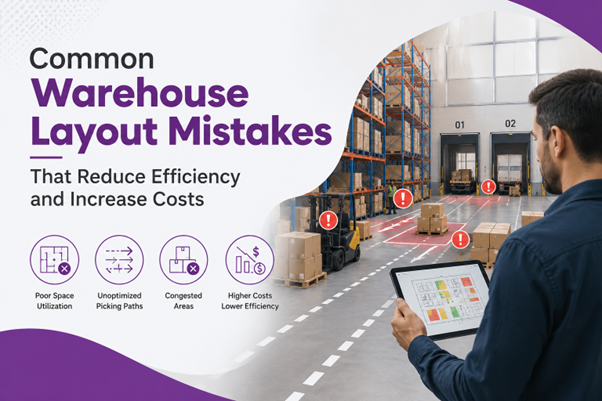
Warehouse layout design mistakes are a key driver of inefficiency and rising costs, even as companies invest in labor and automation. Robot shipments are expected to grow by up to 50% annually through 2030, with warehouse automation expanding at over 10% per year. This makes layout quality critical to converting these investments into real throughput and cost gains.
At the same time, 56% of organizations are increasing supply chain investment. It elevates layout design from a support function to a core operational lever.
This blog outlines the most common warehouse layout mistakes that increase travel time, create congestion, and disrupt flow. It also highlights why areas like reverse logistics require dedicated design rather than being absorbed into standard operations.
1. Poor Space Utilization (Horizontal + Vertical)
Poor space utilization occurs when warehouses optimize for floor fill instead of total usable cube, accessibility, and flow efficiency. Such mistakes in warehouse space utilization create a false sense of capacity where racks appear full, but operations still face excessive travel, frequent replenishment pressure, and fragmented inventory positions.
Solution:
AI-enabled warehouse tools unlock 7-15% additional capacity, and logistics providers increase capacity by nearly 10% without adding space. For this,
- Adjust rack profiles and slot heights to fit SKU dimensions and maximize vertical space utilization
- Use dynamic storage allocation to adapt space based on changing demand patterns
- Consolidate inventory locations to reduce travel distance and improve picking efficiency
With Synkrato, warehouses can evaluate cube utilization and test different storage strategies using AI-driven simulation.
Suggested Read: Warehouse Layout Optimization
2. Inefficient Aisle Width Design
Inefficient aisle width design happens when aisles are sized using static assumptions instead of real movement needs.
Narrow aisles restrict equipment movement, reduce passing flexibility, and increase safety risks, while overly wide aisles lower storage density and increase travel distance. Both conditions reduce throughput and picking efficiency.
Solution:
Aisle width should be defined as a flow decision. High-performing layouts apply different aisle standards by function. Reserve storage, forward picking, replenishment corridors, and cross-aisles require distinct movement profiles, and using a single width across all zones reduces efficiency.
Narrow-aisle strategies improve density when supported by controlled traffic rules and compatible equipment, but they fail when mixed movement is unmanaged. The objective is a balanced design, where safety, speed, and storage capacity work together without creating operational friction.
Suggested Read: Warehouse Putaway Process
3. Poor Inventory Slotting Decisions
Poor inventory slotting decisions increase travel time, labor cost, and replenishment pressure because the same inefficiencies repeat in every pick cycle. Static slotting models fail to keep pace with changes in demand, order patterns, product affinity, and cube movement. As a result, high-velocity SKUs are placed too far from dispatch, bulky items occupy prime pick locations, and workers spend more time walking than handling inventory.
Solution:
Placement decisions should reflect not only velocity, but also handling effort, order frequency, and how SKUs move together through the system. AI-driven slotting models continuously analyze demand patterns and recommend optimal placements.
- Group frequently co-ordered SKUs together to minimize travel for multi-line orders
- Distribute pick activity evenly across zones to prevent congestion
- Align slotting with packaging and handling requirements to improve pick speed
Suggested Read: Warehouse Performance Metrics
4. Unoptimized Picking Paths
Unoptimized picking paths reduce productivity by increasing unnecessary movement and creating avoidable congestion across the warehouse. When routing is treated as a simple shortest-path exercise, it ignores how orders are built, how inventory is positioned, and how replenishment interacts with picking.
The result is inefficient cart or pallet building, frequent cross-traffic, delayed replenishment triggers, and uneven workload distribution across zones.
Solution:
Optimizing picking paths requires aligning routes with order logic and real warehouse flow. Effective paths minimize travel while maintaining aisle balance, reducing conflict with replenishment, and supporting efficient load building based on weight and sequence. Routing should adapt to how orders are structured, not just where items are located.
High-performing warehouses use different routing strategies based on zone, order type, batch configuration, and service priority.
Suggested Read: How to Reduce Warehouse Costs
5. Congested Receiving and Dispatch Areas
Congested receiving and dispatch areas disrupt warehouse flow when multiple inbound and outbound activities compete for the same limited space. Unloading, inspection, staging, putaway, and outbound marshaling often overlap without clear separation. It causes pallets to accumulate near docks, blocking movement and delaying processing. This leads to spillover into aisles, reduced visibility, and slower downstream execution in picking and storage.
Solution:
Design decisions should reflect peak operational conditions rather than average throughput, as congestion typically emerges under stress. Additionally,
- Align dock door assignment with shipment type and priority to reduce cross-movement
- Create dedicated fast lanes for high-frequency or time-sensitive shipments
- Use pre-receiving and appointment scheduling buffers to smooth inbound spikes
Suggested Read: How to Reduce Downtime in Warehouses
6. Poor Traffic Flow Design and Lack of Safety Separation
Poor traffic flow design and lack of safety separation slow operations and increase risk when people and equipment share the same movement space without control. The U.S. The Bureau of Labor Statistics reported a 4.8 total recordable injury rate for warehousing and storage in 2024, while OSHA estimates that around 100 fatalities and 95,000 injuries occur annually due to forklift-related incidents.
Solution:
Effective traffic design separates movement based on type, speed, and exposure. It ensures that different flows do not compete for the same space. Layout decisions should define clear pedestrian walkways, controlled crossing points, and dedicated routes for equipment and replenishment activity. Reducing overlap between these movements improves both safety and execution speed.
Well-designed flow paths minimize hesitation, reduce congestion, and allow operators to move consistently under varying workloads. Applying structured movement logic across the warehouse ensures that safety measures also contribute to productivity rather than slowing operations.
Suggested Read: Warehouse Picking Challenges
7. Ignoring Equipment, Automation, and Labor Strategy Alignment
Ignoring alignment between equipment, automation, and labor strategy leads to layouts that fail under real operating conditions. This happens when facilities are designed for one mode of operation and later forced to accommodate another, such as adding AMRs, conveyors, or pallet automation into spaces originally built for manual movement. The result is constrained flow, poor equipment utilization, and increased operational friction across zones.
Solution:
Effective layouts are designed around the operating model. This means defining how work will be executed across manual, assisted, and automated processes, and ensuring that each zone supports that mix without creating bottlenecks. Labor allocation, equipment movement, and automation workflows should be planned together so that each complements the other.
Future readiness is equally important. Layouts should accommodate evolving automation strategies without requiring major redesign, ensuring flexibility as demand and technology change.
Suggested Read: Common Warehouse Challenges
8. Fixed Layouts With Limited Flexibility and No Scenario Testing
Fixed layouts limit warehouse performance when they are designed for a single demand pattern and not tested against variability. The symptoms appear across operations: longer travel time, staging overflow, uneven labor utilization, and increased pressure at docks. The underlying gap is the absence of scenario validation.
Solution:
Flexible layouts are designed to absorb change without requiring constant redesign. This includes modular staging areas, adaptable pick zones, scalable automation interfaces, and reserve capacity that can be repurposed as demand patterns evolve.
Simulation and scenario modeling reduce risk by identifying constraints early, allowing businesses to refine layouts before they impact live operations.
Suggested Read: Hidden Cost of Warehouse Turnover
9. Weak Capacity Planning for Growth
Weak capacity planning limits a warehouse’s ability to scale because layouts are designed for current volume instead of future demand. This leads to congestion, overflow storage, and rising costs when volumes increase or SKU complexity expands.
Solution:
Capacity planning must account for demand variability, peak volumes, and operational flow, not just static storage limits.
- Build multi-scenario capacity models (baseline, peak, aggressive growth)
- Align storage, labor, and throughput capacity together
- Maintain buffer capacity (not max utilization) to absorb seasonal spikes without congestion
- Integrate real-time data and forecasting tools to adjust capacity decisions continuously
- Review capacity plans quarterly to stay aligned with changing demand patterns
10. Lack of Continuous Layout Optimization
Lack of continuous layout optimization causes warehouses to fall behind demand changes, even if the original design was efficient. Static layouts fail to adapt to shifts in order profiles, SKU mix, and workflow intensity.
Solution:
Layout optimization should be treated as a continuous operating discipline, where decisions are regularly tested and refined using real data and operational feedback.
- Establish regular layout reviews tied to demand changes
- Track layout performance metrics such as travel time, congestion points, and pick density
- Use simulation and scenario testing to validate changes before implementation
- Continuously refine slotting, zoning, and flow paths based on actual order behavior
- Create a feedback loop between operations and design teams to capture real execution gaps
Synkrato’s simulation and AI agents help identify bottlenecks and optimize layout performance before changes hit the floor. Book a demo to see it in action.
Suggested Read: Theory of Constraints for Warehouses
FAQs
What are the most common warehouse layout mistakes?
The most common warehouse organization mistakes include poor space utilization, inefficient aisle widths, weak slotting, lack of zoning, and congestion across key workflows. These issues typically arise from static planning without testing real-world scenarios. With platforms like Synkrato, teams can simulate these conditions in advance and uncover inefficiencies before they scale.
When should businesses consider using Synkrato to address warehouse layout inefficiencies?
Businesses should evaluate solutions like Synkrato when they experience rising travel time, congestion, inconsistent throughput, or are planning expansion or automation. It becomes especially valuable when decisions need to be validated using real operational data rather than assumptions.
Why do warehouse layout mistakes reduce operational efficiency?
Layout mistakes disrupt flow by increasing travel distance, creating cross-traffic, and reducing visibility across operations. This leads to slower picking, delayed replenishment, and unstable labor performance. Synkrato helps surface these hidden inefficiencies by analyzing movement patterns and simulating better alternatives.
Why might traditional layout planning methods overlook critical inefficiencies that Synkrato can identify?
Traditional planning relies on static layouts and limited data, which often miss how workflows interact under real conditions. By contrast, Synkrato’s digital twin and AI-driven simulation model the full operation, revealing bottlenecks and constraints that are difficult to detect manually.
How can a poor warehouse layout affect picking performance?
Poor layout increases travel time, creates congestion in high-demand zones, and disrupts picking sequences, reducing both speed and accuracy. AI slotting and simulation capabilities within Synkrato help optimize inventory placement and routing based on actual order behavior.
Which warehouse layout decisions can Synkrato help optimize for long-term performance?
Key decisions such as slotting strategy, zoning, aisle configuration, picking paths, and staging design benefit from continuous optimization. Using Synkrato, these decisions can be tested and refined dynamically as demand patterns and operational conditions evolve.
What signs indicate a warehouse layout needs improvement?
Common indicators include excessive walking time, recurring congestion, unstable productivity, frequent errors, and reliance on temporary fixes like overflow storage. These patterns can be analyzed and diagnosed more precisely when using Synkrato’s simulation and AI-driven insights.