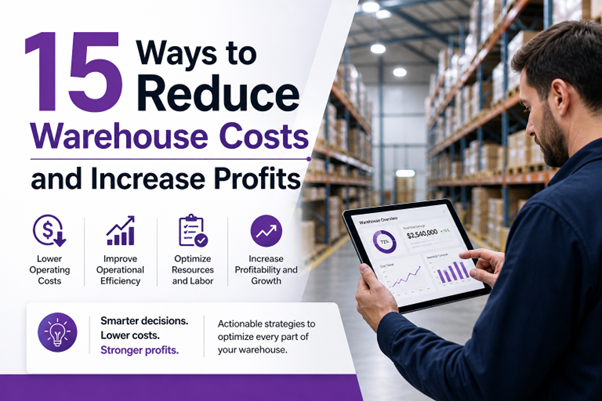
Reducing warehouse costs in 2026 requires improving how work flows across labor, inventory, space, and transportation rather than cutting budgets. The most effective approach is to identify cost leakage across operations, reduce travel and handling, improve inventory accuracy, and use real-time data to make faster, better decisions.
This blog outlines 15 practical, high-impact warehouse cost reduction strategies that improve profitability by fixing operational inefficiencies across the entire warehouse system.
1. Analyze End-to-End Warehouse Operations
Reducing warehouse costs starts with identifying where inefficiencies occur across the full workflow. Most cost leakage happens in the transitions between receiving, putaway, replenishment, picking, packing, and shipping, where delays, re-handling, and misalignment between systems and execution accumulate.
A bottom-up operational view is more effective than high-level benchmarking because it exposes how labor, equipment, and process design interact in real conditions.
To make this analysis actionable:
- Identify bottlenecks across interconnected workflows rather than isolated tasks
- Map process dependencies that create delays between stages
- Quantify the cost impact of rework, idle time, and unnecessary handling
- Test operational changes through simulation before implementation
Platforms like Synkrato strengthen this approach by using digital twins and simulation to help operators test workflows, identify bottlenecks, and evaluate changes before they impact real operations.
Suggested Read: Warehouse Layout Optimization
2. Optimize Labor Productivity and Workforce Management
Improving labor productivity is one of the most effective ways to reduce warehouse costs because labor remains the largest controllable expense.
The goal is not to reduce headcount, but to increase output per labor hour by eliminating non-value-added activities such as excessive travel, waiting time, and error correction. This requires aligning workforce deployment with actual workload patterns and operational demand.
System-driven task allocation reduces reliance on manual supervision and ensures work is distributed based on priority and capacity. At the same time, continuous use of performance data helps refine workforce planning, identify inefficiencies, and improve execution over time.
3. Reduce Travel Time Through Layout, Slotting, and Picking Optimization
Reducing warehouse costs requires minimizing non-value-added movement, and travel time is one of the largest contributors to wasted labor. In many operations, picking consumes the majority of labor hours, and inefficient travel paths significantly increase the cost per order.
The most effective approach is to treat layout, slotting, and picking strategies as a single system. AI-driven slotting plays a critical role here by continuously analyzing order patterns, SKU velocity, and picking behavior to place inventory in optimal locations. This ensures that inventory placement, replenishment strategies, and picking paths are aligned to minimize unnecessary movement.
To reduce travel time effectively:
- Align SKU placement with real order frequency and co-picking patterns
- Redesign pick zones to balance workload and reduce congestion hotspots
- Structure batch, wave, or zone picking based on order profiles
- Continuously update slotting logic based on demand and seasonality shifts
Suggested Read: Warehouse Putaway Process
4. Maximize Space Utilization and Storage Density
Improving space utilization reduces costs not only by delaying expansion but also by improving operational flow. Poor use of warehouse space increases travel distance, lowers pick density, and creates inefficiencies in replenishment and storage. Therefore, space optimization should be treated as an operational performance lever, not just a capacity constraint.
To improve space utilization strategically:
- Increase vertical storage usage without impacting accessibility and safety
- Group SKUs based on velocity and handling requirements to improve flow
- Reduce unused or poorly utilized storage zones across the facility
- Align storage design with throughput goals rather than just capacity targets
5. Improve Inventory Accuracy and Real-Time Visibility
Improving inventory accuracy is one of the fastest ways to reduce hidden warehouse costs because errors compound across operations. Inaccurate inventory leads to mispicks, delays, rework, and poor planning decisions, all of which increase cost per order. Real-time visibility is critical because delayed information still leads to reactive decisions.
Achieving high accuracy and visibility requires automating data capture across receiving, picking, and cycle counting to eliminate manual errors and delays. Inventory data must be integrated across systems to remove silos and ensure a single, consistent view of stock.
Real-time exception detection enables faster issue resolution before errors impact downstream operations, while system-driven validation at each step prevents inaccuracies at the point of execution.
Suggested Read: Warehouse Performance Metrics
6. Optimize Inventory Levels and Carrying Costs
Reducing warehouse costs requires optimizing how much inventory is held and how efficiently it moves through operations. Excess inventory creates financial and operational drag through capital lock-in, storage costs, and increased handling. Median inventory carrying costs at 10% of the inventory value. This makes inventory optimization a direct profitability lever.
To optimize inventory levels strategically, focus on:
- Segmenting inventory based on demand variability and business criticality
- Aligning replenishment cycles with actual consumption patterns
- Reducing slow-moving and obsolete stock through proactive monitoring
- Connecting inventory decisions with downstream impacts on operations and service levels
7. Streamline Inbound Logistics and Supplier Coordination
Improving inbound efficiency starts with standardizing how inventory enters the warehouse and reducing variability before it reaches the dock. Poor advance shipment notice (ASNs), inconsistent labeling, mixed pallets, and noncompliant packaging increase unload time, labor effort, and error rates.
To streamline inbound operations effectively, focus on:
- Standardizing supplier requirements for labeling, packaging, and documentation
- Improving ASN accuracy and timing to align with warehouse scheduling
- Reducing manual checks through system-based validation at receiving
- Coordinating inbound schedules with labor and dock capacity planning
Synkrato addresses this by enabling system-driven workflows, real-time validation, and integrated planning.
Suggested Read: How to Reduce Downtime in Warehouses
8. Optimize Transportation, Shipping, and Fulfillment Costs
Lowering outbound costs requires aligning shipping decisions with order design, packaging logic, network positioning, and execution at the dock. Operators reduce cost per shipment by controlling how orders are built, packed, and routed.
Moreover, transportation cost is heavily influenced by dimensional weight pricing as the charges are based on package volume when it exceeds actual weight. This makes cartonization, packaging size, and shipment consolidation critical cost drivers.
To optimize transportation and fulfillment costs:
- Implement cartonization logic to select the optimal box size based on order composition
- Reduce split shipments through better inventory allocation across locations
- Align order batching and wave planning with shipping cut-offs and carrier schedules
- Use zone skipping or load consolidation strategies to reduce last-mile cost
9. Improve Dock and Yard Operations
Improving dock and yard operations requires aligning arrival schedules, yard movement, and dock capacity to reduce idle time and congestion. Synchronizing inbound and outbound flows with actual warehouse throughput ensures that trucks are processed efficiently without creating bottlenecks.
A warehouse appears efficient internally while still losing money at the dock. For instance, truck driver detention in 2023 led to $3.6 billion in direct costs and $11.5 billion in lost productivity, with delays occurring at 39.3% of stops.
Dock and yard efficiency depends on aligning appointments with real-time dock availability so trucks are scheduled based on actual capacity rather than static plans. Greater yard visibility enables tracking of trailer status, location, and priority, reducing idle time.
Structured load sequencing minimizes staging congestion, while coordinated dock assignments ensure labor and equipment are ready at arrival, preventing delays and maintaining flow.
Suggested Read: Warehouse Picking Challenges
10. Implement Cross-Docking for Faster Throughput
Cross-docking improves efficiency by moving inventory directly from inbound to outbound without storage when holding inventory adds no operational value. It is effective in environments with predictable demand, high product velocity, or time-sensitive goods, where reducing handling and storage directly lowers cost and improves speed.
Additionally, it reduces storage costs and shortens delivery timelines by eliminating intermediate storage steps. However, its success depends on execution precision. Without accurate data, reliable supplier timing, and coordinated dock operations, cross-docking introduces more disruption instead of reducing costs.
To implement cross-docking effectively:
- Identify SKUs and order types suitable for direct flow-through handling
- Ensure real-time visibility of inbound and outbound schedules
- Align supplier delivery timing with outbound demand requirements
- Establish dedicated dock and staging processes for cross-dock operations
Suggested Read: Common Warehouse Challenges
11. Standardize and Digitize Warehouse Workflows
Reducing operational variability is critical to lowering warehouse costs, and this starts with standardizing how tasks are executed across the facility. Standardization removes inefficiencies caused by inconsistent execution, while digitalization ensures that processes are followed correctly at scale.
This digitalization works as the intelligence layer of the warehouse, where workflows, decisions, and task logic are embedded into the system rather than relying on manual supervision. This becomes especially important as operations scale, where variability quickly increases cost and error rates.
To standardize and digitize workflows effectively:
- Embed decision logic directly into operational workflows to reduce reliance on manual judgment
- Enable real-time monitoring of task execution across teams and processes
- Reduce training complexity through guided, system-driven workflows
- Ensure flexibility to adapt workflows quickly as operational needs change
Suggested Read: Common Warehouse Layout Mistakes
12. Reduce Returns and Optimize Reverse Logistics
Managing returns efficiently is essential to protecting warehouse margins, as reverse logistics introduces additional handling, inspection, and processing costs. Reducing avoidable returns streamlines the handling of necessary ones through faster, more accurate decision-making.
Retail returns reached $890 billion, or 16.9% of total sales in 2024. Warehouses that fail to optimize returns often experience increased labor costs, slower throughput, and reduced inventory efficiency.
Separating return workflows from forward operations prevents disruption to core execution, and using data insights to identify root causes helps reduce repeat returns and improve overall inventory efficiency.
13. Optimize Packaging and Material Usage
Controlling packaging cost requires aligning material usage with shipping efficiency and operational needs. The most effective approach is to reduce excess volume, standardize packaging formats, and minimize waste across packing and transportation. Since carriers price shipments based on dimensional weight, inefficient packaging directly increases freight cost and reduces margin.
Packaging decisions impact multiple cost layers, including materials, labor, transport, and disposal. Moreover, efficient and lighter packaging reduces both cost and environmental impact, making packaging optimization a combined financial and operational lever.
To optimize packaging and material usage effectively:
- Use right-size packaging-on-demand systems to eliminate void space dynamically
- Reduce packaging SKUs to simplify operations and inventory management
- Improve packing workflows to reduce material overuse and handling time
- Monitor packaging performance metrics to identify cost and waste reduction opportunities
Suggested Read: Hidden Cost of Warehouse Turnover
14. Maximize Equipment Utilization and Energy Efficiency
Improving equipment and energy efficiency depends on matching asset usage with actual operational demand. Ensuring that equipment is fully utilized, energy consumption is optimized, and operating schedules reflect real throughput patterns rather than fixed assumptions.
Equipment and energy costs are often managed separately, but both contribute to operational inefficiency when not aligned.
To maximize equipment and energy efficiency:
- Monitor asset utilization to identify underused or overburdened equipment
- Align equipment operation with demand patterns to reduce idle time
- Implement energy monitoring systems to track and control consumption
- Coordinate equipment usage with workflow planning to improve overall efficiency
15. Implement Automation, Data Analytics, and Predictive Planning
Reducing warehouse costs at scale requires integrating automation with data-driven decision-making. Combining automation with analytics and predictive planning ensures that operational improvements are guided by insights rather than isolated execution.
Automation delivers value when it improves decision quality, not just speed. AI agents enable faster, data-driven warehouse decisions by unifying information across systems into a conversational interface.
Predictive analytics helps anticipate demand shifts, bottlenecks, and resource requirements in advance, while continuous refinement through performance data and scenario testing ensures that strategies remain aligned with real-world conditions.
Find out how to reduce warehouse costs before they impact your margins. Book a demo with Synkrato to explore how you can optimize labor, inventory, and workflows with data-driven decision-making.
Suggested Read: Theory of Constraints for Warehouses
FAQs
What are the biggest factors that increase warehouse costs?
Warehouse costs increase due to inefficient labor utilization, excessive travel time, poor inventory accuracy, underutilized space, and disconnected systems. These inefficiencies often remain hidden until operations are analyzed end-to-end, which is where Synkrato helps surface cost drivers through unified data and real-time visibility.
Why do many cost-reduction efforts fail without operational intelligence platforms like Synkrato?
Cost-reduction efforts often fail because they focus on isolated improvements without understanding system-wide impact. Without simulation and real-time insights, changes can shift inefficiencies rather than eliminate them. This is something Synkrato addresses by enabling scenario testing and data-driven decision-making before execution.
How can warehouse labor costs be reduced without impacting productivity?
Reducing warehouse labor costs includes eliminating non-value-added activities such as unnecessary travel, waiting, and rework while improving task allocation. With real-time warehouse cost optimization of workflows and labor deployment, Synkrato helps increase output per labor hour without compromising productivity.
How does inventory optimization help lower warehouse costs?
Inventory optimization lowers costs by reducing excess stock, minimizing handling, and improving fulfillment efficiency. By combining AI-driven slotting with simulation, Synkrato enables warehouses to align inventory placement and levels with demand and operational flow.
What makes Synkrato valuable for identifying hidden warehouse cost drivers?
Hidden cost drivers often exist in workflow inefficiencies, poor layout decisions, and disconnected systems that are not visible through standard reporting. Synkrato uses digital twins, AI agents, and real-time data integration to uncover these inefficiencies and provide actionable recommendations.
Can warehouse automation help reduce operating costs?
Automation reduces operating costs when it is applied to the right processes and integrated with overall workflow design. Instead of automating in isolation, Synkrato supports better outcomes by enabling operators to test automation strategies and understand their impact before implementation.
Why is Synkrato relevant for long-term warehouse cost optimization rather than short-term savings?
Long-term cost optimization depends on continuous improvement rather than one-time fixes. By enabling real-time visibility, predictive planning, and ongoing optimization, Synkrato helps warehouses adapt to changing demand and sustain efficiency gains over time.