
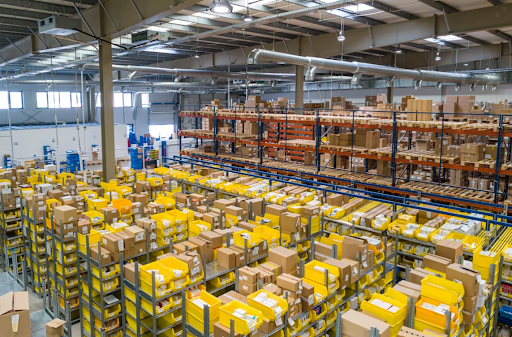
Warehouse optimization improves throughput and lowers operating costs by changing how inventory, labor, equipment, space, and software work together. The greatest improvements come from fixing constraints across the full flow rather than one activity in isolation. The goal is stable flow at the required service level, not maximum utilization everywhere.
Effective optimization also connects receiving, replenishment, picking, packing, inventory accuracy, labor, safety, and shipping so improvements in one area do not create new bottlenecks elsewhere during peak demand.
This blog explains 15 proven warehouse optimization strategies, the technologies that create the largest gains, and how to build a phased warehouse optimization plan.
15 Proven Strategies to Optimize Warehouse Operations
The following 15 proven strategies for warehouse operations optimization improve material flow, space utilization, inventory accuracy, labor productivity, and equipment use.
Optimize warehouse layout and material flow
Warehouse layout and material flow are optimized by aligning storage, docks, aisles, workstations, and equipment with actual product movement. Redesign floor paths around pallet, employee, and equipment traffic to remove crossings, backtracking, and congestion.
Key decisions include:
- Use vertical space with tall high-rack systems or mezzanine levels where retrieval and replenishment remain efficient.
- Protect high-volume receiving, picking, replenishment, and shipping paths from temporary staging.
- Test layouts against peak traffic rather than average volume.
Improve warehouse slotting
Warehouse slotting is improved by using smart slotting to match SKU locations with velocity, order affinity, cube, seasonality, ergonomics, and replenishment demand.
Useful slotting rules include:
- Position high-demand, fast-moving items near packing and shipping areas where appropriate.
- Place frequently ordered-together SKUs near one another.
- Separate fast movers when concentrated demand creates aisle congestion.
- Right-size forward-pick locations to reduce replenishment.
Synkrato’s AI Slotting Recommendations analyze inventory and demand patterns to recommend efficient zones, paths, and inventory moves as order profiles change.
Standardize receiving and putaway
Receiving and putaway are standardized by making purchase-order data, appointments, dimensions, inspection requirements, and destination rules available before unloading. Directed putaway should consider storage compatibility, capacity, expected demand, and replenishment workload.
For suitable inventory, cross-docking can transfer incoming goods directly toward outbound processing, eliminating unnecessary storage and retrieval when demand is already known.
Choose the right picking method
You can choose the right picking method by matching SKU overlap, order-line density, deadlines, travel distance, and consolidation capacity with the picking process.
| Picking Method | How It Works | Best Operational Fit |
| Zone picking | Assigns employees to defined warehouse areas. | Warehouses with clearly separated picking zones |
| Batch picking | Groups orders with overlapping SKUs. | High SKU overlap and repetitive orders |
| Wave picking | Releases work around cutoffs, replenishment, or packing capacity. | Time-sensitive fulfillment operations |
| Cluster picking | Picks multiple separate orders along one common route. | Operations looking to reduce repeated travel |
| Peak order mix | Tests picking performance under peak demand. | Preventing bottlenecks in sorting, consolidation, or packing |
Streamline packing and shipping
Packing and shipping are streamlined by matching order releases with workstation capacity, cartonization requirements, staging space, and carrier cutoffs. Control work-in-process and use automated conveyors or sortation where repetitive volume justifies automation.
FedEx’s AI-powered sorter can process up to 1,000 pieces per hour and manage around 90 destinations simultaneously. This shows how targeted automation can remove repetitive shipping constraints.
Improve inventory management with cycle counting
Inventory management is improved with cycle counting by making the count frequency proportional to operational risk. Prioritize high-velocity inventory, repeated adjustments, stockouts, high-value items, and locations with recurring discrepancies.
Repeated variances should trigger root-cause analysis across receiving, replenishment, picking, and inventory transactions. Walmart’s self-healing inventory, which automatically reroutes excess stock, has generated more than $55 million in savings in Mexico City operations.
Reduce employee travel time
Employee travel time is reduced by combining smart slotting, pick-path optimization, replenishment timing, and accurate location information. Measure travel by task, zone, and shift because facility-wide averages can hide congestion and search-driven detours.
Walmart combined with augmented reality made product searches up to 75% faster across its store and backroom environments. Better location visibility can therefore remove unnecessary travel before additional transport automation is introduced.
Improve labor scheduling and workforce productivity
Labor scheduling and warehouse productivity are improved by converting expected workload into task-level labor demand. Forecast inbound pallets, replenishment moves, pick lines, packing work, and shipping volume by shift rather than relying on historical headcount.
Monitor:
- Earned versus paid hours and overtime.
- Queue growth and backlog by process.
- Schedule adherence and idle time.
- Cross-trained capacity available for constrained functions.
Use barcode scanning and RFID
Barcode scanning and RFID are used effectively by matching identification technology with transaction speed, traceability, and the operating environment. Barcode and RFID scanners, mobile terminals, and handheld scanners allow employees to verify inventory directly at the task point.
Barcode scanning supports controlled transaction verification, while RFID can capture multiple tagged items without direct line of sight. For instance, RFID readers can process up to 1,200 tags per second.
Synkrato’s Enterprise Mobility supports mobile barcode technology by providing real-time inventory and task visibility where warehouse work is performed.
Automate repetitive warehouse tasks
Repetitive warehouse tasks are automated by targeting predictable processes constrained by labor, travel, safety, or cycle time. Scalable automation can include scalable robotics, pick-to-light setups, automated conveyors, sortation, mobile robots, and automated storage.
For instance, more than half of Walmart’s fulfillment-center volume was automated, double the share from one year earlier. The practical priority is to automate stable, repeatable flows first and scale after results are validated.
Optimize forklift and material handling equipment
Forklifts and material handling equipment are optimized by coordinating utilization, empty travel, charging, queues, maintenance, traffic conflicts, and task priorities rather than simply adding vehicles.
At the BMW Group Plant Regensburg in Germany, around 50 automated tugger trains and more than 140 smart transport robots performed approximately 10,000 trips per day in 2024, supported by cloud-based traffic control for routing and charging. The operation demonstrates the value of equipment orchestration.
Improve warehouse safety
Warehouse safety is improved by incorporating risk controls into layout, equipment traffic, ergonomics, workload, and environmental planning. Safety should be treated as a capacity issue because incidents create downtime and labor disruption.
Statistically, the U.S. Bureau of Labor Statistics recorded 32 fatal occupational injuries in U.S. warehousing and storage in 2024. Likewise, OSHA’s warehouse National Emphasis Program, updated in July 2026, reported that the first 18 months of the earlier program identified more than 1,700 violations.
Train employees continuously
Employees are trained continuously by connecting instruction with process changes, equipment updates, exceptions, and measured skill gaps. Use task-level certification and coached observation to confirm employees can perform the required work under operating conditions.
Priorities include:
- Revalidation after process or technology changes.
- Exception-handling and equipment competencies.
- Cross-training across receiving, replenishment, picking, and packing.
Cross-training also creates flexible labor capacity when workload shifts between functions.
Adopt Lean warehousing for continuous improvement
Lean warehousing is adopted for continuous improvement by identifying waiting, excess movement, rework, unnecessary handling, queues, and unstable processes across the end-to-end flow.
Daily management should track:
- Backlog and queue age.
- First-pass inventory and order accuracy.
- Travel and touches per order.
- Replenishment and exception aging.
- Constraint utilization and verified corrective actions.
Each change should improve total warehouse flow rather than shift the bottleneck downstream.
Improve dock and yard coordination
Dock and yard coordination is improved by synchronizing appointments, doors, staging space, labor, equipment, inventory priorities, and downstream capacity. Sequence arrivals according to unload complexity and available processing capacity instead of arrival time alone.
Track trailer dwell, dock-door utilization, unloading time, staging occupancy, and receipt-to-putaway time. Cross-docking can further reduce touches when predictable inbound inventory is already allocated to outbound demand.
Warehouse Technologies That Deliver the Biggest Efficiency Gains (Technology Evaluation)
The warehouse technologies that deliver the biggest efficiency gains include WMS, WES, WCS, AI, AMRs, AS/RS, IoT, computer vision, RFID, and digital twins. In a survey, 28% of 700 supply chain leaders already used AI, and 55% expected to introduce it within five years.
Warehouse Management System (WMS)
A Warehouse Management System (WMS) improves warehouse efficiency by centralizing inventory and execution data. A cloud-based WMS supports decisions through:
- Inventory visibility: Maintains current inventory and location records.
- Task management: Directs receiving, putaway, replenishment, and fulfillment.
- Fulfillment metrics: Tracks execution and exceptions in real time.
Warehouse Execution System (WES)
A Warehouse Execution System (WES) improves warehouse efficiency by dynamically coordinating work as operating conditions change. Its primary capabilities include:
- Work orchestration: Balances tasks across employees and automation.
- Dynamic prioritization: Re-sequences work as deadlines change.
- Flow control: Controls releases to prevent downstream queues.
Warehouse Control System (WCS)
A Warehouse Control System (WCS) improves warehouse efficiency by controlling automated equipment at the execution layer. Its core functions include:
- Equipment control: Coordinates conveyors, sorters, and cranes.
- Dynamic routing: Moves inventory toward assigned destinations.
- Fault management: Identifies equipment interruptions requiring recovery.
AI and predictive analytics
AI and predictive analytics improve warehouse efficiency by using AI & Machine Learning to anticipate operational requirements. Important applications include:
- Predictive inventory analytics: Anticipates inventory requirements and imbalances.
- Demand forecasting: Converts expected demand into workload signals.
- Smart resource planning: Aligns labor and capacity with predicted requirements.
Autonomous Mobile Robots (AMRs)
Autonomous Mobile Robots (AMRs) improve warehouse efficiency by dynamically transporting materials without fixed conveyor infrastructure. Operational advantages include:
- Flexible navigation: Adjusts routes as warehouse conditions change.
- Material movement: Transfers inventory between operational areas.
- Scalable robotics: Adds transport capacity as requirements increase.
Automated Storage and Retrieval Systems (AS/RS)
Automated Storage and Retrieval Systems (AS/RS) improve warehouse efficiency through high-density automated storage and retrieval. Key capabilities include:
- Vertical storage: Uses available warehouse cube more effectively.
- Automated retrieval: Moves inventory without repeated manual access.
- High-density storage: Consolidates inventory into smaller storage footprints.
IoT sensors and connected devices
IoT sensors and connected devices improve warehouse efficiency by capturing physical operating conditions automatically. Computer vision & RFID extend these capabilities through:
- Automated identification: RFID captures inventory without manual entry.
- Computer vision: Supports dimensional measurement and quality-control inspections.
- Connected monitoring: Tracks equipment condition, location, temperature, and batteries.
Digital twins for warehouse optimization
Digital twins improve warehouse optimization by testing operational changes virtually before implementation. They allow teams to:
- Simulate scenarios: Compare layouts, routing, automation, and labor configurations.
- Identify constraints: Find potential bottlenecks before physical changes.
- Validate investments: Estimate operational effects before committing capital.
For instance, PepsiCo’s 2026 U.S. deployments used digital twins to identify up to 90% of potential issues before physical modifications and delivered a 20% throughput increase on initial deployment. Synkrato’s 3D Digital Twin similarly lets warehouse teams test scenarios and identify bottlenecks before changing live operations.
How to Build a Warehouse Optimization Plan
A warehouse optimization plan is built by establishing an operational baseline, cleaning data, prioritizing constraints, implementing changes in phases, and validating results before scaling.
Prioritize high-impact improvements
High-impact improvements are prioritized through an operational assessment & data clean-up that identifies where capacity and cost are being lost.
Start by:
- Analyze demand patterns: Compare normal demand, seasonal volume spikes, workload variability, and traffic bottlenecks.
- Clean product data: Verify SKU weights, dimensions, barcodes, and handling attributes before using them for optimization decisions.
- Apply ABC inventory analysis: Categorize fast-, medium-, and slow-moving inventory to expose where operational resources are concentrated.
Rank identified constraints by throughput loss, labor cost, service impact, safety exposure, and implementation effort.
Build a phased implementation plan
A phased implementation plan is built by converting the assessment into controlled operational changes instead of changing the entire warehouse simultaneously.
The plan should include:
- Layout & flow redesign: Define receiving, quarantine, forward-pick, overstock, packing, returns, and dispatch zones.
- Process & technology integration: Sequence process changes, WMS configuration, equipment modifications, and automation according to dependencies.
- Implementation controls: Assign owners, pilot boundaries, rollback rules, timelines, and acceptance criteria for each phase.
Track results with KPIs
Results are tracked with KPIs that show whether each phase improves end-to-end performance.
| KPI | What It Shows |
| Throughput and cost per order | Whether productivity gains are reducing unit operating costs |
| Inventory and order accuracy | Whether process changes maintain fulfillment quality |
| Cycle and exception time | Whether delays and process interruptions are decreasing |
| Equipment availability and schedule adherence | Whether operational capacity remains reliable |
Scale successful improvements
Successful improvements are scaled after they remain stable across shifts, demand mixes, and peak periods. Document standard operating procedures (SOPs), confirm employee readiness, remeasure performance, and then extend validated changes to additional zones or facilities.
How AI Platforms Like Synkrato Help Optimize Warehouse Operations
Synkrato platform helps with warehouse operations management by turning operational data into measurable recommendations and simulations. It helps to:
- Identify bottlenecks across inventory, flow, labor, and space.
- Compare alternatives before making physical or process changes.
- Validate whether proposed changes improve throughput without shifting congestion downstream.
- Support continuous optimization as workload patterns change.
Book a demo with Synkrato to evaluate where AI-driven warehouse optimization can create the strongest measurable operational impact.
Conclusion
Warehouse optimization performs best when layout, inventory, labor, equipment, safety, and technology operate as one connected system. Start with the constraint, establish a baseline, remove instability, test changes, and automate where economics support the investment. The objective is repeatable throughput at lower cost with fewer exceptions.
The next priority is continuous measurement. Track throughput, cost per order, inventory accuracy, travel time, labor utilization, equipment availability, and exception rates after each change so teams can identify performance drift early and conduct warehouse process optimization before it affects service levels.
Frequently Asked Questions
How do you optimize warehouse operations?
Warehouse operations are optimized by improving layout, slotting, inventory, labor, equipment, and execution around the main constraint. Operational changes can be tested with Synkrato before they are implemented at scale.
What are the most important warehouse KPIs?
The most important warehouse KPIs include throughput per labor hour, cost per order, accuracy, cycle time, travel time, overtime, and equipment availability. These metrics can guide optimization decisions using Synkrato.
What is the fastest way to improve warehouse efficiency?
The fastest way to improve warehouse efficiency is to remove a measured constraint such as poor slotting, search time, or replenishment conflicts. With Synkrato, teams can identify and evaluate potential improvements before implementation.
Which warehouse technology offers the best ROI?
The warehouse technology offering the best ROI addresses the primary operational constraint without creating downstream bottlenecks. Before committing capital, teams can use Synkrato to compare scenarios and expected operational impacts.
How can small warehouses optimize operations with limited budgets?
Small warehouses can optimize operations with limited budgets through layout changes, slotting, cycle counting, labor planning, and KPI tracking. Synkrato enables teams to evaluate lower-cost improvements before considering capital-intensive automation.