
Multi-warehouse networks are becoming more complex, but most coordination failures in these warehouses stem from fragmented visibility, disconnected decision-making, and delayed synchronization across the network. As a result, organizations face unnecessary inventory transfers, fulfillment delays, capacity imbalances, and rising logistics costs. Warehousing alone can account for 20%-30% of total logistics costs, making network-wide coordination a significant performance driver.
A warehouse digital twin addresses this challenge by creating a real-time operational model of the entire warehouse network. Instead of managing facilities independently, organizations gain synchronized visibility into inventory, order flow, capacity, and fulfillment activities across all nodes.
In this article, we’ll explore how digital twins improve coordination, enable predictive decision-making, and optimize performance across distributed warehouse operations.
Why Coordination Problems in Multi-Warehouse Networks Often Start With Visibility Gaps
Multi-warehouse operations generate enormous amounts of operational data. The real challenge is maintaining a synchronized operational understanding of what is happening across every node at the same moment.
When warehouse leaders operate from fragmented information, coordination decisions become reactive. Inventory allocation, order routing, replenishment planning, and labor deployment begin to diverge from actual network conditions.
How Fragmented Network Signals Create Hidden Coordination Inefficiencies
Most distributed warehouse environments operate through a combination of WMS, OMS, TMS, ERP, and labor management systems. While each platform performs its designated function, it often maintains a separate operational state. Inventory availability may appear accurate inside the WMS while transportation constraints remain invisible to allocation engines. Similarly, order prioritization systems may lack awareness of emerging congestion within fulfillment operations.
These disconnected signals create coordination inefficiencies such as:
- Simultaneous stock shortages or excess inventory across different facilities
- Inefficient order splitting across multiple warehouses
- Redundant inter-warehouse transfers
- Delayed replenishment decisions
- Misaligned transportation planning
At scale, these issues cause hidden network-wide throughput losses while individual warehouse KPIs still appear healthy.
A common challenge in distributed operations is that warehouse-level optimization can mask systemic inefficiencies, achieving productivity targets while increasing transportation costs, inventory carrying costs, or fulfillment cycle times.
Suggested Read: Warehouse Digital Twin for Ecommerce to Optimize Operations
Why Distributed Operations Expose Synchronization Constraints
As warehouse networks expand geographically, synchronization becomes a major operational constraint. Every warehouse continuously changes state through:
- Inventory movements
- Order releases
- Labor availability fluctuations
- Equipment utilization changes
- Carrier schedule updates
- Replenishment activities
The complexity increases exponentially as additional nodes are added. For example, a surge in demand in one region may require immediate inventory reallocation from neighboring warehouses. However, if inventory visibility updates are delayed or allocation rules operate independently, the network may continue fulfilling orders from suboptimal locations.
This creates:
- Higher transportation expenses
- Increased fulfillment latency
- Additional transfer requirements
- Reduced customer service performance
The constraint is not inventory availability itself. The constraint is the inability to synchronize decisions across multiple operational states simultaneously.
How Digital Twin Intelligence Addresses Visibility Gaps Traditional Systems Miss
A warehouse digital twin for multi-warehouse operations creates a continuously updated virtual representation of the entire warehouse network. Unlike traditional reporting systems, the digital twin maintains real-time awareness of:
- Inventory positions
- Order queues
- Resource utilization
- Transportation dependencies
- Throughput rates
- Capacity constraints
The value extends beyond visibility. A digital twin continuously evaluates how changes at one node impact downstream operations, providing a dynamic view of network-wide interactions rather than isolated warehouse conditions.
This enables organizations to identify bottlenecks before they spread across facilities. As warehouse networks become increasingly interconnected, digital twin intelligence shifts operations from reactive coordination to predictive orchestration.
The global digital twin market is expected to grow from approximately $21.14 billion in 2025 to $149.81 billion by 2030, driven largely by the need for real-time visibility, predictive decision-making, and supply chain optimization.
Network Level Throughput Variability Across Distributed Warehouse Nodes
Warehouse networks rarely operate under uniform conditions. Demand patterns, inventory profiles, labor availability, transportation capacity, and customer expectations vary significantly across regions.
These differences create throughput variability that directly impacts network coordination. Without a synchronized operational model, organizations struggle to balance capacity, inventory, and fulfillment priorities across distributed nodes.
Demand Supply Imbalance Across Geographically Distributed Fulfillment Centers
Demand rarely follows static forecasts. Promotional activity, seasonality, weather disruptions, regional buying behavior, and market volatility continuously alter order volumes across warehouse locations.
Many organizations experience situations where:
- One warehouse faces severe demand pressure
- Another warehouse operates below capacity
- Inventory exists within the network but remains inaccessible operationally
Traditional tools often react after imbalances become visible. A warehouse digital twin for distributed warehouse operations management continuously monitors demand, inventory, and fulfillment capacity across all nodes, enabling operators to anticipate disruptions before they affect service levels. This allows organizations to proactively reposition inventory and adjust allocation strategies using simulated demand scenarios rather than responding to shortages after they occur.
Order Routing Inefficiencies Due to Fragmented Inventory Visibility
Order routing decisions significantly influence fulfillment efficiency. In many warehouse networks, routing engines rely on static rules such as:
- Nearest warehouse
- Lowest shipping cost
- Available inventory
- Regional assignment
While these rules appear logical, they often fail to account for dynamic operational conditions.
For example, the closest warehouse may currently experience:
- Labor shortages
- Pick congestion
- Trailer bottlenecks
- Carrier delays
- Capacity limitations
As a result, the network continues directing orders toward constrained facilities while underutilized nodes remain available. A digital twin evaluates routing decisions against live operational states rather than static business rules.
This creates a more balanced fulfillment network where workload distribution aligns with actual capacity conditions. The result is improved throughput stability across all participating nodes.
Suggested Read: Warehouse Digital Twin for 3pl Warehouses to Improve Fulfillment
Latency in Inter-Node Coordination Impacting Fulfillment Timelines
Coordination latency is one of the least visible but most expensive challenges in multi-warehouse operations. Latency occurs whenever information, decisions, or actions fail to synchronize quickly enough across warehouse nodes.
Common examples include:
- Delayed inventory updates
- Slow transfer approvals
- Lagging order reallocation decisions
- Inconsistent replenishment signals
- Transportation scheduling delays
Individually, these delays may appear insignificant. Collectively, they create cascading disruptions in fulfillment throughout the network.
Digital twins address this issue by maintaining synchronized operational states across facilities. Rather than waiting for periodic updates or manual intervention, the network operates from a shared operational model.
This reduces decision latency and enables faster responses to changing fulfillment conditions. For large-scale fulfillment networks, reducing coordination latency often generates greater performance improvements than increasing labor or facility capacity.
System Fragmentation in Multi-Warehouse Execution Environments
In multi-warehouse environments, system fragmentation occurs when disconnected software platforms such as WMS, OMS, TMS, and ERP platforms create isolated operational data silos. While each system may function effectively within its domain, they often fail to maintain a synchronized view of inventory, orders, capacity, and transportation activity across the network.
This lack of integration causes operational bottlenecks as warehouse networks scale. Poor data quality and fragmented data environments cost organizations an average of $12.9 million annually through operational inefficiencies and poor decision-making. In warehouse networks, these inefficiencies frequently manifest as inventory imbalances, delayed fulfillment decisions, and redundant inventory movements.
A digital twin acts as a unified, real-time virtual overlay across disconnected systems. It continuously synchronizes operational states from WMS, OMS, TMS, labor management, and warehouse automation platforms into a single network-wide model, rather than replacing them. This enables decision-makers to evaluate warehouse interactions through a common operational framework.
Disconnected Decision Making Across Independent Warehouse Nodes
Many warehouse networks still operate as a collection of individual facilities rather than a coordinated fulfillment ecosystem. Each site may independently manage:
- Inventory replenishment priorities
- Order release timing
- Labor deployment
- Slotting strategies
- Capacity utilization targets
While these decisions may improve local performance, they can create inefficiencies elsewhere in the network. For example, a warehouse may increase order releases to maximize throughput, inadvertently consuming inventory needed for higher-priority orders in another region. Likewise, inventory transfers may address local shortages without considering downstream demand impacts.
A digital twin for multi-warehouse provides a shared operational model that aligns decisions with network-wide objectives rather than facility-specific metrics. By evaluating how actions affect overall throughput, service levels, and fulfillment costs, organizations can optimize performance across the entire network instead of in isolated warehouses.
Lack of Synchronization Between Inventory Positioning and Order Allocation Logic
Inventory positioning and order allocation are often managed through separate systems and planning processes. Inventory planning teams focus on:
- Forecast-driven replenishment
- Safety stock targets
- Regional inventory strategies
- Network inventory availability
Meanwhile, order allocation systems prioritize:
- Inventory availability
- Customer service commitments
- Shipping distance
- Fulfillment costs
As these functions operate independently, allocation decisions frequently ignore future inventory requirements. This disconnect creates common network problems such as:
- Premature stock depletion
- Excess inventory transfers
- Regional stock imbalances
- Increased split shipments
- Elevated transportation costs
A digital twin continuously aligns inventory positions with real-time demand, fulfillment priorities, and network constraints.
Rather than relying on static allocation rules, the digital twin evaluates how inventory decisions affect future network performance. This enables organizations to optimize inventory deployment across locations while reducing unnecessary transfers, fulfillment delays, and inventory imbalances.
As warehouse networks become increasingly distributed, this synchronization between inventory positioning and allocation logic becomes essential for maintaining network-wide efficiency and fulfillment agility.
Suggested Read: Warehouse Digital Twin for High Volume Warehouses to Improve Efficiency
Digital Twin Architecture for Cross-Node State Synchronization
The effectiveness of a digital twin depends on its ability to maintain synchronized operational awareness across every warehouse node. The objective is to create a continuously updated representation of network behavior that accurately reflects real-world operating conditions. This synchronized operational model serves as the foundation for network-wide coordination.
Real-Time Replication of Inventory, Order Flow, and Resource States Across All Nodes
Warehouse networks operate as dynamic systems. Every minute, facilities generate changes across multiple operational dimensions, including:
- Inventory movements
- Order arrivals
- Picking progress
- Labor availability
- Dock utilization
- Equipment status
- Transportation schedules
A warehouse digital twin for distributed warehouse operations continuously replicates these changing states across the virtual network model. It creates a digital representation of:
- Inventory locations
- Order priorities
- Resource availability
- Capacity utilization
- Fulfillment progress
As the model continuously updates, decision-makers can evaluate network conditions based on current operational realities rather than historical snapshots. This is particularly valuable during peak periods when conditions change faster than traditional reporting cycles can support.
Unified Visibility Layer for Network-Wide Operational Orchestration
Visibility alone does not improve performance. The real value emerges when synchronized visibility enables coordinated action. A digital twin establishes a unified visibility layer that consolidates information from:
- Warehouse Management Systems
- Order Management Systems
- Transportation Management Systems
- Labor Management Systems
- Inventory planning platforms
- Automation Control Systems
This integrated view allows organizations to evaluate network conditions through a single operational framework. Instead of switching between multiple dashboards and reports, planners can observe how changes in one area affect performance across the entire network.
The visibility layer also supports orchestration capabilities such as:
- Dynamic order routing
- Inventory reallocation
- Capacity balancing
- Labor prioritization
- Fulfillment optimization
As warehouse networks become more interconnected, orchestration increasingly becomes a competitive advantage.
How Scenario Simulation Improves Network-Level Coordination Decisions
Multi-warehouse networks operate in constantly changing conditions. Demand shifts, inventory imbalances, transportation disruptions, and capacity constraints can quickly impact fulfillment performance. Traditional planning tools often rely on historical data, making it difficult to predict the network-wide impact of operational decisions.
An AI-driven digital twin for multi-warehouse operations addresses this challenge by allowing organizations to simulate different scenarios before executing them. Digital twins help organizations improve decision-making through real-time scenario planning, predictive analysis, and operational optimization.
Modeling Inter-Warehouse Order Routing Strategies Under Varying Demand Conditions
Order routing decisions directly affect fulfillment speed, transportation costs, and warehouse utilization. However, routing strategies that perform well under normal demand conditions may fail during demand spikes or capacity disruptions.
A warehouse digital twin allows organizations to simulate different routing strategies under scenarios such as:
- Regional demand surges
- Inventory shortages
- Transportation disruptions
- Carrier disruptions
- Warehouse capacity constraints
- Seasonal volume surges
This enables planners to identify the routing strategy that delivers the best balance of service levels, throughput, and cost before implementing changes in live operations.
For example, leaders can evaluate whether routing orders through secondary fulfillment nodes would improve throughput during peak demand periods. The digital twin measures the impact on:
- Order cycle time
- Transportation costs
- Capacity utilization
- Service levels
- Inventory availability
This creates a more data-driven approach to network coordination.
Evaluating Transfer, Fulfillment, and Allocation Scenarios Across Distributed Nodes
Inventory transfers and allocation decisions often create hidden costs across warehouse networks. Many transfers occur because organizations lack visibility into future demand shifts or emerging inventory imbalances.
A digital twin enables simulation of alternative inventory strategies before transfers occur. Organizations can evaluate scenarios such as:
- Repositioning inventory between regions
- Delaying transfers
- Adjusting allocation priorities
- Modifying replenishment schedules
- Redirecting incoming inventory
The simulation environment quantifies operational tradeoffs associated with each decision.
Instead of relying on assumptions, planners gain evidence-based insights into the most effective coordination strategy. This reduces unnecessary inventory movement while improving network responsiveness.
Why Dynamic Coordination Strategies Improve Multi-Warehouse Performance
Static operating rules struggle to keep pace with modern fulfillment networks. Demand patterns, inventory availability, labor capacity, and transportation conditions continuously change across warehouse locations. As a result, organizations need coordination strategies that can adapt in real time.
A warehouse digital twin enables dynamic decision-making by continuously evaluating network conditions and adjusting fulfillment, inventory, and allocation strategies accordingly.
Organizations implementing an advanced digital twin in warehouse applications can help improve productivity by 25% and reduce travel time by up to 50%.
Real-Time Order Allocation Based on Node Capacity and Proximity
Traditional order allocation often prioritizes the nearest warehouse. However, the closest facility may be operating under labor shortages, inventory constraints, or throughput bottlenecks.
A digital twin evaluates multiple variables simultaneously, including:
- Available labor capacity
- Queue length
- Inventory availability
- Equipment utilization
- Carrier schedules
- Throughput constraints
This allows orders to be routed to the most efficient fulfillment node rather than simply the nearest one. The result is improved service levels, reduced congestion, and better network-wide utilization.
Inventory Rebalancing Across Warehouses Aligned With Demand Patterns
Inventory imbalances create significant coordination challenges. Some facilities experience shortages while others carry excess inventory. A digital twin continuously monitors inventory conditions against projected demand patterns.
Using predictive models, organizations can identify inventory risks before service levels deteriorate.
A digital twin supports proactive inventory rebalancing by determining:
- Where inventory should move
- When transfers should occur
- How much inventory should be repositioned
- Which nodes require replenishment priority
This approach reduces emergency transfers while improving inventory utilization across the network.
Synchronization of Fulfillment Workflows Across Multiple Nodes
Many fulfillment networks suffer from workflow misalignment. Receiving operations, replenishment activities, picking processes, and outbound execution often operate on different timelines across facilities.
These inconsistencies create bottlenecks that propagate through the network. With Synkrato’s digital twins, warehouses can effectively synchronize workflow visibility across multiple nodes. This enables organizations to coordinate inventory movement, labor deployment, and fulfillment priorities based on real-time network conditions.
Examples include:
- Aligning replenishment schedules with forecasted order demand
- Coordinating transfer shipments with receiving capacity
- Synchronizing labor deployment across facilities
- Balancing outbound workload across regions
This coordinated execution model reduces operational variability and improves overall network stability.
How AI Strengthens Predictive Coordination in Multi-Warehouse Networks
As warehouse networks grow, the number of variables affecting coordination increases significantly. Demand fluctuations, inventory availability, labor capacity, transportation constraints, and fulfillment priorities continuously interact across multiple facilities. Managing these dependencies with static rules or manual planning becomes increasingly difficult.
This is where AI strengthens coordination by analyzing real-time and historical operational data to predict future network conditions. By combining simulation, machine learning, and real-time network telemetry, AI enables the digital twin to move beyond visibility and support predictive coordination.
Predictive Demand Allocation Across Warehouse Nodes
Most allocation decisions in warehouses are based on current inventory availability and existing demand signals. However, network performance often depends on future conditions rather than present conditions.
For example, inventory that appears available today may be required tomorrow to support forecasted regional demand. Allocating that inventory prematurely can create shortages, emergency transfers, and increased transportation costs.
AI models embedded within the digital twin continuously evaluate:
- Historical demand patterns
- Regional demand variability
- Promotional impacts
- Seasonal trends
- Customer ordering behavior
- Inventory consumption rates
The digital twin uses these signals to forecast demand pressure across warehouse nodes before bottlenecks emerge. Instead of reacting to inventory shortages after they occur, organizations can proactively align inventory with anticipated demand. This capability significantly improves inventory utilization while reducing stock imbalances across the network.
Synkrato’s digital twin and AI-driven simulation enhance predictive demand allocation by combining real-time operational data, simulation, and AI-driven forecasting to optimize inventory positioning, reduce stock imbalances, and improve network-wide fulfillment performance.
Continuous Optimization of Routing, Transfer, and Fulfillment Decisions
Warehouse networks operate in constantly changing conditions. A routing strategy that is effective today may become inefficient tomorrow due to capacity constraints, transportation delays, or shifting demand patterns.
An AI-driven digital twin continuously evaluates network performance and recommends adjustments to:
- Order routing
- Inventory transfers
- Fulfillment prioritization
- Capacity allocation
- Replenishment strategies
Unlike traditional planning systems that operate on periodic review cycles, AI continuously learns and adapts to changing conditions, enabling real-time optimization of routing, transfers, and fulfillment. This reduces transportation costs and delays, improves throughput, and creates a more agile, resilient warehouse network.
Why Coordinated Execution Improves Network Efficiency Outcomes
Organizations often focus on individual warehouse KPIs such as pick rates, labor productivity, and dock utilization. While these metrics remain important, network-wide coordination ultimately determines overall fulfillment performance. When warehouse nodes operate from synchronized operational intelligence, measurable improvements emerge across multiple performance dimensions.
Reduction in Order Fulfillment Latency Across Regions
Order fulfillment delays often result from inefficient routing, inventory imbalances, and slow coordination between warehouse locations. By synchronizing inventory availability, order priorities, and capacity conditions across all facilities, a digital twin enables faster allocation decisions and more efficient fulfillment execution. This reduces fulfillment latency and improves customer service performance across regions.
Improved Utilization of Distributed Warehouse Capacity
Warehouse networks frequently experience uneven capacity utilization, where some facilities operate near capacity while others remain underutilized. A warehouse digital twin for distributed warehouse operations management continuously evaluates workload distribution and available capacity across nodes. This allows organizations to balance order volumes more effectively and maximize throughput without adding new infrastructure.
Decrease in Inter-Warehouse Transfer Costs and Delays
Inter-warehouse transfers represent one of the highest hidden costs within distributed fulfillment networks. Many transfers occur because inventory positioning decisions were made without sufficient network visibility.
Digital twins reduce unnecessary transfers by:
- Improving demand forecasting accuracy
- Optimizing inventory allocation
- Identifying emerging imbalances earlier
- Supporting proactive inventory positioning
When transfers are necessary, organizations can identify the most efficient movement strategy based on network conditions, lowering both costs and delays.
Lower Cost Per Order Across the Fulfillment Network
Multiple factors, including transportation, labor, inventory carrying costs, fulfilment efficiency, and facility utilization, influence order costs. Synkrato’s digital twin improves these variables simultaneously through coordinated decision-making. Instead of optimizing individual cost categories independently, organizations optimize network-wide operational flow.
This holistic approach often delivers greater financial impact than isolated improvement initiatives. The result is a more efficient fulfillment network capable of supporting higher order volumes without proportional increases in operating costs.
By combining real-time visibility, digital twin, simulation, and AI-driven decision intelligence, Synkrato helps organizations synchronize execution across warehouse networks, improving fulfillment speed, capacity utilization, and overall network efficiency.
Why Digital Twin Performance Depends on Execution Discipline
A digital twin is only as effective as the operational data, system integration, and execution processes supporting it. While digital twins provide real-time visibility and simulation capabilities, their accuracy depends on how well organizations connect data streams, maintain synchronized operations, and continuously optimize network performance. Without strong execution discipline, even the most advanced digital twin can produce incomplete insights or inaccurate recommendations.
Integration of WMS, OMS, and Network-Level Data Streams Across Nodes
A digital twin is only as accurate as the operational data feeding it. To maintain synchronized network visibility, organizations must integrate data from multiple execution systems, including:
- Warehouse Management Systems (WMS)
- Order Management Systems (OMS)
- Transportation Management Systems (TMS)
- Labor Management Systems
- ERP platforms
- Automation control systems
- Inventory planning applications
When these systems operate in silos, visibility gaps emerge, and coordination decisions become less effective. Poor data quality costs organizations an average of $12.9 million annually, underscoring the importance of integrated and reliable data streams.
A warehouse digital twin depends on synchronized data across all nodes to accurately represent network conditions and support real-time decision-making.
Building Scalable Simulation Environments for Cross-Node Operations
As warehouse networks grow, simulation environments must scale alongside operational complexity. Organizations need simulation models capable of representing:
- Multiple fulfillment centers
- Inventory movement flows
- Transportation dependencies
- Capacity constraints
- Regional demand variability
A scalable digital twin allows planners to evaluate network-wide decisions without disrupting live operations. This enables organizations to test expansion strategies, inventory allocation models, and fulfillment scenarios before implementation.
Continuous Coordination Optimization Driven by Real-Time Network Telemetry
Warehouse networks are constantly changing. Demand patterns shift, inventory moves, and capacity constraints emerge throughout the day. To remain effective, a digital twin must continuously analyze real-time telemetry such as:
- Throughput rates
- Inventory movement data
- Labor utilization metrics
- Order flow patterns
- Capacity consumption trends
This creates a continuous optimization loop where the digital twin identifies emerging bottlenecks, evaluates alternative actions, and supports proactive coordination decisions.
Synkrato’s Digital Twin helps warehouses create a 3D virtual replica of their operations for real-time visibility, simulation, and optimization across the warehouse network.
How Synkrato Powers Intelligent Warehouse Network Coordination
Multi-warehouse operations require more than disconnected dashboards and historical reporting. To optimize coordination, organizations need a real-time understanding of how inventory, orders, resources, and fulfillment activities interact across the entire network.
Synkrato’s Digital Twin creates a 3D virtual representation of warehouse operations, enabling teams to visualize, simulate, and optimize performance across multiple facilities from a single operational view.
With a digital twin, organizations can:
- Gain real-time visibility across distributed warehouse networks
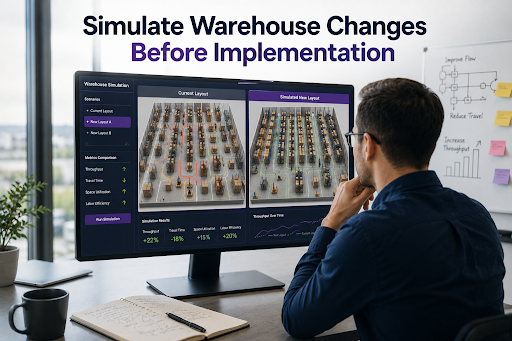
- Simulate routing, allocation, and fulfillment scenarios before execution
- Predict bottlenecks and capacity constraints using AI-driven insights
- Optimize inventory positioning and inter-warehouse coordination
- Improve throughput, service levels, and operational efficiency
By combining Digital Twin with AI and advanced simulation, Synkrato helps warehouse leaders move from reactive decision-making to predictive network orchestration.
Ready to optimize coordination across your warehouse network? Schedule a demo with Synkrato and discover how Digital Twin technology can improve visibility, fulfillment efficiency, and network-wide performance.
FAQs
How does a digital twin synchronize operations across multiple warehouse nodes?
A digital twin continuously replicates inventory, order, labor, capacity, and transportation states across all warehouse nodes. By maintaining a synchronized virtual model of the network, a digital twin enables real-time coordination, faster decision-making, and consistent execution across distributed fulfillment operations.
What coordination inefficiencies occur in multi-warehouse networks?
Common inefficiencies in multi-warehouse networks include fragmented inventory visibility, delayed order allocation decisions, redundant inventory transfers, capacity imbalances, inconsistent replenishment strategies, and poor synchronization between warehouses. These issues increase fulfillment costs and reduce network responsiveness.
How can simulation improve inter-warehouse order routing decisions?
Simulation allows organizations to test routing strategies under different demand, inventory, labor, and transportation conditions. Decision-makers can evaluate impacts on service levels, fulfillment costs, capacity utilization, and throughput before implementing changes in live operations.
What data is required to build a network-level digital twin?
A network-level digital twin typically requires data from WMS, OMS, TMS, ERP, labor management systems, automation platforms, inventory planning tools, and transportation networks. Real-time operational data improves model accuracy and decision quality.
How does a digital twin optimize inventory allocation across locations?
A digital twin continuously evaluates inventory positions against demand forecasts, fulfillment requirements, and network constraints. This enables proactive inventory balancing and reduces stock shortages, excess inventory, and emergency transfers.
Can digital twins reduce inter-warehouse transfer costs and delays?
Yes. Digital twins improve inventory positioning, demand forecasting, and allocation decisions, reducing unnecessary transfers. When transfers are required, simulation helps identify the most efficient movement strategy, lowering transportation costs and operational delays.
How does AI improve predictive coordination across warehouse networks?
AI enhances forecasting, identifies emerging bottlenecks, evaluates millions of operational scenarios, and continuously optimizes routing, inventory allocation, and fulfillment decisions. An AI-driven digital twin enables proactive coordination instead of reactive problem-solving.
How quickly can multi-warehouse operations see ROI from digital twin deployment?
ROI timelines vary based on network complexity and implementation scope. Organizations typically realize value through reduced transfer costs, improved inventory utilization, better capacity balancing, lower fulfillment costs, and increased throughput. Initial benefits often appear within the first few months after deployment, while larger optimization gains accumulate over time.