
Fulfillment operations in 3PL warehouses are under constant pressure from rising order volumes, tighter delivery windows, and unpredictable disruptions. Even small inefficiencies in picking routes, slotting decisions, or labor allocation can quietly snowball into delays and rising costs. The challenge is to know what will break before it actually does.
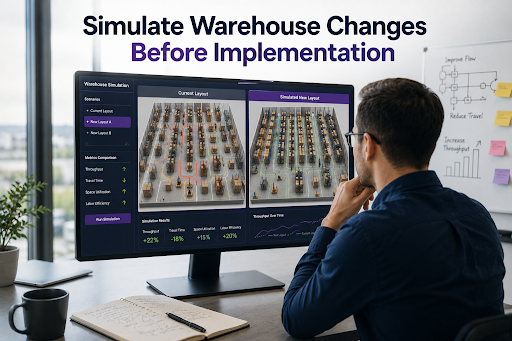
A digital twin solves this by creating a live virtual replica of the warehouse that mirrors real-time operations. It allows 3PL providers to simulate changes, spot bottlenecks early, and optimize performance before anything is executed on the floor.
In this blog, we’ll explore how a warehouse digital twin helps 3PL warehouses simulate scenarios, uncover hidden inefficiencies, and continuously optimize fulfillment performance.
Why Problems Often Start With Limited Operational Visibility in 3PL Fulfillments
Limited visibility across multi-client operations prevents 3PL warehouses from identifying system-level inefficiencies in real time. This lack of visibility typically manifests across three critical operational gaps:
How Fragmented Client Data Creates Hidden Fulfillment Inefficiencies
3PL warehouses typically operate across multiple disconnected data sources, including WMS, OMS, carrier platforms, and client-specific systems. Each client may also define its own SLAs, order structures, and priority rules, which further fragments operational data.
This fragmentation leads to blind spots, such as:
- Inability to see true cross-client demand pressure in real time
- Delayed detection of inventory imbalances across zones or locations
- Misalignment between order priority and actual execution sequencing
- Limited understanding of how one client’s spikes affect others
As a result, operational decisions are often made based on partial information, which increases inefficiencies and reactive firefighting.
Why Shared Infrastructure Often Exposes Coordination Constraints
In shared 3PL environments, all clients compete for the same underlying resources: labor, storage space, picking capacity, and dispatch windows. Without unified visibility, coordination across these shared resources becomes reactive rather than planned.
This creates structural constraints such as:
- Overloaded zones while adjacent areas remain underutilized
- Conflicting priorities during peak dispatch periods
- Inefficient labor allocation across clients with varying urgency levels
- Bottlenecks that shift unpredictably between inbound, storage, and outbound flows
Even when individual processes are optimized, a lack of end-to-end coordination reduces overall system efficiency.
Suggested Read: Warehouse Digital Twin for Ecommerce to Optimize Operations
How Digital Twin Intelligence Addresses Visibility Gaps Traditional Systems Miss
A digital twin is a real-time virtual model of a physical warehouse that mirrors ongoing operations by integrating data from systems like WMS, OMS, labor management tools, and IoT devices. Unlike traditional dashboards that show fragmented or delayed information, it provides a continuously updated, unified view of the entire fulfillment environment.
In 3PL warehouses, visibility gaps arise because each system typically captures only one part of the operation, making it difficult to see how orders, inventory, and labor interact across clients in real time. This leads to blind spots in resource utilization, demand spikes, and SLA risks.
A digital twin closes these visibility gaps by integrating all operational layers into a single, continuously updated model. This enables 3PL operators to:
- Monitor real-time order flow across all clients, channels, and priority levels
- Track inventory movement across bins, zones, and fulfillment nodes in real time
- Visualize labor allocation and equipment utilization as conditions change
- Understand how delays or spikes in one process cascade across the entire system
More importantly, it shifts visibility from descriptive to predictive. Instead of only showing what is happening, the digital twin helps simulate what will happen under different scenarios, such as demand surges, labor shortages, or carrier delays.
This unified and dynamic visibility allows warehouse operators to move from reactive firefighting to proactive orchestration, ensuring that SLA commitments are maintained even under complex, multi-client conditions.
Why 3PL Fulfillment Models Break Under Multi-Client Complexity
3PL fulfillment models often struggle because multiple clients with different priorities, products, and service expectations must be managed within the same operational environment. This complexity typically breaks down in a few critical areas:
Conflicting SLA Requirements Across Multiple Clients
3PL warehouses operate under overlapping SLAs that often compete for the same resources. Clients may require:
- Same-day or next-hour fulfillment
- Cost-optimized batch processing
- Fixed dispatch windows for B2B orders
These requirements create priority conflicts at the execution level. A high-priority D2C order can disrupt bulk wave picking, while strict dispatch cutoffs may override optimal batching strategies.
SKU diversity and Demand Variability
3PL warehouses handle diverse business models, including B2B, D2C, and omnichannel retail. Each introduces different SKU velocity patterns and storage requirements.
High SKU proliferation increases:
- Slotting complexity
- Picking path variability
- Inventory fragmentation
Demand variability further amplifies the issue. Seasonal spikes from one client can disrupt baseline operations for others, especially when shared resources are limited.
Operational Fragmentation Across Shared Warehouse Infrastructure
Shared infrastructure creates operational silos:
- Dedicated zones for specific clients
- Segmented labor pools
- Isolated workflows within the same facility
This fragmentation reduces overall system efficiency. Local optimizations often conflict with global throughput objectives. Synkrato’s Digital Twin approach unifies fragmented workflows into a single coordinated model, improving overall productivity by up to 25%.
Digital Twin as a Unified Control Layer for Multi-Client Operations
A digital twin acts as a centralized intelligence layer that synchronizes and optimizes all client operations within a shared warehouse environment. This unified control layer enables coordinated decision-making across fragmented workflows:
Real-Time Replication
A digital twin continuously mirrors the warehouse by creating a real-time, client-level operational model.
This includes:
- Order inflow segmented by client, channel, and priority
- Inventory positions across bins, zones, and storage types
- Resource allocation, including labor, equipment, and dock capacity
Unlike traditional systems that provide static snapshots, the digital twin continuously synchronizes WMS and OMS data to maintain a real-time replica of warehouse operations.
This allows operators to:
- Track how each client’s demand impacts shared resources
- Dynamically reallocate labor based on workload shifts
- Adjust picking and replenishment strategies in real time
This is a core capability of a digital twin for 3PL order processing and workflow optimization.
Centralized Visibility Across Processes for All Clients
A major limitation in 3PL operations is fragmented visibility across operational stages for all clients.
Digital twins unify:
- Inbound scheduling, dock utilization, and receiving workflows
- Storage allocation, slotting efficiency, and inventory movement
- Outbound processing, picking, packing, and dispatch timelines
This creates a single, unified operational view across all clients and processes. A digital twin system enables synchronized monitoring and control across complex industrial environments. In a 3PL context, this translates into:
- Cross-client workload balancing
- Bottleneck identification across shared processes
- Coordinated execution of fulfillment strategies
- SLA-driven resource reallocation in real time
- Predictive operational adjustments through simulation insights
Scenario Simulation for SLA Driven Fulfillment Optimization
A Digital Twin enables 3PL warehouses to move beyond reactive execution by simulating different fulfillment strategies and assessing their impact on SLA performance before deployment in the real environment. This becomes especially powerful when optimizing for competing client priorities:
Testing Fulfillment Strategies
A digital twin allows operators to simulate multiple fulfillment strategies against competing SLA frameworks and priority hierarchies. This includes testing:
- Centralized vs. decentralized fulfillment: Testing single large DC vs multiple regional nodes for speed vs cost trade-offs
- Wave, batch, and real-time picking strategies: Evaluating throughput, labor efficiency, and order latency impacts
- Dynamic inventory slotting and re-slotting policies: Optimizing pick paths based on demand patterns and SKU velocity
- Multi-carrier allocation and routing optimization: Assigning shipments to carriers based on cost, speed, reliability, and SLA priority tiers
- Cross-docking vs. storage-based fulfillment flows: Minimizing dwell time by bypassing storage for fast-moving or priority orders
These simulations expose trade-offs that are otherwise invisible in live operations. For example:
- Faster SLA compliance vs. higher operating cost: Prioritizing premium or same-day orders improves on-time delivery but increases labor overtime, expedited shipping, and handling costs.
- Delivery speed vs. inventory efficiency: Distributing inventory across more nodes reduces delivery time but increases total inventory holding cost and risks stock imbalance across locations.
- High-priority order focus vs. backlog accumulation: Prioritizing urgent orders can improve customer satisfaction metrics but may delay lower-priority orders and create downstream congestion.
- Carrier optimization vs. cost variability: Assigning the fastest carriers improves SLA performance but increases cost volatility when premium carriers hit capacity limits, and fallback carriers are used.
By quantifying these trade-offs, operators can define optimal execution policies aligned with contractual SLAs. Simulation-driven decision-making is essential for optimizing complex logistics systems with multiple constraints.
Suggested Read: Warehouse Digital Twin for Multi Warehouse Operations to Optimize Coordination
Modeling Order Surges Across Clients
A digital twin can simulate sudden and concurrent demand spikes across multiple clients to understand system behavior under stress. This helps uncover capacity limits, SLA risks, and prioritization conflicts.
Key aspects typically modeled include:
- Concurrent demand spikes across accounts: Simulating multiple clients experiencing promotions, seasonality, or viral demand at the same time.
- Priority-based resource allocation: Testing how warehouse space, labor, and transport capacity are distributed when high-priority clients compete with standard SLA clients.
- System bottlenecks under peak load: Identifying constraints in picking, packing, sorting, or dispatch when order volumes exceed normal thresholds.
- Cascading SLA violations: Observing how delays in early stages (e.g., picking delays) propagate downstream and impact delivery commitments.
This allows operators to:
- Pre-allocate labor and equipment
- Adjust inbound and outbound schedules
- Reconfigure workflows before disruptions occur
In practice, this reduces operational firefighting, emergency interventions, and SLA violations during peak periods.
This capability is central to 3PL warehouse simulation using digital twin technology, enabling predictive rather than reactive fulfillment management.
AI Augmented Digital Twin for Predictive SLA Management
AI integration transforms a digital twin from a monitoring system into a predictive and self-optimizing control layer for SLA-driven fulfillment.
This enables proactive decision-making across complex, multi-client warehouse environments:
Predicting Fulfillment Risks
An AI-augmented digital twin continuously analyzes incoming demand signals such as order inflows, promotional events, seasonal trends, and client-specific spikes. By combining these signals with historical patterns, it generates short-term and mid-term forecasts of order volume across clients, SKUs, and fulfillment nodes.
Once demand is projected, the twin evaluates whether existing operational capacity can support it. This includes:
- Warehouse labor availability
- Picking and packing throughput
- Inventory positioning
- Carrier capacity
- Cut-off schedules
Instead of reacting to delays, operators receive forward-looking risk alerts. For example:
- A sudden spike in D2C orders for one client may trigger pre-emptive labor reallocation
- Predicted congestion in picking zones can prompt dynamic rerouting of tasks
It also evaluates different prioritization strategies, such as premium vs. standard SLAs, and shows how shifting focus impacts overall system stability. In some cases, protecting one high-priority client may increase backlog risk elsewhere, and the twin makes these trade-offs explicit.
The outcome is a predictive risk layer that continuously flags:
- Orders likely to miss SLA thresholds
- Nodes approaching capacity saturation
- Workforce shortages under projected load
- Inventory mismatches across fulfillment centers
This allows planners to take preventive actions such as redistributing inventory, pre-allocating labor shifts, adjusting carrier assignments, or throttling order acceptance during extreme spikes.
Continuous Optimization of Workflows
AI enables the digital twin to continuously improve fulfillment performance by feeding live operational data back into it and dynamically adjusting workflows. The system integrates real-time inputs from WMS, transportation management systems, order management platforms, and IoT sensors on the floor. This includes live updates on order status, pick rates, dock congestion, labor utilization, and shipment departures.
Using this data, the digital twin constantly recalibrates its internal state to reflect actual warehouse conditions. Unlike static planning models, it adapts to disruptions such as equipment downtime, labor shortages, carrier delays, or sudden order surges.
Based on updated conditions, the AI layer recommends or automatically triggers workflow optimizations. These may include:
- Reassigning picking tasks to reduce travel distance and congestion
- Adjusting batch sizes or wave schedules to improve throughput
- Dynamically changing slotting strategies for high-velocity SKUs
- Rerouting orders to alternate fulfillment centers for faster SLA compliance
- Optimizing dock scheduling to reduce idle time and bottlenecks
Over time, reinforcement learning or optimization algorithms evaluate which interventions consistently improve SLA adherence, cost efficiency, and throughput. The system learns from outcomes and refines future decision-making policies. This creates a closed-loop optimization cycle where:
- Operations generate real-time data
- The digital twin updates the system state
- AI models evaluate and simulate alternatives
- Optimized decisions are applied back to operations
- Results are measured and fed into learning models
The result is a continuously improving fulfillment system that becomes more efficient and resilient over time, rather than relying on fixed rules or periodic planning cycles. With Synkrato, the digital twin continuously refines workflows and reduces unnecessary movement, contributing to up to 50% reduction in travel time on the warehouse floor.
Quantifying Fulfillment Performance Improvements in 3PL Warehouses
A warehouse digital twin for 3PL warehouses to improve fulfillment must deliver measurable impact across service, efficiency, and cost metrics. These improvements can be quantified across key operational performance areas:
Improvement in SLA Adherence Across Multiple Clients
One of the most direct indicators of performance improvement is higher SLA adherence rates across diverse client accounts. In a 3PL environment, each client may have different delivery promises, prioritization rules, and service levels, making consistent fulfillment challenging.
With predictive modeling and real-time optimization, warehouses can better anticipate demand fluctuations and allocate resources proactively. This reduces late shipments caused by capacity overload, bottlenecks, or misaligned prioritization.
Improvements are typically observed in:
- Higher on-time-in-full (OTIF) delivery rates
- Reduced SLA breaches during peak demand periods
- More consistent performance across premium and standard clients
- Better handling of competing priority orders without systemic delays
This leads to more stable service quality even under variable and high-volume conditions.
Suggested Read: Warehouse Digital Twin for High Volume Warehouses to Improve Efficiency
Reduction in Order Processing Delays and Exceptions
Order delays and exceptions often arise from inefficiencies such as picking errors, stock mismatches, dock congestion, or manual intervention requirements. In multi-client warehouses, these issues are amplified due to complexity and scale.
By using AI-driven orchestration and digital twin simulations, workflows become more predictable and streamlined. The system can detect potential delays early and reroute or rebalance workloads before exceptions occur.
Key improvements include:
- Faster order cycle time from receipt to dispatch
- Lower frequency of exception handling (rework, corrections, re-picks)
- Reduced manual intervention in exception resolution
- Earlier detection of stockouts or misallocations
Overall, the warehouse shifts from a reactive exception-handling model to a proactive prevention model.
Increase in Throughput Within Shared Warehouse Environments
Throughput improvement refers to the ability to process more orders within the same infrastructure and time window. In shared 3PL environments, throughput is often constrained by labor efficiency, space utilization, and process bottlenecks.
Optimization techniques such as dynamic slotting, wave optimization, and real-time task balancing improve how work is distributed across teams and zones. This reduces idle time and congestion while maximizing productive labor hours.
Improvements are typically seen in:
- Higher orders processed per hour per labor unit
- Improved pick-and-pack efficiency
- Better utilization of warehouse zones and equipment
- Reduced idle time in staging and dispatch areas
This allows 3PL operators to handle higher volumes without proportional increases in resources.
Reduction in Cost Per Order Across Multi-Client Operations
Cost per order is a critical profitability metric in 3PL operations, where efficiency directly impacts margins. Labor, transportation, storage inefficiencies, and exceptions highly influence costing. With labor accounting for 50–70% of total warehouse operating costs, optimizing workforce allocation has a direct impact on cost per order.
By optimizing workflows and reducing inefficiencies, digital twin-driven systems help lower overall operational costs per transaction. Better resource allocation ensures fewer wasted movements, reduced overtime, and improved carrier utilization.
Key cost reductions come from:
- Lower labor cost per fulfilled order due to improved productivity
- Reduced overtime and surge staffing requirements
- Optimized carrier selection and reduced shipping inefficiencies
- Fewer reworks and exception-handling costs
Over time, these efficiencies compound, enabling more competitive pricing for clients while preserving or improving profitability for the 3PL provider.
Strategic Triggers for Digital Twin Adoption in 3PL Warehousing
Adoption of a warehouse digital twin for 3PL warehouses to improve fulfillment is typically driven by scaling complexity and diminishing returns from traditional optimization approaches. These triggers indicate when existing systems can no longer sustain performance:
Increasing Client Base with Diverse Fulfillment Requirements
As the client portfolio of 3PL providers expands, operational complexity increases exponentially rather than linearly. Each client may introduce unique SLAs, packaging rules, order profiles, cut-off times, carrier preferences, and priority hierarchies. This diversity makes it difficult to manage operations using standardized workflows alone.
A growing client base creates challenges such as:
- Conflicting SLA requirements across premium and standard clients
- Different order profiles (B2B bulk shipments vs B2C small parcels)
- Varying peak demand cycles across industries and geographies
- Customized handling rules (labeling, kitting, compliance constraints)
At this stage, warehouse optimization tools struggle to evaluate cross-client trade-offs in real time. A digital twin becomes valuable because it can simulate multi-client interactions under shared constraints. It allows operators to test how changes in prioritization, inventory placement, or labor allocation affect all clients simultaneously.
This helps ensure that service improvements for one client do not silently introduce SLA risk for others. The key trigger here is rising heterogeneity combined with shared infrastructure pressure, where operational decisions are no longer independent across clients.
Operational Inefficiencies Despite Process Standardization or Automation
Many 3PL warehouses invest in standard operating procedures (SOPs), warehouse management systems (WMS), and automation tools to improve efficiency. However, inefficiencies often persist even after these implementations because the system remains largely reactive and rule-based rather than adaptive.
Common signs include:
- Persistent SLA variability despite standardized workflows
- Bottlenecks shifting between processes rather than being eliminated
- Underutilization in some areas, while others are consistently overloaded
- Increased exception handling even in “automated” environments
- Limited visibility into cross-process interdependencies
These inefficiencies occur because traditional systems optimize individual processes in isolation (e.g., picking, packing, dispatch) rather than simulating the entire end-to-end flow under real-world variability. A digital twin allows warehouses to simulate:
- End-to-end order flow dynamics across receiving, storage, picking, packing, and dispatch to understand system-wide behavior rather than siloed performance
- Resource contention scenarios where labor, equipment, and dock capacity are simultaneously stressed by demand fluctuations
- Multi-client priority conflicts to evaluate how competing SLAs interact under shared infrastructure constraints
- Peak load and disruption events, such as demand surges, carrier delays, or workforce shortages, to test operational resilience
By modeling these scenarios, the digital twin shifts operations from reactive problem-solving to predictive and prescriptive decision-making, enabling continuous optimization of the entire fulfillment network.
Execution Framework for 3PL Digital Twin Implementation
Implementing a warehouse digital twin for 3PL warehouses to improve fulfillment requires a structured execution framework that aligns data, simulation, and continuous optimization. This framework ensures scalability, accuracy, and measurable impact across multi-client operations:
Integrating WMS, OMS, and Client-Level Data Streams
The foundation of a 3PL digital twin is data integration. Most warehouses operate with fragmented systems where the Warehouse Management System (WMS), Order Management System (OMS), transport systems, and client platforms function independently. This creates visibility gaps and limits end-to-end optimization.
To build a unified model, the following data streams are integrated:
- WMS data: Inventory levels, location mapping, pick/pack status, labor allocation, and warehouse task execution
- OMS data: Order creation time, priority rules, SLA definitions, cancellations, and modifications
- Transport data (TMS/carrier feeds): Dispatch schedules, delivery status, transit delays, and carrier performance
- Client-level inputs: Contractual SLAs, priority tiers, order profiles, packaging rules, and business-specific constraints
Once unified, these datasets are normalized into a single operational representation of the warehouse ecosystem. This enables the digital twin to reflect real-time conditions across all fulfillment stages, rather than isolated system views. The key outcome is a single source of operational truth, where every order, resource, and constraint is visible in one simulation environment.
Building Simulation Scenarios Aligned with SLA
After data integration, the next step is constructing simulation scenarios that reflect real operational complexity. These scenarios are designed around SLA commitments, client hierarchies, and demand variability.
Typical scenario structures include:
- Priority-based fulfillment scenarios: Testing how premium vs. standard orders are processed under constrained capacity
- Demand surge simulations: Modeling sudden spikes from individual clients or multiple clients simultaneously
- Resource stress scenarios: Evaluating performance under reduced labor, limited dock capacity, or carrier shortages
- Disruption scenarios: Introducing delays such as system downtime, shipment backlogs, or inbound inventory delays
- Policy comparison scenarios: Comparing wave picking vs batch picking, centralized vs decentralized fulfillment, or different slotting strategies
Each scenario is aligned with SLA rules to measure real business impact, not just operational efficiency. For example, the model evaluates how a decision affects on-time delivery rates for high-priority clients versus overall system throughput.
This enables decision-makers to test “what-if” conditions before execution, ensuring that operational changes are both efficient and SLA-compliant.
Continuous Optimization Cycles for Multi-Client Fulfillment Performance
Once deployed, the digital twin operates as a continuous optimization system rather than a one-time planning tool. It evolves through iterative feedback loops that connect simulation outputs with real-world performance data.
The optimization cycle typically includes:
- Real-time data ingestion from WMS, OMS, and transport systems
- State synchronization of the digital twin with live warehouse conditions
- Simulation of alternative actions under current constraints and demand forecasts
- Selection of optimized decisions based on SLA adherence, cost, and throughput objectives
- Execution in physical operations through WMS or orchestration systems
- Performance feedback capture to measure actual outcomes against predictions
Over time, machine learning models refine decision accuracy by learning from discrepancies between simulated and real outcomes. This allows the system to improve predictions for demand surges, resource constraints, and client-specific behavior patterns.
In multi-client environments, this continuous loop is critical because it ensures that optimization is not static. Instead, the system dynamically balances competing SLAs, adjusts to shifting demand patterns, and improves overall warehouse performance over time without manual reconfiguration.
Transform Multi-Client Fulfillment with Synkrato
Managing multi-client complexity requires more than visibility; it demands real-time orchestration, predictive intelligence, and continuous optimization. This is where Synkrato enables 3PL operators to move beyond fragmented execution. Synkrato is designed to operationalize digital twins for 3PL warehouses to improve fulfillment, integrating data, simulation, and AI into a unified control layer.
With Synkrato, 3PL leaders can:
- Achieve end-to-end visibility across all processes in your warehouse, from inventory to delivery.
- Simulate multiple fulfillment scenarios to predict potential bottlenecks, optimize workflows, and align with SLA priorities before making operational changes.
- Continuously optimize performance with real-time data ingestion and machine learning models that evolve with your operations, ensuring constant improvements in efficiency and client satisfaction.
- Maximize throughput and minimize operational costs, helping you deliver on SLAs consistently while improving profitability.
Synkrato helps you anticipate demand fluctuations, manage multi-client complexity, and respond to disruptions, ensuring your warehouse operates at its peak every day. Start your digital twin journey today and transform your 3PL operations with Synkrato!
FAQs
How can a digital twin manage multiple client SLAs in a 3PL warehouse?
A digital twin models client-specific SLAs, order priorities, and resource constraints in real time, enabling dynamic resource allocation and workflow adjustments across competing requirements. With Synkrato’s digital twin, these decisions are continuously simulated and optimized, helping maintain consistent SLA adherence across all clients.
What fulfillment inefficiencies are unique to 3PL operations that a digital twin can solve?
3PL warehouses face inefficiencies like SLA conflicts, resource contention, and fragmented workflows. A digital twin resolves these by providing unified visibility, predictive insights, and system-wide optimization across shared infrastructure.
How does simulation help optimize resource allocation across multiple clients?
Simulation tests different allocation strategies under varying demand and SLA conditions. It identifies optimal labor, space, and equipment distribution without disrupting operations. Synkrato’s digital twin enables this by running real-time scenario simulations to evaluate trade-offs before execution.
What data is required to build a digital twin for 3PL warehouse environments?
A digital twin requires data from WMS, OMS, inventory systems, labor management tools, and client-specific order streams. Real-time data on operations, resources, and workflows is essential for accurate modeling and optimization.
How can a digital twin reduce order delays and SLA violations?
A digital twin reduces delays by predicting bottlenecks, identifying SLA risks, and dynamically adjusting workflows and resource allocation. Synkrato’s digital twin continuously analyzes live operations to trigger preemptive adjustments, ensuring smoother execution and fewer SLA breaches.
Can digital twins improve throughput in shared warehouse infrastructure?
Yes. By optimizing picking strategies, labor deployment, and equipment usage, digital twins increase throughput without requiring additional infrastructure, improving overall operational efficiency in shared environments.
How does AI enhance predictive fulfillment management in 3PL warehouses?
AI analyzes historical and real-time data to forecast demand, detect risks, and optimize workflows. It enables continuous learning and adaptive decision-making, improving fulfillment performance and SLA compliance.
What KPIs should be tracked to measure fulfillment performance improvements?
Key KPIs include SLA adherence rate, order cycle time, throughput, cost per order, resource utilization, and exception rates. These metrics quantify the impact of digital twin implementation on operational performance.