E-commerce warehouse performance is no longer constrained by infrastructure. It is constrained by how well the system understands and adapts to its own behavior.
Order profiles shift continuously, SKU velocity changes, order composition fragments, and channel-specific SLAs introduce conflicting execution priorities. With fulfillment costs accounting for 15-25% of total ecommerce revenue, even marginal efficiency gains at the warehouse level have a disproportionate impact on profitability.
A warehouse digital twin for e-commerce to optimize operations addresses this gap by creating a continuously synchronized model of the warehouse. I
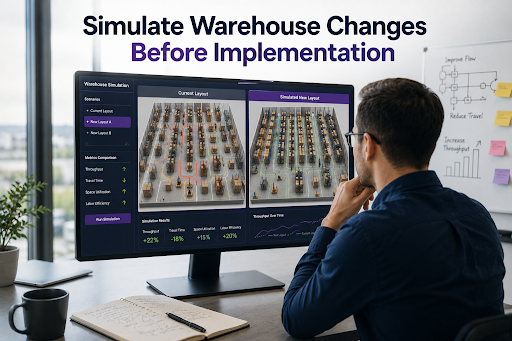
This blog dives into how digital twin environments allow operators to test decisions against real operational constraints before executing them. This shifts warehouse management from reactive control to predictive execution.
Why Fulfillment Problems Often Start With Limited Operational Visibility
In most warehouse networks, operational inefficiencies do not originate from execution. They originate from incomplete visibility across systems, workflows, and time horizons. You typically see performance metrics in isolation: inventory accuracy, order cycle time, labor productivity, but not how these variables interact in real time. This fragmentation delays intervention until constraints surface as delays, congestion, or SLA breaches. As fulfillment complexity increases, this lag between system state and operational reality becomes the primary driver of inefficiency.
Modern platforms like Synkrato address this by introducing a decision intelligence layer above your WMS, creating a continuously updated operational model that aligns inventory, labor, and order flow in real time.
How Fragmented Data Creates Hidden Fulfillment Inefficiencies
You operate across multiple systems like WMS for inventory, OMS for order orchestration, and separate tools for labor or automation. Each system is optimized locally, but they rarely converge into a unified operational view. This fragmentation creates blind spots where inefficiencies accumulate without immediate detection.
Across supply chain surveys, 60%-80% of companies consistently rank improved visibility across orders, inventory, and shipments as a top operational priority, underscoring that end-to-end transparency has become a core constraint
In practice, this means:
- You may see high pick productivity while packing queues silently build up downstream
- Labor allocation may appear balanced, while zone-level congestion goes undetected
- Inventory may be “available,” but not positioned for actual demand flow
The inefficiency is not operational failure but an informational latency.
Suggested Read: Warehouse Digital Twin for 3pl Warehouses to Improve Fulfillment
Digital Twin as a Live Operational Mirror of E-commerce Fulfillment
Even baseline visibility is often flawed. Industry benchmarks show that warehouses operate at only 92-94% inventory accuracy, meaning a consistent gap between recorded and actual stock, directly impacting picking, replenishment, and order fulfillment reliability. A digital twin can address the gap significantly.
Synkrato’s real-time digital twin and AI-driven decision intelligence integrate with your existing WMS, enabling warehouses to simulate, validate, and continuously optimize execution without disrupting live operations.
Real-Time Replication Of Inventory Movement, Order Flow, And Resource Utilization
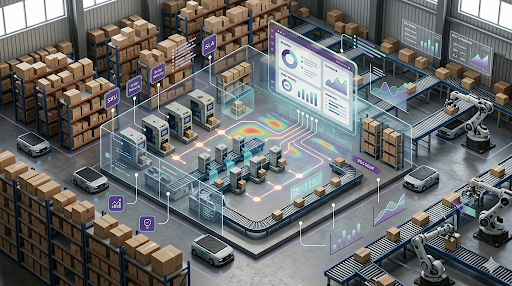
A digital twin operates as a real-time computational model of the warehouse. To understand its role, it helps to define three core elements: inventory movement, order flow and resource utilization.
By continuously synchronizing these elements, the digital twin creates a state where the system can simulate near-future outcomes.
For example, it can estimate how a surge in orders for a specific SKU will impact pick paths, replenishment cycles, and downstream processing capacity within the next hour. This is what enables a warehouse digital twin for order fulfillment optimization in e-commerce. Decisions are evaluated against their operational consequences before execution.
Continuous Visibility Into Micro-Level Process Inefficiencies Across Warehouse Zones
Warehouse inefficiencies are rarely driven by a single constraint. They emerge from repeated micro-level deviations such as slightly longer pick paths, uneven workload distribution across zones, and minor delays in handoffs between processes.
Individually, these are negligible. Collectively, they define throughput.
A digital twin captures these inefficiencies as patterns over time. For instance, it can identify that a specific zone consistently experiences congestion during certain order profiles, or that certain SKU combinations increase travel distance disproportionately.
This level of analysis enables e-commerce warehouse performance optimization using a digital twin, where improvements are driven by eliminating cumulative inefficiencies rather than isolated fixes.
Identifying Hidden Operational Inefficiencies Using Digital Twin Intelligence
In warehouse operations, inefficiencies are often misattributed to labor productivity or capacity limitations. In reality, they are frequently structural, embedded in how work is organized and executed. At an e-commerce scale, even small error rates compound. A warehouse operating at 98% picking accuracy can still generate hundreds of incorrect shipments monthly, each introducing rework, cost, and customer friction.
The table below outlines how these inefficiencies manifest and how a digital twin surfaces them:
| Operational Area | Hidden Issue | How It Manifests | Digital Twin Insight |
| Picking paths | Suboptimal routing | Increased travel time per pick | Identifies actual movement patterns vs optimal paths |
| Inventory placement | Misaligned slotting | High-frequency SKUs in low-access zones | Detects divergence between demand and placement |
| Zone activity | Imbalanced workload | Congestion in some zones, idle capacity in others | Maps real-time load distribution |
| Downstream flow | Sequencing inefficiencies | Delays in packing and dispatch | Tracks order progression and queue formation |
AI Augmented Digital Twin for Predictive Operational Control
As warehouse variability increases, the challenge shifts from visibility to anticipation. It is no longer enough to understand the current state. Operations need to predict how conditions will evolve. AI augments the digital twin by identifying patterns, forecasting disruptions, and enabling proactive control over execution.
Predicting Demand-Driven Disruptions Before They Impact Fulfillment Performance
Artificial intelligence enhances the digital twin by identifying patterns that precede operational disruption.
For example, a rapid increase in SKU-level demand, combined with rising pick density in specific zones, may indicate an impending congestion point. Instead of reacting after delays occur, the system can recommend preemptive actions such as redistributing workload or adjusting batching logic.
Continuous Learning From Real Time Warehouse Data To Refine Execution Strategies
Unlike rule-based systems, an AI-augmented digital twin evolves with the operation. Each execution cycle provides feedback on:
- Which strategies improved throughput
- Where bottlenecks emerged despite optimization
- How demand patterns influenced flow
Over time, this creates a system that does not just respond to change but learns how to operate more efficiently under changing conditions.
Suggested Read: Warehouse Digital Twin for Multi Warehouse Operations to Optimize Coordination
Quantifying Operational Gains from Digital Twin Deployment
The impact of a digital twin is best understood not as isolated improvements, but as systemic gains across flow efficiency.
| Metric | Before Digital Twin | After Digital Twin |
| Order cycle time | Variable, dependent on bottlenecks | More consistent and predictable |
| Cost per order | Inflated by excess movement and idle time | Reduced through optimized workflows |
| Throughput | Constrained by coordination gaps | Increased through-flow alignment |
Scenario Simulation for High Variability E-commerce Workloads
E-commerce workloads are defined less by volume and more by variability, shifting SKU demand, changing order structures, and uneven workload distribution across the warehouse. Static planning cannot accommodate this. Simulation becomes essential to evaluate how different demand conditions will impact flow before execution.
Modeling Peak Demand Events And Promotional Order Surges
Peak events in ecommerce do not simply increase order volume—they fundamentally alter how work is distributed across the warehouse. SKU concentration increases, order similarity rises, and specific zones experience disproportionate pressure.
A digital twin models these demand shapes before they occur. Instead of asking “can we handle 2x volume,” it evaluates how that volume will move: Which SKUs will dominate picks, which zones will experience congestion, and where replenishment cycles will fail to keep pace.
This distinction matters. Most warehouses are not constrained by total capacity, but by localized saturation points- areas where flow breaks under uneven load.
A warehouse digital twin for order fulfillment optimization in e-commerce enables pre-event adjustments such as rebalancing inventory, modifying pick strategies, or reallocating labor based on simulated outcomes rather than assumptions.
Testing Fulfillment Strategies Across Different SKU Mix And Order Profiles
Two warehouses processing the same number of orders can experience completely different performance outcomes depending on order structure. Key variables include:
- Order lines per order (single-line vs multi-line)
- SKU affinity (how often items are picked together)
- Pick density (number of picks per unit of travel)
Traditional systems apply fixed logic like wave picking, batch picking, or zone picking, without evaluating how effective that logic is under changing conditions.
A digital twin allows operators to test different strategies against live order profiles. For example, it can simulate whether batching improves efficiency for a high-affinity SKU mix or whether it introduces delays due to downstream congestion.
This is where e-commerce warehouse performance optimization using a digital twin becomes practical. It identifies not just the best strategy, but the best strategy for a specific demand condition.
Strategic Triggers for Adopting Digital Twin in E-commerce Warehousing
Digital twins are not required for all warehouses. They become critical when operational complexity exceeds the ability of static systems to maintain alignment between demand and execution.
Scaling SKU Count With Increasing Order Complexity Across Channels
As SKU count grows, so does variability in picking behavior. More importantly, SKU interactions increase- how items are ordered together, how frequently they are accessed, and how they impact movement patterns.
At a certain point, this creates non-linear complexity, where small demand changes produce disproportionate operational impact. Symptoms include rapid degradation in pick efficiency, increased reliance on manual overrides, and growing inconsistency across shifts.
Performance Plateau Despite Process Improvements Or Automation Investments
Automation improves task efficiency, but it does not automatically improve system coordination. Many warehouses reach a stage where:
- Pick rates improve, but order cycle time does not
- Conveyor or sorter capacity increases, but queues persist
- Labor productivity rises, but cost per order remains flat
This plateau indicates that the constraint is no longer execution speed. It is how decisions are made across the system.
A digital twin addresses this by introducing a decision layer that continuously aligns execution with real-time conditions- unlocking value from existing infrastructure.
Execution Framework for E-commerce Digital Twin Implementation
Implementing a digital twin is less about deploying technology and more about establishing a decision system grounded in operational reality.
Integrating Real-Time Data Streams Across Wms, Oms, And Warehouse Systems
At the core of any digital twin is data synchronization.
- WMS (Warehouse Management System) provides inventory state and task execution data
- OMS (Order Management System) provides order inflow and prioritization
- Additional systems (automation controls, IoT sensors) provide movement and utilization data
The objective is not just integration, but low-latency alignment. Delays in data propagation create discrepancies between the model and actual operations, reducing decision accuracy.
Building Simulation Models Aligned With Actual Operational Constraints
A digital twin is only as effective as the assumptions it operates on. High-fidelity models account for travel time variability across different zones, labor behavior, including fatigue and shift patterns, and equipment performance under varying load conditions.
Ignoring these factors leads to recommendations that are optimal in theory but infeasible in execution. A digital twin for warehouse process optimization in e-commerce fulfillment must reflect constraints as they exist, not as they are designed.
Continuous Optimization Cycles Driven By Performance Feedback And Scenario Testing
Unlike traditional optimization projects, digital twin implementation is not a one-time initiative. It operates as a continuous loop:
- Simulate potential changes under current conditions
- Execute validated strategies in live operations
- Measure impact across flow-level KPIs
- Refine models based on observed outcomes
This feedback cycle is what enables a sustained digital twin for e-commerce warehouse throughput improvement, ensuring that optimization evolves with the operation rather than lagging behind it.
Suggested Read: Warehouse Digital Twin for High Volume Warehouses to Improve Efficiency
Extending WMS into an Intelligent Operating System with Synkrato
Most warehouse systems today are execution engines. They record transactions, manage inventory states, and orchestrate tasks. What they lack is decision intelligence or the ability to understand how operations behave and continuously optimize them.
Synkrato builds on top of your existing WMS to introduce a decision-intelligence layer powered by a digital twin and AI. Instead of replacing systems, it transforms them into a continuously optimizing warehouse environment.
- 3D Digital Twin: Creates a real-time, virtual replica of warehouse operations- mapping inventory, order flow, and resource movement for complete operational visibility.
- Simulation & Scenario Testing Engine: Allows operators to test changes in layout, labor allocation, and workflows before execution, reducing risk and improving decision accuracy.
- AI-Driven Slotting Optimization: Continuously aligns inventory placement with real-time SKU velocity and order patterns to reduce travel time and improve pick efficiency.
- AI-Powered Decision Intelligence (AI Agents): Analyzes operational data to identify inefficiencies, predict disruptions, and recommend optimized execution strategies.
- Real-Time Data Integration (WMS, OMS, IoT Systems): Unifies data across systems to ensure decisions are based on current operational conditions, not delayed reports.
- Warehouse Process Optimization Layer: Continuously refines picking, packing, and dispatch workflows based on flow-level performance insights.
- Enterprise Mobility & AR Enablement: Guides warehouse operators with optimized paths and real-time instructions, improving execution speed and accuracy.
- Enterprise Labeling Platform: Standardizes labeling processes across warehouses, improving consistency and reducing operational errors.
Are you managing warehouse operations or actually optimizing them? Book a demo with us to bridge the gap with real-time intelligence, simulation, and AI-driven decision-making.
FAQs
How can a digital twin model predict e-commerce order variability at the SKU level?
A digital twin models variability by tracking SKU behavior at a granular level—how often items are picked, how they are combined in orders, and how demand shifts over time. Instead of relying on static classifications, it continuously updates these patterns, allowing the system to simulate how changes in SKU demand will impact picking, replenishment, and overall flow. Platforms like Synkrato enable this by maintaining a live, continuously updated model of SKU-level behavior aligned with real-time demand signals.
What operational inefficiencies can a warehouse digital twin uncover that traditional systems miss?
Traditional systems highlight outcomes like missed SLAs, increased cycle time, or low productivity. A digital twin identifies underlying causes such as inefficient pick paths, imbalance in zone workloads, misaligned inventory placement, and sequencing issues in downstream processes. These inefficiencies are often too granular or dynamic to be captured through standard reporting. Synkrato extends this by directly linking these issues to slotting and workflow decisions, making them actionable at an operational level.
How does simulation within a digital twin improve fulfillment decision-making?
Simulation allows operators to evaluate decisions before implementing them. For example, changing batching logic or reallocating labor can be tested against current demand conditions to assess the impact on throughput and cycle time. This reduces trial-and-error in live operations and ensures that decisions are aligned with actual constraints. With Synkrato, simulation is embedded into daily operations, allowing you to validate slotting, labor, and workflow changes before execution.
What data architecture is required to build a real-time warehouse digital twin?
A real-time digital twin requires a unified data layer that integrates WMS, OMS, and operational systems with minimal latency. This includes continuous data pipelines for order inflow, inventory updates, and execution events. The architecture must support both real-time synchronization and historical analysis for simulation and learning.
How does a digital twin help manage peak demand and promotional surges?
It enables pre-event simulation of demand scenarios, allowing warehouses to anticipate how order surges will impact different parts of the operation. Based on these insights, adjustments can be made to inventory placement, labor allocation, and process design before the surge occurs, reducing disruption during peak periods.
Can a digital twin reduce cost per order in e-commerce fulfillment operations?
Yes. Cost reduction is achieved by minimizing non-value-added activities such as excess travel, idle time, and rework. By aligning workflows and resource allocation with real demand patterns, a digital twin improves efficiency without requiring proportional increases in labor or infrastructure.
How does AI enhance predictive capabilities within a warehouse digital twin?
AI identifies patterns in operational data that signal potential disruptions—such as rising congestion, shifting SKU demand, or uneven workload distribution. These insights allow the system to recommend proactive adjustments, improving stability and performance under changing conditions.
What KPIs should be used to measure digital twin performance in e-commerce warehouses?
Key KPIs include order cycle time, throughput rate, cost per order, pick efficiency, and resource utilization. In addition to absolute values, variability across these metrics is critical, as consistent performance under changing demand conditions is a primary indicator of effective optimization.