High-volume warehouses can feel like a swirling storm of products, people, and deadlines. A single misstep can cascade into delays, errors, and lost revenue, but what if you could see the whole system in real time, anticipate bottlenecks, and optimize operations without moving a single pallet? That’s the power of a digital twin. The warehouse digital twin market is rapidly expanding, projected to reach $4.4 billion by 2036 from $900 million in 2025, with a 15.9% annual growth rate.
In this blog, we’ll dive into how warehouse digital twin architecture addresses throughput instability, system coupling, and operational blind spots in complex warehouse environments. It focuses on advanced execution strategies, adaptive control, and AI-driven optimization for sustained performance under scale.
Why Efficiency Problems in High-Volume Warehouses Often Start With System Visibility Gaps
Limited insight into warehouse operations is often the unseen culprit behind inefficiencies. When warehouse managers can’t see the full picture, small issues multiply into costly disruptions. Key areas to examine include:
How Fragmented Operational Signals Create Hidden Efficiency Losses
High-volume warehouses generate massive operational data from WMS, WES, automation controllers, and labor management systems. These traditional systems rely on batch updates, periodic scans, or siloed automation telemetry.
While these data points are useful for micro-level management, they often remain fragmented and unsynchronized, creating delayed visibility and hiding bottlenecks under peak loads. For example:
- A minor delay in inbound docking can propagate across cross-docking and putaway tasks, increasing congestion in high-density storage zones.
- Inconsistent update frequencies between automated storage/retrieval systems (AS/RS) and manual picking can result in temporary over-allocations of labor or material handling equipment, unseen in standard dashboards.
- Inventory anomalies in high-turn SKUs can remain hidden until they cause downstream stockouts or order delays.
- Unexpected machine downtime or maintenance events can ripple through scheduling, disrupting order fulfillment timelines and creating hidden workflow inefficiencies.
Digital twins address these gaps by continuously integrating live operational signals into a unified simulation model, exposing inefficiencies that traditional monitoring tools cannot quantify.
By leveraging Synkrato digital twin solutions, warehouses can transform fragmented operational signals into a unified, actionable model, uncovering hidden bottlenecks before they impact throughput.
Why Complex Process Interdependencies Expose Control Constraints
High-volume warehouses are characterized by tight coupling between processes:
- Picking speed is limited not just by labor but by upstream replenishment accuracy and conveyor throughput.
- Resource allocation for packing depends on real-time synchronization of outbound shipments, which is itself contingent on order wave planning and staging accuracy.
- Automation sequences, such as robotic sorters, interact dynamically with manual zones; misalignment here can propagate queues and reduce overall system fluidity.
- Inventory accuracy and slotting decisions affect both picking efficiency and replenishment cycles; errors or misplacements in high-turn SKUs can cascade, causing congestion in picking lanes and delays in order fulfillment.
Without a holistic model, warehouse managers often optimize local performance metrics, such as picking rate per zone, only to inadvertently degrade total throughput.
Suggested Read: Warehouse Digital Twin for Ecommerce to Optimize Operations
How Digital Twin Intelligence Addresses Visibility Gaps Traditional Systems Miss
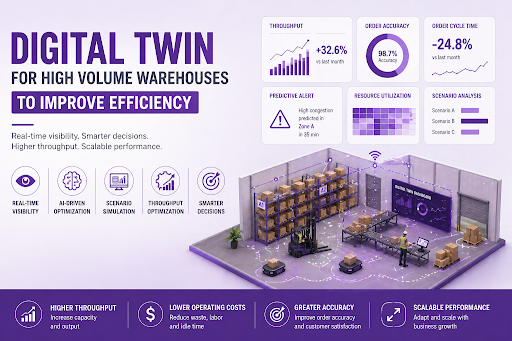
Traditional warehouse systems provide descriptive insights. They report what has already happened. Digital twins integrate multi-source telemetry into real-time operational models. They continuously replicate real-world system states using live data streams. This enables forward-looking analysis of system behavior.
Key capabilities include:
- State replication: mirroring real-time system status for every storage, picking, and outbound node.
- Predictive scenario analysis: simulating consequences of equipment downtime, labor shortages, or demand spikes.
- Adaptive recommendations: suggesting immediate adjustments in task allocation, conveyor routing, and inventory positioning.
- Bottleneck detection: identifying emerging congestion across workflows before it impacts throughput, enabling proactive interventions.
- Performance benchmarking: continuously comparing actual operations against historical and simulated optimal states to guide continuous improvement.
By leveraging this intelligence, warehouses can preemptively manage bottlenecks and maintain consistent throughput even under peak conditions.
Companies using Synkrato digital twins have reported a 25% increase in productivity and a 50% reduction in travel time for warehouse staff, demonstrating the tangible benefits of real-time visibility and proactive bottleneck management.
Throughput Instability Under High Volume Load Conditions
High-volume warehouses often experience significant variability in throughput, where minor disruptions can escalate into systemic performance issues. Understanding the root causes of instability is critical for applying digital twin-based optimization, as these conditions reveal underlying operational fragilities:
Flow Rate Mismatches Across Inbound, Storage, and Outbound Execution Layers
When inbound receiving, storage replenishment, and outbound fulfillment operate at different processing speeds in high-volume warehouses, system-wide inefficiencies emerge. For instance, Inbound receiving may exceed storage capacity, or picking rates may not align with packing throughput. These mismatches disrupt continuity and create accumulation points within the workflow.
Key impacts include:
- Inbound congestion due to delayed putaway capacity
- Storage saturation from unbalanced replenishment cycles
- Outbound delays caused by insufficient pick-ready inventory
Over time, these imbalances reduce effective throughput and increase cycle time variability across operations. Traditional systems struggle to detect these imbalances early. They operate on static thresholds and delayed metrics.
Queue Propagation Effects Across Interconnected Warehouse Processes
Queues formed in one process stage often propagate downstream, amplifying delays across the entire warehouse. This cascading effect is especially pronounced in tightly coupled systems where processes depend on sequential execution.
For example:
- A delay in carton sorting at a single outbound node can force upstream picking to pause, generating idle time in high-value labor zones.
- Automated guided vehicles (AGVs) waiting for blocked conveyors create cascading traffic congestion, lowering overall system efficiency.
Digital twins enable visualization of these propagation patterns and allow scenario testing of mitigation strategies such as temporary re-routing or dynamic prioritization.
Suggested Read: Warehouse Digital Twin for 3pl Warehouses to Improve Fulfillment
Resource Contention Under Peak Order Concurrency Scenarios
During peak demand periods, multiple processes compete for limited shared resources such as labor, equipment, and storage space. This contention creates operational conflicts that reduce efficiency and increase processing time.
Typical contention scenarios include:
- Forklift Bottlenecks: Multiple picking or replenishment tasks requiring the same equipment simultaneously.
- Packing Station Overload: High order volumes exceeding the capacity of packing or sorting stations.
- Labor Scheduling Conflicts: Limited staff assigned to overlapping high-priority tasks, causing delays.
- Storage Space Congestion: Inbound and outbound flows clash in limited storage areas, slowing movement.
- System Queue Backups: Automated systems like conveyor belts or sorters are being overwhelmed by sudden spikes in order activity.
Without dynamic coordination, resource contention leads to idle time in some areas and overload in others, further destabilizing throughput performance.
Using Synkrato, warehouses can visualize queue propagation effects and simulate mitigation strategies to stabilize throughput even under peak conditions.
System Coupling Effects in High Volume Warehouse Networks
High-volume warehouses operate as tightly coupled systems where decisions in one layer directly influence performance across others, often amplifying inefficiencies under scale. Recognizing and managing these couplings is essential to maintain efficiency and avoid unintended consequences:
Interdependencies Between Inventory Positioning, Order Flow, and Resource Allocation
Inventory placement, order sequencing, and resource deployment are tightly linked, with changes in one element directly impacting the others. High-volume warehouses cannot treat these factors in isolation without risking systemic inefficiency.
Key dynamics include:
- Fast-moving SKUs require optimal placement to minimize picker travel and cycle times.
- Order waves interact with resource availability, impacting labor and equipment utilization.
- Equipment routing and task assignment must align with inventory positioning to maintain smooth flow.
- Storage density and aisle configuration influence pick path optimization and congestion probability.
- Variability in SKU velocity can shift resource demand dynamically across zones.
When these elements are not synchronized:
- High-demand SKUs may be positioned in suboptimal locations, increasing picker travel time and cycle delays.
- Order waves may overload specific zones while underutilizing others, creating localized bottlenecks.
- Labor and equipment may be misaligned with actual workload distribution, reducing resource efficiency.
- Conveyors, sorters, or automated storage systems may experience congestion or idle periods due to flow mismatches.
- Inventory accumulation in critical aisles can block access and propagate delays downstream.
This interdependency requires coordinated real-time operational modeling, dynamic workload balancing, and adaptive control strategies to maintain throughput efficiency across all layers.
Local Process Optimization Causing Downstream Performance Degradation
Optimizing individual nodes without accounting for the broader warehouse network can produce unexpected inefficiencies. High-volume operations are highly interdependent, meaning that improvements in one area often create bottlenecks or idle time in others.
Even when local metrics show gains, systemic throughput may decline if downstream processes are not aligned. These dynamics highlight the importance of evaluating operational changes in the context of the entire workflow:
- Accelerating picking rates in one zone without synchronizing packing and shipping capacity may result in queuing, overstocking, or increased idle time elsewhere.
- Automation scheduling that maximizes conveyor throughput in isolation can lead to starvation of downstream AS/RS modules.
- Even small misalignments in batch or wave sequencing can propagate delays across multi-zone order fulfillment.
Digital twin environments simulate both micro- and macro-level process interactions, enabling managers to evaluate trade-offs and implement adjustments that preserve overall system performance.
Digital Twin Architecture for Real-Time State Replication
High-volume warehouses require digital twin architectures that replicate operational states continuously and accurately, enabling real-time analysis and decision-making. To achieve this, a robust architecture must combine precise process modeling with live system synchronization:
Event Driven Modeling of Warehouse Operations Across Process Layers
High-volume warehouse systems operate through discrete events. These include order releases, inventory movements, task assignments, and equipment triggers.
Traditional systems capture these events but do not model their interactions dynamically. Digital twins employ event-driven models to capture warehouse operations at the finest granularity:
- Every task, picking, packing, replenishment, and equipment movement, is represented as a discrete event with temporal and spatial attributes.
- Interdependencies between events, such as triggering replenishment when stock drops below a threshold or rerouting conveyors due to congestion, are dynamically modeled.
- This approach captures nonlinear behaviors and emergent bottlenecks that traditional batch or averaged models miss.
- By modeling process layers from inbound to outbound, managers gain insight into how local disruptions propagate across the warehouse network.
Event-driven modeling ensures that the digital twin reflects not only individual process performance but also the complex interactions that define high-volume throughput stability.
Synchronization of Live Data Streams With Simulated System States
Accurate digital twin operation depends on continuous synchronization between the physical warehouse and its virtual representation:
- Real-time telemetry from WMS, automation systems, conveyors, AGVs, and labor management platforms feeds the digital twin with up-to-date event data.
- Any divergence between simulated and actual states is automatically reconciled, maintaining a precise reflection of the warehouse in motion.
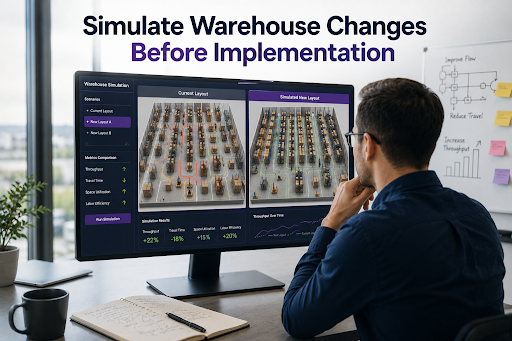
- This allows managers to test “what-if” scenarios, simulate equipment failures, or evaluate surge volumes without disrupting live operations.
- Synchronization also enables adaptive control strategies, where operational adjustments derived from the twin can be deployed immediately to stabilize throughput.
By combining event-driven modeling with live data synchronization, high-volume warehouses achieve a continuously accurate digital twin that supports predictive insights, scenario simulation, and adaptive operational control.
Why Scenario Engineering Improves Decision Making Under Load Stress
High-volume warehouses face unpredictable fluctuations in order volume and SKU velocity that can compromise throughput and operational efficiency. To proactively address these challenges, scenario engineering allows managers to evaluate specific stress conditions and operational constraints across multiple dimensions:
Modeling Extreme Order Volume Spikes and SKU Velocity Fluctuations
Scenario engineering allows simulation of sudden demand surges and rapid changes in SKU velocity, which are common in ecommerce peak cycles. It enables the simulation of extreme operational conditions to identify vulnerabilities:
- Sudden surges in high-demand SKUs can overwhelm picking, packing, and outbound operations, creating cascading queues.
- Variability in SKU velocity shifts workload distribution across zones, exposing resource imbalances.
- Digital twins allow testing of adaptive strategies such as dynamic wave scheduling, inventory repositioning, and labor reallocation.
- Managers can quantify the impact of extreme conditions on throughput and service levels, enabling preemptive operational adjustments.
By modeling these extreme conditions, warehouses can proactively prepare for variability instead of reacting to performance breakdowns.
Suggested Read: Warehouse Digital Twin for Multi Warehouse Operations to Optimize Coordination
Evaluating System Response Under Constrained Resource and Layout Configurations
Scenario engineering also evaluates how the warehouse performs when resources or layout flexibility are limited, which is critical during peak operations.
Key evaluation areas include:
- Labor shortages or uneven workforce distribution
- Limited equipment availability or shared resource conflicts
- Fixed layout constraints impacting flow and accessibility
This analysis helps:
- Understand system resilience under operational constraints
- Identify critical dependencies and failure points
- Optimize contingency strategies for maintaining throughput
By testing constrained scenarios, warehouses can design more robust systems that maintain performance even under adverse conditions, ensuring stability and operational continuity.
Why Adaptive Control Strategies Improve High-Volume System Performance
Adaptive control strategies enable warehouses to continuously adjust operations based on real-time conditions, ensuring stable throughput and balanced resource utilization under fluctuating demand. These strategies dynamically respond to system variability by coordinating execution across interconnected processes:
Dynamic Workload Redistribution Across High-Density Operational Zones
In high-volume environments, workload is rarely evenly distributed across zones. Adaptive control systems continuously rebalance tasks to prevent localized congestion and underutilization.
Key Mechanisms of Dynamic Workload Redistribution:
- Real-Time Task Allocation: Tasks are assigned dynamically based on current zone workload, worker availability, and equipment status.
- Zone Load Monitoring: Continuous telemetry tracks throughput, queue lengths, and cycle times to detect emerging bottlenecks.
- Cross-Zone Task Shifting: Overloaded zones can offload tasks to adjacent or underutilized areas, balancing labor and automation.
- Predictive Rebalancing: AI algorithms forecast upcoming surges based on order patterns and SKU velocity, proactively redistributing work.
- Resource Prioritization: Critical zones receive additional labor or automated support temporarily to maintain throughput during peak periods.
This approach ensures that high-density operational zones operate efficiently without creating downstream congestion or idle capacity elsewhere.
Real Time Inventory Reallocation Aligned With Throughput Demand
Static inventory placement fails under fluctuating demand conditions. Adaptive systems continuously reposition inventory to align with current throughput requirements.
Core capabilities include:
- Dynamic slotting based on SKU velocity and order patterns
- Replenishment prioritization driven by real-time demand signals
- Redistribution of inventory across forward pick and reserve locations
This results in:
- Reduced travel time for high-frequency picks
- Improved availability of fast-moving SKUs
- Better alignment between storage and picking operations
By continuously adjusting inventory positioning, warehouses maintain operational efficiency even during demand spikes.
Synchronization of Picking, Packing, and Dispatch Cycles Under Variable Load
Adaptive control ensures process cycles are aligned to prevent downstream inefficiencies:
- Picking, packing, and dispatch operations are continuously synchronized based on live throughput data.
- Dynamic adjustments prioritize tasks to match available labor, automation, and equipment capacity.
- Queue propagation and idle periods are minimized by coordinating wave sizes, batch sequencing, and dispatch timing.
- The result is a stable, predictable flow of orders even under variable or peak load conditions.
Without synchronization, mismatched process speeds lead to congestion, delays, and throughput instability across the warehouse.
Why AI Strengthens Continuous System Optimization in Digital Twin Environments
AI enhances digital twin environments by enabling continuous learning, prediction, and adjustment of warehouse operations, ensuring sustained performance under dynamic conditions. It strengthens optimization by embedding intelligence into both simulation and execution layers:
Predictive Modeling of Throughput Degradation Patterns
AI-driven digital twin for high-volume warehouse optimization analyzes historical and real-time operational data to identify patterns that lead to throughput degradation before they impact performance.
Key Functions:
- Bottleneck Prediction: Identifies zones likely to experience congestion based on order volume, SKU velocity, and equipment utilization.
- Failure Forecasting: Predicts potential delays from equipment downtime, labor shortages, or high-variability order waves.
- Scenario Simulation: Tests alternative operational strategies virtually to evaluate their impact on throughput under anticipated stress conditions.
- Trend Analysis: Recognizes recurring patterns in demand spikes, seasonal variability, or labor scheduling inefficiencies.
This predictive capability allows managers to implement preemptive adjustments, mitigating the risk of cascading delays and maintaining stable throughput.
Continuous Recalibration of Operational Parameters Using Live System Data
AI continuously adjusts operational parameters based on live system inputs, ensuring that warehouse processes remain aligned with current conditions. Core recalibration mechanisms include:
- Dynamic Task Prioritization: Adjusting picking, packing, and replenishment tasks in real time to respond to evolving queue lengths and workload distribution.
- Adaptive Resource Allocation: Reassigning labor, forklifts, AGVs, and automation assets to zones experiencing peak demand or emerging bottlenecks.
- Throughput Stabilization: Modifying wave sizes, batch sequencing, and conveyor speeds to maintain consistent order flow under variable load conditions.
- Predictive Adjustment Feedback: Incorporating live telemetry to continuously refine predictive models and preemptively address potential performance degradation.
- Cross-Process Synchronization: Aligning interdependent operations such as replenishment, picking, packing, and dispatch cycles to prevent localized congestion from cascading downstream.
These mechanisms ensure that high-volume warehouse operations remain agile, efficient, and resilient, even under fluctuating order volumes and dynamic operational conditions.
AI-driven insights from Synkrato enable continuous recalibration of warehouse operations, aligning labor, equipment, and inventory in real time for sustained efficiency.
Why Certain Scale Thresholds Indicate It’s Time for Digital Twin Deployment
As warehouse operations scale, traditional optimization approaches reach limits where incremental improvements no longer sustain performance, signaling the need for system-level intelligence. These thresholds become evident when variability and complexity exceed the system’s ability to respond effectively.
Throughput Volatility Beyond System Capacity Limits
When order volumes approach or exceed system capacity, throughput becomes increasingly unstable, with performance fluctuating under similar workload conditions.
Indicators that a digital twin is veeded:
- Frequent bottlenecks despite optimized labor and equipment deployment.
- Surging queue lengths in high-demand zones that propagate downstream delays.
- Fluctuating cycle times across picking, packing, and outbound processes under similar load conditions.
- Manual interventions or reactive adjustments fail to stabilize throughput consistently.
This results in:
- Unpredictable fulfillment timelines
- Reduced service level adherence
- Increased operational firefighting
At this stage, static planning and reactive adjustments fail to stabilize performance, making predictive and simulation-driven control essential.
Diminishing Returns From Incremental Process or Automation Improvements
As warehouses scale, isolated process enhancements or additional automation often produce smaller-than-expected efficiency gains:
Common signs that a digital twin is needed:
- Automation investments yield marginal throughput improvements due to systemic constraints elsewhere.
- Local process optimizations improve one zone while causing delays in downstream or upstream operations.
- Labor allocation adjustments cannot compensate for emerging interdependencies between inventory flow, SKU velocity, and equipment scheduling.
- Bottlenecks migrate rather than resolve, indicating the need for holistic, end-to-end operational modeling.
Deploying a digital twin allows managers to simulate changes, quantify trade-offs, and implement strategies that optimize the entire system, rather than isolated nodes, ensuring that scaling operations remain efficient and predictable.
Why Digital Twin Performance Depends on Execution Discipline
The effectiveness of a digital twin is directly tied to the rigor and precision of its operational execution. Without disciplined integration of data, simulation fidelity, and iterative optimization, even the most advanced digital twin models cannot deliver meaningful improvements in throughput.
Integration of Event-Level Operational Data Across Warehouse Platforms
Digital twins rely on granular, event-level data from multiple systems such as WMS, WCS, IoT devices, and automation controllers. Seamless integration is critical to maintain a synchronized system state.
Key Requirements:
- Comprehensive Data Capture: Event-level data from WMS, labor management systems, AS/RS, conveyors, AGVs, and IoT sensors.
- Cross-Platform Synchronization: Ensures consistent data definitions, timestamps, and event sequencing across diverse platforms.
- Real-Time Streaming: Continuous ingestion of operational events to maintain a precise representation of live warehouse activity.
- Data Quality Enforcement: Automated validation and anomaly detection to prevent errors from propagating into the digital twin.
Accurate event-level integration ensures that simulations and predictive models reflect the true operational state and respond correctly to dynamic changes.
Construction of Scalable Simulation Environments Aligned With Real World Constraints
Simulation environments must accurately reflect physical, operational, and resource constraints while scaling with warehouse complexity. Oversimplified models fail under real-world conditions, especially in high-volume scenarios.
This demands alignment between simulation logic and operational realities:
- Modeling of physical constraints like layout, travel paths, and capacity limits
- Inclusion of operational rules such as batching, prioritization, and shift patterns
- Scalability to handle high SKU counts and order volumes
- Accurate representation of resource availability and constraints
- Validation of simulation outputs against actual warehouse behavior
A scalable simulation environment ensures that the digital twin mirrors operational reality while remaining flexible for experimentation and continuous improvement.
Continuous Optimization Cycles Driven by System Performance Telemetry
Digital twins require continuous feedback loops driven by live performance data to remain relevant and effective. Static optimization approaches cannot adapt to dynamic warehouse conditions.
This is enabled through ongoing telemetry-driven optimization cycles:
- Continuous monitoring of KPIs such as throughput, cycle time, and utilization
- Real-time feedback loops between execution and simulation layers
- Iterative refinement of slotting, routing, and resource allocation strategies
- Early detection of performance deviations and bottlenecks
- Adaptive adjustments based on demand variability and system behavior
Execution discipline ensures that the digital twin not only reflects warehouse operations accurately but also actively drives sustained performance improvements.
If your warehouse is hitting performance limits, it may be time to rethink execution. Connect with Synkrato to explore how digital twins can stabilize throughput and improve efficiency.
FAQs
How does a digital twin capture nonlinear behavior in high-volume warehouse systems?
A digital twin captures non-linear behavior by modeling warehouse operations as interconnected event streams rather than isolated processes. It simulates how small disruptions propagate across systems, enabling an accurate representation of cascading delays, congestion, and throughput variability.
What types of inefficiencies only emerge under high throughput conditions?
High throughput conditions expose inefficiencies such as queue propagation, resource contention, and flow imbalances that are not visible under normal load. These include congestion in high-density zones, delayed replenishment cycles, and misalignment between picking and packing capacities.
How can scenario simulation improve decision-making under peak load stress?
Scenario simulation allows warehouses to test extreme demand conditions, resource constraints, and layout limitations before execution. This helps identify bottlenecks, validate strategies, and make data-driven decisions that reduce risk during peak operations.
What data infrastructure is required to support event-driven digital twin models?
Event-driven digital twins require a robust data infrastructure that supports real-time data ingestion, processing, and synchronization across systems. This includes integration with WMS, IoT devices, automation systems, and standardized event-level data with accurate timestamps.
How does digital twin enable real-time control of warehouse execution systems?
Digital twins enable real-time control by synchronizing live operational data with simulation models, allowing systems to adjust workflows dynamically. Synkrato extends this capability by enabling continuous alignment between execution and simulation layers.
Can digital twins reduce queue propagation and latency across workflows?
Yes, digital twins reduce queue propagation by identifying bottlenecks early and optimizing flow paths dynamically. They enable coordinated adjustments across processes, minimizing delays and improving overall system responsiveness.
How does AI enhance predictive optimization in high-volume environments?
AI enhances digital twins by identifying patterns in throughput degradation and predicting performance under varying conditions. It enables proactive optimization of slotting, labor allocation, and workflow sequencing based on real-time and historical data.
What system level KPIs should be tracked to measure efficiency stabilization?
Key KPIs include throughput rate, cycle time variability, queue length across processes, resource utilization, and order fulfillment accuracy. Monitoring these metrics helps evaluate system stability and identify areas for continuous optimization.