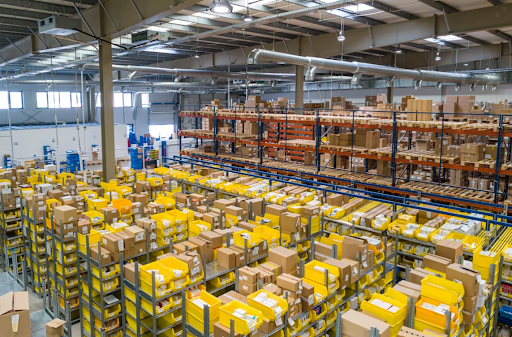
Warehouse automation uses software, sensors, controls, robotics, and material-handling equipment to execute warehouse work with less manual intervention and stronger operational control.
Its importance is growing as warehouse demand rises faster than labor capacity. In the United States, warehousing and storage employment is projected to increase by only 1.4%, from 1.8491 million jobs in 2024 to 1.8751 million in 2034. With this, the U.S. Bureau of Labor Statistics is specifically linking slower labor growth to WMS, AGVs, robots, and AI-based warehouse automation systems.
This guide covers automation types, technologies, processes, benefits, implementation decisions, and emerging warehouse automation trends.
What Is Warehouse Automation?
Warehouse automation is the coordinated use of physical equipment and digital systems to sense warehouse conditions, decide what work should happen, execute that work, and verify the result.
The important distinction is coordination. Automating picking alone may increase picks per hour while creating queues at replenishment, packing, or shipping. Mature automation therefore optimizes end-to-end flow, including inventory availability, equipment capacity, labor, order priority, downstream queues, and exceptions.
Types and Technologies of Warehouse Automation
Types of warehouse automation include basic, system, mechanized, and intelligent automation, combining software and digital automation with physical and robotic automation. The technologies within each type address specific decisions, movements, or handling requirements.
| Type of automation | Key technologies | Primary role |
| Basic automation | Auto-ID, Pick-to-Light / Put-to-Light, Voice Picking & Tasking | Standardizes repeatable warehouse tasks |
| System automation | WMS, WCS, WES | Coordinates inventory, equipment, labor, and execution |
| Mechanized automation | AGVs, AS/RS, GTP, Automated Sortation Systems | Automates storage and physical material movement |
| Intelligent automation | AMRs, Cobots, AI, IoT, AI Agents | Adapts warehouse decisions as operating conditions change |
Basic automation
Basic automation uses fixed rules and digital tools to standardize repetitive warehouse activities with predictable inputs and outputs.
- Automatic Identification (Auto-ID): Barcode scanners and RFID tags capture item and location data during receiving, inventory movement, picking, and shipping.
- Pick-to-Light / Put-to-Light: LED indicators direct workers to specific locations and quantities, reducing search and confirmation steps.
- Voice Picking & Tasking: Headsets provide hands-free instructions so employees can execute directed picking or movement tasks without repeatedly checking screens.
System automation (WMS, WCS, WES)
System automation creates the software and digital management layer that determines what work should happen and communicates those decisions to people and equipment.
- Warehouse Management Systems (WMS): Control inventory locations, replenishment, orders, picking tasks, and warehouse transactions.
- Warehouse Control Systems (WCS): Translate higher-level instructions into commands for conveyors, sorters, AS/RS, and other automated equipment.
- Warehouse Execution Systems (WES): Dynamically sequence labor and machine work as order priorities, equipment availability, and downstream capacity change.
Mechanized automation
Mechanized automation uses robotic and physical handling systems to reduce travel, lifting, storage movement, and repetitive material handling.
- Automated Guided Vehicles (AGVs): Transport pallets, totes, and heavy loads along predefined warehouse routes.
- Automated Storage and Retrieval Systems (AS/RS): Use computer-controlled cranes, shuttles, or vertical modules for high-density storage and retrieval. At UPS’s 2026 Taoyuan International Logistics Center in Taiwan, customers can store twice as many products in equivalent conventional shelving space.
- Goods-to-Person (GTP) Systems: Bring targeted inventory to stationary operators through automated storage, robots, carousels, or conveyors, reducing picker travel.
- Automated Sortation Systems: Combine conveyors, scanners, sensors, and diverters to route items toward downstream destinations. FedEx’s Memphis World Hub facility in Tennessee, opened in October 2024, can sort 56,000 packages per hour.
Intelligent automation (AI and robotics)
Intelligent automation combines AI, robotics, sensors, and operational data so warehouse execution can respond dynamically instead of depending entirely on fixed routes or rules.
- Autonomous Mobile Robots (AMRs): Navigate independently using sensors and mapping rather than fixed paths. AMR-supported processing at UPS’ 2026 Taiwan facility is approximately 40% faster, with picking errors reduced to near zero.
- Robotic Arms & Palletizers: Automate repetitive picking, sorting, stacking, palletizing, and other structured handling activities.
- Collaborative Robots (Cobots): Work alongside employees on repetitive handling while people manage variable or judgment-intensive tasks.
- AI, IoT, and Warehouse Analytics: Analyze inventory, equipment, queues, and workload to support dynamic decisions. Walmart’s Self-Healing Inventory generated more than $55 million in savings in Mexico by July 2025 by automatically redirecting excess inventory.
- AI Agents: AI agents analyze warehouse conditions and determine the next action. Synkrato’s AI Agents apply this across picking, replenishment, labor, and slotting.
Warehouse Processes That Can Be Automated
Warehouse processes that can be automated include receiving and unloading, put-away and storage, inventory management, order picking, packing and sorting, shipping, and returns processing. Automation should target the transactions, movements, and decisions within each process rather than simply replacing manual handling.
Receiving and put-away
Receiving and put-away automation connects inbound identification directly with storage assignment. Mobile barcode scanners and RFID can capture receipts, while conveyor lines, AMRs, or AGVs transfer inventory from receiving docks toward assigned storage locations. This reduces the delay between physical receipt, system availability, and put-away completion.
Inventory tracking and replenishment
Inventory tracking and replenishment automation maintain stock visibility while protecting forward-pick availability. IoT sensors, RFID gates, barcode events, and inventory thresholds can identify discrepancies or replenishment requirements and automatically create tasks before insufficient pick-face inventory interrupts active orders.
Order picking
Order picking automation reduces travel and unnecessary handling through goods-to-person (GTP) systems, pick-to-light, voice-directed picking, AMRs, and robotic picking. At FedEx’s Cologne air-network facility in Germany, an AI-powered sorting robot introduced in June 2025 processes up to 1,000 pieces per hour across about 90 destinations.
Packing and labeling
Packing and labeling automation can coordinate carton selection, machine-assisted sizing, weight checks, documentation, label printing, and verification. Synkrato Enterprise Labeling adds centralized label templates and version control, while ERP, WMS, or inventory events can automatically trigger the correct labels across warehouse locations.
Shipping and dispatch
Shipping and dispatch automation connects automated sortation, dimension scanning, weight checks, carrier label printing, lane assignment, and shipment verification. Linking these activities to the shipping transaction helps ensure that the correct order, carrier service, documentation, and destination are validated before freight leaves the facility.
Returns processing
Returns processing automation routes returned inventory through identification, inspection, restocking, repair, or other disposition paths. Automated conveyors and system-directed routing can move products toward the appropriate processing zone, while items requiring condition or quality judgment remain exceptions for employee review.
Benefits of Warehouse Automation
Warehouse automation benefits include faster fulfillment, higher accuracy, lower labor costs, better space utilization, improved safety, scalability, and real-time inventory visibility.
- Faster order fulfillment: Less travel and fewer manual handoffs accelerate picking, packing, and shipping.
- Higher inventory accuracy: Automated verification reduces picking errors, rework, and incorrect shipments.
- Lower labor costs: Automation reduces repetitive transport and handling while shifting employees toward higher-value work.
- Better warehouse space utilization: High-density storage increases usable capacity without expanding the facility footprint.
- Improved employee safety: Automation reduces repetitive lifting and material-handling exposure. U.S. general warehousing recorded a 5.2 injury rate in 2020–2024 versus 2.6 across private industry.
- Greater scalability: Modular equipment, storage, and workstations can support higher volumes as demand grows.
- Real-time inventory visibility: Connected systems surface stock levels, movements, shortages, and exceptions faster.
- Less product damage: Controlled handling reduces unnecessary touches and handling variability.
Challenges of Warehouse Automation
Challenges of warehouse automation include financial and cost hurdles, technical and integration issues, people and training barriers, downtime, and poor automation fit.
- High initial investment: Robots, conveyors, software, integration, and facility changes require significant capital, while uncertain ROI can make payback difficult to validate.
- Ongoing expenses: Maintenance, licenses, repairs, upgrades, and technical support increase the total cost of ownership.
- Integration with existing systems: Legacy software limits can make it difficult for ERP, WMS, and newer automation to exchange accurate inventory and task data.
- Layout limits: Narrow aisles, floors, ceiling height, docks, and existing storage infrastructure can restrict automation choices.
- Workforce training and change management: Worker fear and skill gaps can slow adoption, making early training on operations, troubleshooting, and safety important.
- Maintenance and system downtime: System downtime can interrupt connected workflows, especially when critical equipment or interfaces become single points of failure.
- Selecting the right automation strategy: Automation should match SKU profiles, demand variability, facility constraints, and actual operational bottlenecks.
How to Choose the Right Warehouse Automation Solution
The right warehouse automation solution should be chosen by analyzing operational data, order profiles, physical building constraints, integration requirements, and long-term growth before selecting equipment.
| Selection factor | What to evaluate | Why it affects automation |
| Warehouse size and layout | Travel, congestion, storage cube, ceiling height, floors, power | Determines physical automation feasibility |
| SKU count and order volume | 12 months of orders, peaks, dimensions, weight, fragility | Determines capacity and handling requirements |
| Budget and ROI goals | Labor, throughput, expansion, integration, maintenance | Establishes financial viability |
| ERP and WMS integration | Inventory, orders, tasks, priorities, exceptions | Prevents execution and data gaps |
| Future scalability | Volume growth, SKU growth, peaks, downstream capacity | Determines whether automation can expand economically |
How to Implement Warehouse Automation
Warehouse automation should be implemented through a structured rollout that establishes ownership, validates current performance, pilots automation, and measures results before expansion.
Assess current warehouse operations
Current warehouse operations should be assessed before equipment selection.
- Form a team: Create an implementation committee with operations, IT, engineering, maintenance, and process owners.
- Audit data: Establish baseline inventory, throughput, travel, cycle time, errors, and exceptions by process and shift.
Identify bottlenecks
Bottlenecks should be identified where workload repeatedly exceeds effective capacity. Map inventory and order flows to locate recurring queues, excessive touches, waiting, and capacity restrictions before deciding where automation belongs.
Define automation goals
Automation goals should convert bottlenecks into measurable targets such as units per hour, cycle time, labor hours, accuracy, equipment utilization, or storage capacity. Calculate ROI against the same baseline to create a measurable business case.
Start with a pilot project
A pilot project should start small with one workflow or operating zone before facility-wide deployment. Test the selected automation under real SKU, volume, and exception variability while training employees on operation and recovery procedures.
Measure performance and optimize
Performance should be measured against the pre-automation baseline using throughput, cycle time, uptime, errors, labor hours, and queue behavior. Validate results, correct new constraints, and then phase automation into additional processes.
Warehouse Automation Best Practices
Warehouse automation best practices focus on controlled scaling, reliable data, workforce readiness, and continuous performance improvement.
- Automate in phases: Scale workflows only after throughput, reliability, and exception handling meet targets.
- Use data to drive decisions: Use SKU variability, peaks, queues, and workload patterns to guide optimization.
- Automate audits: Use system-driven inventory checks to maintain accurate data as transaction volumes grow.
- Train employees early: Prepare employees for new workflows, safety requirements, troubleshooting, and exception handling.
- Engage workers: Use frontline operational knowledge to identify problems and improve automated warehouse workflows.
- Monitor KPIs continuously: Track throughput, cycle time, uptime, utilization, queues, and exception rates.
- Choose scalable technologies: Use modular automation and a flexible WMS that can support future volume and workflow changes.
Warehouse Automation Trends
Warehouse automation trends are shifting toward real-time software orchestration, AI-driven decision-making, and modular robotics that can adapt capacity and workflows as operating conditions change.
- AI as a Real-Time Operator: AI is moving beyond forecasting to adjust task priorities, inventory movement, and resource allocation using current warehouse conditions.
- Inbound Automation: Robotic depalletizing, AI vision inspection, and automated induction are extending automation upstream into receiving and inbound handling.
- Centralized Orchestration: Advanced WES increasingly coordinates labor, AMRs, AGVs, storage, and other equipment through a common execution layer.
- Robotics-as-a-Service (RaaS): Subscription models allow warehouses to add or reduce robotic capacity without making the entire investment upfront.
- Modular Infrastructure: Mobile storage, modular robotics, and configurable sortation provide alternatives to fixed infrastructure when volumes or workflows frequently change.
- Predictive Maintenance: Equipment condition, utilization, and fault data help identify maintenance requirements before failures interrupt critical workflows.
- Digital Twins: Digital twins test automation and capacity changes virtually. Synkrato’s 3D Digital Twin enables this before changes reach live operations.
- Sustainable Warehouse Automation: Sustainable automation reduces material and resource use alongside improving operations. For example, Amazon avoided more than 134 million plastic bags in the U.S. during 2024 through automated packaging.
How Synkrato Helps Businesses Build Smarter Warehouse Automation Solutions
Synkrato helps businesses make warehouse automation decisions with better visibility into how proposed changes affect total warehouse performance. It helps to:
- Test automation changes before they disrupt live operations.
- Identify bottlenecks and downstream capacity constraints earlier.
- Evaluate labor, inventory, space, and automation together rather than separately.
- Compare alternative operating scenarios before committing capital.
- Improve decisions continuously as warehouse conditions and demand change.
Book a demo with Synkrato to test warehouse automation decisions before they reach the floor.
Conclusion
Warehouse automation creates the greatest value when software, machines, inventory, labor, and process constraints operate as one system. The strongest automation strategies start with the bottleneck, validate downstream effects, measure complete-flow performance, and scale only when the improvement survives real warehouse variability.
Successful automation also requires reliable data, system integration, workforce readiness, and continuous performance monitoring. As AI, warehouse robotics, and digital twins advance, warehouses can increasingly adapt automation decisions to changing operational conditions.
Frequently Asked Questions
What is warehouse automation in simple terms?
Warehouse automation in simple terms uses software, sensors, machines, and robotics to execute warehouse work with less manual handling. Synkrato adds visibility into how these changes affect overall warehouse flow.
What are the four types of warehouse automation?
The four types of warehouse automation are basic, system, mechanized, and intelligent automation. For intelligent automation, Synkrato AI Agents can support decisions across picking, replenishment, labor, and slotting.
What technologies are used in warehouse automation?
Warehouse automation technologies include WMS, WCS, WES, AS/RS, AGVs, AMRs, conveyors, GTP, RFID, IoT, AI, and robotics. Synkrato’s 3D Digital Twin adds simulation for testing proposed automation changes.
What warehouse processes can be automated?
Warehouse processes that can be automated include receiving, put-away, inventory control, replenishment, picking, packing, labeling, shipping, and returns. For labeling, Synkrato Enterprise Labeling centralizes templates and automates label triggers.
How much does warehouse automation cost?
Warehouse automation cost depends on equipment, integration, facility modifications, software, maintenance, training, and deployment scale. Before committing capital, teams can use Synkrato’s 3D Digital Twin to test proposed changes virtually.
Is warehouse automation suitable for small businesses?
Warehouse automation is suitable for small businesses when a measurable bottleneck justifies the investment. A phased approach can target specific constraints first, while Synkrato can help evaluate changes before wider deployment.