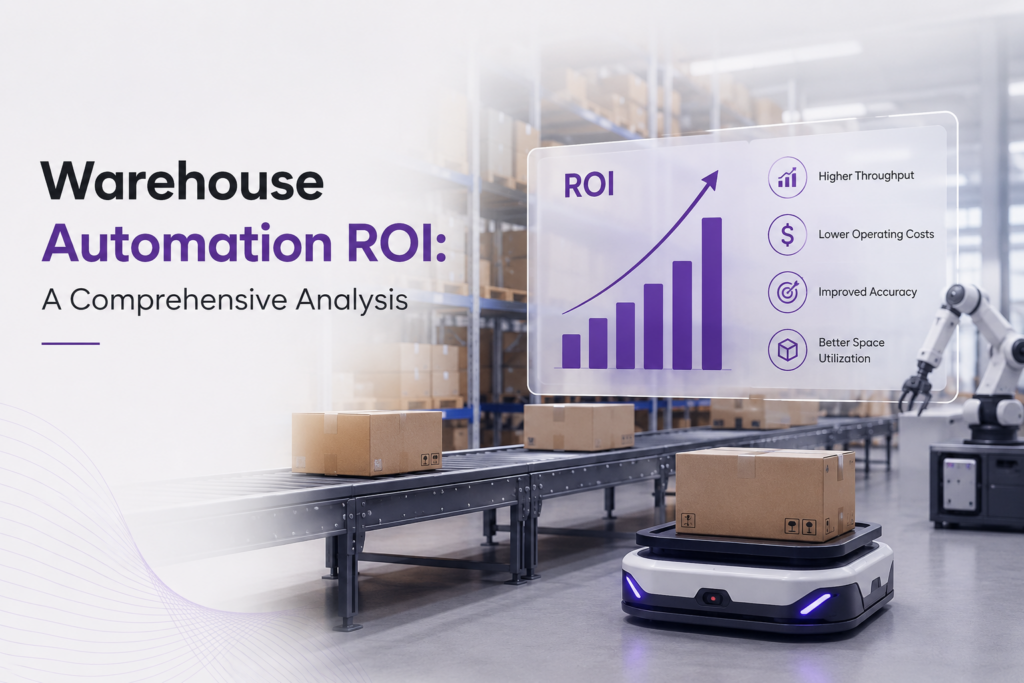
Warehouse automation ROI measures the operational and financial value businesses gain from automation investments. ROI improves when automation increases throughput, improves inventory visibility, reduces fulfillment errors, strengthens labor productivity, and lowers operating costs while supporting long-term scalability.
Warehouse automation is also becoming a standard operational strategy across supply chains. By 2028, 80% of warehouses and distribution centers are expected to deploy some form of warehouse automation equipment. As adoption increases, businesses will need to identify which technologies strengthen warehouse performance and which add operational complexity without delivering measurable returns.
In this blog, we will cover the key factors influencing warehouse automation ROI, strategies to improve returns, common ROI mistakes, and how warehouses can assess automation investments before scaling.
Factors Influencing Warehouse Automation ROI
The return on investment for warehouse automation depends on how effectively automation improves warehouse performance relative to the investment required.
- Capital Expenditure: Large automation investments must generate measurable operational gains to justify their cost. Returns improve when spending on robotics, software, infrastructure, and integration reduces cost-to-serve, increases throughput capacity, or delays facility expansion.
- Operational Amplification: Processing more orders without proportionally increasing labor, space, or equipment is a major ROI driver. Higher operational amplification improves output per labor hour while lowering cost per order as volume grows.
- Labor Reengineering: Workforce productivity improves when employees spend less time on repetitive activities such as traveling, searching, and manual verification. This increases productive labor time while reducing overtime, onboarding dependency, and workflow variability.
- Mitigation of Errors: Hidden operational costs often originate from picking errors, inventory inaccuracies, and labeling mistakes. Reducing these issues lowers rework, returns, chargebacks, and replacement shipments while improving fulfillment reliability.
- Optimized Space Utilization: Maximizing storage capacity within an existing footprint can delay costly facility expansion. Cube-based automated storage systems demonstrate this potential by delivering up to 4x higher space utilization compared with conventional storage methods.
- Inventory Orchestration: Faster fulfillment depends on placing inventory in the right location at the right time. Synkrato’s AI slotting recommendations support this process by analyzing inventory movement, order history, and demand patterns to identify more efficient inventory locations.
- Scale and Growth Agility: Future demand growth should not require constant warehouse redesign. Flexible automation helps warehouses adapt to changing SKU counts, order profiles, fulfillment channels, and customer expectations while protecting long-term ROI.
- Customer Gratitude: Product availability, delivery speed, and order accuracy directly influence customer experience. Improvements in these areas can lower fulfillment costs while supporting retention, repeat purchases, and service-level performance.
Suggested Read: What is Warehouse Automation
Strategies to Maximize ROI Through Warehouse Automation
Warehouse automation ROI improves when automation is selected, deployed, and refined through a disciplined operating model. The goal is not to install technology. The goal is to improve measurable performance.
Holistic Diagnosis
A strong diagnosis improves ROI by directing investment toward the highest-cost constraint. This helps businesses avoid spending capital on automation that improves one workflow while leaving the actual bottleneck untouched.
A diagnosis should identify:
- Where labor time is being lost
- Which workflows create rework or delays
- Which zones create congestion
- Where inventory accuracy breaks down
- Which constraints affect throughput, cost, and service levels
Suggested Read: Warehouse Automation Trends
Quantify the ROI
ROI weakens when expected gains are not tied to measurable financial outcomes. Broad goals such as “improve productivity” make it harder to prove whether automation actually improved warehouse performance.
Key ROI outputs should include:
- Lower cost per order
- Higher orders processed per labor hour
- Reduced rework and return costs
- Better storage capacity within the same footprint
- Lower overtime and temporary labor dependency
- Higher throughput without proportional cost growth
Ecosystem Integration
Automation ROI declines when systems work in silos. Robotics, WMS, ERP, labeling, mobile workflows, TMS, labor, and carrier systems need connected data flows; otherwise, automation can speed up one task while delays continue elsewhere.
Integrated systems improve ROI by reducing handoff errors, duplicate work, replenishment delays, and visibility gaps. Synkrato’s digital twins and AI-driven warehouse management help businesses test and coordinate operational changes before scaling them.
Suggested Read: Warehouse Automation Statistics
Enabling Human Capital
ROI falls when employees are not prepared to work with the new operating model. Poor training, unclear role changes, weak exception handling, and low supervisor visibility can reduce adoption and slow down productivity gains.
Human capital enablement improves ROI by helping teams use automation consistently from the start. It should include:
- Workflow-based training
- Clear role and task changes
- Supervisor dashboards
- Maintenance readiness
- Exception-handling rules
- Feedback loops from frontline workers
Dynamic Refinement
Initial automation gains rarely remain constant without ongoing optimization. As SKU velocity, order profiles, and fulfillment requirements evolve, previously efficient slotting strategies, replenishment rules, and labor allocation models can become new sources of congestion and inefficiency.
Dynamic refinement helps sustain ROI by continuously adjusting slotting, replenishment, labor allocation, and exception handling. This allows warehouses to maintain throughput, reduce operational drift, and capture additional productivity gains after deployment.
Adaptability
Changing demand patterns can quickly expose the limitations of rigid automation systems. A solution designed around one SKU mix, order profile, or fulfillment channel may require costly modifications as business requirements evolve.
Adaptable automation strengthens long-term ROI by reducing the need for large-scale redesigns. Modular robotics, configurable mobile workflows, AI slotting, cloud-native labeling, and digital twin simulation help warehouses adjust to seasonal demand, new channels, returns volume, and changing service expectations.
Suggested Read: How Much Does Warehouse Automation Cost
Long-Term Vision
Disconnected investments can create integration gaps, duplicate spending, and operational silos. A long-term roadmap increases ROI by aligning automation with facility strategy, data readiness, workforce planning, and future growth. It should define:
- Which constraints should be automated first
- Which facilities should pilot automation
- Which systems must integrate
- Which data gaps need to be fixed
- Which workflows should scale across sites
- Which ROI assumptions require validation before a larger rollout
Avoiding Common Warehouse Automation ROI Mistakes
Warehouse automation ROI often weakens when businesses automate without understanding operational constraints, underestimate integration complexity, or overestimate projected gains. Avoiding these common mistakes helps create more realistic automation planning and stronger long-term ROI.
- Define Assessment Process: Warehouse assessments should identify operational bottlenecks before selecting automation technologies. In many cases, issues such as poor slotting, replenishment delays, or inventory inaccuracies create larger constraints than the workflow initially targeted for automation.
- Develop Realistic Design Goals: Automation goals should be specific and measurable rather than broadly targeting productivity improvement. Warehouses should define expected improvements across throughput, pick efficiency, dock-to-stock time, storage density, or order accuracy based on actual operational conditions.
- Know Your Inventory Accuracy: Warehouse automation depends heavily on accurate inventory data. Incorrect SKU dimensions, quantities, slotting data, or replenishment rules can cause automation systems to move faster while still making poor operational decisions.
- Determine Order Accuracy Metrics: Order accuracy metrics should be measured before automation deployment to establish the financial impact of operational errors. Mis-picks, wrong labels, returns, chargebacks, and rework hours all contribute to hidden fulfillment costs that affect ROI.
- Changes in Headcount: Automation does not always reduce labor requirements uniformly across the warehouse. While some manual tasks decrease, warehouses may still require additional maintenance, technical support, analytics, and exception-handling roles.
- Use Fully Loaded Labor Costs: Labor ROI calculations should include overtime, recruiting, training, supervision, turnover, and onboarding costs instead of relying only on hourly wages. Automation often creates value by improving workforce stability, operational visibility, and execution consistency.
- Realistic ROI Timeframe: Warehouse automation ROI timelines should reflect the size and complexity of the deployment. Smaller workflow automation projects may deliver faster returns, while large AS/RS, conveyor, or fulfillment network projects often require longer implementation and payback periods.
Warehouse Automation ROI – Using an Assessment to Calculate ROI
The warehouse automation ROI calculation connects operational constraints to measurable financial outcomes. Instead of starting with vendor selection, businesses should begin with baseline performance, operational bottlenecks, and long-term business goals, rather than starting with vendor selection.
Suggested Read: Benefits of Warehouse Automation
Step 1: Establish the Baseline
The baseline measures warehouse performance before automation deployment. Without baseline data, it becomes difficult to prove whether automation improved operational or financial performance.
Key baseline metrics should include:
| Category | Metrics to Capture |
| Labor | Labor hours, overtime, temporary labor, training time |
| Throughput | Orders per hour, dock-to-stock time, pick cycle time |
| Accuracy | Inventory accuracy, order accuracy, labeling errors |
| Space | Storage density, cube utilization, congestion points |
| Cost | Cost per order, rework cost, delivery cost |
| Customer service | Fill rate, backorders, on-time shipping |
| Scalability | Peak capacity, SKU growth, volume volatility |
Step 2: Identify the Constraint
Common issues include excessive picker travel, replenishment delays, poor slotting, manual labeling, inventory inaccuracies, congestion, low storage density, and slow onboarding.
This step helps businesses avoid automating the wrong workflow while uncovering the operational issue creating the highest cost or capacity impact.
Step 3: Model Financial Impact
The ROI model should convert operational improvements into measurable financial value.
| Benefit Area | Financial Impact |
| Labor productivity | Reduced labor hours and overtime |
| Error reduction | Lower rework, returns, and chargebacks |
| Space savings | Delayed expansion and reduced overflow storage |
| Throughput gains | Higher order capacity and fulfillment volume |
| Inventory improvement | Fewer stockouts and replenishment failures |
| Delivery economics | Lower fulfillment and transportation costs |
| Customer service | Improved retention and SLA performance |
Warehouse automation ROI should also extend beyond warehouse walls. Rent and facility costs account for only 3-6% of total logistics spend, while transportation represents approximately 45-70%. As a result, automation that improves consolidation, throughput, and delivery efficiency can create network-wide logistics savings.
Suggested Read: Automated Warehouse Picking Systems
Step 4: Include Total Investment
ROI models should include all investment categories instead of focusing only on equipment costs.
This includes:
- Automation hardware
- Software licenses
- System integration
- Facility modifications
- Data cleanup
- Testing and simulation
- Training and change management
- Maintenance and spare parts
- Vendor support and IT governance
Step 5: Validate Through Simulation or Pilot
Before scaling automation across the warehouse network, businesses should validate assumptions through pilots, phased deployments, or simulation-led testing.
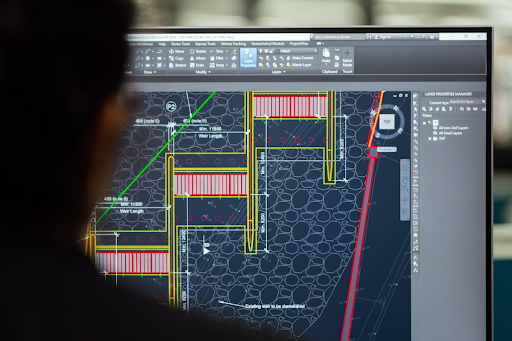
Digital twins can help warehouses test layout changes, slotting strategies, labor allocation, congestion risks, and automation placement before physical deployment.
For instance, Synkrato’s 3D digital twin improves warehouse automation implementation ROI and implementation risk while helping businesses evaluate whether projected ROI holds under real operating conditions.
Suggested Read: 3pl Warehouse Automation
Conclusion
As warehouse automation adoption increases, businesses are placing greater focus on ROI validation, operational flexibility, and scalable execution models. This is making simulation, inventory orchestration, and connected warehouse planning more important before scaling automation investments.
Digital twins and AI-driven warehouse simulation are helping businesses evaluate layout, slotting, labor, and automation decisions before deployment. Synkrato enables warehouses to test operational changes virtually, helping reduce implementation risk and improve long-term planning.
Ready to turn warehouse automation into measurable business growth? Take the next step with Synkrato to streamline warehouse operations, reduce costs, improve accuracy, and maximize the return on your automation investments. Book a demo today.
FAQs
What does warehouse automation ROI mean?
Warehouse automation ROI measures the operational and financial value created by warehouse automation investments. It includes improvements in throughput, labor productivity, inventory accuracy, fulfillment speed, space utilization, and cost-to-serve.
Why is calculating warehouse automation ROI important before implementation?
ROI calculation helps businesses identify whether automation will solve a measurable operational constraint before committing capital. It also helps validate expected gains across productivity, fulfillment capacity, labor efficiency, and long-term scalability.
What factors impact warehouse automation ROI the most?
Warehouse automation ROI is influenced by throughput improvement, labor optimization, inventory accuracy, storage density, fulfillment efficiency, and integration quality across warehouse systems. Poor slotting, weak replenishment flow, and disconnected systems can reduce expected returns.
What challenges can affect warehouse automation ROI?
Common challenges include inaccurate inventory data, unrealistic ROI assumptions, weak system integration, poor workflow design, workforce adaptation issues, and automation strategies that do not align with actual operational bottlenecks. Synkrato helps warehouses reduce these risks through digital twin simulation, AI slotting, and operational scenario testing before deployment.
How can Synkrato help businesses improve warehouse automation ROI?
Synkrato helps businesses improve warehouse automation ROI through 3D digital twins, AI-driven slotting, simulation, enterprise mobility, and warehouse optimization tools. These capabilities help warehouses test operational changes, reduce implementation risk, and improve warehouse decision-making before scaling investments.
Why do some warehouse automation projects fail to achieve expected ROI without platforms like Synkrato?
Many automation projects struggle because warehouses implement technology without fully validating workflows, slotting logic, labor allocation, or operational bottlenecks. Simulation and digital twin environments help businesses identify these issues before deployment, reducing costly rework and operational disruption.
What operational areas can Synkrato optimize to maximize warehouse automation performance?
Synkrato can help optimize slotting, warehouse layout, inventory movement, labor allocation, labeling workflows, replenishment flow, cycle counting, pick accuracy, and warehouse simulation. Its AI-driven tools also help warehouses evaluate operational changes before implementing them on the physical floor.