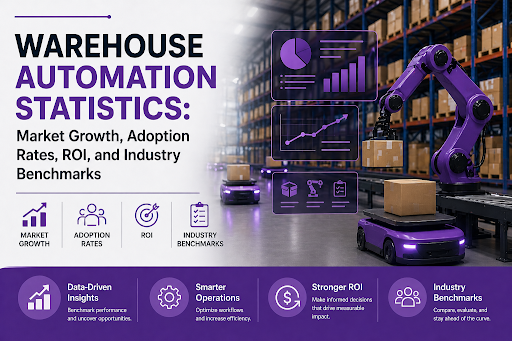
Warehouse automation is becoming core infrastructure for modern supply chains, driven by e-commerce growth, labor shortages, and the need for faster fulfillment cycles. It enables warehouses to operate as high-speed, data-driven execution hubs rather than static storage facilities.
Across regions, enterprises are shifting from pilot deployments to full-scale automation, using robotics and AI to improve speed, reliability, flexibility, and overall operational productivity.
Global Warehouse Automation Market Growth Projections
The growth of warehouse automation reflects a shift in how companies approach supply chain performance. Organizations are prioritizing speed, reliability, flexibility, and productivity, with automation serving as the primary driver to achieve these outcomes at scale.
Further, the global warehouse automation market statistics show that it was valued at USD 31.21 billion in 2025 and is projected to reach USD 36.24 billion in 2026, with long-term growth expected to hit USD 119.86 billion by 2034, reflecting a CAGR of 16.13% (global).
This rapid growth indicates increasing adoption of robotics and intelligent systems across warehouse operations, with platforms like Synkrato enabling real-time, execution-level decision-making from operational data.
Suggested Read: What is Warehouse Automation
Warehouse Robotics Market Adoption Statistics
Enterprise adoption of warehouse automation is accelerating rapidly, with over 75% of companies expected to implement cyber-physical systems by 2027.
However, as of 2026, nearly 80% of warehouses globally remain non-automated, indicating that most facilities are still in early-stage digitization. This gap highlights a significant opportunity for large-scale transformation in supply chain operations.
Growth Trends Across AMRs, AS/RS, and Sortation Systems
Hardware systems dominate warehouse automation, accounting for nearly 80% of global revenue in 2025, reflecting the high capital intensity of physical automation infrastructure.
- AMRs are a leading entry point into warehouse automation, driven by fast ROI and deployment flexibility, with many systems achieving payback in under 24 months.
- Automated storage and retrieval systems (AS/RS) AS/RS systems enhance space utilization through vertical storage while improving inventory accuracy and real-time tracking using radio frequency identification (RFID) and barcode technologies, making them ideal for space-constrained environments.
- The global parcel sortation systems market was valued at USD 2.01 billion in 2023 and is projected to reach USD 3.66 billion by 2030, growing at a 9.3% CAGR.
Suggested Read: Warehouse Automation Trends
Warehouse Automation Statistics by Industry
Warehouse automation adoption varies by industry, driven by differences in order complexity, throughput requirements, and margin pressures. From e-commerce to manufacturing, companies deploy automation differently to address specific operational challenges, making industry-specific benchmarks essential to understand where and how value is created.
E-commerce Warehouse Automation Statistics
Amazon’s Sequoia robotic system demonstrates how automation is accelerating e-commerce fulfillment, enabling inventory identification and storage up to 75% faster and reducing order processing time by up to 25% at its Houston fulfillment center in 2023.
3PL and Logistics Automation Adoption Data
DHL Supply Chain, in partnership with Locus Robotics, surpassed 500 million picks using autonomous mobile robots across 35 global sites as of June 2024. The adoption curve shows acceleration, with the first 10 million picks taking 2.5 years, while the most recent 100 million were completed in just 154 days.
Suggested Read: How Much Does Warehouse Automation Cost
Retail and Distribution Center Automation Benchmarks
Walmart targets 65% of stores to be serviced by automation and 55% of fulfillment center volume to flow through automated facilities by FY2026, alongside an expected 20% improvement in unit costs. This reflects a broader shift toward integrated, omnichannel supply networks where stores, fulfillment centers, and distribution centers operate as a unified system.
Manufacturing Warehouse Automation Statistics
Manufacturing warehouse automation is scaling alongside industrial robotics adoption, with approximately 542,000 robots installed globally in 2024, more than double the level a decade earlier and marking the fourth consecutive year above 500,000 units.
Regionally, Asia leads with 74% of deployments, followed by Europe at 16% and the Americas at 9%, highlighting geographic concentration in automation investment. At the execution level, no-code mobility platforms are enabling warehouses to digitize frontline operations without heavy IT dependency, improving accuracy, speed, and labor efficiency.
Suggested Read: Benefits of Warehouse Automation
Warehouse Automation Statistics for Productivity and Efficiency
Warehouse automation is improving operational performance across key metrics, including speed, accuracy, space utilization, and overall productivity, as organizations move from implementation to execution-focused outcomes.
Order Fulfillment Speed Improvement Statistics
Parcel delivery speed in the US improved by about 40%, reducing from 6.6 days in Q1 2020 to 4.2 days in Q2 2023, driven by investments in regional distribution networks, micro-fulfillment centers, route optimization, and tracking technologies.
Automation-led execution improvements are also evident at the enterprise level, with Decathlon standardizing automation across multiple European warehouses through its Skyfleet program with Exotec. It doubled its daily order preparation at the Setúbal facility from 57,000 to 114,000 orders while supporting 3,000 to 4,000 lines per hour and processing up to 200,000 items per day.
Picker Travel Time Reduction Data
Order picking is a major cost and time driver in warehouses, accounting for up to 55% of operating costs, with over 50% of picking time spent on travel.
Automation reduces this inefficiency, as seen in Decathlon’s 2026 rollout at its Northampton site. Here, the adoption of Exotec’s Skypod system reduced average walking distance from 10 km to 1 km per day and compressed order preparation space from 17,000 square meters to 5,000 square meters.
Warehouse Space Utilization and Storage Density Statistics
Warehouse automation is driven by space constraints, with 87% of decision-makers expanding or planning to expand warehouse capacity by 2024. Additionally, 82% are expecting to increase the number of facilities, while 59% identify capacity utilization as a top challenge.
Productivity Benchmarks for Automated vs Manual Operations
Warehouse productivity is increasingly defined by automation and software-led execution, with 93% of logistics professionals using WMS systems and reliance on paper-based picking dropping to 44% after remaining in the mid-50% range in prior years.
This shift highlights how automated data capture and system-driven picking are becoming the operational baseline for modern warehouses.
Suggested Read: Warehouse Automation ROI
Warehouse Automation Statistics by Operational Challenges
Warehouses face persistent structural challenges that impact performance, cost, and scalability, driving automation investments to address issues such as labor shortages, fulfillment delays, and system-level inefficiencies.
Labor Shortage Statistics Driving Automation Adoption
Labor constraints are a key driver of warehouse automation, with the transportation and warehousing sector employing 6.6 million people in June 2024. It accounted for 5% of all private-sector jobs, and warehousing and storage representing 26.9% within the sector.
Employment in warehousing and storage has also increased by 34% since February 2020, reflecting sustained labor demand driven by e-commerce growth and post-pandemic supply chain shifts.
Statistics on Fulfillment Delays and Bottlenecks
Delivery reliability remains below pre-pandemic levels, with last-mile on-time performance declining from 85-90% before 2020 to about 72% in May 2020 and not fully recovering by 2024.
This highlights the role of warehouse automation in improving delivery outcomes, as factors such as inventory visibility, fulfillment accuracy, cycle-time control, and order processing speed directly influence last-mile performance.
Warehouse Error Rates Before and After Automation
Automation significantly improves warehouse accuracy, reducing error rates from up to 4% in manual picking to 0.04% or lower, with automated systems achieving 99.96% to 99.99% accuracy.
This gap is critical for high-volume operations, as each mispick drives returns, reshipments, refunds, customer service load, and inventory discrepancies.
Implementation Failure and Integration Challenge Statistics
Warehouse automation challenges are primarily driven by implementation clarity and integration complexity, with 77% of companies viewing worker-augmentation as the preferred entry point, but only 35% having a clear starting strategy.
This highlights the need for defined process mapping, strong data foundations, and phased deployment before committing to automation. Integration risk is also increasing as systems scale, with 50% of new warehouses in developed markets expected to become robot-centric and human-optional by 2030.
Suggested Read: Automated Warehouse Picking Systems
Future Warehouse Automation Forecast Statistics Beyond 2026
Warehouse automation is evolving into integrated, intelligent operating environments, where robotics, software, and autonomous systems collectively drive execution, with forecasts indicating continued transformation of warehouse operations through 2030 and beyond.
Projected Robot Deployment Growth Through 2030
Mobile robotics is becoming core warehouse infrastructure, with autonomous mobile robots (AMRs) expected to surpass 500,000 installed units globally by 2030, driven by flexible deployment, maturing vendors, and increasing adoption across small and mid-sized operations.
The future of warehouses with robot deployment is expanding beyond item- and case-level handling into pallet-level operations, creating growth opportunities for autonomous forklifts and heavy-duty mobile robots.
Forecasts for Smart Warehouse Adoption Rates
Warehouse automation is becoming an operational baseline, with 80% of warehouses and distribution centers expected to deploy automation equipment by 2028. This shift increases the importance of selecting the right software, integration model, and execution layer to avoid delays and cost overruns.
The smart warehousing market reflects this growth, expanding from USD 20.95 billion in 2022 to a projected USD 57.97 billion by 2030 at a 14.2% CAGR.
Future Trends in Autonomous and Software-Defined Warehousing
Warehouse value creation is shifting toward software-driven automation, with the warehouse software market projected to grow from USD 7.2 billion in 2023 to USD 16.6 billion by 2030.
Automation-related software is expanding faster at a 19.5% CAGR, increasing its share from 31% in 2023 to 46% by 2030, while traditional WMS declines proportionally. This indicates a transition toward execution-focused warehouses where orchestration, control, and automation intelligence are as critical as inventory and order management.
Move from warehouse automation data to real operational impact. Book a demo with Synkrato and drive faster fulfillment, higher productivity, and smarter decisions.
Suggested Read: 3pl Warehouse Automation
FAQs
What are warehouse automation statistics?
Warehouse automation statistics are data-driven metrics that quantify how technologies like robotics, AI, and WMS/WOS systems impact efficiency, cost, speed, and accuracy. Platforms like Synkrato turn raw warehouse data into actionable insights, making these statistics easier to interpret and apply in real-time decision-making.
What do warehouse automation adoption statistics measure?
These statistics measure how widely automation technologies are being deployed across warehouses, including robotics, AI-driven systems, and digital workflows. Synkrato helps contextualize these adoption trends by mapping them directly to operational impact through simulations and AI-driven scenario planning.
Why use Synkrato to benchmark warehouse automation performance?
Synkrato enables benchmarking by creating a 3D digital twin of your warehouse, allowing you to compare current performance against optimized scenarios. This makes it easier to quantify improvements in productivity, travel time, and throughput before implementing changes on the floor.
What are common warehouse performance metrics tracked in automation statistics?
Key metrics include order fulfillment speed, pick accuracy, travel time, space utilization, labor productivity, and error rates. Synkrato tracks and improves these metrics by combining real-time data, AI slotting recommendations, and simulation-driven optimization within a unified platform.
Why is Synkrato valuable for improving metrics tracked in warehouse automation statistics?
Synkrato improves these metrics by simulating operations in a digital twin and identifying bottlenecks before they impact real workflows. Its AI-driven recommendations help reduce travel time, increase productivity, and improve accuracy without requiring disruptive physical changes.
How can businesses use warehouse automation statistics for decision-making?
Businesses use these statistics to prioritize automation investments, optimize layouts, and improve operational efficiency. With Synkrato, leaders can test decisions virtually, evaluate outcomes, and deploy only the most effective strategies based on data-backed insights.
Why choose Synkrato for data-driven warehouse automation optimization?
Synkrato transforms your WMS into a decision-making engine by combining digital twins, AI agents, and real-time analytics. This enables continuous optimization across inventory, labor, and workflows, helping warehouses scale performance without increasing complexity or cost.