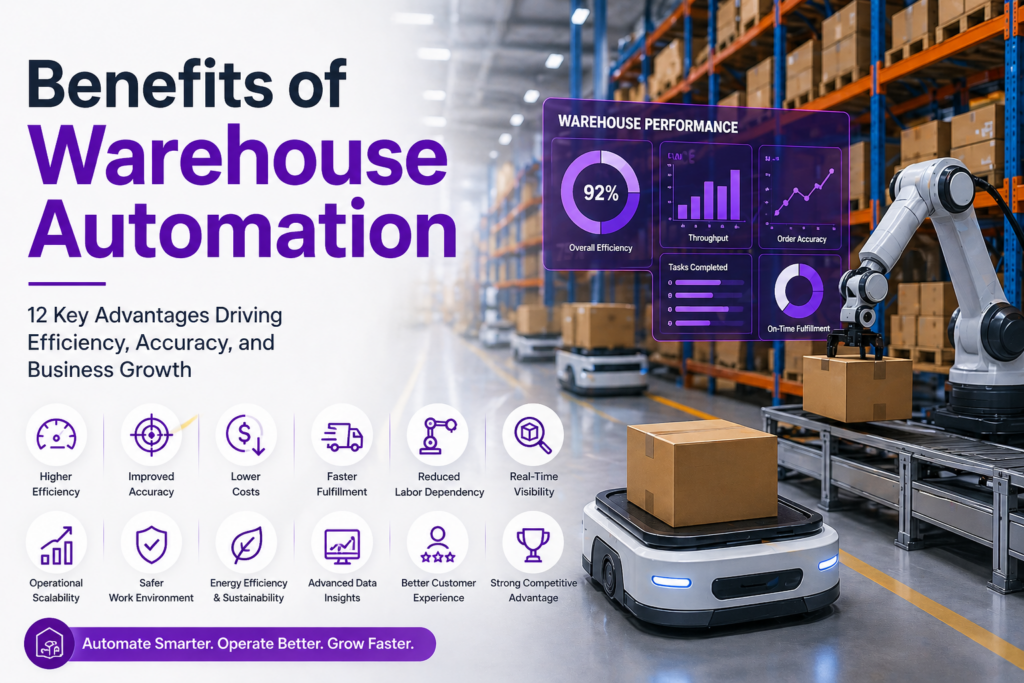
Modern warehouses are under constant pressure to deliver: Speed, accuracy, and efficiency, all three without compromise. Yet relying on manual processes alone often creates hidden slowdowns and costly errors. That’s where automation steps in, turning operational chaos into a streamlined, high-performing system.
In this blog, we’ll uncover the key benefits of warehouse automation and how it elevates productivity, reduces costs, and improves scalability.
1. Higher Operational Efficiency
Warehouse automation transforms fragmented, manual workflows into a tightly synchronized system where every process is optimized for speed and consistency. By integrating technologies such as robotics, conveyor systems, warehouse management software, and decision intelligence, operations become faster, smoother, and far less dependent on human intervention.
With Synkrato’s digital twin and simulation & optimization, warehouses can test and refine workflows before deploying them, ensuring optimal efficiency from day one.
Key ways it improves efficiency include:
- Faster order processing: Automated picking, sorting, and packing significantly reduce fulfillment time.
- Reduced bottlenecks: Continuous system flow eliminates waiting time between tasks.
- Optimized space utilization: Smart storage systems maximize vertical and horizontal space.
- Consistent performance: Automation maintains accuracy and speed even during peak demand.
Suggested Read: What is Warehouse Automation
2. Lower Workforce Costs
Labor volatility continues to challenge warehouse operations. One of the most measurable benefits of warehouse automation is its impact on workforce cost structures.
Automation reduces dependency on manual labor for repetitive and high-frequency tasks. Instead of scaling headcount, warehouses scale throughput through systems.
This results in:
- Reduced overtime and temporary labor reliance
- Lower training and onboarding costs
- Stabilized productivity across peak and non-peak periods
Automation enables long-term reductions in labor costs while improving output per employee. However, the value is not just cost reduction. Automation enables workforce reallocation toward supervision, exception handling, and system optimization.
These structural shifts define the long-term cost benefits of warehouse automation, especially in high-SKU and high-volume environments.
Suggested Read: Warehouse Automation Trends
3. Improved Inventory Precision
Automation provides real-time visibility and control over inventory, ensuring that stock levels and locations are always accurate and up to date. By eliminating manual tracking errors, businesses can maintain tighter control over their supply chain and make more informed decisions.
Key benefits of improved precision include:
- Real-time tracking: Instant updates on stock movement and availability.
- Reduced human error: Automated data capture eliminates manual entry mistakes.
- Better demand forecasting: Accurate data supports smarter planning and replenishment.
- Minimized stock issues: Prevents overstocking, understocking, and misplaced inventory.
4. Greater Order Accuracy
Automation significantly reduces the risk of human error in order fulfillment by standardizing picking, packing, and shipping processes. With the help of robotics, vision systems, and automated verification tools, warehouses can ensure that the right product is selected, packed correctly, and shipped to the correct destination every time. This consistency strengthens customer trust and reduces costly returns.
Key benefits include:
- Error-free picking: Automated systems ensure correct item selection.
- Packing validation: Technology checks order completeness before dispatch.
- Reduced returns: Fewer mistakes lead to fewer reverse logistics costs.
- Improved customer satisfaction: Accurate orders enhance reliability and brand reputation.
Synkrato Enterprise Labeling helps standardize and manage labeling across facilities, improving tracking accuracy and inventory visibility.
Suggested Read: Warehouse Automation Statistics
5. Accelerated Order Processing
Speed is a defining factor in modern fulfillment, and one of the key benefits of warehouse automation is significantly faster order processing. Automation removes bottlenecks and enables parallel task execution.
Systems such as goods-to-person, automated sortation, and AI-driven orchestration optimize workflow sequencing and reduce idle time.
Key outcomes include:
- Shorter order cycle times
- Higher throughput during peak demand
- Reduced dependency on manual coordination
Automation plays a critical role in improving fulfillment speed within complex supply chains. It enables faster, more consistent order processing, especially in high-volume operational environments.
Using simulation & optimization, warehouses can continuously identify inefficiencies and improve processing speed.
6. Optimized Warehouse Space Usage
Space optimization in 2026 goes beyond high-density storage systems. It is driven by intelligent design supported by simulation and continuous optimization.
Automation allows warehouses to operate with adaptive storage strategies rather than fixed layouts. Inventory placement is continuously adjusted based on demand patterns, handling frequency, and replenishment cycles.
Technologies contributing to space optimization include:
- Autonomous mobile robots (AMRs) enabling flexible storage zones
- High-density automated storage and retrieval systems (AS/RS)
- AI-driven slotting and re-slotting algorithms
- Digital twin and simulation models
These systems reduce wasted space while improving accessibility and throughput. For facilities facing expansion constraints, these technologies enable capacity growth without physical expansion.
Suggested Read: How Much Does Warehouse Automation Cost
7. Safer Working Environment
Automation significantly improves workplace safety by reducing the need for employees to perform high-risk, physically demanding, or repetitive tasks. Robots and automated systems handle heavy lifting, long-distance transport, and hazardous movements, lowering the likelihood of injuries and accidents.
This creates a more controlled and predictable environment where human workers can focus on supervision and decision-making roles. Key benefits include:
- Reduced manual handling injuries: Fewer strains and accidents from lifting heavy goods.
- Lower exposure to hazards: Automation handles dangerous or high-risk tasks.
- Fewer workplace accidents: Controlled robotic movements reduce collision risks.
- Improved ergonomics: Employees are assigned safer, less physically demanding roles.
Overall, this shift not only protects workers but also strengthens operational stability by reducing downtime caused by workplace incidents.
8. Improved Energy Optimization and Sustainability
Energy efficiency is becoming a measurable KPI in warehouse operations. One of the key benefits of warehouse automation is the ability to optimize energy usage through controlled and predictable system performance.
Automated systems reduce unnecessary energy consumption by operating only when required and minimizing idle time. Advanced technologies such as regenerative braking in AS/RS can further improve efficiency.
Key outcomes include:
- Reduced energy consumption through optimized equipment usage
- Lower carbon emissions via efficient system design
- Improved sustainability tracking and reporting
Studies show that technologies like AGVs can reduce energy consumption in handling processes by up to 30%, and warehouses using AI-driven automation can save up to 12% of energy costs. This strengthens long-term ROI benefits while aligning with sustainability goals.
Suggested Read: Warehouse Automation ROI
9. Advanced Data Insights and Reporting
Modern warehouse automation doesn’t just execute tasks; it generates continuous streams of data that can be turned into actionable insights. With integrated analytics, AI, and warehouse management systems, businesses gain real-time visibility into performance, inventory movement, and operational bottlenecks. This helps leaders make faster, more accurate decisions instead of relying on manual reports or guesswork.
Key benefits include:
- Real-time performance tracking: Instant visibility into order flow, delays, and throughput.
- Data-driven decision-making: AI-powered analytics identify inefficiencies and optimization opportunities.
- Improved forecasting accuracy: Historical and live data improve demand planning and inventory control.
- Automated reporting: Reduces manual reporting effort while increasing accuracy and consistency.
Studies show that AI-powered warehouse systems can significantly improve decision-making and reduce operational inefficiencies by turning raw data into predictive insights for better planning and execution.
10. Greater Operational Scalability
Scalability is no longer about adding more labor or expanding physical space. It is about how efficiently a warehouse can adapt to demand variability without operational disruption.
Automation provides modular scalability, allowing systems to expand incrementally as demand grows. Synkrato supports modular scalability, allowing warehouses to expand capacity and capabilities without major operational disruption.
For example:
- Easy capacity expansion: Adding robots, storage modules, or software upgrades increases throughput without major redesigns.
- Consistent performance at scale: Operations remain stable even as order volumes increase.
- Faster response to demand spikes: Automation adapts to seasonal or unexpected surges in activity.
- Flexible infrastructure: Modular systems allow warehouses to expand incrementally rather than rebuilding from scratch.
The global logistics automation market is projected to reach USD 148.76 billion by 2033, growing at a CAGR of 16.8%, reflecting increasing demand for scalable and flexible warehouse systems. This highlights how scalability is becoming a core warehouse automation advantage for high-growth operations.
Suggested Read: Automated Warehouse Picking Systems
11. Better Customer Experience
Warehouse automation directly improves the end customer experience by making fulfillment faster, more accurate, and more reliable. Automation ensures orders are processed accurately and shipped faster, reducing delays and service inconsistencies. Real-time tracking and system-driven updates further improve communication across the order lifecycle.
Key outcomes include:
- Faster and more predictable delivery timelines
- Higher order accuracy
- Reduced order returns and replacements
- Improved visibility and proactive issue resolution
Automation-driven supply chains improve customer satisfaction by ensuring accurate and timely deliveries, leading to stronger loyalty and retention.
12. Strong Competitive Advantage
Warehouse automation gives businesses a clear edge in an increasingly fast-paced and cost-sensitive market. By improving efficiency, reducing costs, and increasing accuracy, companies can operate at a level that is difficult to match using manual processes alone. This advantage becomes even more significant as customer expectations for speed and reliability continue to rise.
Over 70% of supply chain professionals view automation as a positive driver of warehouse performance, highlighting its role in competitive differentiation. As supply chains become more complex, automation becomes a foundational capability for sustaining growth and maintaining market leadership.
Automation alone isn’t enough. Optimize, scale, and maximize results with Synkrato. Book a demo today and take control of your warehouse performance.
Suggested Read: 3pl Warehouse Automation
FAQs
What are the main benefits of warehouse automation?
The main benefits of warehouse automation include higher operational efficiency, improved order accuracy, faster processing, reduced labor dependency, better inventory visibility, and scalable operations. These advantages collectively lower costs, enhance throughput, and improve overall supply chain performance.
Why do businesses struggle to unlock full efficiency even after adopting warehouse automation?
Businesses often struggle because automation is implemented in silos without proper system integration or orchestration. Limited data utilization, static configurations, and a lack of continuous optimization prevent systems from achieving full efficiency and adapting to changing operational demands.
How does warehouse automation improve productivity?
Warehouse automation improves productivity by reducing manual tasks, minimizing travel time, and enabling parallel task execution. It ensures consistent performance, lowers variability, and increases output per labor hour, allowing operations to handle higher volumes without proportional resource increases.
Why does Synkrato enhance the benefits of warehouse automation beyond traditional systems?
Synkrato enhances the benefits of warehouse automation by using simulation, digital twins, and advanced analytics to continuously optimize operations. It identifies inefficiencies, improves system configurations, and ensures automation adapts dynamically to changing demand and operational conditions.
How does automation improve order accuracy in warehouses?
Automation improves order accuracy by using system-directed picking, barcode validation, and vision-based verification. These technologies eliminate manual errors, ensure correct item selection, and standardize workflows, resulting in fewer returns, reduced rework, and more reliable fulfillment outcomes.
Why is Synkrato important for maximizing ROI from warehouse automation investments?
Synkrato maximizes ROI by enabling continuous performance optimization rather than one-time implementation gains. It improves system utilization, identifies bottlenecks, and enhances decision-making, ensuring automation investments deliver sustained cost savings and long-term operational efficiency.
What impact does warehouse automation have on fulfillment speed?
Warehouse automation significantly improves fulfillment speed by eliminating bottlenecks and enabling parallel processing of tasks. It reduces order cycle times, accelerates picking and sorting, and ensures faster dispatch, helping warehouses meet increasing demand and tighter delivery timelines.