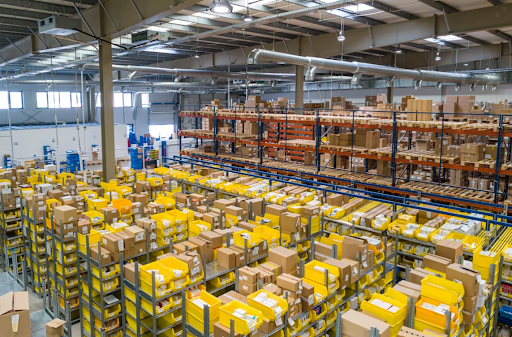
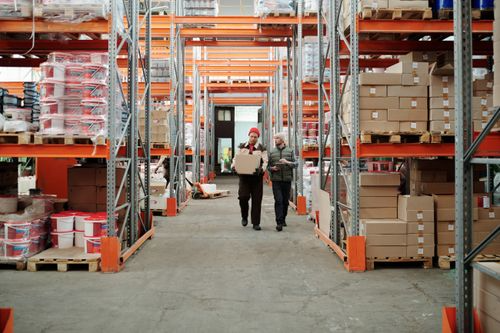
Warehouse efficiency improves when every movement, labor hour, storage location, and system decision contributes to accurate order flow. The priority is not to automate more work; it is to remove travel, waiting, rework, congestion, inventory errors, and handling.
In U.S. warehousing and storage, labor productivity fell 0.6% in 2024 while unit labor costs rose 9.0%. Likewise, 48.6% of distribution-center respondents of a survey named cost reduction as their primary organizational goal.
This blog covers warehouse efficiency strategies, KPIs, technologies, operational challenges, future trends, and practical optimization methods.
What Causes Poor Warehouse Efficiency?
Poor warehouse efficiency is caused by layout, process, inventory, labor, visibility, and technology gaps that increase travel, delays, errors, and operating costs.
Poor warehouse layout
- Poor warehouse layout creates long routes, traffic conflicts, blocked staging, and extra handling.
- Poor facility design and overcrowded storage increase congestion between forklifts, pallet jacks, and workers.
- Synkrato’s 3D Digital Twin helps visualize layout, space, congestion, and flow issues before physical changes.
Excessive travel time
- Excessive travel time raises labor hours without increasing warehouse throughput.
- Substandard picking and poorly located inventory make workers walk farther, backtrack, and repeatedly cross busy zones.
Inventory inaccuracies
- Inventory inaccuracies cause stock searches, short picks, substitutions, and emergency replenishment.
- Inaccurate tracking makes system inventory unreliable.
- Workers then spend more time locating misplaced or incorrectly recorded stock.
- Frequent discrepancies also increase recounts and operational delays.
Manual workflows
- Manual workflows slow operations through repeated data entry, spreadsheets, paper processes, and manual checks.
- Chaotic receiving adds delays when goods are not quickly logged and validated.
- Slow putaway can leave inventory in staging areas and disrupt downstream warehouse workflows.
Inefficient picking and packing
- Inefficient picking and packing creates unnecessary touches, poor batching, pack queues, and rework.
- Weak coordination between picking, replenishment, packing, and quality control delays fulfillment.
Labor shortages and skill gaps
- Labor shortages and skill gaps create bottlenecks when critical tasks depend on a few experienced employees.
- Inadequate training increases mistakes and slows task execution.
- Limited cross-training reduces flexibility when workloads shift between warehouse functions.
Lack of real-time visibility
- Lack of real-time visibility makes growing queues, aged orders, inventory issues, and equipment delays harder to detect.
- Poor connectivity, including Wi-Fi dead spots, interrupts handheld devices and delays operational data.
- Delayed data makes it harder to respond to changing warehouse conditions.
- Managers may identify bottlenecks only after throughput or service levels are affected.
Outdated warehouse technology
- Outdated warehouse technology slows operations through old software, disconnected systems, and paper-based processes.
- Outdated systems also restrict real-time updates, coordination, predictive decisions, and warehouse optimization at scale.
How to Measure Warehouse Efficiency
Warehouse efficiency is measured by tracking connected KPIs across inbound, storage, outbound, labor, cost, and service. WERC’s 2026 DC Measures program tracks 36 operational metrics, providing benchmarks for comparing warehouse performance.
| Warehouse Efficiency KPI | What It Measures | How to Use It |
| Order picking accuracy | Percentage of orders or lines picked without errors. | Track by SKU, zone, and picking method. Have 99.5%–99.9% as a benchmark range. |
| Inventory accuracy rate | How closely system inventory matches verified physical inventory. | Segment high-value, fast-moving, lot-controlled, and serialized stock; use inventory turnover rate to understand stock movement. |
| Order cycle time | Time from order release until the order is ready for shipment. | Separate queue, picking, replenishment, packing, staging, and dispatch time to locate delays. |
| Warehouse throughput | Units, lines, cases, pallets, or orders processed within a defined period. | Compare throughput with backlog, labor hours, and Units Per Hour (UPH) to assess actual warehouse productivity. |
| Labor productivity | Completed warehouse output relative to labor hours used. | Compare UPH by shift, zone, task, and order profile rather than relying on one warehouse-wide average. |
| Space utilization | Percentage of usable floor and vertical cube actively used for storage. | Analyze by zone and storage type to find honeycombing, blocked capacity, poor slot fit, and unused vertical space. |
| Cost per order shipped | Controllable warehouse operating cost relative to completed orders. | Segment by channel, customer, service level, and order profile to identify high-cost fulfillment flows. |
| Perfect order rate | Percentage of orders shipped accurately, on time, damage-free, and with correct documentation. | Review alongside dock-to-stock time to identify whether efficiency gains are shifting delays or defects elsewhere. |
20 Proven Ways to Improve Warehouse Efficiency
The most effective ways to improve warehouse efficiency combine better layout, inventory placement, workflows, labor planning, and technology. Apply each strategy against a measurable operational constraint rather than changing processes without a clear performance target.
1. Optimize warehouse layout and warehouse flow
Optimize warehouse layout and warehouse flow around inventory movement from receiving through shipping. Focus on a few physical changes:
- Place high-demand goods closer to packing and shipping.
- Use vertical storage where building and equipment constraints allow.
- Keep aisles clear and separate conflicting traffic routes.
- Design ergonomic workstations around frequently performed tasks.
2. Improve warehouse slotting with ABC analysis
Improve warehouse slotting with ABC analysis by positioning high-turnover A items in accessible pick locations and slower C items farther away. Add cube, weight, product affinity, seasonality, and replenishment frequency; Synkrato AI Slotting can recommend SKU-location moves as demand changes.
3. Reduce picker travel time
Reduce picker travel time by shortening pick paths and limiting unnecessary movement. Prioritize:
- High-frequency SKUs near primary pick paths.
- Compatible orders for batch or cluster picking.
- Route sequencing that prevents backtracking.
4. Choose the right order picking method
Choose the right order picking method based on order-line density, SKU overlap, item characteristics, service cutoffs, and consolidation capacity. Discrete picking suits simpler flows, while batch, cluster, zone, or wave picking can reduce repeated travel for compatible order profiles.
5. Streamline receiving and putaway operations
Streamline receiving and putaway operations by preplanning dock doors, validating receipts immediately, and separating exceptions. Direct accepted inventory to available locations quickly, and use dock-to-stock time to identify delays across unloading, scanning, inspection, staging, and putaway.
6. Improve inventory accuracy through cycle counting
Improve inventory accuracy through cycle counting based on risk rather than counting every SKU equally. Prioritize high-value inventory, fast movers, repeated variances, short picks, and transaction exceptions. Use barcode or RFID verification where appropriate to reduce manual data-entry errors.
7. Standardize warehouse workflows
Standardize warehouse workflows by documenting the best current method for repeatable activities. Keep standards operationally useful:
- Define required scan and validation points.
- Set quality-control checks.
- Document exception and escalation rules.
- Use clear signage and location labels.
8. Optimize inventory replenishment
Optimize inventory replenishment by predicting when forward-pick locations will run out based on active orders and near-term demand. Prioritize replenishment by stockout risk and downstream impact rather than task age alone, preventing pickers from waiting for inventory.
9. Reduce packing errors and improve quality control
Reduce packing errors and improve quality control with item verification, expected-weight checks, carton rules, and label validation. GEODIS reports its automated packaging solutions can reduce labor 40%–60% and improve throughput 30%–50% for many U.S. clients.
10. Optimize shipping and dispatch processes
Optimize shipping and dispatch processes by coordinating staging, loading sequences, carrier cutoffs, route requirements, and documentation. Monitor aged staged orders so teams can resolve loading or carrier exceptions before they turn into missed shipments.
11. Cross-train warehouse employees
Cross-train warehouse employees across bottleneck-sensitive activities such as receiving, replenishment, picking, packing, and shipping. A shift-level skills matrix helps supervisors identify qualified employees and move labor between functions as workload changes.
12. Implement Lean warehousing principles
Implement Lean warehousing principles by removing waiting, unnecessary motion, transport, overprocessing, defects, excess inventory, and redundant handling. Apply Lean to measured constraints rather than isolated housekeeping projects so each change can be linked to throughput, cost, or cycle-time improvement.
13. Improve warehouse safety practices
Improve warehouse safety practices while designing workflows, traffic routes, equipment rules, and ergonomic workstations. In U.S. warehousing and storage, the BLS recorded 4.8 total recordable injury and illness cases per 100 full-time workers in 2024.
14. Minimize equipment downtime
Minimize equipment downtime through preventive and condition-based maintenance. Focus maintenance resources where interruptions matter most:
- Track downtime by asset and failure type.
- Maintain critical spare parts.
- Rank failures by lost throughput minutes.
15. Strengthen communication across warehouse teams
Strengthen communication across warehouse teams with structured shift handoffs covering backlog, aged orders, equipment issues, safety risks, and upcoming workload. Use shared operational signals so receiving, replenishment, picking, packing, and shipping teams work from the same priorities.
16. Monitor warehouse KPIs continuously
Monitor warehouse KPIs continuously at the frequency operational decisions are made. Track throughput, backlog, order age, picking accuracy, replenishment risk, labor allocation, equipment downtime, cost per order, and inventory turnover by shift or zone rather than relying only on monthly averages.
17. Use warehouse data for continuous improvement
Use warehouse data for continuous improvement by comparing expected and actual performance, finding recurring exceptions, and testing corrective actions. Synkrato Simulation & Optimization lets teams test labor, slotting, pick paths, and operational scenarios virtually before implementing changes in the warehouse.
18. Improve supplier collaboration
Improve supplier collaboration by aligning appointment schedules, ASNs, labels, packaging, palletization, and quality requirements. Track supplier-caused receiving exceptions separately so teams can distinguish internal warehouse delays from upstream problems and address recurring issues with suppliers.
19. Optimize reverse logistics and returns
Optimize reverse logistics and returns with a dedicated flow for identification, inspection, grading, disposition, and return-to-stock. About 19.3% of U.S. online sales will be returned in 2025, making efficient returns processing increasingly important.
20. Conduct regular warehouse audits
Conduct regular warehouse audits to find performance gaps that daily warehouse operations can hide. Review:
- Process adherence and location accuracy.
- Blocked or underused capacity.
- Equipment and safety conditions.
- Master-data errors and recurring exceptions.
- Corrective actions, owners, and completion dates.
Warehouse Technologies That Improve Efficiency
Warehouse technologies improve efficiency by combining real-time inventory tracking, automated machinery, and data-driven management. The strongest systems reduce manual work while improving fulfillment speed, accuracy, and capacity.
- Warehouse Management Systems (WMS): WMS improve efficiency by centrally managing inventory, storage locations, order releases, and daily tasks. Real-time data also gives other warehouse technologies a consistent operational record for faster decisions.
- Barcode Scanning and RFID Technology: Barcode scanning and RFID technology improve efficiency by recording inventory movements with less manual entry. RFID can process tagged cases without line-of-sight scanning, supporting faster automated identification.
- Autonomous Mobile Robots (AMRs): AMRs improve efficiency by moving goods and supporting goods-to-person picking. Globally, 102,900 transportation and logistics service robots were sold in 2024, up 14% year over year.
- Automated Storage and Retrieval Systems (AS/RS): AS/RS improves efficiency by automatically storing and retrieving inventory from high-density storage. In 2024, Walmart planned 500,000+ square feet of warehouse automation at each of four U.S. perishable DCs.
- IoT-Enabled Warehouse Monitoring: IoT-enabled warehouse monitoring improves efficiency through connected sensors that track equipment health, inventory location, and environmental conditions. This visibility helps teams detect operational exceptions earlier and respond before they disrupt fulfillment.
- AI-Powered Warehouse Analytics: AI-powered warehouse analytics improve efficiency by analyzing demand, inventory, labor, equipment, and congestion data. Synkrato’s AI Agents connect warehouse data to identify bottlenecks, forecast workloads, and recommend actions for faster operational decisions.
- Warehouse Digital Twins: Warehouse Digital Twins improve efficiency by testing layouts, automation, and operating changes virtually. In 2026, PepsiCo achieved 20% higher throughput at a U.S. Gatorade facility within three months.
Future Trends in Warehouse Efficiency
Future warehouse efficiency will rely on AI, predictive planning, intelligent robotics, sustainability, and connected real-time operations.
| Future Trend | Impact on Warehouse Efficiency |
| Autonomous AI-driven warehouse decision-making | AI will automate decisions across slotting, replenishment, routing, congestion, and exceptions. |
| Predictive inventory and labor orchestration | Forecasts will align inventory, replenishment, and labor with expected workloads and capacity. |
| Human-robot collaboration | Robots will handle repetitive tasks while workers focus on judgment-intensive work. IKEA operated 250+ autonomous drones across 73 locations in 2024. |
| Robotics fleet intelligence | Connected AMRs and cobots will coordinate tasks, traffic, utilization, and changing priorities. |
| Sustainable and energy-aware warehouse optimization | Warehouses will optimize energy, equipment, travel, packaging, and storage alongside cost and performance. |
| End-to-end real-time supply chain visibility | Connected data will enable earlier exception detection. UPS’ global-network Digital Twin updates every 10 minutes. |
How Synkrato Helps Improve Warehouse Efficiency
Synkrato improves warehouse efficiency by combining operational data, AI, simulation, and execution tools for faster, data-driven decisions.
- AI-powered warehouse optimization: Analyzes inventory, demand, travel, and congestion to recommend better slotting and operational decisions.
- Digital Twin simulation for warehouse planning: Tests layouts, labor, automation, and inventory changes virtually before physical implementation.
- Real-time warehouse visibility and analytics: Identifies bottlenecks, queues, exceptions, and changing operating conditions.
- Intelligent automation for warehouse operations: Combines AI Agents, mobility, labeling, and simulation to reduce manual work.
- Scalable solutions for modern distribution centers: Adapts optimization capabilities across different facilities and order profiles.
Book a demo to identify and test warehouse efficiency improvements before implementation.
Frequently Asked Questions
How do you measure warehouse efficiency?
Warehouse efficiency is measured through accuracy, throughput, cycle time, labor productivity, space use, cost per order, and perfect orders. Synkrato can connect these KPIs with operating conditions to expose the highest-value improvement opportunities.
What are the most important warehouse efficiency KPIs?
The most important warehouse efficiency KPIs are picking accuracy, inventory accuracy, cycle time, throughput, labor productivity, space utilization, cost per order, and perfect order rate. Synkrato helps analyze these measures together rather than in isolation.
What causes poor warehouse efficiency?
Poor warehouse efficiency is caused by bad layout, excessive travel, inventory errors, manual work, weak picking and packing, labor gaps, poor visibility, and outdated technology. A Synkrato Digital Twin can test corrective changes before live operations are disrupted.
How can AI improve warehouse efficiency?
AI improves warehouse efficiency by analyzing demand, inventory, travel, congestion, labor, and exceptions to recommend better decisions. With Synkrato, teams can evaluate those recommendations through digital-twin simulation before implementation.
What is a good warehouse picking accuracy rate?
A good warehouse picking accuracy rate is at least 99.5% for most operations, with 99.5%–99.9% used in Synkrato’s 2026 KPI guide. The target should still reflect product, regulatory, and customer requirements.