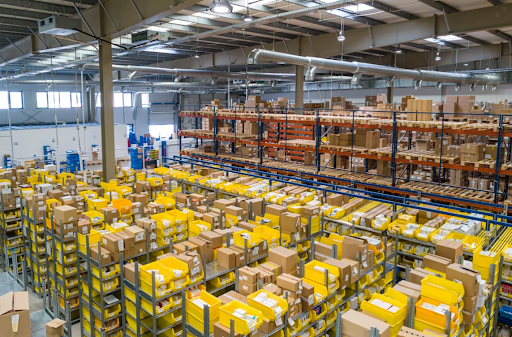

Warehouse replenishment is the process of moving inventory from reserve storage, inbound shipments, or backup stock into active pick locations before fulfillment is affected. It directly impacts picking speed, warehouse capacity, labor efficiency, space utilization, and order flow.
Moreover, the cost of poor replenishment is growing rapidly. The global retail inventory distortion, including overstocks and out-of-stocks, costs businesses $1.73 trillion annually, equal to 6.5% of global retail sales. However, retailers using AI and machine learning for inventory management achieved 2.3x higher sales growth and 2.5x higher profit growth than businesses using traditional inventory processes.
In this blog, we cover warehouse replenishment methods, operational challenges, and best practices for improving warehouse stock replenishment efficiency.
What Is Warehouse Replenishment?
Warehouse replenishment is the process of maintaining usable inventory in active pick locations by moving stock from reserve or backup storage. It connects receiving, putaway, slotting, picking, production supply, and outbound execution.
Synkrato’s AI Slotting continuously aligns replenishment decisions with live demand, inventory availability, and storage capacity.
Moreover, replenishment should be distinguished from purchasing. Purchasing brings inventory into the network. Warehouse replenishment repositions inventory already available within the facility or network. The movement may be:
- Pallet to case
- Case to each
- Reserve to forward pick
- Buffer to workstation
- Warehouse to store
- Production to finished-goods storage
How Does the Warehouse Replenishment Process Work?
The warehouse replenishment process works by identifying demand, calculating the shortage, selecting eligible inventory, creating movement tasks, and confirming the completed transfer.
1. Detect Demand and Inventory Availability
Demand and inventory availability are detected by comparing current or expected orders with the usable inventory already available in the pick location. Demand may come from released orders, waves, production orders, transfer orders, kanbans, or forecast consumption. Microsoft Dynamics 365, for example, can create replenishment work when wave demand exceeds the inventory available for picking.
The system checks:
- Current pick-face inventory and open picks
- Reserve stock, pending receipts, and inventory in transit
- Existing replenishment work for the same demand
- Lot, expiration, ownership, quality, or inventory-status restrictions
Only stock that is physically accessible and eligible for the affected order should be treated as available.
2. Calculate the Shortage and Need Time
The shortage and the need time are calculated by comparing expected consumption with the usable inventory available before the next refill can arrive. It should subtract quantities assigned to open replenishment tasks so that several operators are not sent to solve the same shortage. Microsoft supports using unreserved quantities from existing replenishment work to meet new wave demand.
The calculation should consider:
- Demand expected before the next refill can arrive
- Safety stock required at the pick face
- Retrieval, travel, and destination putaway time
The final quantity is rounded to an executable unit, such as a case, tote, layer, or pallet.
3. Select the Source, Destination, and Movement Quantity
The source, destination, and movement quantity are selected according to inventory eligibility, handling rules, destination capacity, and order requirements. The WMS searches reserve storage for inventory that meets the order and warehouse rules. The closest source is not always the best source. A more distant pallet may have an earlier expiration date, contain the correct handling quantity, or eliminate a fragmented balance.
Source selection can account for:
- FIFO or FEFO sequence
- Lot, batch, and expiration eligibility
- Pallet condition and available quantity
- Equipment and location accessibility
- Opportunities to consolidate partial pallets
The destination must also have enough cube, weight, and handling-unit capacity. Capacity-controlled replenishment prevents inventory from being released into a location that cannot accept it.
4. Create and Prioritize Replenishment Work
Replenishment work is created and prioritized according to the expected stockout time, order cutoff, customer priority, equipment availability, and downstream dependencies. SAP EWM can create warehouse tasks for internal stock movements when a wave is released.
Tasks should be ranked by:
- Projected pick-face stockout time
- Affected order or production cutoff
- Customer and order priority
- Equipment availability
- Travel distance and aisle congestion
- Dependencies on downstream picking or packing
5. Execute and Validate the Movement
The replenishment movement is executed and validated by confirming the source, item, quantity, handling unit, and destination during the physical transfer. The assigned operator, forklift, conveyor, or robot, retrieves the inventory and moves it to the destination. Mobile or automation controls should verify each critical transaction rather than accepting completion based only on operator confirmation.
Validation normally includes:
- Source location and license plate
- Item, quantity, lot, or serial number
- Destination location
- Remaining source balance
6. Update Inventory and Improve Replenishment Rules
Inventory is updated, and replenishment rules are improved after the confirmed movement closes the task and provides performance and exception data. Synkrato AI Agents connect automatic replenishment and rule-based task grouping with wider warehouse execution.
The Warehouse replenishment system should capture:
- Task completion and waiting time
- Short sources and destination overflows
- Quantity or scan differences
- Emergency replenishment frequency
- Repeated shortages by SKU and location
These results help teams adjust minimums, maximums, slot sizes, task priorities, and replenishment timing.
Warehouse Replenishment Methods
Warehouse replenishment methods determine when inventory should move, how much stock should be transferred, and which pick locations should receive it. Some of these methods are as follows.
Minimum/Maximum Inventory Replenishment
Minimum/maximum inventory replenishment triggers a refill when stock falls below a set minimum in a pick location and restores it to a defined maximum level.
This warehouse replenishment strategy works when demand is steady, and warehouse teams already understand SKU movement patterns. It is useful for:
- C-parts and consumables
- Spare parts
- Common retail SKUs
- Items with repeatable demand across shifts
- Inventory with predictable reorder quantities
RFID tags provide real-time inventory visibility, helping adjust shipments, optimize popular items, and use space efficiently. In warehouses, minimum/maximum replenishment is only effective when inventory data is accurate.
Demand-Driven Replenishment
Demand-driven replenishment moves inventory according to real-time demand, forecasts, released orders, promotions, seasonality, and changing SKU velocity. This ensures pick locations are replenished based on current demand rather than fixed thresholds. Demand-driven replenishment works best for:
- Omnichannel fulfillment operations
- Seasonal demand fluctuations
- Promotional spikes
- Fast-changing SKU velocity
The main advantage is responsiveness. Warehouses can adjust replenishment priorities faster as demand patterns shift across products, regions, or fulfillment channels. By connecting live warehouse data with replenishment workflows, Synkrat’s Enterprise Mobility enables faster and more demand-aware inventory decisions across warehouse operations.
Top-Off Inventory Replenishment
Top-off inventory replenishment refills pick locations before expected demand surges, shift changes, wave releases, or outbound peaks.
This method is commonly used before:
- Peak picking shifts
- Carrier cutoff windows
- Flash sales
- Large B2B order waves
- Production runs
However, top-off replenishment requires strong inventory control. Overfilling pick locations can increase congestion, block access paths, and reduce space efficiency if replenishment is not aligned with SKU velocity and storage capacity.
Periodic Inventory Replenishment
Periodic inventory replenishment moves stock at fixed intervals, such as once per shift, overnight, daily, or weekly. As replenishment follows a scheduled cycle, warehouses can plan labor, equipment usage, and replenishment windows more easily.
Periodic replenishment is often suitable for:
- Predictable warehouse operations
- Stable inventory movement
- Manufacturing support environments
- Slower-moving SKUs
The limitation is flexibility. If demand changes suddenly between replenishment cycles, warehouses may still experience pick-face stockouts even when reserve inventory is available elsewhere in the facility.
When Should Warehouse Replenishment Be Triggered?
Warehouse replenishment should be triggered when projected demand during the refill lead time is likely to exceed the usable inventory available in the pick location.
Strong trigger logic combines:
- Projected depletion: Release the task when demand expected during replenishment lead time, plus safety stock, exceeds usable pick-face inventory.
- Released-order shortfall: Compare open demand with inventory already available and replenishments already assigned.
- Capacity opportunity: Top off during periods when labor, equipment, and aisle capacity are available, while respecting destination cube and weight limits.
- Inventory events: Respond to receipts, count adjustments, damaged pallets, lot holds, cancellations, or abnormal consumption.
- Shelf-life requirements: Move eligible lots according to first-expired, first-out rules while preserving the remaining shelf life required by the customer.
A reserve pallet that is blocked, held for inspection, or requires unavailable equipment is not operationally available. Release the task early enough to complete retrieval, travel, validation, and putaway before the affected pick.
REWE Group incorporated this level of coordination into its Magdeburg, Germany, distribution center. The 49,500-square-meter facility can process up to 286,000 packages per day and uses automation to support store replenishment.
At that volume, refill decisions cannot depend on visual checks. They must be synchronized with case sequencing, mixed-pallet construction, dispatch cutoffs, and store-specific demand.
Common Warehouse Replenishment Challenges
Common warehouse replenishment challenges include limited space, poor inventory visibility, inaccurate stock records, delayed movements, and pick-face stockouts. For instance:
- Limited Space: Limited warehouse space forces tradeoffs between reserve stock, pick locations, staging, packing, returns, and outbound flow. If replenishment rules don’t match storage capacity and SKU velocity, congestion and blocked pick faces can still occur even when inventory is available.
- Lack of Inventory Visibility: Poor inventory visibility turns replenishment into a reactive process instead of a planned operational workflow. Warehouse teams may rely on manual checks, supervisor input, or picker complaints because inventory systems do not reflect real-time stock movement accurately.
- Managing Stockouts: Stockouts are not always caused by insufficient inventory levels. They can result from delayed replenishment, inaccurate inventory records, poor slotting decisions, supplier delays, sudden demand spikes, or forward pick locations that cannot support actual order volume.
Best Practices to Optimize Warehouse Replenishment
The best practices to optimize warehouse replenishment include using accurate inventory data, demand-based WMS triggers, emergency procedures, automation, effective slotting, and supplier performance tracking.
Configure WMS Triggers for Re-Ordering and Internal Replenishment
WMS triggers for reordering and internal replenishment should use live demand, inventory levels, pick-face capacity, lead times, order priorities, and operational conditions. Further, warehouses connect WMS replenishment logic with live operational and demand-planning data. Modern replenishment triggers often use:
- Minimum inventory thresholds
- Demand forecasts
- Order wave activity
- Supplier lead times
- Pick-face capacity
- Priority customer orders
Have an Emergency Replenishment Plan
An emergency replenishment plan should define when urgent refills are allowed, who approves them, which equipment receives priority, and how active picking will be protected. Warehouses should define:
- When emergency replenishment is allowed
- Which teams can approve requests
- Which equipment should be prioritized
- How replenishment avoids interrupting active picking
Replenish After Receiving Fast-Moving Inventory
Fast-moving inventory should be replenished after receiving, so it becomes available in forward pick locations before outbound demand creates a shortage. Delays between receiving and active storage create gaps between inventory availability and inventory usability.
This becomes important during:
- Seasonal demand spikes
- Promotional events
- Omnichannel fulfillment peaks
- High-volume outbound periods
Enhance Picking Accuracy With Automation
Automation enhances picking accuracy by improving inventory identification, movement confirmation, replenishment timing, and real-time stock visibility. Common technologies include:
- Barcode scanning
- RFID tracking
- Pick-to-light systems
- Voice-directed picking
- Automated storage and retrieval systems
- AI-based task prioritization
With Synkrato’s simulation and optimization approach, you can connect inventory visibility, warehouse workflows, and operational data to improve replenishment timing and reduce manual intervention across warehouse operations.
Monitor and Measure Vendor Performance
Vendor performance should be monitored and measured because late, damaged, incomplete, or incorrectly documented shipments can disrupt warehouse replenishment.
Warehouses should regularly track:
- On-time delivery performance
- Vendor fill rates
- ASN accuracy
- Lead-time variability
- Damage rates
- Packaging consistency
Optimize Warehouse Space
Warehouse space should be optimized by aligning storage locations, pick-face capacity, and replenishment rules with SKU velocity, cube size, seasonality, and handling requirements.
A practical approach is grouping SKUs into categories such as:
- Fast-moving inventory
- Slow-moving inventory
- Seasonal products
- Bulky items
- Fragile inventory
Streamline Warehouse Replenishment With Synkrato WMS
Synkrato WMS streamlines warehouse replenishment by connecting inventory movement, demand signals, slotting logic, WMS data, and operational workflows.
With Synkrato, warehouses can:
- Improve slotting for fast-moving SKUs
- Identify replenishment bottlenecks faster
- Trigger replenishment based on real warehouse conditions
- Reduce congestion and emergency stock movement
- Balance space, labor, and inventory more efficiently
The result is better warehouse capacity utilization, more reliable fulfillment, and stronger replenishment planning across warehouse operations. Book a demo today.
Frequently Asked Questions About Warehouse Replenishment
What is warehouse replenishment?
Warehouse replenishment is the process of moving inventory from reserve storage or inbound stock into active pick locations before fulfillment operations are disrupted. It helps maintain inventory availability, picking efficiency, and smoother warehouse flow.
What triggers warehouse replenishment?
Warehouse replenishment triggers include projected depletion, minimum thresholds, released-order shortages, forecast demand, top-off windows, inventory adjustments, receipts, lot rules, and unexpected consumption. Synkrato uses estimated stockout time and task lead time rather than quantity alone.
What are the different warehouse replenishment methods?
The different types of replenishment methods include minimum/maximum replenishment, demand-driven replenishment, top-off replenishment, and periodic replenishment. Synkrato helps optimize warehouse replenishment by using AI-driven insights, inventory visibility, and operational data to improve inventory movement decisions. It helps warehouses identify replenishment needs, optimize workflows, prioritize tasks, and maintain inventory availability across warehouse operations.
What are the common warehouse replenishment challenges?
Some of the common warehouse replenishment challenges include limited warehouse space, inaccurate inventory records, poor demand forecasting, supplier delays, and lack of real-time visibility. With Synkrato, warehouses can improve replenishment operations through better inventory visibility, AI-driven insights, and workflow optimization
Which KPIs should be tracked?
Key warehouse replenishment KPIs that should be tracked are pick-face availability, on-time task completion, emergency-task share, and cycle time. Track travel per unit, inventory accuracy, exception rates, labor productivity, aisle-blocking time, and stockouts caused by late replenishment. Segment results by SKU class, zone, shift, and trigger method.