Warehouse labor optimization helps warehouses maintain throughput during labor shortages by matching available workers to real-time demand, order complexity, skills, equipment capacity, and downstream constraints.
Workforce volatility makes this critical. In 2025, U.S. transportation and warehousing recorded a 3.1% absence rate, while 1.7% of usual working hours were lost. Temporary staffing also has limits. In July 2023, production, transportation, and material-moving roles made up one in four temporary-help agency workers, but only 48.2% preferred temporary work.
This blog covers labor inefficiencies, planning limits, resilience strategies, and optimization signals.
Why Labor Shortages Expose Structural Weaknesses in Warehouse Operations
Labor shortages expose inefficiencies that often remain hidden when sufficient staffing is available.
Why Labor Gaps Amplify Existing Process Inefficiencies
Warehouse performance depends on productive labor time. During an eight-hour shift, time is commonly lost to:
- Walking between pick locations
- Waiting for replenishment or equipment
- Searching for inventory
- Resolving discrepancies and correcting orders
- Moving work through congested warehouse areas
Labor shortages magnify these inefficiencies. Reducing a picking team from 20 to 17 workers represents a 15% reduction in headcount. However, throughput may decline much more because of congestion, stockouts, equipment shortages, and downstream constraints.
To measure how strongly labor shortages affect warehouse performance, use the labor sensitivity ratio:
Labor sensitivity ratio = % change in throughput ÷ % change in available labor hours
Thus, if labor hours decrease by 10% but throughput falls by 18%, the ratio is 1.8, which indicates that process dependencies are amplifying the labor shortage.
How Operational Dependencies Increase Workforce Vulnerability
Warehouse activities depend on inventory, equipment, data, space, timing, and technology. A delay in one area quickly affects the entire operation. For instance:
- Late receiving delays putaway, picking, packing, and carrier cutoffs.
- Warehouse management systems (WMS), voice picking, wearable devices, and autonomous mobile robots (AMRs) create technology dependencies.
- Labor shortages, time off task (TOT) quotas, manual workarounds, and limited cross-training increase bottlenecks, safety risks, and reliance on experienced workers.
Reduce these vulnerabilities with a task-and-skill matrix, documented processes, manual fallback procedures, redundant power and network systems, collaborative automation, and cross-training.
Why Hiring More Workers Doesn’t Always Restore Performance
Recruitment increases labor supply but does not automatically improve warehouse performance.
Key limitations include:
- Training, supervision, system access, and equipment delays.
- Aisle congestion and bottlenecks at packing, forklifts, and replenishment.
- Supervisor dilution, increasing errors, and idle time.
In May 2026, the U.S. transportation, warehousing, and utilities sector recorded 298,000 job openings, 308,000 hires, 335,000 separations, and 188,000 quits (2.6%). This shows that hiring alone cannot stabilize capacity. Automation instead shifts labor toward equipment supervision, maintenance, exception handling, and process control.
The Operational Decisions That Have the Greatest Impact on Labor Utilization
Improving labor utilization depends more on operational decisions than simply increasing workforce size.
Balancing Workforce Allocation Across High-Impact Activities
Allocating workers equally across departments is less effective than allocating them to the warehouse constraint.
Labor allocation should consider:
- Orders at risk of missing carrier cutoffs
- Downstream backlogs and replenishment needs
- Equipment and workstation capacity
- Skills, certifications, and ergonomic workload balancing
- Expected exception volume and remaining productive shift time
- The marginal throughput gained from one additional worker
Modern warehouse management systems (WMS), labor management systems (LMS), AI, warehouse analytics, and orchestration platforms help warehouses make data-driven labor allocation decisions.
Synkrato’s AI agents further support this by identifying emerging bottlenecks and recommending real-time labor reallocation to keep warehouse operations flowing efficiently.
Identifying Tasks That Consume Disproportionate Labor Resources
Warehouse labor analysis should separate direct work, enabling work, and avoidable work to expose hidden inefficiencies.
Top labor-consuming tasks include:
- Order picking: Uses up to 55% of labor resources, with excessive travel time as the largest drain.
- Replenishment, putaway, and slotting: Require moving bulk stock, finding open locations, and transporting pallets.
- Packing, kitting, and reverse logistics: Involve sorting, carton selection, condition checks, repacking, and restocking.
Warehouses should use value stream mapping, productivity metrics, units or orders shipped per hour, labor cost per unit, turnover data, and training data to benchmark performance and identify non-value-added work. These insights support dynamic labor models, reduce burnout, and lead to warehouse labor productivity improvement with the frontline.
Reducing Non-Value-Adding Work Across Warehouse Processes
Travel is one of the largest sources of non-value-added (NVA) work and should be reduced by eliminating the 8 Wastes of Lean. These include Defects, Overproduction, Waiting, Non-utilized Talent, Transportation, Inventory, Motion, and Extra-processing.
High-impact warehouse workforce optimization strategies:
- Dynamic slotting, velocity profiling, smart routing (batch, zone, and wave picking), and task interleaving.
- Cross-docking, waveless order release, inventory pre-positioning, optimized layouts, vertical racking, and fewer manual touchpoints.
- Separating exception work from routine tasks, routing workers away from congestion, and delivering task information directly to mobile devices.
Synkrato’s AI Slotting continuously optimizes product placement to reduce travel time, congestion, and pick density.
Why Traditional Workforce Planning Struggles During Labor Constraints
Traditional models of warehouse workforce planning for labor shortages often fail because warehouse demand, workloads, and operating conditions constantly change.
The Limits of Fixed Staffing Models in Variable Operations
A case study of a 17,000-square-foot U.S. distribution center found that labor accounted for 76% of annual operating costs, highlighting why workforce planning directly affects warehouse performance. Staffing based on average productivity often creates costly mismatches, leading to idle labor during slow periods and overtime during demand spikes.
Many warehouses estimate labor using:
Required workers = Expected units ÷ (Units per worker-hour × Available hours)
However, this formula assumes every unit requires the same effort. A more accurate model is:
Required labor hours = Total (Expected workload by type × Standard minutes per task) + Planned exception hours
It should also account for order complexity, travel distance, equipment capacity, role flexibility, skill availability, absences, and demand variability.
How Demand Volatility Disrupts Workforce Productivity
Demand volatility should be measured by order shape, not just order volume, because similar order counts can require very different labor.
Key planning variables include:
- Order-line distribution, pick density, SKU concentration, cube and weight profile.
- Replenishment demand, non-conveyable orders, service cutoffs, and expected returns or exceptions.
Volatile demand causes overstaffing during slow periods and understaffing during surges, while disrupting labor allocation and increasing overtime, missed SLAs, and reactive scheduling.
Walmart addresses this challenge through network-wide automation, with over 45% of U.S. e-commerce fulfillment-center volume automated and 1,800 stores supplied by 15 regional distribution centers undergoing automation.
Why Reactive Labor Planning Increases Operational Risk
Reactive labor planning relies on historical data, recent events, or managerial gut feel instead of predictive forecasting. As a result, managers respond only after backlogs, absenteeism, dock congestion, or productivity losses become visible, forcing operational firefighting.
Common warning signs include:
- Projected work exceeding qualified labor hours.
- Queue times, replenishment demand, or backlog recovery exceeding planned thresholds.
- Rising exception work, overtime, and emergency labor transfers.
- Increasing reliance on temporary workers and accelerated onboarding.
Reactive planning also increases operational risk. Working 12-hour shifts is associated with a 37% higher risk of workplace injury. It makes excessive overtime a short-term solution that can reduce long-term workforce availability through fatigue, injuries, and absenteeism.
Building Operational Resilience When Labor Availability Is Unpredictable
Warehouses maintain performance by adapting processes, workflows, and priorities as labor availability changes.
Designing Workflows That Depend Less on Workforce Expansion
Reducing dependence on workforce expansion requires designing workflows that scale through automation, orchestration, and process optimization instead of additional headcount. The objective is to decouple business growth from labor growth by minimizing manual handling, repetitive tasks, and unnecessary movement while improving operational consistency.
This can be achieved through:
- ABC analysis
- Velocity profiling
- Automated Storage and Retrieval Systems (ASRS)
- Vertical carousels
- Automated cartonization
Integrating WMS, Enterprise Resource Planning (ERP), and Warehouse Control Systems (WCS) further synchronizes inventory, equipment, and workflows, enabling higher throughput without proportional workforce expansion.
Strengthening Operational Flexibility Across Warehouse Functions
Operational flexibility enables warehouses to maintain performance despite changing order profiles, SKU mixes, and labor availability. Rather than relying on fixed processes, resilient operations continuously adapt storage configurations, material handling paths, and inventory locations to changing business requirements without disrupting throughput.
This flexibility is supported by scalable solutions, which allow warehouses to expand capacity without major infrastructure changes. A few of them include:
- Modular robotics
- Flexible material handling equipment
- High-density storage
- RFID-enabled inventory visibility
Synkrato’s Enterprise Mobility further improves operational flexibility by delivering real-time task updates to frontline workers as priorities change.
Maintaining Service Levels Under Workforce Constraints
Maintaining service levels under workforce constraints requires prioritizing work based on customer impact rather than completing every task equally. Labor should first support activities that protect the next carrier cutoff, future fulfillment, and multiple downstream orders, while lower-priority work can be delayed, combined, or cancelled.
Resilient warehouses use:
- Dynamic prioritization based on promise times
- Order release aligned with packing and shipping capacity
- Carrier cutoff monitoring, controlled backlog limits, reserved labor for urgent replenishment, and real-time workload rebalancing.
They also measure backlog recovery time to ensure staffing disruptions do not affect subsequent shifts.
Business Indicators That Signal the Need for Labor Optimization
Operational data provides early warning signs when existing workforce strategies are no longer delivering expected performance.
Rising Labor Costs Without Corresponding Productivity Gains
A widening gap between labor spending and completed output is one of the clearest warning signs. Between 2019 and 2024, U.S. warehousing and storage unit labor costs increased 13.8% annually, while labor productivity declined 7.4% per year.
During the same period, hourly compensation increased 5.4% annually, hours worked increased 8.0%, yet output recorded 0.0% annual growth. Average hourly earnings also increased from $25.50 in June 2025 to $26.66 in May 2026, which makes labor efficiency increasingly important.
Key indicators include:
- Overtime increasing faster than shipped volume.
- Temporary labor spending rising without reducing backlogs.
- More paid hours or labor cost per order.
- Higher indirect labor and supervisor expediting time.
- Rising labor costs with unstable service levels.
Recurring Fulfillment Delays Despite Workforce Adjustments
Persistent fulfillment delays usually indicate a structural workflow constraint rather than a staffing shortage.
If adding workers, changing shifts, or approving overtime does not improve order-cycle time, managers should analyze:
- Queue time
- Touch time
- Work-in-process (WIP)
- Constraint utilization
- Order-cycle-time variation
That’s because a process can achieve high units per hour while still delaying shipments if downstream operations become overloaded.
Declining Operational Stability as Workforce Availability Changes
A warehouse should experience only gradual changes in output as labor availability changes. Large productivity swings, repeated dependence on experienced employees, frequent supervisor intervention, high order-cycle-time variation, and throughput declining faster than available labor hours indicate excessive dependence on specific people or processes.
Useful stability metrics include:
- Throughput coefficient of variation
- Schedule attainment by shift
- Overtime dependency
- Productive time as a percentage of paid time
- Exception hours as a percentage of total labor
- Percentage of tasks covered by at least two trained employees
- Backlog recovery time
- Labor sensitivity ratio
The objective of warehouse labor optimization is to determine which activities should be eliminated, redesigned, reassigned, automated, or protected so available labor consistently supports warehouse flow, order accuracy, safety, and customer service.
How to Overcome Warehouse Labor Shortages with Synkrato
Synkrato enables warehouses to adapt to changing demand with AI-driven labor optimization, real-time operational visibility, and predictive decision support. It helps managers allocate the right people to the right tasks while minimizing bottlenecks, travel time, and idle labor.
With Synkrato, warehouses can:
- Optimize product placement to reduce picker travel, congestion, and unnecessary movement across the warehouse.
- Detect emerging bottlenecks early and rebalance labor before they impact throughput, carrier cutoffs, or service levels.
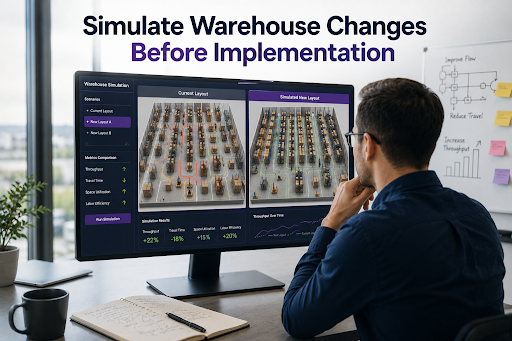
- Test staffing, layout, and workflow changes in a virtual environment before implementing them in live operations.
- Deliver real-time tasks and workflow updates to frontline workers, improving execution, productivity, and response to changing order priorities.
Book a demo to see how Synkrato’s platform optimizes labor utilization, improves warehouse flow, and maintains high throughput during demand fluctuations.
FAQs
Why do warehouse labor shortages continue even after increasing recruitment efforts?
Recruitment does not solve high turnover, slow onboarding, skill gaps, or inefficient workflows. New hires also require training, equipment, supervision, and time to reach full productivity, so higher headcount may not immediately increase stable labor capacity.
How does Synkrato help warehouses optimize labor during workforce shortages?
Synkrato uses AI-driven insights and real-time warehouse visibility to identify bottlenecks, reduce unnecessary movement, and improve task allocation. This helps warehouses generate more throughput from available workers without relying only on additional hiring.
What operational metrics best indicate declining labor efficiency?
Important metrics include units or orders shipped per labor hour, labor cost per unit, travel time, idle time, exception volume, overtime, error rates, and missed carrier cutoffs. A rising labor sensitivity ratio can also show that process problems are amplifying workforce shortages.
Can Synkrato identify operational inefficiencies that increase labor dependency?
Yes. Synkrato can highlight congestion, poor inventory placement, workflow delays, excess travel, and emerging process constraints. These insights help managers redesign operations to reduce warehouse labor dependency on manual intervention and a small number of experienced workers.
Why do some warehouses maintain performance with fewer workers than others?
High-performing warehouses maintain performance through optimized slotting, cross-trained teams, standardized workflows, balanced capacity, and automation. Synkrato reinforces these capabilities with AI-driven recommendations that improve labor allocation and warehouse flow.
How does Synkrato improve warehouse productivity when labor availability is limited?
Synkrato helps prioritize high-impact tasks, optimize inventory placement, and detect bottlenecks before they disrupt throughput. It also supports faster labor reallocation and workflow decisions, allowing available employees to spend more time on productive work.