Workflow optimization increasingly depends on understanding how decisions interact before they are executed. AI agents imprive one process can unintentionally create bottlenecks, resource conflicts, or instability elsewhere in the operation.
Gartner predicts that by 2028, 15% of day-to-day work decisions will be made autonomously through agentic AI, reflecting the growing role of AI agents in enterprise decision-making.
This blog examines how AI agents evaluate workflow risks, identify hidden tradeoffs, and support process optimization through scenario analysis before operational decisions affect live performance.
Why Workflow Inefficiencies Often Stem From Hidden Scenario Complexity
Workflow inefficiencies rarely come from one broken process. They usually emerge when demand shifts, labor constraints, system delays, and resource dependencies interact in ways traditional analysis does not detect. This is why AI agents for workflow optimization and scenario planning are useful: they test how workflow decisions behave under changing conditions before live execution.
How Operational Variability Creates Undetected Workflow Risks
Operational variability becomes risky when small changes propagate across dependent workflows. A demand spike can increase queue pressure, a labor shortage can delay task completion, and system latency can disrupt process timing. AI agents for process optimization evaluate these conditions before they create recurring bottlenecks.
Why Scenario Interdependencies Distort Process Performance
A decision that improves one workflow can weaken another. Faster task intake may overload downstream processing, while higher resource utilization can reduce recovery capacity during disruptions. AI-powered agents for operational decision analysis expose these tradeoffs by evaluating connected workflows together, not as isolated processes.
How Complexity Conditions Trigger Workflow Instability
Workflow instability increases when shared resources, shifting priorities, and variable demand create too many execution paths to evaluate manually. Intelligent agents for workflow scenario modeling help teams compare alternatives, identify constraint patterns, and reduce operational risk before changes affect live performance.
Why Traditional Workflow Analysis Often Misses Structural Optimization Gaps
Traditional workflow analysis explains past performance but often fails to show how workflows behave under changing operating conditions. Historical reports, static process maps, and periodic reviews evaluate averages, not execution variability. This is why AI agents for workflow optimization and scenario planning are increasingly used to test workflow behavior before changes go live.
Suggested Read: AI Agents for High Volume Warehouses to Improve Efficiency
Static Analysis Models Failing Under Dynamic Conditions
Static models rely on fixed assumptions about demand, capacity, and task sequencing. When labor availability, workload intensity, or priorities shift, those assumptions quickly lose accuracy, creating decisions based on outdated conditions.
Optimization Risks That Conventional Scenario Planning Often Overlooks
Conventional planning usually tests expected outcomes, but workflow risk often appears in edge conditions. It can miss:
- Local improvements that create downstream bottlenecks
- Higher utilization that reduces recovery capacity
- Policy changes that introduce new execution dependencies
AI-powered agents help evaluate these tradeoffs across connected workflows more continuously.
Why Incremental Workflow Adjustments Often Underperform
Small workflow adjustments often improve one metric while leaving the underlying constraint unchanged.
For example:
- Faster task execution may simply move congestion downstream
- Additional resources may mask constraints rather than eliminate them
- Process redesigns may improve local efficiency while leaving system-wide dependencies unchanged
Synkrato AI Slotting Recommendations can help evaluate whether SKU placement is contributing to workflow instability by identifying slotting changes that reduce travel time, congestion, and downstream execution pressure. This is especially relevant when faster task execution or added labor fails because the real constraint is poor inventory positioning.
Agent-Led Scenario Reasoning for Diagnosing Workflow Tradeoffs
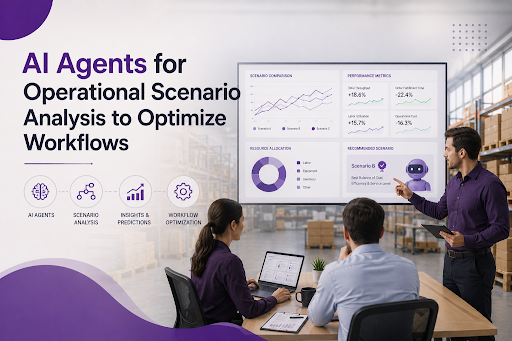
Most organizations can identify where performance declines. Far fewer can determine why a workflow behaves differently under changing operating conditions. This is where AI Agents for operational scenario analysis can differ from traditional analytics. Rather than measuring outcomes after execution, they model or simulate alternative decision pathways before changes are implemented in live operations.
Scenario Evaluation of Operational Decision Pathways
Every workflow decision creates multiple possible execution paths. Changing priorities, reallocating resources, accelerating approvals, or modifying task sequencing can improve one outcome while creating new constraints elsewhere.
AI agents for workflow optimization can help evaluate these alternative pathways by simulating likely outcomes before execution.
For example, accelerating order processing may improve cycle time but increase downstream queue pressure if fulfillment capacity remains unchanged. Similarly, increasing resource utilization may improve short-term productivity while reducing resilience during demand spikes.
Instead of asking “What happened?”, agent-led analysis asks:
- What is likely to happen under different operating conditions?
- Which decision path produces the best overall outcome?
- Where do hidden risks emerge as conditions change?
This shifts workflow optimization from reactive correction to predictive evaluation.
Suggested Read: AI Agents for 3pl Logistics to Optimize Fulfillment Accuracy
Constraint Patterns Influencing Workflow Stability
Workflow instability rarely results from isolated events. It usually develops through recurring constraint patterns that appear across multiple processes.
Common patterns include:
| Constraint Pattern | Workflow Impact |
| Resource contention | Growing execution delays |
| Queue accumulation | Throughput degradation |
| Process synchronization gaps | Workflow variability |
| Capacity bottlenecks | Reduced operational resilience |
The challenge is that these constraints often move. A bottleneck that appears in one workflow today may emerge elsewhere tomorrow as operating conditions change.
Intelligent agents for workflow scenario modeling continuously evaluate how constraints shift across interconnected workflows, allowing teams to identify structural risks before performance deteriorates.
Tradeoff Conditions Revealed Through Agent-Based Analysis
Most workflow decisions involve tradeoffs. Improving one objective often affects another.
Examples include:
- Higher utilization versus operational flexibility
- Faster execution versus increased exception risk
- Cost reduction versus resilience during disruptions
- Throughput optimization versus service consistency
Traditional workflow analysis often evaluates these objectives independently. Agent-based reasoning evaluates them in a unified framework.
This allows AI-powered agents to reveal tradeoffs that remain hidden when performance metrics are reviewed separately, helping leaders make decisions based on system-wide outcomes rather than local improvements.
Adaptive Workflow Responses That Influence Optimization Outcomes
Identifying workflow risks is only part of the challenge. The larger question is how operations should respond once changing conditions begin affecting performance.
Suggested Read: AI Agents for Ecommerce Warehouses to Improve Operational Decision-making
Dynamic Response Logic Affecting Process Efficiency
Traditional workflow controls often rely on predefined rules. These rules work reasonably well under stable conditions but become less effective as variability increases.
Adaptive response logic evaluates changing conditions continuously and adjusts execution priorities accordingly.
Examples include:
- Increasing resource utilization during steady demand periods can leave little buffer capacity, causing delays when sudden demand spikes occur.
- Accelerating task execution in upstream workflows can shift congestion downstream, where downstream teams become overloaded and queues accumulate.
- Reducing staffing or operating costs can improve short-term efficiency but slow recovery when disruptions or unexpected workload surges occur.
- Optimizing for maximum throughput can lead to uneven workload distribution, where some stages of the process become chronic bottlenecks while others remain underutilized.
According to Gartner, organizations increasingly view agentic AI as a mechanism for autonomous decision support because it enables faster responses to operational variability.
This is one reason AI agents are becoming increasingly relevant in complex operating environments.
Adjustment Decisions Supporting Workflow Stability
Not every adjustment improves workflow performance. Effective responses target the underlying constraint rather than the visible symptom.
Consider the difference:
| Response Type | Likely Outcome |
| Add resources to a delayed workflow | Temporary improvement |
| Remove upstream constraint | Structural improvement |
| Increase processing speed | May shift bottleneck downstream |
| Improve workflow coordination | Stabilizes overall flow |
The quality of a decision depends on understanding how workflows interact. Agent-led systems evaluate whether an intervention removes a constraint or simply relocates it elsewhere in the process.
Continuous Learning Effects on Operational Optimization
Most workflow optimization initiatives operate through periodic reviews. The challenge is that operating conditions often change faster than review cycles.
Continuous learning allows agents to refine scenario models using execution feedback over time.
As additional workflow data becomes available, the system improves its ability to:
- Identify emerging constraint patterns
- Evaluate decision effectiveness
- Predict workflow instability
- Recommend higher-confidence interventions
Synkrato AI Agents can continuously evaluate operational scenarios, helping teams understand how workflow changes affect broader execution outcomes before decisions are implemented at scale.
Structural Conditions That Define Scalable Workflow Improvement
Workflow optimization becomes significantly more difficult as process complexity increases. At scale, sustainable improvement depends less on individual process efficiency and more on how effectively the organization manages interactions between workflows.
Indicators That Existing Workflow Logic Has Reached Limits
Several signals indicate that current workflow management approaches are no longer sufficient:
- Performance variability increases despite optimization efforts
- Exceptions grow faster than the workload volume
- Resource utilization remains high while throughput stagnates
- Decision-making becomes increasingly reactive
These conditions often indicate that workflow complexity has exceeded the capability of traditional planning models.
Suggested Read: AI Agents for Real-time Inventory Management to Improve Accuracy
Conditions Requiring Agent-Led Scenario Optimization
Not every organization requires agent-led workflow analysis. However, complexity thresholds eventually make manual evaluation impractical.
Common triggers include:
- High workflow interdependency
- Frequent priority changes
- Variable demand conditions
- Shared resource environments
- Large-scale operational networks
Under these conditions, the number of possible execution scenarios grows too quickly for conventional planning approaches to evaluate effectively.
Factors Supporting Sustainable Workflow Performance Gains
Long-term workflow optimization depends on more than better decision models. It requires structural conditions that support continuous improvement.
The most important factors include:
- Reliable operational data improves scenario accuracy
- Process visibility reveals emerging risks
- Cross-functional coordination reduces dependency conflicts
- Continuous scenario evaluation improves decision quality
Organizations that combine these capabilities with AI agents are generally better positioned to improve workflow performance without creating new operational constraints elsewhere.
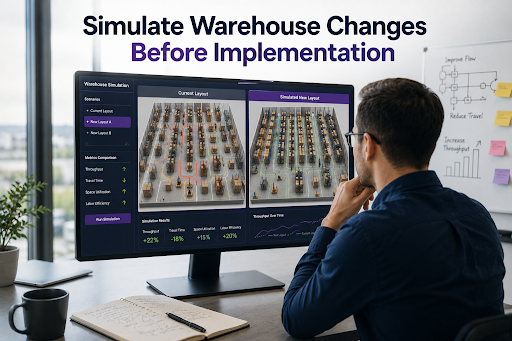
Synkrato Simulation & Optimization helps teams model workflow scenarios, evaluate constraints, and test operational decisions before live deployment.
Conclusion
Workflow optimization improves when decisions are evaluated through scenario-based analysis rather than relying only on historical performance. In dynamic environments, changes in demand, capacity, and dependencies can produce outcomes that static analysis may not anticipate.
AI agents for operational scenario analysis can help evaluate potential decision paths, surface tradeoffs, and identify possible constraint shifts before implementation. This supports more scenario-informed workflow improvement, complementing traditional monitoring and reactive optimization.
Book a demo with Synkrato to use agent-led scenario analysis to improve workflow stability, resource utilization, and operational performance at scale.
FAQs
How can AI agents reveal hidden tradeoffs between workflow efficiency objectives and operational resilience?
AI agents compare how different workflow decisions affect speed, capacity, recovery buffers, and downstream stability. For example, maximizing resource utilization may improve short-term efficiency but reduce resilience during demand spikes. Synkrato AI Agents help evaluate these tradeoffs before decisions affect live operations.
Why do workflow inefficiencies often persist even after process redesign and optimization initiatives?
Workflow inefficiencies persist when redesigns improve individual steps but leave dependencies unresolved. Faster task execution can still create downstream queues if capacity, sequencing, or resource availability remain misaligned. AI agents for workflow optimization and scenario planning help identify where the real constraint sits.
How can AI agents evaluate the downstream impact of prioritization decisions on workflow performance outcomes?
AI agents model how prioritization changes affect connected workflows before execution. For example, pushing high-priority orders forward may improve service levels but overload packing, replenishment, or labor capacity. Synkrato’s simulation & optimization help test these outcomes before operational changes go live.
What role does operational variability play in long-term workflow instability?
Operational variability causes workflow instability when demand, labor availability, task duration, and system response times shift faster than static plans can adapt. Over time, small mismatches compound into queues, idle time, rework, and inconsistent output. Intelligent agents for workflow scenario modeling help detect these patterns earlier.
How can AI agents assess whether policy-level process decisions may introduce systemic workflow risks?
AI agents test how operating policies behave under different scenarios, such as demand surges, labor constraints, or capacity limits. A policy that works under average conditions may create bottlenecks during volatility. Synkrato AI Agents help evaluate whether process rules improve system-wide flow or introduce hidden risk.
Can AI agents quantify the cumulative effect of minor execution deviations on broader workflow performance?
Yes. AI agents can track how repeated small deviations, such as delayed handoffs, task overruns, or sequencing errors, affect throughput, labor utilization, and workflow reliability. AI-powered agents for operational decision analysis help connect minor execution variance to broader performance degradation.
How does agent-driven analysis support validation of alternative workflow strategies before live deployment?
Agent-driven analysis allows teams to compare alternative workflow strategies in simulated conditions before implementation. It can test changes in sequencing, resource allocation, prioritization, or capacity rules. Synkrato supports this validation by helping teams identify constraint shifts before deployment.
What factors determine whether AI agent outputs are reliable enough for enterprise workflow decisions?
Reliable AI agent outputs depend on accurate operational data, connected systems, clear decision rules, and continuous performance feedback. Poor data quality or disconnected workflows can weaken recommendations. Synkrato’s AI Agents can help improve decision reliability by evaluating live operational conditions, dependencies, and execution constraints together.