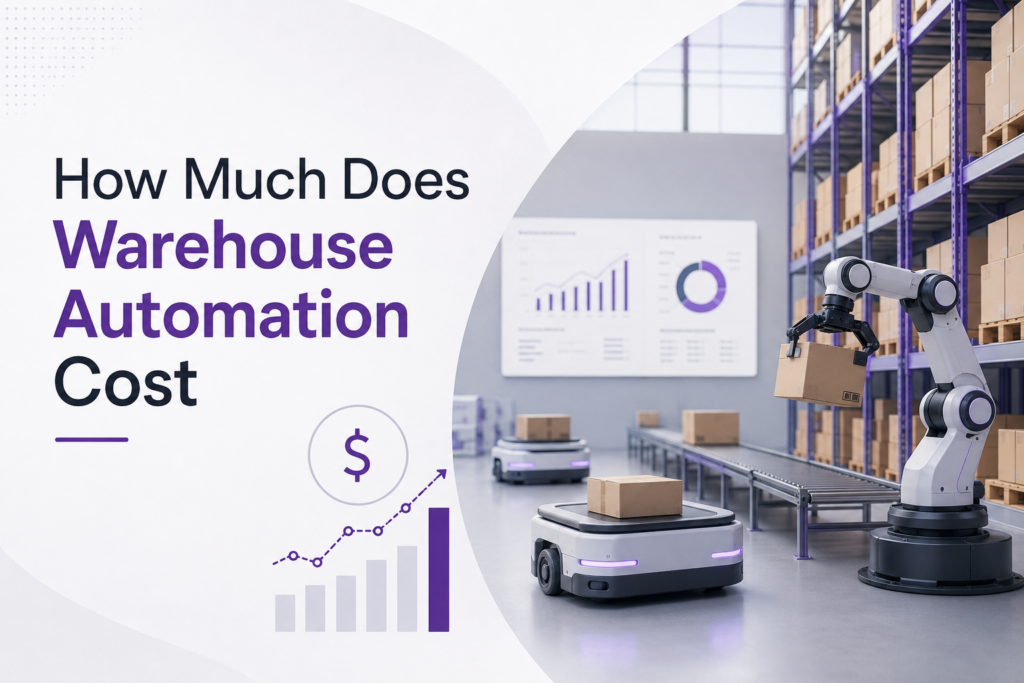
Warehouse automation costs are estimated to start around $200,000 for targeted automation projects and can exceed $500,000 for broader automated warehouse systems. These estimates depend on warehouse size, automation level, equipment type, software integration, and operational complexity.
Warehouses implementing barcode scanning, conveyors, and WMS upgrades usually require lower investment than facilities deploying automated storage and retrieval systems (AS/RS), robotic picking, autonomous mobile robots (AMRs), AI slotting, and digital twin technologies.
This blog covers estimated warehouse automation costs, the main factors influencing automation pricing, and the operational benefits businesses can expect from warehouse automation investments.
Suggested Read: What is Warehouse Automation
Warehouse Automation Cost Breakdown
Warehouse automation system costs vary because every warehouse has different operational requirements, inventory movement patterns, and fulfillment goals. A facility automating pallet movement and storage will have a very different cost structure than an e-commerce warehouse focused on high-speed piece picking, packing, and returns processing.
| Component | Estimated Cost | Details |
| Warehouse Size | $200,000+ for partial automation; $500,000+ for larger automation programs | Smaller warehouses automate receiving, picking, labeling, or packing first. Larger facilities require more equipment, software integration, safety systems, and testing, which increases total automation costs. |
| AS/RS System | $70,000+ to $1.5 million+ | Vertical carousel modules may start around $70,000. Robotic cube storage, mini-load AS/RS, and multi-shuttle systems can exceed $1 million because of higher storage density and robotics complexity. |
| Medium Duty Shelving | $80-$300 per bay | Medium-duty shelving costs depend on bay dimensions, shelf levels, weight capacity, and warehouse configuration. These systems are commonly used for cartons, spare parts, and slower-moving inventory. |
| Heavy Duty Pallet Racking | $50-$450 per pallet position | Selective pallet racks are generally lower cost, while gravity-flow, push-back, and double-deep racking systems require higher investment because of denser storage configurations. |
| Conveyor Systems | $5,000 to $500,000+ | Conveyor costs vary based on routing complexity, controls, speed, length, and warehouse integration requirements. Fully automated conveyor networks require higher investment than standalone belt conveyors. |
| Robotic Picking Systems | $100,000 to $1 million+ | Robotic picking costs depend on robot count, AI vision systems, grippers, throughput targets, and software integration. High-volume e-commerce and retail fulfillment operations typically require larger deployments. |
| Warehouse Software | $25,000 to $500,000+ | Warehouse software costs include WMS, WES, WCS, AI workflows, dashboards, API integration, analytics, testing, and implementation services. |
| Installation and Setup | 10-25% of the total automation project cost | Installation includes equipment assembly, controls integration, electrical work, layout changes, commissioning, testing, and operational cutover. |
| Maintenance and Support | 5-10% of the initial automation cost annually | Ongoing warehouse automation maintenance costs include preventive servicing, spare parts, controls support, software updates, and technical support agreements required to minimize warehouse downtime. |
Warehouse automation budgets include equipment, software integration, implementation, facility changes, training, and ongoing support. Many projects exceed planned costs because businesses underestimate integration complexity, testing, process redesign, and operational disruption during deployment.
Synkrato helps warehouses reduce this risk by improving visibility across warehouse data, automation workflows, slotting decisions, and operational planning before large-scale automation investments are deployed.
Factors That Influence the Cost of Warehouse Automation
Warehouse automation pricing depends on factors such as automation level, warehouse size, operational complexity, software integration, and scalability requirements. These investments are also increasing across the industry, with the global warehouse automation market projected to exceed $65.74 billion by 2031 to reflect growing demand for faster and more efficient warehouse operations. Some factors that influence these costs include:
Type of Technology
Technologies focused on inventory visibility and workflow efficiency usually require lower investment than systems designed for dense storage, high-speed fulfillment, robotic movement, or fully automated material handling.
For example, warehouse automation costs increase as businesses move toward more advanced and infrastructure-intensive technologies, such as:
- Barcode scanning, mobile workflows, and WMS upgrades usually support lower-cost workflow automation.
- Conveyor systems and automated sortation improve material flow across receiving, picking, packing, and shipping zones.
- AS/RS and pallet shuttle systems, which increase storage density and reduce manual inventory movement.
- Robotic picking systems and robotic cube storage, which support high-speed automated fulfillment and require advanced robotics, software orchestration, and real-time controls.
Suggested Read: Warehouse Automation Trends
Level of Automation
The investment in warehouse automation increases as warehouses move from assisted workflows to highly orchestrated operations. Semi-automated facilities may still rely on workers for picking, replenishment, packing, and exception handling, while advanced operations use robotics, automated storage systems, AI-driven task allocation, and real-time analytics to coordinate warehouse activity more efficiently.
Higher levels of automation require investment in:
- Automated storage and retrieval systems that reduce manual inventory movement.
- Robotics and AMRs that improve picking productivity and reduce travel time.
- Warehouse software that synchronizes labor, inventory, and equipment workflows.
- AI-driven analytics that identify bottlenecks and improve operational planning.
Warehouse Size and Layout
Warehouse size influences automation investment, but layout complexity often has a greater operational impact than square footage alone. As warehouse operations become more complex, businesses often invest in automation to:
- Increase storage density without expanding warehouse real estate.
- Improve inventory flow between receiving, storage, picking, and shipping.
- Reduce congestion in high-volume fulfillment zones.
- Minimize unnecessary travel time across large picking areas.
- Support higher throughput during seasonal and peak demand periods.
This is also why many warehouses use simulation and digital twin technologies before deployment. Synkrato’s digital twin helps warehouses test layouts, slotting, and workflows before automation rollout to improve warehouse planning decisions.
Customization and Integration
Customization increases warehouse automation costs because systems must align with operational requirements such as product dimensions, storage rules, order profiles, carrier workflows, label formats, and customer-specific fulfillment processes.
At the same time, integration plays a critical role in automation performance. Warehouse automation systems need to exchange real-time data across multiple operational platforms to maintain visibility, inventory accuracy, and workflow coordination.
This often includes integration with:
- WMS, ERP, and order management systems.
- Robotics platforms, conveyors, and automated storage systems.
- Barcode scanners, label systems, and mobile warehouse devices.
- Reporting dashboards, labor tools, and operational analytics platforms.
Suggested Read: Warehouse Automation Statistics
Supplier and Brand
Supplier selection influences more than upfront equipment pricing. It also affects implementation timelines, system reliability, service quality, spare parts access, upgrade flexibility, and long-term operational support. Lower-cost vendors may reduce initial investment but can increase downtime risk if support coverage, integration quality, or technical documentation is limited.
Because of this, businesses often evaluate suppliers based on several operational and technical factors, including:
- Implementation experience in similar warehouse environments.
- System interoperability with existing warehouse technologies.
- Local service availability and spare parts support.
- Cybersecurity standards and software update capabilities.
- Long-term scalability and phased automation support.
Scalability and Future Expansion
Warehouse automation investments should support future operational growth. If businesses expect SKU expansion, higher order volumes, faster fulfillment windows, or increased returns processing, automation systems must be designed with enough flexibility to scale without requiring a complete infrastructure redesign later.
As warehouse networks grow, businesses often prioritize automation systems that can:
- Expand storage and throughput capacity gradually.
- Support additional robotics, conveyors, or picking zones over time.
- Handle changing SKU profiles and order patterns more efficiently.
Complexity of Operations
Operational complexity is another major factor influencing warehouse automation costs. Warehouses handling high SKU counts, split-case picking, returns, lot tracking, batch controls, kitting, personalization, or multi-channel fulfillment require more advanced automation logic and workflow coordination.
Automation requirements also vary significantly by industry and fulfillment model. For example:
- Retail distribution centers shipping full pallets may prioritize storage density and replenishment efficiency.
- E-commerce operations often require high-speed piece picking, rapid sortation, and multi-carrier shipping workflows.
- Grocery warehouses may require temperature-controlled automation, freshness tracking, and expiration-date management.
Suggested Read: Benefits of Warehouse Automation
Training and Workforce Costs
Workforce training is an important part of warehouse automation costs because automation changes how warehouse teams operate daily. Associates, supervisors, engineers, and maintenance teams must learn new workflows, system coordination, exception handling, robotics interaction, and preventive maintenance procedures.
As automation adoption increases, businesses often invest in workforce readiness across areas such as:
- Robotics and AMR safety procedures.
- Warehouse software and dashboard usage.
- Scanning accuracy and inventory handling workflows.
- Equipment troubleshooting and preventive maintenance.
Regulatory and Compliance Requirements
Regulatory and compliance requirements can significantly increase warehouse automation costs because automated environments require stricter operational controls, safety systems, and equipment certification standards. Warehouses deploying robotics, conveyors, AS/RS, or automated material handling systems often need additional infrastructure to support worker safety and compliance monitoring.
These requirements commonly include:
- Safety guarding and emergency stop systems.
- Forklift and pedestrian traffic separation.
- Rack safety inspections and fire protection alignment.
- Equipment certification and operational documentation.
- Workforce safety training for automated environments.
Suggested Read: Warehouse Automation ROI
Return on Investment (ROI) Expectations
ROI expectations influence how much businesses are willing to invest in warehouse automation. While finance teams may focus on payback periods and capital efficiency, operations leaders evaluate automation based on throughput improvement, labor productivity, inventory accuracy, service levels, and long-term scalability.
As a result, warehouse automation ROI is often measured through operational improvements such as:
- Lower manual travel time across picking zones.
- Higher picks per labor hour and better labor utilization.
- Fewer order errors, returns, and fulfillment exceptions.
- Better inventory accuracy and slotting efficiency.
- Lower overtime dependency during peak demand periods.
- Higher storage density and improved space utilization.
- Better equipment utilization across warehouse workflows.
- Reduced safety exposure in repetitive or congested operations.
- More reliable fulfillment cutoffs and shipping performance.
- Improved operational visibility for supervisors and managers.
Benefits of Investing in an Automated Warehouse
Some of the major benefits of investing in warehouse automation include improved operational efficiency, lower labor dependency, better inventory accuracy, optimized space utilization, and more scalable warehouse operations.
- Increased Efficiency: Automated warehouse systems improve efficiency by reducing unnecessary travel, balancing workflow movement, and increasing throughput across warehouse operations. Automation technologies and warehouse orchestration systems help facilities process higher order volumes with fewer operational bottlenecks.
- Reduced Labor Costs: Businesses use automation to reduce repetitive manual tasks such as walking, sorting, scanning, and inventory movement while improving labor productivity and reducing overtime pressure.
- Improved Accuracy and Reduced Errors: Connected warehouse technologies improve inventory accuracy and fulfillment precision by validating inventory movement, scanning workflows, labeling, and replenishment activity in real time. WMS platforms, barcode workflows, robotics, and AI-driven controls help reduce inventory mismatches and fulfillment errors.
- Optimized Space Utilization: Better space utilization allows warehouses to increase storage density without immediately expanding facility footprint. Technologies such as AS/RS, VLMs, robotic storage systems, and AI slotting improve vertical storage usage and create more usable warehouse capacity.
- Scalability: Scalable automation strategies help warehouses expand throughput, storage capacity, and fulfillment operations more predictably as demand changes. Modular automation models allow businesses to gradually add robotics, conveyors, warehouse software, and automated storage systems based on operational growth.
Suggested Read: Automated Warehouse Picking Systems
How Synkrato Optimizes Warehouse Automation Decisions?
Warehouse automation projects become more effective when businesses can evaluate workflows, storage movement, labor coordination, and operational bottlenecks before making large infrastructure investments. Synkrato helps warehouses improve automation planning, operational visibility, and warehouse decision-making through connected warehouse intelligence tools.
Key capabilities include:
- 3D Digital Twin: Simulates layouts, slotting strategies, and workflows before automation rollout.
- AI Slotting: Optimizes inventory placement based on demand patterns and SKU movement.
- AI Agents: Converts warehouse data into real-time operational insights and recommendations.
- Enterprise Mobility and Labeling: Improves workflow execution, inventory visibility, and labeling accuracy across warehouse operations.
Conclusion
Warehouse automation is most effective when businesses focus on solving specific operational bottlenecks, such as inefficient picking, low storage density, labor pressure, fulfillment delays, or limited scalability. Instead of automating every workflow at once, many businesses adopt phased automation strategies that improve throughput, inventory flow, and operational efficiency over time while keeping investment aligned with operational priorities.
As warehouse operations become more complex, connected warehouse intelligence is becoming equally important alongside automation equipment itself. Synkrato helps warehouses improve automation planning and operational visibility through digital twins, AI slotting, warehouse intelligence, and connected workflow management.
Still wondering whether warehouse automation is worth the investment? With Synkrato, you can connect systems, automate workflows, and improve operational visibility without unnecessary complexity. Book a demo to explore the right automation strategy for your warehouse operations.
Suggested Read: 3pl Warehouse Automation
FAQs
What factors influence warehouse automation costs the most?
Warehouse automation costs are mainly influenced by automation level, warehouse layout, software integration, storage density requirements, operational complexity, and scalability goals. Synkrato helps businesses evaluate these factors using digital twins, AI slotting, and warehouse intelligence tools before large automation investments are deployed.
Why does warehouse automation pricing vary between businesses?
Warehouse automation pricing varies because every facility has different workflows, SKU profiles, throughput requirements, labor challenges, and fulfillment models. Businesses handling high-volume e-commerce fulfillment or complex multi-client operations usually require more advanced automation coordination, simulation, and software orchestration.
How does warehouse size impact automation investment costs?
Warehouse size affects automation costs, but layout complexity, congestion, travel distance, and inventory movement patterns often have a bigger impact than square footage alone. Synkrato’s 3D digital twin helps warehouses simulate layouts, slotting strategies, and workflow movement to improve automation planning before implementation.
Can warehouse automation reduce long-term operational costs?
Yes. Warehouse automation can reduce long-term operational costs by improving labor productivity, reducing fulfillment errors, increasing storage density, lowering overtime dependency, and improving throughput efficiency. Connected warehouse intelligence platforms also help businesses improve operational visibility and decision-making over time.
How can Synkrato help businesses plan warehouse automation investments more effectively?
Synkrato helps businesses plan warehouse automation investments through digital twins, AI slotting, simulation tools, enterprise mobility, and AI Agents that convert warehouse data into actionable operational insights. This allows teams to test automation strategies, layout changes, and workflow improvements before committing capital.
Why can warehouse automation projects become more expensive without operational simulation and planning tools like Synkrato?
Warehouse automation projects often become more expensive when businesses underestimate workflow complexity, integration requirements, congestion risks, or operational disruption during deployment. Simulation and planning tools like Synkrato’s help warehouses identify bottlenecks, evaluate automation impact, and reduce costly redesign or rework after implementation begins.
What warehouse operations can Synkrato optimize to improve warehouse automation ROI?
Synkrato can help optimize slotting, inventory movement, workflow coordination, labeling, warehouse mobility, labor allocation, and operational visibility. Its AI-driven recommendations and digital twin capabilities help businesses improve throughput, reduce travel time, and increase warehouse efficiency before and after automation deployment.