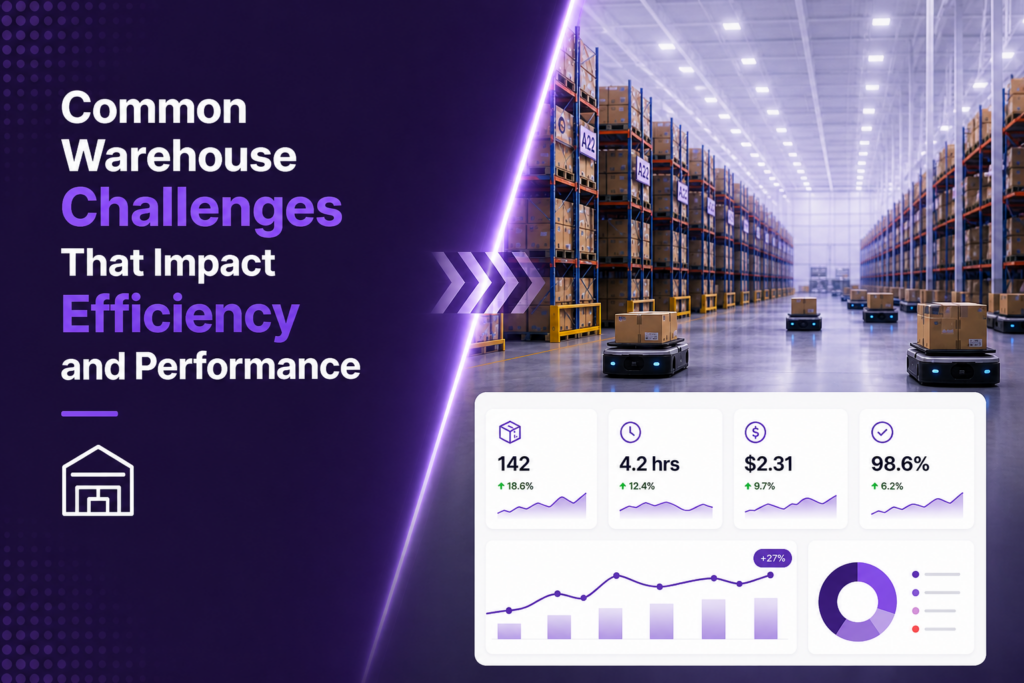
Throughput is collapsing, labor cost per order is rising, and fulfillment SLA adherence is slipping, while lagging data masks root causes. For high-SKU, high-volume operations, these common warehouse challenges stem from structural failures like inventory inaccuracy, inefficient warehouse layout, poor labor allocation, and system integration gaps.
These issues compound across workflows, driving warehouse efficiency challenges and rising costs. This blog breaks down the most critical warehouse management challenges and the execution levers to fix them.
1. Inaccurate Inventory Management
Inventory inaccuracies cost retailers an estimated $1.1 trillion annually through lost sales, overstocking, and returns.
When stockouts occur alongside dead-stock accumulation, the issue is rarely counting accuracy alone. The deeper failure is inventory drift, where WMS records no longer reflect actual bin-level inventory.
As this gap widens across SKUs, allocation, ATP, and replenishment decisions begin executing against unreliable data, driving pick failures, excess safety stock, and fulfillment instability.
Solution
Resolving inventory inaccuracy requires moving from periodic audits to a continuous inventory intelligence model. RFID-enabled perpetual counting, exception-triggered discrepancy investigations, and real-time WMS synchronization reduce decision latency and prevent replenishment logic from operating on stale data.
Synkrato’s AI Agents identify variance hotspots across bin locations and flag high-drift zones before they generate fulfillment failures. It is driving accuracy toward the 99%+ threshold required for reliable ATP and order promising.
Suggested Read: Warehouse Layout Optimization
2. Inefficient Warehouse Layout
Every inefficient warehouse layout carries a hidden travel-time tax that compounds at scale. What appears manageable at lower order volumes quickly becomes a throughput constraint as SKU counts, order velocity, and fulfillment complexity increase.
Layouts designed for past demand patterns often fail to support current operational flow, forcing pickers to travel farther, navigate congestion, and operate within increasingly fragmented workflows. As high-velocity SKUs remain buried in low-access zones and golden-zone assignments fail to reflect current demand, travel distance per order rises while picks per hour decline.
Solution
- Velocity-tier reclassification: Slot assignments continuously re-evaluated against current order data, not historical configuration
- Golden zone expansion: Top-frequency SKU cohort assignments reviewed on a demand-driven cadence, not annual slotting reviews
- Zone boundary redesign: Validated through simulation of alternative configurations before physical restructuring commits capital
Synkrato’s digital twin simulation environment allows operations teams to model layout changes against live demand profiles. It validates throughput impact and congestion reduction before any physical reconfiguration begins.
Suggested Read: Warehouse Putaway Process
3. Space Utilization Constraints
The real operational failure occurs when static slotting logic leaves dead stock in prime pick zones while high-velocity inventory overflows into secondary storage areas, increasing replenishment frequency and travel time simultaneously.
This creates multiple warehouse efficiency challenges, including:
- High-frequency SKUs positioned outside optimal pick zones
- Overflow inventory increases replenishment labor and travel distance
- Slotting instability caused by outdated velocity assumptions
- Pick accuracy degradation as bin assignments become inconsistent
Solution
- The dynamic slotting engine continuously re-evaluates bin assignments against current velocity data, returns patterns, and seasonal demand shifts
- Vertical storage optimization calibrated to pick frequency and ergonomic access requirements, not static bin configuration
- Threshold-based re-slotting triggers automatic reconfiguration rather than waiting for scheduled slotting reviews
A slotting intelligence engine automates the reconfiguration loop, ensuring storage assignments remain optimized across catalog changes and demand cycles without requiring manual re-analysis.
Suggested Read: Warehouse Performance Metrics
4. Order Picking and Fulfillment Errors
Order picking errors are rarely isolated execution mistakes. They usually originate from upstream failures such as outdated slotting data, inaccurate bin locations, inefficient pick paths, and misaligned WMS instructions. As order complexity and SKU counts increase, these issues scale rapidly across fulfillment workflows.
Even low error rates create significant operational impact through returns, rework, reverse logistics costs, and missed SLAs. When directed work instructions no longer reflect actual warehouse conditions, pick errors become structurally embedded into the operation rather than workforce-dependent exceptions.
Solution
Reducing fulfillment errors requires tighter alignment between WMS instructions and real-time warehouse conditions. Scan-to-verify confirmation, AI-driven pick path optimization, and co-occurrence-based SKU clustering help reduce travel complexity, improve pick accuracy, and strengthen SLA adherence.
Suggested Read: How to Reduce Warehouse Costs
5. Labor Shortages and Productivity Gaps
Labor remains the largest controllable warehouse cost (50-70%), but productivity gaps are rarely caused by headcount alone. Most warehouse productivity issues stem from poor workload distribution, inefficient pick paths, and limited real-time visibility into operational performance. As order volume fluctuates, supervisors often lack the intelligence needed to rebalance labor before throughput declines.
| Productivity Gap Driver | Root Cause |
| Low picks per hour | Broken pick path + poor zone balance |
| Headcount scales with volume | No labor orchestration intelligence |
| Supervisor in reactive mode | Shift-end reporting only |
| Onboarding drag | No engineered labor standards |
Solution
Engineered labor standards based on actual workflow performance, combined with dynamic work assignment and intra-shift productivity visibility, allow supervisors to rebalance staffing in real time instead of reacting after throughput declines.
A labor management intelligence layer connects workforce deployment decisions to live throughput data. It enables supervisors to reallocate pickers, adjust zone staffing, and optimize batch sizes in response to operational variance, without waiting for end-of-shift reporting.
Suggested Read: How to Reduce Downtime in Warehouses
6. Poor Demand Planning and Seasonal Disruptions
Seasonal peaks and promotional spikes rarely create warehouse efficiency challenges. They expose existing operational weaknesses in staffing, slotting, and replenishment logic. By the time demand surges appear in fulfillment data, the window for proactive intervention is often already closed.
Common failure patterns include:
- Fixed staffing models unable to absorb throughput spikes
- Slotting configurations misaligned with changing SKU velocity
- Replenishment thresholds based on historical averages instead of real-time demand shifts
- Congestion across pick zones and packing stations during peak periods
Most operations respond reactively through emergency labor scaling and expedited replenishment, increasing operational cost precisely when fulfillment pressure is highest.
Solution
Improving resilience during demand volatility requires forecast-driven execution adjustments before disruption occurs. Demand-aware slotting, proactive labor positioning, and dynamic replenishment thresholds help warehouses absorb throughput spikes without triggering congestion, stockouts, or SLA failures.
Synkrato’s scenario simulation environment allows operations teams to model demand spike scenarios against current layout and staffing configurations, identifying bottlenecks before they become fulfillment failures.
Suggested Read: Warehouse Picking Challenges
7. Lack of Real-Time Operational Visibility
Without real-time visibility into throughput, queue depth, labor utilization, and replenishment status, warehouse decisions are made against lagging data.
By the time issues appear in shift-end reports, congestion, pick-to-empty events, and SLA failures have already impacted multiple workflows. Most WMS platforms provide historical reporting, not the operational intelligence required for real-time intervention.
Most operations believe their WMS provides visibility. It provides data. Data describes what happened.
Solution
- Unified dashboards that surface congestion, throughput variance, and replenishment gaps in real time
- Continuous monitoring that detects operational anomalies before they escalate
- Live operational alerts that enable supervisors to rebalance labor and workflows intra-shift
Suggested Read: Common Warehouse Layout Mistakes
8. Manual Processes and Data Errors
Manual data capture introduces both accuracy errors and decision latency into warehouse operations. When receiving, put-away, inventory updates, and replenishment triggers rely on manual input, incorrect data quickly propagates across downstream workflows.
At high SKU counts and order volumes, even small delays between physical events and system updates create inventory drift, pick errors, and replenishment failures. Common issues include inaccurate receiving records, incorrect bin assignments, and delayed replenishment requests that increase pick-to-empty events and fulfillment instability.
Solution
Reducing manual intervention requires tighter synchronization between physical warehouse activity and system-level updates. The following operational improvements help eliminate data latency, reduce inventory drift, and improve execution accuracy across workflows.
| Solution Area | Operational Improvement |
| Scan-based receiving and automated put-away | Eliminates manual data capture during high-frequency inventory movements |
| Event-triggered replenishment | Enables real-time replenishment decisions based on live scan activity |
| Real-time WMS/ERP integration | Updates the system-of-record inventory instantly without batch latency or manual intervention |
Synkrato’s Enterprise Mobility eliminates manual data capture delays by enabling scan-based receiving, automated inventory transactions, and real-time warehouse updates across workflows.
Suggested Read: Hidden Cost of Warehouse Turnover
9. System Integration Challenges
Modern warehouses operate across interconnected systems such as WMS, ERP, OMS, TMS, labor platforms, and automation controls. When these systems fail to synchronize in real time, operational disruptions spread quickly across fulfillment workflows, especially during peak demand periods.
Key integration breakdowns include:
- Order data failing to move from OMS into warehouse execution workflows
- Inventory adjustments not syncing correctly across the ERP and WMS platforms
- Shipment confirmations failing to update available inventory accurately
- Labor allocation data disconnected from wave planning and execution priorities
These integration gaps create fulfillment delays, inventory distortion, labor imbalance, and increased SLA risk across warehouse operations.
Solution
Reducing integration failures requires real-time synchronization between warehouse systems instead of relying on delayed batch updates. Event-driven workflows, automated exception handling, and continuous integration monitoring help maintain operational continuity during high-volume periods.
Synkrato’s platform functions as a cross-system orchestration layer, ensuring order, inventory, labor, and fulfillment data move reliably across WMS, ERP, and automation systems. It maintains workflow continuity under volume stress.
Suggested Read: Theory of Constraints for Warehouses
10. Scalability and Growth Constraints
As warehouse operations scale, systems and workflows designed for earlier growth stages often become operational constraints. Increasing SKU depth, order complexity, and fulfillment network expansion place pressure on layouts, labor models, and system architectures that were not built for continuous scale.
Common scalability and growth constraints include:
- Throughput ceiling: Fixed layouts and static slotting configurations struggle to support growing order volumes without increasing congestion.
- Labor cost inflection: Linear staffing models increase headcount proportionally with volume due to limited orchestration intelligence.
- WMS capacity constraints: Legacy WMS configurations often lack the flexibility required for higher SKU depth and complex order flows.
- Network complexity growth: Single-facility operating logic becomes difficult to scale across multi-node fulfillment networks.
Solution
Scalable warehouse operations require flexible layouts, targeted automation, and systems designed for continuous expansion. Modular zone reconfiguration allows warehouses to adapt to changing demand profiles without full redesigns, while automation should focus on high-labor workflows with the greatest operational impact.
WMS configurations must support increasing SKU complexity and order volume without repeated re-implementation. Continuous optimization across slotting, labor deployment, and workflow orchestration helps operations scale without amplifying congestion or cost.
Conclusion
Warehouse efficiency challenges rarely exist in isolation. They stem from a disconnect between real-time demand, inventory placement, and execution logic. Fixing them individually only delivers short-term gains. Sustainable improvement requires a system that continuously aligns decisions with live warehouse conditions.
Synkrato enables this by combining AI-driven slotting recommendations, digital twin simulation, and real-time analytics to optimize picking, reduce travel time, and eliminate congestion.
Are you ready to switch from reactive fixes to a closed-loop system where every execution cycle improves the next? Book a demo with Synkrato.
FAQs
What are the most common warehouse challenges businesses face?
Common warehouse challenges include inventory inaccuracies, inefficient layouts, picking errors, low labor productivity, and disconnected systems like WMS, ERP, and OMS. These issues often impact each other, increasing costs and reducing efficiency. Synkrato helps solve them through real-time decision intelligence.
Who benefits most from using Synkrato?
Synkrato delivers the most value to COOs, supply chain leaders, e-commerce operators, and 3PL providers managing high-SKU, high-velocity environments where traditional optimization has hit its limits. It is designed for operations that have outgrown reactive fixes and require a continuous intelligence layer to sustain throughput and efficiency at scale.
Why do warehouse challenges impact efficiency?
Warehouse challenges reduce efficiency because they are structurally linked. Inventory errors lead to pick failures, layout inefficiencies reduce picks per hour, and integration gaps create data latency that affects decision-making. These compounding failures drive higher costs and lower throughput, making isolated fixes ineffective.
Why do inefficiencies remain unresolved without platforms like Synkrato?
Most warehouse systems report outcomes, not root causes. By the time issues appear in reports, the impact has already spread across workflows. Without real-time intelligence and continuous monitoring, the gap between problem occurrence and intervention allows inefficiencies to persist and compound.
How can businesses solve inventory-related challenges?
Businesses must shift from periodic cycle counts to continuous inventory intelligence. This includes perpetual counting through RFID or scanning, real-time reconciliation with WMS, and exception-triggered investigations. Achieving higher inventory accuracy requires eliminating batch delays and enabling proactive correction.
What challenges should Synkrato help prioritize?
Synkrato prioritizes challenges based on impact, focusing on slotting inefficiencies, labor productivity gaps, inventory inaccuracies, and integration risks. Its simulation capabilities allow leaders to prioritize improvements based on measurable KPI gains rather than assumptions.
What role does labor management play?
Labor management ensures efficient task allocation, workload balance, and real-time productivity control in warehouse operations. It helps reduce inefficiencies caused by layout, inventory, and system gaps, improving throughput and stability without increasing headcount.