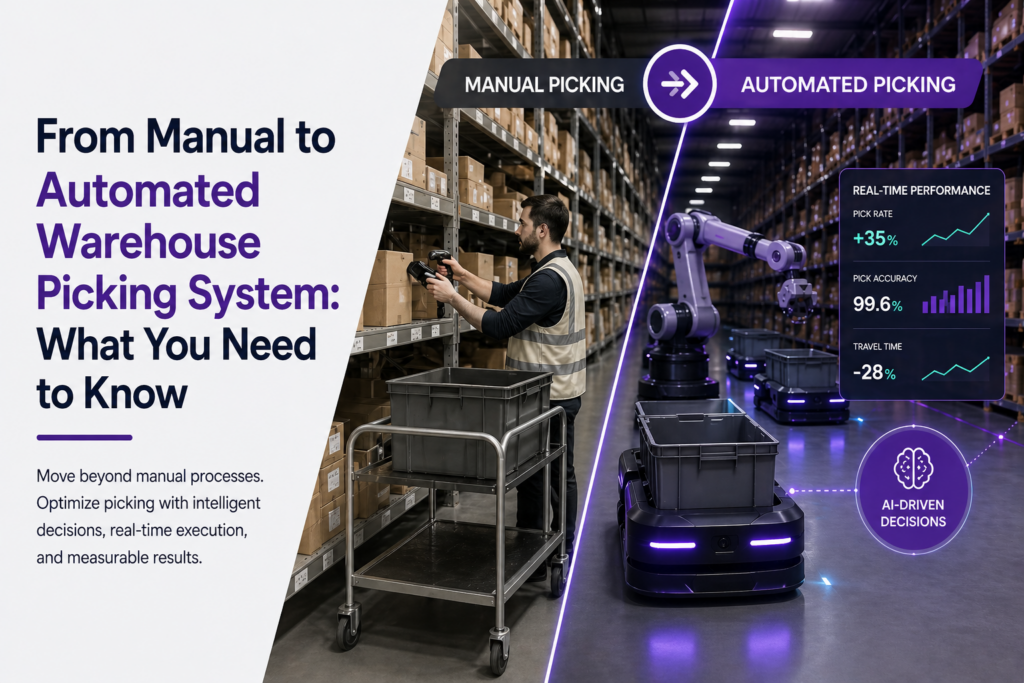
Warehouse picking is shifting from manual execution to system-driven operations where decisions define performance. As SKU complexity rises and fulfillment speeds tighten, static picking methods fail to optimize flow, which leads to inefficiencies in throughput, accuracy, and scalability.
The real value of automated picking comes from connecting planning with execution, where systems continuously adapt to demand, congestion, and operational constraints.
In this blog, you will learn how automated warehouse picking works, its key system types, benefits, and how to transition effectively from manual operations.
What is Automated Warehouse Picking?
Automated warehouse picking is the use of robotics, AI, and software-driven systems to automatically locate, pick, and prepare items for orders with minimal human involvement. It replaces manual searching and movement with system-guided execution, improving speed, accuracy, and consistency.
It is a major cost and performance driver, with global warehousing spend reaching approximately USD 350 billion annually and increasing pressure from smaller order sizes and higher fulfillment expectations.
Suggested Read: What is Warehouse Automation
Benefits of Automated Warehouse Picking
Warehouse picking automation systems improve execution by shifting from human-driven decisions to system-driven operations, where labor, inventory, and workflows are continuously aligned. They enable consistent, scalable, and optimized performance beyond just speed gains.
Next-generation Productivity
Automated warehouse picking systems improve productivity by continuously optimizing pick sequences, dynamically adjusting routes based on congestion, and prioritizing orders using real-time demand signals, eliminating delays between planning and execution.
The primary gain comes from reducing decision friction, enabling faster and more consistent execution at scale. Platforms like Synkrato enhance this further by simulating picking strategies and identifying bottlenecks before they impact operations, ensuring sustained productivity improvements rather than short-term gains.
Suggested Read: Warehouse Automation Trends
Legacy Systems Integration
Most warehouses rely on legacy systems such as WMS and ERP that are not built for real-time execution. This makes automated picking solutions critical for enabling system-driven operations without requiring full infrastructure replacement.
Additionally, these systems improve execution by extracting existing data, applying optimization logic, and converting it into actionable instructions for workers and machines, addressing the gap between data availability and usability. However, effective integration depends on adding an execution layer that works alongside existing systems, rather than replacing them.
Accessibility and User-friendliness
Automated warehouse picking improves execution by simplifying tasks for frontline workers, reducing cognitive load, accelerating onboarding, and ensuring consistent performance even in complex environments.
Modern systems like no-code platforms guide execution through step-by-step workflows, visual cues, and real-time validation, minimizing errors and improving productivity, especially in high-SKU operations.
Consistency
Manual warehouse operations create performance variability across workers, shifts, and workload conditions, leading to inefficiencies in accuracy, throughput, and customer satisfaction.
Automated picking systems address this by standardizing execution through embedded rules and logic, ensuring consistent, predictable outcomes regardless of who performs the task and enabling scalable operations with lower risk.
Scalability
Warehouse scalability is constrained by labor, training time, and process complexity in manual environments, where higher volumes require proportional increases in workforce and supervision.
Automated picking systems remove this dependency by enabling operations to scale output without linear resource growth, adapting to changes in order profiles, SKU complexity, and demand patterns without structural changes. Synkrato supports this by enabling simulation of scaling scenarios before implementation.
Suggested Read: Warehouse Automation Statistics
Types of Automated Warehouse Picking Solutions
Automated warehouse picking consists of multiple system types designed to address specific constraints related to speed, accuracy, and operational complexity Thus, it is essential to select the right model based on order profiles, SKU variability, and throughput requirements.
Goods-to-person Picking
Goods-to-person (GTP) picking improves warehouse efficiency by shifting from worker travel to inventory movement, enabling controlled, sequenced delivery of items that reduces decision time and operational variability.
GTP systems are especially effective for managing high SKU complexity, but their performance depends on aligned upstream inputs such as slotting strategy, order batching, and demand forecasting, as poor inputs can limit overall efficiency.
Suggested Read: How Much Does Warehouse Automation Cost
Assisted picking
Assisted picking improves execution by enhancing human performance through technologies such as pick-to-light, voice picking, and mobile-directed workflows. It reduces worker-level decision-making while retaining flexibility for complex tasks.
Additionally, it is particularly effective in dynamic environments, as it adapts to changing SKU mixes, order profiles, and layouts without requiring heavy infrastructure changes.
However, sustained value depends on continuous system-driven optimization, as static configurations quickly lose effectiveness under changing operational conditions.
Autonomous Mobile Robots (AMRs)
AMRs operate as a flexible execution layer that moves with the warehouse. They follow AI-optimized paths, dynamically reroute based on congestion, and coordinate with other robots and systems in real time.
Unlike fixed automation, AMRs support incremental scaling without redesigning the layout. When integrated with intelligent automation, they also help balance workloads across zones, reducing idle time and improving overall throughput.
Robotic Picking Arms
Robotic arms combine computer vision, machine learning, and end-effectors to pick items directly from bins or belts. The real advancement lies in grasping intelligence where systems are now trained on large datasets to handle varied shapes, textures, and packaging types.
While still evolving for highly unstructured environments, they perform well in semi-structured operations where SKU variability is controlled. Their value increases when paired with upstream systems that present items in optimized orientations.
Suggested Read: Benefits of Warehouse Automation
Pick-to-Light and Put-to-Light Systems
Light-directed systems reduce cognitive load by turning picking into a guided execution task. Advanced implementations integrate with order management systems to enable zone-based picking, real-time task allocation, and error-proofing through confirmation scans.
This allows warehouses to maintain high accuracy even during peak volumes or with temporary labor. They are especially effective in operations with high SKU counts and frequent order fragmentation.
Voice Picking Systems
Voice-picking systems translate warehouse tasks into real-time audio instructions for hands-free and eyes-free execution. Beyond basic commands, advanced systems use adaptive logic, which includes adjusting instructions based on worker performance, location, and task complexity.
This improves pick speed and reduces training time, especially in large, complex layouts. Voice systems also capture real-time feedback, feeding execution data back into optimization engines.
Automated Storage and Retrieval Systems (AS/RS)
AS/RS systems automate storage and picking using cranes, shuttles, or vertical lift modules within high-density structures. The key advantage is precision and space optimization. Thus, these systems can significantly increase storage density while maintaining fast retrieval times.
Modern AS/RS setups are integrated with inventory intelligence, enabling dynamic slotting and prioritization based on demand patterns. This ensures that high-velocity items are always positioned for faster access.
Suggested Read: Warehouse Automation ROI
The Future of Warehousing is Automated (but Not Fully)
Warehousing is evolving toward a hybrid model where automation handles execution, and humans handle control. Full autonomy is not the goal, but coordinated, system-driven operations are.
The real advantage comes from combining robotics, AI, and human oversight to improve speed, consistency, and decision quality at scale. Around 70% of logistics executives plan to invest nearly USD 100 million in automation over the next five years.
What defines this shift:
- Hybrid execution model: Automation drives repetitive tasks, while humans manage exceptions, governance, and continuous improvement.
- Incremental, scalable automation: Warehouses are deploying modular systems like AMRs and AI layers that scale with demand instead of relying on large, fixed infrastructure.
- Decision-centric operations: Systems are moving beyond execution to continuously optimize slotting, routing, and workload distribution in real time.
- Evolving workforce roles: Labor is shifting from manual picking to supervising systems, managing workflows, and improving operations.
Why warehouses are not fully automated:
- High upfront investment limits full-scale deployment
- Rigid automation struggles with demand variability and disruptions
- System dependency increases risk around downtime and maintenance
Synkrato Automates Warehouse Picking With Outsourced Fulfillment and a WMS
Synkrato improves warehouse picking by connecting planning with execution, acting as a warehouse operating system layered over existing WMS and ERP systems to convert data into real-time, system-driven actions. It addresses the execution gap where traditional WMS platforms manage transactions but do not ensure optimized floor-level performance.
The 3D digital twin enables warehouses to simulate picking strategies, slotting changes, and layout decisions before implementation, reducing risk and identifying bottlenecks without disrupting live operations. Combined with simulation and optimization, this allows continuous flow improvement and better decision-making.
Synkrato strengthens picking through:
- AI-driven slotting and workflow optimization to improve inventory placement and task sequencing
- Enterprise mobility and no-code workflows that guide workers with real-time instructions
- AI agents that provide instant access to operational insights
If your warehouse is still relying on manual picking as complexity grows, it may be time to rethink your approach. Synkrato’s solutions help moving operations from static execution to real-time, optimized performance. Book a demo today.
Suggested Read: 3pl Warehouse Automation
FAQs
How do automated picking systems improve warehouse efficiency?
Automated picking improves efficiency by reducing travel time, minimizing manual decision-making, and standardizing execution across orders. It ensures faster throughput and higher accuracy. Synkrato enhances this further by simulating workflows and optimizing picking strategies in real time, ensuring that efficiency gains are sustained, not temporary.
Why use Synkrato for optimizing automated warehouse picking systems?
Synkrato goes beyond execution by enabling decision-level optimization through digital twins, AI slotting, and simulation. It allows warehouses to test and refine picking strategies before implementation. This reduces risk and ensures that automation investments deliver measurable performance improvements.
Are automated picking systems suitable for high-SKU warehouses?
Yes, but only when supported by intelligent management. High-SKU environments require dynamic slotting, sequencing, and workflow control. Synkrato analyzes demand patterns and inventory movement to continuously optimize placement and picking logic, making automation viable even in complex SKU environments.
Why is Synkrato valuable for reducing bottlenecks in automated picking operations?
Bottlenecks often occur due to poor layout, inefficient slotting, or unbalanced workloads. Synkrato identifies these issues through simulation and predicts constraints before they impact operations. This allows teams to resolve bottlenecks proactively rather than reacting after performance drops.
What challenges can automated picking systems solve?
Automated picking addresses issues like labor dependency, inconsistent execution, high error rates, and slow order processing. However, these systems still require optimization to perform effectively. Synkrato ensures that picking, slotting, and workflows remain aligned with real-time conditions, solving both operational and decision-level challenges.
Why choose Synkrato to support automated picking performance improvements?
Synkrato connects planning, optimization, and execution into a single loop. Its digital twin, AI recommendations, and mobility layer ensure that improvements are tested, validated, and applied consistently. This leads to continuous performance gains without increasing operational complexity.
How do businesses measure the success of automated picking systems?
Success is measured through metrics like pick rate, order accuracy, travel time, and labor productivity. Synkrato strengthens this by providing simulation-backed insights and real-time visibility, helping businesses track performance improvements and validate the impact of every operational change.