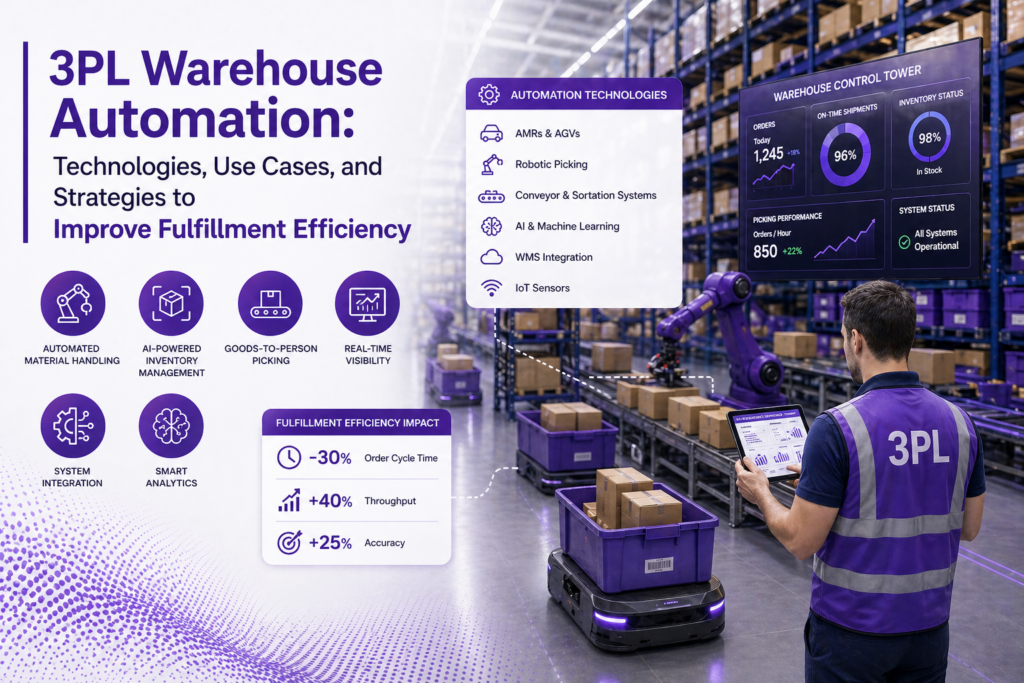
3PL warehouse automation is no longer optional as fulfillment networks face throughput collapse, rising labor costs per order, and unstable execution amid SKU and order volatility. As order profiles become fragmented and demand spikes intensify, static workflows fail to maintain efficiency in third-party logistics warehouse automation environments.
Automation serves as a control mechanism to stabilize throughput, reduce travel time, and improve pick density while maintaining service levels in multi-client warehouse environments.
This blog examines technologies and strategies to improve throughput, reduce costs, and stabilize fulfillment performance in 3PL environments.
Core Automated Systems for 3PL Warehouses
These systems address specific operational constraints across picking, storage, and order flow, enabling higher throughput, reduced travel dependency, and more consistent execution in high-SKU, multi-client warehouse environments.
Autonomous Mobile Robots (AMRs) for 3PL Picking Operations
AMRs are a core component of 3PL warehouse robotics and automation, directly targeting one of the largest cost drivers in 3PL operations: travel distance per order. Research consistently shows that travel accounts for over 50% of picking time in manual systems.
Suggested Read: What is Warehouse Automation
The operational issue is not just travel; it is path fragmentation caused by SKU dispersion and order variability. AMRs address this by:
- Enabling dynamic path optimization
- Reducing congestion density in high-traffic zones
- Supporting batch and cluster picking models
Studies on multi-robot warehouse systems show that uncoordinated routing increases congestion nonlinearly, with throughput drops of 15-25% under peak-density conditions if traffic control logic is not optimized.
However, AMR efficiency depends on upstream slotting logic. Poor SKU placement reduces robot utilization and increases idle time. This creates a dependency between slotting intelligence and robotic throughput.
At scale, AMRs improve picks per hour, labor cost per order, and travel distance per pick.
But without coordinated orchestration, they introduce queue buildup at pick zones. This is where Synkrato acts as an intelligence layer, optimizing task allocation and movement coordination across robotic fleets and human workflows.
Suggested Read: Warehouse Automation Trends
Goods-to-Person Systems for High Volume Fulfillment
Goods-to-person (GTP) systems eliminate picker travel by bringing inventory to stationary workstations. This shifts the bottleneck from movement to workstation throughput.
GTP systems are effective when:
- Order volumes are high and predictable
- The SKU velocity distribution is stable
- Workstation balancing is optimized
Operational levers include:
- Workstation load balancing: Workstation load balancing ensures that incoming order tasks are evenly distributed across all active picking stations to prevent overloading any single workstation while maximizing overall system throughput. It continuously adjusts allocation based on real-time station capacity, operator speed, and queue depth.
- Dynamic tote sequencing: Dynamic tote sequencing controls the order in which totes are presented at each workstation to reduce idle time and ensure a smooth, uninterrupted picking flow aligned with order priorities and SKU dependencies.
- Queue prioritization logic: Queue prioritization logic determines the sequence in which orders or tasks are processed based on factors like urgency, SLA deadlines, order complexity, and downstream system capacity to maintain consistent fulfillment flow under variable demand conditions.
Joint optimization of order allocation and rack sequencing in GTP systems, using ‘order similarity’ strategies, has been shown to reduce physical rack movements by up to 44.8%, directly increasing the upper limit of workstation throughput.
The failure mode occurs when SKU velocity shifts rapidly. Static configurations lead to uneven workload distribution.
Synkrato’s simulation-driven decision layer helps test workstation configurations and queue policies before deployment, reducing execution risk in high-volume environments.
Suggested Read: Warehouse Automation Statistics
Conveyor and Sortation Automation for Order Processing
Conveyor and sortation systems are critical for maintaining flow continuity across picking, packing, and shipping stages. The core issue is not movement; it is flow imbalance. When upstream picking rates fluctuate, conveyors either starve or overflow.
Operational consequences:
- Accumulation zones become bottlenecks
- Sortation errors increase under peak load
- SLA adherence drops
Optimization levers include:
- Flow rate synchronization: Flow rate synchronization ensures that the rate of items entering the conveyor and sortation system matches the downstream processing capacity. It prevents situations where upstream picking overwhelms the system or underfeeds it, both of which create inefficiencies. This is typically achieved by dynamically regulating release rates from pick zones based on real-time system load.
- Dynamic routing logic: Dynamic routing logic continuously determines the optimal path for each item or order as it moves through the conveyor and sortation network. Instead of fixed paths, routing decisions adjust based on congestion levels, destination priorities, and system availability. This helps reduce bottlenecks and improve overall flow efficiency across multiple sorting destinations.
- Buffer management strategies: Buffer management strategies control how and where inventory temporarily accumulates within the system to absorb fluctuations in workflow. Properly designed buffers prevent downstream congestion during peaks and avoid starvation during low input periods. They act as shock absorbers that stabilize throughput and maintain consistent processing rates across the system.
However, conveyors lack adaptability. They require upstream intelligence to regulate input rates. This is achieved through real-time orchestration that aligns picking output with sortation capacity.
Suggested Read: How Much Does Warehouse Automation Cost
Automated Storage and Retrieval Systems (AS/RS) in 3PL Facilities
AS/RS systems are widely used 3PL warehouse automation solutions for high-density storage, where performance is constrained by retrieval sequencing and storage allocation logic.
Key levers:
- Retrieval batching logic: Retrieval batching logic refers to how AS/RS systems group multiple retrieval requests into optimized batches instead of processing each order individually. The goal is to minimize redundant movements of cranes or shuttles by consolidating picks based on order similarity, location proximity, or timing windows. Poor batching increases travel cycles and reduces system throughput, especially during peak demand.
- Storage assignment optimization: Storage assignment optimization is the process of deciding where each SKU is stored within the AS/RS to minimize future retrieval effort and balance system load. It typically uses demand frequency, velocity, and co-occurrence patterns to place high-velocity or frequently co-picked SKUs in faster-to-access locations. Without this optimization, retrieval times increase and storage density is often underutilized, creating hidden inefficiencies at scale.
AS/RS systems perform best when:
- SKU demand patterns are predictable
- Storage allocation is continuously optimized
Synkrato enhances AS/RS performance by continuously recalibrating storage strategies using demand signals and simulation models.
Suggested Read: Benefits of Warehouse Automation
Automation Strategies for High-SKU and High-Volume 3PL Operations
These strategies focus on coordinating inventory placement, resource allocation, and workflow sequencing to maintain throughput stability and prevent bottlenecks under variable demand and SKU complexity.
Coordinating Automation for Peak Order Volume Handling
Peak demand doesn’t just increase workload. It destabilizes system behavior across automated and manual layers. Once utilization crosses a threshold, small inefficiencies compound into nonlinear congestion, where delays in one node propagate across picking, buffering, and sortation systems, creating a cascading throughput collapse.
The core problem is not volume itself, but loss of synchronization between interconnected subsystems with AMRs, conveyors, storage, and human workflows all beginning to operate on mismatched timing cycles.
Key breakdown points:
- Queue amplification at pick and induction points due to uneven task inflow
- Resource contention between automation fleets and manual zones competing for shared throughput capacity
- Workflow desynchronization, where upstream picking outpaces downstream sortation or packing capacity
Effective coordination strategies:
System-wide load balancing: dynamically redistributing order volume across zones based on real-time capacity rather than static assignments
Priority-aware task orchestration: sequencing work based on SLA risk, cut-off constraints, and downstream bottleneck sensitivity, not just FIFO order flow
Temporary workflow reconfiguration: shifting system behavior during peak windows (e.g., batching rules, zone specialization, or conveyor pacing adjustments) to stabilize flow instead of maximizing local efficiency.
Suggested Read: Warehouse Automation ROI
Balancing Manual and Automated Workflows in Hybrid 3PL Warehouses
Fully automated systems are not always feasible in multi-client 3PL environments. Hybrid models combine manual flexibility with automation efficiency.
The challenge is workflow fragmentation. Poor coordination leads to idle automation assets, overloaded manual zones, and increased handoff delays.
Optimization levers:
- Task allocation logic: It assigns work dynamically based on zone load, order priority, and resource availability, preventing overloading of specific areas while keeping automation and manual tasks balanced.
- Workflow synchronization: It aligns the timing between manual picking, automated movement, and downstream processes so that work progresses without idle gaps or accumulation at handoff points.
- Resource balancing: It distributes labor and automation capacity across zones based on real-time demand, ensuring that no part of the system becomes a bottleneck while others remain underutilized.
These mechanisms improve labor utilization, increase system throughput, and maintain operational stability by reducing imbalances between manual and automated workflows.
Hybrid environments require orchestration layers to maintain balance by aligning manual and automated workflows through real-time decision logic.
Performance Metrics Used to Measure 3PL Automation Success
| KPI Category | Metric | What it Measures | What it Indicates |
| Order Throughput & Fulfillment Speed | Orders processed per hour | Total system output rate | Overall capacity and processing bottlenecks |
| Order cycle time | Time from order receipt to dispatch | Workflow delays, queue buildup, and processing inefficiencies | |
| SLA adherence rate | Percentage of orders meeting delivery timelines | Operational consistency under demand variability | |
| Labor Productivity & Movement Efficiency | Picks per hour | Picking productivity per labor unit or robot | Efficiency of picking workflows and task execution |
| Travel distance per order | Movement required per fulfilled order | Layout efficiency and slotting effectiveness | |
| Labor cost per order | Cost efficiency of fulfillment operations | Workforce productivity and automation impact | |
| Accuracy & Cost Efficiency | Order accuracy rate | Correctness of fulfilled orders | Quality of execution and error control in workflows |
| Error rate | Frequency of picking/packing/shipping mistakes | System reliability and process stability | |
| Cost per order | Total fulfillment cost per unit order | End-to-end operational efficiency |
Factors to Evaluate When Scaling 3PL Warehouse Automation
Achieving scalable automation for 3PL operations requires aligning system capacity with demand variability and workflow dependencies.
Automation Fit Based on Order Profiles and SKU Complexity
Automation must align with order size, SKU count, and demand variability. For example, high-SKU warehouses with uneven demand may underutilize rigid systems if SKU velocity shifts frequently. Similarly, batch-heavy operations require different configurations than single-line orders. Misalignment leads to idle capacity, congestion, and poor ROI.
Scalability Considerations for Multi-Client 3PL Networks
Multi-client 3PL warehouses must balance competing workloads across different order types and service levels. For instance, prioritizing high-volume clients during peak periods can delay time-sensitive orders from others. Without dynamic workload distribution, some zones become overloaded while others remain underutilized.
Integration Requirements for Expanding Automation Infrastructure
Automation systems must integrate with WMS and execution tools to ensure consistent data flow. For example, delayed inventory updates can disrupt automated retrieval, while poor synchronization between picking and sortation creates bottlenecks. Strong integration ensures coordinated execution and prevents system-level inefficiencies.
Suggested Read: Automated Warehouse Picking Systems
Validate 3PL Warehouse Automation Decisions with Synkrato
Most 3PL warehouse automation failures happen due to untested decisions, slotting changes, labor allocation, or automation investments made without understanding system-wide impact. Synkrato enables you to simulate these decisions using a digital twin of your warehouse.
By modeling real operational constraints, SKU variability, order spikes, and workflow dependencies, Synkrato helps you identify bottlenecks early, optimize resource allocation, and deploy automation strategies that scale without disrupting ongoing fulfillment performance.
Evaluate your warehouse decisions before execution and reduce risk across automation, labor, and inventory planning. Explore Synkrato’s solutions for 3PL warehouse efficiency.
FAQs
What is 3PL warehouse automation?
3PL warehouse automation refers to the use of automated systems such as robotics, AS/RS, and sortation technologies to improve fulfillment efficiency, reduce labor dependency, and stabilize throughput in third-party logistics operations. In multi-client environments, automation must handle SKU variability, fluctuating demand patterns, and shared resource allocation without degrading service levels or increasing operational cost.
How does Synkrato support 3PL warehouse automation?
Synkrato supports 3PL warehouse automation by acting as an intelligence layer that optimizes decision-making across slotting, task allocation, and workflow orchestration using simulation-driven models.
What types of automation are used in 3PL warehouses?
Common types include autonomous mobile robots, goods-to-person systems, conveyor and sortation systems, and automated storage and retrieval systems. Each addresses a specific constraint: AMRs reduce travel, GTP increases pick rates by eliminating movement, conveyors maintain flow across stages, and AS/RS improves storage density and retrieval speed. Their effectiveness depends on coordination with order profiles and workload distribution.
Can Synkrato improve automation efficiency in 3PL warehouses?
Yes, Synkrato improves efficiency by continuously analyzing operational data and adjusting system configurations to reduce bottlenecks, improve throughput, and enhance resource utilization. Evaluating tradeoffs between routing, slotting, and resource allocation helps maintain throughput stability under demand variability and reduces performance loss from misconfigured automation setups.
What challenges can 3PL warehouse automation solve?
Automation addresses high labor costs, travel inefficiencies, throughput instability, order inaccuracies, and challenges associated with peak demand handling. These improvements depend on how well automation is configured and coordinated across workflows. Misalignment between systems, order profiles, and resource allocation can reduce the expected impact on cost and throughput.
Does Synkrato integrate with existing 3PL automation systems?
Synkrato integrates with existing systems by acting as a coordination and optimization layer, enabling better synchronization across WMS, robotics, and execution workflows. It connects data streams across systems to align task timing, resource allocation, and workflow sequencing, reducing execution delays and ensuring that automation outputs remain consistent with real-time operational demand.
What should 3PL companies consider before implementing warehouse automation?
Key considerations include order profile and SKU complexity, scalability requirements, integration capability, total cost of ownership, and operational flexibility. Synkrato identifies constraint points across SKU distribution, workload imbalance, and system dependencies, enabling operators to evaluate tradeoffs between automation configurations, resource allocation, and network-level performance before scaling.