The main types of warehouse storage systems are pallet racking, static and mobile shelving, mezzanine flooring, cantilever racking, and automated storage and retrieval systems. Each system offers a different balance of storage density, inventory access, travel time, replenishment effort, safety, and automation potential.
The right warehouse storage system depends on how inventory moves through receiving, putaway, replenishment, picking, packing, and shipping. For example, deep storage may save floor space, but it can reduce output when workers must enter lanes, wait for access, or move other pallets before reaching the required load.
In this blog, we explain the main warehouse storage options, their ideal applications, and how to choose between them.
What Is Warehouse Storage?
Warehouse storage is the controlled placement of inventory in locations that protect products, use cubic space effectively, and support workflow. It includes the structure, location rules, handling equipment, inventory data, safety limits, and replenishment logic.
The key measure is not only capacity. The design must show retrieval speed, handling touches, stock-rotation control, and resilience to changes in SKU count, load dimensions, and demand.
What Are the Main Types of Warehouse Storage?
The main types of warehouse storage are selective pallet racking, drive-in or drive-thru racking, push-back racking, cantilever racking, static shelving, mobile shelving or racking, mezzanine flooring, and automated storage and retrieval systems. Each type makes a different trade-off between density and immediate access.
Selective Pallet Racking
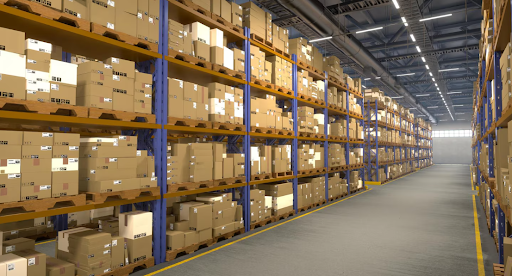
Selective pallet racking gives direct access to every pallet from an open aisle. It is a strong base system for warehouses with many palletized SKUs, changing demand, mixed load dimensions, or frequent cycle counting. Key characteristics include:
- Storage type: Fixed pallet rack with one pallet position normally accessible from the aisle face.
- Best for: High-SKU reserve storage, mixed inventory, fast-moving pallets, and operations requiring flexible FIFO, lot, or customer allocation.
- Storage density: Medium. Capacity depends on aisle width, rack height, beam spacing, and rack depth.
- Accessibility: Very high because a forklift can reach each front position without moving another pallet.
- Automation potential: High. Selective racks can work with narrow-aisle trucks, automated guided vehicles, stacker cranes, pallet conveyors, barcode scanning, and WMS-directed putaway.
Large distribution centers often combine selective racking with higher-density storage to balance accessibility and capacity. The OMEGA 1 project in Selangor, Malaysia, shows why facilities mix access levels. It includes more than 100,000 pallet locations across 38 aisles, 30 single-deep and eight double-deep.
The approximately 693,000-cubic-meter system preserves access where pallet diversity helps while adding density elsewhere.
Drive-In and Drive-Thru Racking
Drive-in and drive-thru warehouse racking systems increase density by removing most internal aisles and allowing forklifts to enter deep pallet lanes.
A drive-in normally supports last-in, first-out movement because loading and retrieval occur from one side. Drive-thru opens both ends and can support first-in, first-out flow. Its performance can be assessed across the following factors:
- Storage type: High-density pallet lanes entered by a forklift.
- Best for: Large batches, low SKU variety, seasonal reserve stock, cold storage, and products moved in full-pallet quantities.
- Storage density: Very high when lanes remain full. Density falls through honeycombing when a partially used lane cannot accept another SKU.
- Accessibility: Low to medium. Only the pallet nearest the working end is immediately available.
- Automation potential: Medium to high.
- Drive-in commonly uses manual forklifts.
- Drive-thru lanes can connect the receiving and shipping sides.
- Pallet shuttles can reduce forklift travel inside deep lanes.
Synkrato’s Digital Twin can simulate different lane depths, forklift travel, and storage utilization to identify the most efficient drive-in or drive-thru configuration before implementation.
Push-Back Racking
Push-back racking keeps deep pallets at the aisle face using nested carts or rollers. New pallets push earlier loads backward, and gravity returns the next load when the front pallet is removed. The following characteristics explain where this system performs best:
- Storage type: Last-in, first-out pallet lanes, commonly two to six positions deep.
- Best for: Several pallets per SKU, grouped batch movement, food or beverage inventory with controlled dates, and facilities that need density without forklift entry into the rack.
- Storage density: High because several pallet positions share one aisle face.
- Accessibility: Medium. The front pallet is directly accessible, but the rear pallets become available in sequence.
- Automation potential: Medium. The system can integrate with WMS lane assignments, scanners, lift-truck guidance, and pallet conveyors, although the gravity mechanism remains mechanical.
This balance between density and front-aisle accessibility can significantly reduce forklift travel. One example comes from a food-distribution project in Kaukauna, Wisconsin. It replaced damaged drive-in racks and floor stacking with five- and six-deep push-back lanes.
The cheese producer shipped multiple pallets of the same SKU together, making the last-in, first-out flow suitable. The redesign kept active pallets at the aisle face and removed forklift travel inside the rack.
Cantilever Racking
Cantilever racking stores long and irregular loads on arms extending from upright columns.
Warehouses handling oversized materials often combine cantilever racks with conventional pallet systems. Bilstein Group’s automotive spare-parts center in Venda do Pinheiro, Portugal, shows the value of combining systems. The 7,000-square-meter facility manages more than 45,000 SKUs and prepares 358 orders, totaling 2,744 lines, daily. It uses 306 cantilever slots, 56,383 shelving slots, and has a capacity for 6,656 pallets.
The following criteria help evaluate this system:
- Storage type: Open-front rack with adjustable arms.
- Best for: Long, bulky, awkward, or non-palletized warehouse inventory storage.
- Storage density: Medium. Density depends on arm spacing, load deflection, stacking height, and the aisle required by sideloading equipment.
- Accessibility: High from the rack face, although long loads may require four-way or multidirectional trucks.
- Automation potential: Low to medium.
- WMS control can assign locations by length, weight, and turnover.
- Guided vehicles or specialized cranes can automate repeatable long-load movement.
- Irregular dimensions make full automation harder than standard pallet handling.
Static Shelving
Static warehouse shelving systems support direct manual, small-item picking through fixed shelves open to every aisle. Performance depends more on location sizing and slotting discipline than on the shelf itself. To improve slotting decisions, Synkrato’s AI Slotting recommends shelf locations based on demand and product movement. Key characteristics include:
- Storage type: Stationary shelves for bins, cartons, components, tools, and each-pick inventory.
- Best for: Small parts, slower-moving SKUs, maintenance inventory, repair components, and operations requiring direct visual access.
- Storage density: Low to medium. Narrow aisles and multi-tier shelving can improve density, but excessive shelf depth can conceal stock.
- Accessibility: High for properly slotted items within the normal reach zone.
- Automation potential: Medium.
- Pick-to-light, voice, handheld scanning, and mobile carts can direct manual work.
- Conveyors or autonomous mobile robots can move completed totes.
- Vertical lift modules can replace static shelves where floor space becomes the constraint.
Mobile Shelving and Mobile Racking
Mobile shelving and mobile racking remove unused aisles by mounting storage units on movable bases. The racks remain compacted until the required aisle opens. The following factors define its performance:
- Storage type: Shelving or pallet racks that travel laterally on floor rails.
- Best for: Expensive floor space, archives, controlled rooms, cold storage, and inventory that needs high density with direct access.
- Storage density: Very high because several fixed aisles are replaced by one or a limited number of working aisles.
- Accessibility: High to the selected rack face but restricted across the wider zone while an aisle is closed.
- Automation potential: Medium to high. PLC controls, sensors, remote commands, and WMS integration can open the correct aisle before equipment arrives.
The benefits become more noticeable where warehouse space or refrigerated storage is expensive. Havi Logistics demonstrated this in its Lodi, Italy, distribution center. It combined mobile, push-back, drive-in, and selective racks across four temperature zones in Lodi, Italy.
The project increased capacity from 4,566 to 12,500 pallets, reduced storage costs by 64%, increased capacity by 55%, and achieved a 1.2-year return on investment. Mobile racks also reduced refrigerated volume.
Mezzanine Flooring
Mezzanine flooring converts building height into a second or third operating level space for shelves, packing, conveyors, automation, or pallet buffering. The system can be compared using the following criteria:
- Storage type: Raised, semi-permanent floors supported inside the warehouse.
- Best for: High-SKU piece picking, light goods, packing, value-added work, and facilities with unused vertical clearance.
- Storage density: High because the same footprint supports multiple operating levels.
- Accessibility: Medium to high, depending on stairs, lifts, conveyors, replenishment routes, and worker travel between levels.
- Automation potential: High. Mezzanines can support conveyors, lifts, sortation, automated buffers, and goods-to-person workstations.
A mezzanine becomes even more valuable when it supports automated material flow instead of only adding storage space. For instance, Vectura installed an automated pallet buffer on an approximately 700-square-meter, two-level mezzanine in Norway. The beverage logistics system can process up to 150 pallets per hour and sequence as many as 460 pallets. Vectura used the added level to separate buffering and dispatch flow vertically.
Automated Storage and Retrieval Systems
Automated storage and retrieval systems deliver goods to the operator through computer-controlled cranes, shuttles, robots, lifts, or cube-based grids. They use height and depth while reducing walking and forklift travel. Synkrato’s Simulation & Optimization helps evaluate AS/RS throughput, queueing, and resource utilization before implementation.
The following characteristics highlight where AS/RS delivers the greatest value:
- Storage type: Automated pallet, tote, tray, bin, or carton storage.
- Best for: High-volume operations, constrained buildings, repeatable load units, labor-limited sites, and processes requiring controlled sequencing.
- Storage density: Very high, particularly in high-bay, mini-load, vertical-lift, and cube-storage designs.
- Accessibility: System-directed rather than manual. Goods arrive at a port or transfer point when requested.
- Automation potential: Very high.
- WMS software manages inventory and orders.
- Warehouse control software directs equipment.
- Redundant robots, ports, or aisles can protect throughput during maintenance.
The impact of AS/RS is easiest to understand in high-volume fulfillment environments. For instance, Fenix Outdoor Logistics implemented an AutoStore system in Ludwigslust, Germany, using 100,000 bins in a 3,000-square-meter grid, 42 robots, and 16 picking ports.
The system occupies 25% of the area a comparable manual system would require, creating a reported 75% space saving, and now handles about 85% of item processing. The six-month implementation connected the grid to pallet overstock, sorting, and packing.
How to Choose the Right Warehouse Storage System
The right warehouse storage solution should be chosen by modeling inventory, space, flow, and risk together. A few points to consider:
- Segment SKUs by load type, dimensions, weight, velocity, order frequency, pallets per SKU, and stock-rotation rule.
- Calculate usable cubic capacity after deducting aisles, columns, clearances, staging, fire protection, and equipment paths.
- Compare effective density at expected lane fill rather than using maximum rack capacity.
- Model simultaneous putaway, replenishment, picking, and retrieval demand during the peak hour.
- Check whether the design supports FIFO, FEFO, lot control, quarantine, serialization, and customer-owned stock.
- Test assortment growth, demand changes, automation, and equipment failures before fixing the layout.
- Evaluate cost per order line or pallet movement, not only cost per storage position.
How Synkrato Helps Optimize Warehouse Storage
Synkrato helps with warehouse organization and storage by testing layouts, slotting rules, labor plans, and automation scenarios in a 3D digital twin before changes reach the live facility. It helps to:
- Compare storage-system layouts against capacity, travel, congestion, and throughput.
- Simulate new racks, pick paths, labor shifts, or automation before committing capital or disrupting operations.
- Connect WMS and operational data to continuously refine putaway, replenishment, and storage decisions.
Book a demo to see how Synkrato can evaluate storage changes before they reach the warehouse floor.
FAQs
What are the main types of warehouse storage?
The main warehouse storage types are selective pallet racking, drive-in or drive-thru racking, push-back racking, cantilever racking, static shelving, mobile shelving or racking, mezzanine flooring, and automated storage and retrieval systems. Synkrato helps evaluate which combination best fits a warehouse.
What is the most common warehouse storage system?
The most common warehouse storage system is selective pallet racking because it provides direct access to every pallet and accommodates many SKUs, load sizes, and turnover rates. It offers less density than deep-lane storage but is easier to replenish, count, reconfigure, and automate.
Which warehouse storage system provides the highest density?
The warehouse storage system that provides the highest density is usually an AS/RS, mobile racking system, or deep-lane pallet system. Synkrato’s Simulation & Optimization can compare these options based on throughput as well as storage density.
What type of storage is best for pallets?
The type of storage that is best for pallets depends on SKU depth and retrieval rules. Selective racking fits many SKUs requiring direct access. Drive-in and push-back fit multiple pallets per SKU. Mobile racking fits costly space or cold rooms, while automated pallet storage fits stable, high-volume flows.
What storage system is best for small items?
The storage system that is best for small items is static shelving for flexible manual picking, mezzanine shelving for more vertical space, or a mini-load, vertical-lift, or cube-based AS/RS when volume supports goods-to-person automation. Synkrato’s AI Slotting can further optimize storage locations based on SKU demand and movement.
How does a WMS optimize warehouse storage?
A WMS optimizes warehouse storage by assigning inventory according to dimensions, weight, turnover, demand, capacity, and lot rules. Synkrato complements a WMS by simulating layouts, slotting, and workflows before operational changes are implemented, while the WMS directs putaway, replenishment, counting, and retrieval through real-time inventory data.