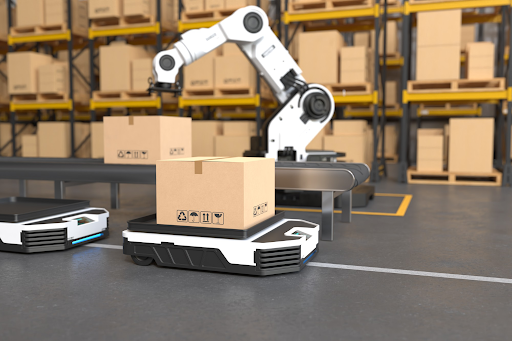
Different types of warehouse robots, including AMRs, AGVs, AS/RS, and robotic picking systems, help businesses improve efficiency, accuracy, and warehouse productivity. Warehouse robots are automated machines that perform tasks such as moving inventory, storing products, picking orders, packing shipments, and managing inventory with minimal human intervention.
According to the 2026 MHI Annual Industry Report, 55% of supply chain leaders plan to increase investments in robotics and automation over the next five years as fulfillment complexity, labor shortages, and throughput pressures continue to grow.
In this blog, we’ll cover the most common warehouse robot types, their use cases, the best robot for each warehouse task, and how Synkrato helps optimize warehouse automation.
What Are Warehouse Robots?
Warehouse robots are automated machines that perform repetitive warehouse tasks with little or no human intervention. They use sensors, cameras, AI, and navigation technologies to move inventory, retrieve products, assist workers, and streamline material handling. As a key part of warehouse automation technology, these warehouse robots help improve operational efficiency, inventory accuracy, workplace safety, and order fulfillment speed.
Modern warehouse robotics includes everything from mobile robots that transport goods to automated warehouse robots that pick, sort, store, and retrieve inventory. When combined with warehouse management systems (WMS), these warehouse robotics solutions enable businesses to automate workflows, reduce labor-intensive tasks, and build more scalable fulfillment operations.
Types of Warehouse Robots
Each of the ten types of warehouse robots supports a different warehouse function, from inventory movement and picking to storage, packaging, monitoring, and facility safety.
| Robot Type | Primary Function | Best Fit | Key Limitation |
| AMRs | Dynamic inventory movement | Flexible fulfillment environments | Needs traffic coordination |
| AGVs | Fixed-route transport | Stable, repetitive workflows | Limited route flexibility |
| GTP Robots | Inventory-to-operator picking | High-SKU fulfillment | Requires layout planning |
| AS/RS | Automated storage and retrieval | Space-constrained warehouses | High capital investment |
| Cobots | Human-assisted tasks | Repetitive manual workflows | Lower payload capacity |
| Picking & Sorting Robots | Automated item handling | High-volume fulfillment | Struggles with irregular SKUs |
| Palletizing Robots | Heavy-load stacking | Bulk shipment operations | Needs standardized loads |
| Packaging & Labeling Robots | Outbound shipment processing | Shipping-intensive warehouses | Requires system integration |
| UAVs | Inventory monitoring | High-rack facilities | Battery and navigation limits |
| Cleaning & Security Robots | Facility maintenance | Large 24/7 warehouses | Still needs human oversight |
1. Autonomous Mobile Robots (AMRs) for Dynamic Warehouse Movement
AMRs are most valuable when warehouse performance is constrained by travel time rather than picking speed. In many e-commerce facilities, associates spend more time walking than picking. AMRs reduce this non-value-added travel by autonomously moving inventory between storage, replenishment, picking, and packing zones.
According to McKinsey, order picking can account for up to 55% of warehouse operating costs, making travel reduction one of the highest-ROI automation opportunities.
Synkrato’s Simulation & Optimization allows operators to model robot traffic, replenishment timing, and pick-flow interactions before changes are deployed, helping warehouses identify congestion risks and throughput constraints before they impact performance.
2. Automated Guided Vehicles (AGVs) for Fixed Route Transportation
AGVs are automated warehouse robots built for predictable material movement, not flexible fulfillment. They move pallets, raw materials, and heavy inventory along fixed routes using lasers, magnetic tape, QR codes, or guided infrastructure. In executive terms, AGVs are strongest when the workflow is stable enough to justify route discipline.
3. Goods-to-Person (GTP) Robots for Faster Order Picking
Goods-to-Person robots reduce picker travel by bringing inventory to operators instead of sending workers through aisles. This matters because picking is one of the highest-cost warehouse workflows, often representing a major share of operational labor. Warehouse automation is growing by more than 10% annually as facilities look to reduce manual movement and improve fulfillment speed.
GTP systems are useful when SKU dispersion, walking time, and order complexity are limiting throughput. They are common in high-SKU e-commerce, retail distribution, and high-volume fulfillment environments.
4. Automated Storage and Retrieval Systems (ASRS) for High-Density Storage
AS/RS systems automate storage and retrieval using shuttles, cranes, lifts, conveyors, or robotic mechanisms. They are most valuable when the primary constraint is cubic space, inventory accuracy, or controlled retrieval speed. DHL describes AS/RS as a solution for autonomously handling, storing, and retrieving inventory to improve storage density and efficiency.
DHL’s AutoStore partnership involved more than 1,000 robots across fulfillment warehouses, showing how high-density automated storage can support throughput improvement in large networks.
5. Collaborative Robots (Cobots) for Human-Assisted Operations
Cobots are warehouse robotics systems designed to work alongside human employees rather than replace entire workflows. They support repetitive tasks such as packing, picking assistance, inspection, sorting, and light material handling. Their value is highest when a warehouse needs targeted automation without redesigning the entire facility.
Cobots deliver the most value when human workflows are standardized and digitally guided. Synkrato’s Enterprise Mobility supports this by giving warehouse teams real-time task visibility, mobile execution guidance, and inventory updates, helping employees coordinate more effectively with collaborative robots across picking, packing, inspection, and light material handling workflows.
6. Robotic Picking and Sorting Systems for Fulfillment Efficiency
Robotic picking and sorting systems use AI, machine vision, grippers, barcode scanning, and robotic arms to identify, pick, sort, and route items. These AI warehouse robots are increasingly important in fulfillment environments where order volume, SKU variation, and dispatch speed exceed manual capacity.
The strategic value is consistency. Robotic picking systems can reduce repetitive handling, stabilize sorting throughput, and support peak-volume execution when labor availability is constrained. However, the technology performs best when packaging, item dimensions, and product presentation are predictable.
Synkrato’s AI Agents help warehouses continuously evaluate these variables and adapt workflow decisions in real time to maintain fulfillment efficiency.
7. Palletizing and Depalletizing Robots for Heavy Load Handling
Palletizing and depalletizing robots automate repetitive stacking, unloading, and heavy-load handling using specialized suction cups and grippers. Their value is both operational and ergonomic: they improve load consistency while reducing manual lifting exposure.
These automated warehouse robots are common in manufacturing, food and beverage, retail distribution, and bulk shipping environments where pallet movement is frequent and physically demanding.
8. Automated Packaging and Labeling Robots for Shipping Accuracy
Automated packaging and labeling robots streamline outbound execution by handling cartonization, box assembly, labeling, barcode verification, and shipment documentation. In shipping-heavy warehouses, the bottleneck is often not picking but the final handoff between order completion, carrier compliance, and dispatch readiness.
These robotic warehouse automation systems help reduce label errors, shipment mismatches, and manual packaging delays. They are especially useful in e-commerce, parcel, retail distribution, and multi-carrier environments where outbound accuracy directly affects delivery performance.
9. Unmanned Aerial Vehicles (UAVs) for Inventory Monitoring
UAVs, or warehouse drones, automate inventory scanning in high-rack, large-footprint, or hard-to-access storage environments. They use cameras, barcode scanning, RFID, and navigation systems to validate stock levels without requiring employees to manually inspect elevated locations.
For executives, the value is not “drone novelty.” It is faster inventory reconciliation, safer audits, and better visibility into locations that are expensive or risky to count manually. UAVs are best suited for warehouses where cycle counting consumes labor hours or disrupts normal operations.
10. Cleaning and Security Robots for Warehouse Maintenance and Safety
Cleaning and security robots support facility uptime rather than direct fulfillment execution. Cleaning robots automate repetitive floor maintenance in high-traffic warehouse zones, while security robots monitor restricted areas, detect unusual activity, and improve facility oversight in large or 24/7 operations.
Their value is strongest in facilities where maintenance disruption, safety monitoring, and labor availability affect operational continuity. They do not usually transform throughput directly, but they help protect the operating environment that fulfillment depends on.
Which Warehouse Robot Is Best for Each Warehouse Task?
The best warehouse robot depends on the task being automated. Choosing the right warehouse automation robots depends on factors such as warehouse layout, order volume, SKU complexity, and operational goals. Here’s a breakdown of the best robots used in warehouses for each warehouse task:
Receiving
Receiving is the first step in warehouse operations, where goods are unloaded, verified, and moved to staging areas. Autonomous Mobile Robots (AMRs) and Automated Guided Vehicles (AGVs) automate material transport from loading docks, while vision-enabled robots verify shipments through barcode and label scanning. These warehouse robotics solutions reduce manual handling, speed up receiving, and improve inventory accuracy from the start.
Best robots: AMRs, AGVs, Vision-based inspection robots
Putaway
After receiving, inventory must be transported to the correct storage location. AMRs dynamically navigate warehouse floors, while AGVs efficiently move pallets along predefined routes. Integrated with warehouse management systems, these warehouse robot types automatically place inventory in optimal storage locations to reduce travel time and improve warehouse organization.
Best robots: AMRs, AGVs
Storage
High-density storage requires fast and accurate inventory retrieval. Automated Storage and Retrieval Systems (AS/RS) automate the storage and retrieval of pallets, totes, and cartons while maximizing vertical space utilization. These automated warehouse robots improve storage density, minimize picking delays, and increase inventory accuracy across warehouse operations.
Best robots: AS/RS, Shuttle Systems
Inventory Management
Maintaining accurate inventory becomes easier with warehouse robotics that continuously monitor stock across the facility. Instead of relying on manual cycle counts, automated systems provide real-time inventory visibility while reducing labor requirements. Ideal robots include:
- Inventory Drones (UAVs): Scan barcodes and RFID tags in high storage racks for faster cycle counting.
- AMRs: Travel warehouse aisles to verify stock levels and locate inventory discrepancies.
- Inventory Scanning Robots: Perform continuous inventory audits and update stock records in real time.
Order Picking
Order picking is often the most labor-intensive warehouse process. Goods-to-Person (GTP) robots, robotic picking systems, and collaborative robots (cobots) bring inventory directly to workers or automate item selection, improving fulfillment efficiency and reducing unnecessary travel. Key benefits of these warehouse automation robots include:
- Faster order fulfillment by minimizing picker travel.
- Higher picking accuracy using AI-powered vision systems.
- Improved productivity during peak order volumes.
- Reduced repetitive work and enhanced employee safety.
Packing & Labeling
Packing and labeling robots automate carton assembly, product packaging, barcode verification, and shipping label application. These warehouse robotics solutions integrate with warehouse management and carrier systems to prepare orders accurately while increasing packing throughput and reducing shipping errors.
Best robots: Packaging & Labeling Robots, Cobots
Shipping
The shipping process involves transporting completed orders to staging areas, building pallets, and loading outbound trucks. AMRs, AGVs, and palletizing robots automate these tasks, helping warehouses move orders faster while reducing manual material handling. By streamlining outbound workflows, these robotic warehouse systems improve shipping speed, optimize dock operations, and support higher fulfillment volumes.
Best robots: AMRs, AGVs, Palletizing Robots
Industries That Benefit Most from Warehouse Robots
Almost any business with high inventory volumes or complex fulfillment operations can benefit from warehouse robots. By automating repetitive tasks, improving inventory accuracy, and increasing throughput, warehouse robotics solutions help organizations reduce operating costs while scaling warehouse operations more efficiently.
Some of the industries that benefit the most from warehouse automation robots include:
- E-commerce: Speeds up order picking, packing, and shipping to meet growing customer expectations.
- Retail & Omnichannel Fulfillment: Supports high SKU counts, faster replenishment, and accurate inventory management across multiple sales channels.
- Third-Party Logistics (3PL): Improves warehouse flexibility, optimizes labor utilization, and handles fluctuating customer demand.
- Manufacturing: Automates material movement, production staging, and inventory replenishment to maintain continuous production.
- Food & Beverage: Enhances inventory traceability, supports cold storage operations, and speeds up order fulfillment.
- Healthcare & Pharmaceuticals: Improves inventory accuracy, regulatory compliance, and secure handling of medical products.
- Automotive & Industrial Distribution: Automates heavy pallet movement, parts storage, and high-volume order fulfillment.
As warehouse operations continue to evolve, more businesses are investing in robotic warehouse systems to improve productivity, increase operational resilience, and create scalable fulfillment networks.
Optimize Warehouse Automation with Synkrato
Deploying the right types of warehouse robots requires more than selecting the right technology; it requires understanding where automation delivers the greatest operational value. Synkrato helps businesses optimize warehouse robotics solutions using AI-powered digital twins, simulation, and warehouse optimization. By evaluating different robotic warehouse systems, layouts, and workflows before implementation, organizations can maximize ROI, improve productivity, and confidently scale their warehouse automation technology.
Conclusion
From AMRs and AGVs to robotic picking systems and inventory monitoring drones, businesses are increasingly adopting warehouse robotics systems to streamline workflows and scale fulfillment operations more efficiently.
However, successful robotic warehouse automation requires more than implementing robots alone. Businesses also need connected workflows, operational visibility, and better coordination across warehouse processes to maximize automation performance and long-term efficiency.
Book a demo with Synkrato to support smarter warehouse automation strategies through connected planning, operational visibility, and real-time workflow coordination.
FAQs
What are the different types of warehouse robots?
The main types of warehouse robots include AMRs, AGVs, AS/RS, Goods-to-Person robots, cobots, robotic picking systems, palletizing robots, packaging robots, inventory drones, and cleaning or security robots, each designed for specific warehouse tasks. Each supports a different warehouse function, from inventory movement and storage optimization to order fulfillment and facility maintenance.
Why are warehouses using different types of robots for operations?
Warehouses deploy different robotic warehouse automation technologies because no single robot solves every operational challenge. AMRs improve inventory movement, ASRS maximizes storage density, and robotic picking systems accelerate fulfillment. Combining multiple warehouse robotics systems helps organizations improve throughput, labor productivity, and operational scalability.
Which warehouse operations benefit the most from robotic automation?
Order picking, inventory transportation, pallet handling, storage retrieval, packaging, and inventory monitoring typically generate the strongest automation ROI. High-volume fulfillment environments often combine warehouse robots with solutions like Synkrato AI Agents to coordinate workflows, reduce bottlenecks, and improve execution consistency across interconnected operations.
Can warehouse robots improve operational efficiency and productivity?
Yes, warehouse robots help improve operational efficiency by reducing manual errors, accelerating repetitive workflows, and improving inventory accuracy. Businesses often combine automation technologies with operational visibility platforms like Synkrato to better coordinate workflows and maximize warehouse performance.
How are AI and automation shaping the future of warehouse robotics?
AI warehouse robots are becoming more adaptive and intelligent through machine learning, computer vision, and predictive analytics. Modern robotic systems can optimize routes, recognize products, and improve decision-making in real time, helping warehouses scale operations more efficiently.
How can Synkrato help businesses choose the right types of warehouse robots for their operations?
Synkrato helps businesses align warehouse automation strategies with operational workflows, planning visibility, and execution coordination. Instead of focusing only on robotic deployment, organizations can use Synkrato to improve warehouse efficiency, resource planning, and workflow management across operations.
Why do some warehouse robotics deployments struggle without operational planning platforms like Synkrato?
Many warehouse automation projects struggle because businesses focus only on implementing robotic hardware without improving workflow coordination and operational visibility. Platforms like Synkrato help connect warehouse processes, inventory movement, and execution planning to support more efficient automation outcomes.
What is the difference between AMRs and AGVs?
AMRs navigate dynamically using sensors, cameras, and AI to avoid obstacles and choose optimal routes. AGVs follow predefined paths or markers, making them ideal for repetitive material transport in structured warehouse environments.
Which warehouse robot is best for order picking?
Goods-to-Person (GTP) robots, robotic picking systems, and collaborative robots (cobots) are the best warehouse robots for order picking because they improve picking accuracy, reduce travel time, and increase fulfillment speed.
How do warehouse robots navigate?
Most warehouse robots navigate using sensors, cameras, LiDAR, GPS-free localization, AI, and mapping technologies. While AMRs dynamically plan routes, AGVs follow predefined paths using magnetic tape, QR codes, or embedded guides.
Which industries use warehouse robots?
Industries including e-commerce, retail, 3PL, manufacturing, food and beverage, healthcare, pharmaceuticals, and automotive use warehouse robotics to automate material handling, improve inventory accuracy, and increase warehouse productivity.