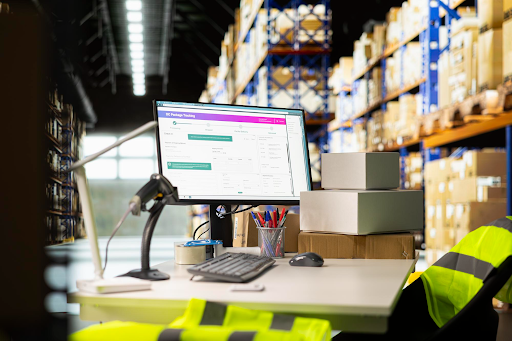

The future of warehouse management systems lies in combining AI, automation, cloud technology, and real-time decision-making to create faster, smarter, and more connected warehouse operations. As supply chains become more complex, businesses are adopting intelligent technologies that improve inventory visibility, optimize workflows, and increase operational efficiency.
As operational complexity continues to grow, the future of warehouse management systems is shifting from simply executing tasks to continuously analyzing data, optimizing operations, and adapting to changing business conditions.
In this blog, we’ll explore the key warehouse management trends, emerging technologies, and strategies businesses should adopt to build future-ready warehouse operations.
What Is a Warehouse Management System (WMS)?
A Warehouse Management System (WMS) is software that helps businesses manage inventory, fulfill orders, track stock movement, and coordinate warehouse operations from receiving and storage to picking, packing, and shipping. As the future of warehouse management systems evolves, modern WMS platforms are integrating AI, automation, cloud technology, and real-time analytics to improve operational efficiency and accuracy.
Why Warehouse Management Systems Are Evolving
Warehouse management systems are evolving because modern supply chains demand greater speed, flexibility, and real-time visibility. As eCommerce grows, customer expectations rise, and warehouse operations become more complex, traditional WMS platforms are no longer enough.
Growth of eCommerce and Omnichannel Fulfillment
Online shopping and omnichannel fulfillment have increased order complexity. A next-generation warehouse management system helps businesses manage multiple fulfillment channels while maintaining speed and inventory accuracy.
Labor Shortages and Rising Operating Costs
Labor shortages continue to drive investment in warehouse automation software, warehouse robotics, Autonomous Mobile Robots (AMRs), and Automated Guided Vehicles (AGVs) to improve productivity without proportionally increasing workforce costs.
Demand for Real-Time Visibility and Faster Fulfillment
Customers expect accurate inventory information and faster deliveries. Cloud warehouse management software, IoT warehouse technologies, and real-time inventory visibility help warehouses respond quickly to changing operational conditions.
The global warehouse management system market is projected to grow at a 21.9% CAGR, reaching nearly $15.95 billion by 2033, reflecting widespread adoption of execution platforms across industries. Despite this maturity, many warehouses still encounter persistent inefficiencies.
From System of Execution to System of Decision
Execution systems standardize operations. Decision systems optimize them.
In most environments, decisions are still made across fragmented layers with planners, supervisors, and static system rules. Each operates with partial visibility, leading to local optimization rather than system-wide efficiency. A decision-centric architecture introduces a layer that continuously evaluates:
- Demand variability
- Resource availability
- Operational constraints
- Service-level priorities
This layer determines what should change in execution before inefficiencies compound.
| Traditional Execution Model | Decision-Centric Model |
| Static rules and workflows | Adaptive decision logic |
| Batch updates | Real-time evaluation |
| Human-led adjustments | System-driven optimization |
| Local efficiency | Network-wide optimization |
Platforms like Synkrato operate as a decision intelligence layer on top of your existing WMS, not as a replacement. This allows you to move from reactive adjustments to proactive, system-driven optimization without disrupting your current infrastructure.
Top Trends Shaping the Future of Warehouse Management Systems
The future of warehouse management systems is being shaped by technologies that improve efficiency, visibility, and decision-making across warehouse operations. The following warehouse management trends are helping businesses build more connected, automated, and data-driven warehouses.
AI-powered warehouse decision-making
AI in warehouse management is moving beyond reporting what happened to determining what should happen next. An AI warehouse management system can evaluate operational variables simultaneously and recommend actions based on changing warehouse conditions.
An AI warehouse management system analyses operational data, identifies patterns, and recommends actions that improve warehouse efficiency and operational performance.
| Decision Area | What AI Evaluates | Operational Impact |
| Demand intelligence | SKU velocity, order patterns, seasonality | Aligns inventory placement and replenishment with demand |
| Execution variability | Workload fluctuations, zone congestion | Adjusts labor allocation and task sequencing |
| Constraint optimization | Labor availability, space limits, SLA priorities | Balances competing operational objectives |
This allows warehouse decisions to adapt as demand, capacity, and resource availability change rather than depending entirely on static rules.
Cloud-Native and SaaS-Based WMS
A cloud-based warehouse management system provides the computational foundation required for real-time decision-making. According to Grand View Research, cloud deployments already account for the largest revenue share of WMS due to scalability and flexibility.
Cloud infrastructure enables decision-making to operate beyond a single facility. It allows distributed processing across locations, supports coordinated optimization in multi-site environments, and provides the computational scale required to run continuous simulation and optimization models. As a result, decisions are no longer constrained by system capacity or location. They can be evaluated and executed in real time across the entire network.
Real-Time Data and IoT-Enabled Inventory Visibility
Future WMS platforms increasingly depend on continuous operational data rather than periodic system updates. IoT devices, connected sensors, and event-driven data streams capture inventory movements, scans, orders, and equipment activity as they occur.
Every operational event can become an input for decision-making. This reduces the delay between a change on the warehouse floor and the system response, while improving real-time inventory visibility and helping identify inventory discrepancies before they affect fulfillment.
Warehouse Automation and Robotics
However, robotics primarily acts as an execution endpoint. Robots can move inventory, execute picking tasks, sort products, and perform repetitive processes, while upstream systems determine which tasks should be prioritized and how resources should be coordinated.
Benefits include:
- Faster picking, sorting, and material movement
- Reduced repetitive manual work
- Better coordination between robots, workers, and warehouse systems
- More efficient task prioritization and resource allocation
- Improved throughput and fulfillment consistency
Synkrato can complement WMS and automation systems by evaluating operational conditions and generating optimized decisions that execution systems can act on.
Digital Twins for Warehouse Simulation and Optimization
A warehouse digital twin adds another capability to modern warehouse management: the ability to evaluate operational decisions before implementing them.
Slotting changes, labor reallocation, and layout adjustments affect multiple variables at once, including travel time, congestion, throughput, and SLA performance. Instead of testing those changes directly in live operations, digital twins allow teams to simulate different scenarios first.
For example, warehouses can test how slotting performs during peak demand, assess labor distribution under intra-day variability, or evaluate the impact of a layout change on material flow.
Synkrato’s digital twin supports this approach by allowing warehouse teams to validate operational changes before they affect live execution.
Predictive Analytics and Optimization Engines
Predictive analytics uses historical and real-time warehouse data to anticipate future operating conditions, including demand changes, inventory requirements, workload fluctuations, and potential capacity constraints.
Optimization engines take this further by evaluating multiple constraints and determining the best available course of action. Depending on the operational problem, these systems can use techniques such as linear programming, heuristic models, and constraint solvers.
For example, an optimization engine can evaluate order priority, travel time, labor availability, and storage constraints simultaneously rather than optimizing each variable independently.
Together, predictive analytics and optimization shift warehouse management from reacting to operational problems toward anticipating conditions and continuously adjusting execution.
Optimization Engines
Warehouse operations involve multi-variable trade-offs that cannot be solved manually. Optimization engines use several levers to determine the best possible outcome under given conditions:
Linear programming: Optimizes decisions with defined constraints, such as allocating labor or space efficiently. It is effective for structured problems where relationships between variables are predictable.
Heuristic models: Handle decisions with discrete choices, such as assigning tasks or locations. It enables precise planning in scenarios with strict operational constraints.
Constraint solvers: Provide fast, near-optimal solutions for complex problems where exact methods are too slow. They are essential for real-time decision-making in dynamic warehouse environments.
Example: Balancing order priority, travel time, and labor availability simultaneously.
Robotics as Execution Endpoints
Robotics in warehouse management has scaled execution efficiency, but its role remains limited to execution. Robotic systems:
- Move inventory:
Robotic systems such as Autonomous Mobile Robots (AMRs) and Automated Guided Vehicles (AGVs) move inventory by following predefined paths or dynamically generated routes within the warehouse.
They use sensors, cameras, and mapping algorithms (like SLAM) to navigate safely and avoid obstacles in real time. Tasks are assigned by upstream systems (WMS/WCS), which instruct robots where to pick up and drop off inventory. This allows continuous material flow without manual transport, reducing travel time and congestion.
- Execute picking tasks:
Robotic picking systems use computer vision and AI models to identify, locate, and grasp items from storage locations. These systems combine cameras, depth sensors, and robotic arms to handle different product shapes and sizes with precision.
The WMS or control system assigns picking tasks, and robots execute them based on optimized sequences and paths. This improves picking accuracy and consistency, especially in high-volume operations.
- Handle repetitive processes:
Robotics handles repetitive tasks such as sorting, packing, and palletizing by following programmed workflows and predefined rules. Sensors and control systems ensure that each action is performed consistently, whether it is scanning, labeling, or stacking items.
These systems operate continuously with minimal variation, which reduces errors caused by fatigue or manual handling. As a result, repetitive processes become faster, more predictable, and easier to scale.
However, they do not determine what should be done; that responsibility shifts to the decision layers like Synkrato.
Emerging Technologies Defining Next-Generation WMS
The next-generation warehouse management system is rapidly evolving with technologies that improve automation, intelligence, and connectivity. These innovations help businesses make faster decisions, strengthen operational resilience, and prepare for future warehouse technology trends.
Generative AI and AI Copilots
Generative AI is making AI in warehouse management more intuitive by enabling users to interact with warehouse data using natural language. AI copilots can:
- Summarize warehouse performance
- Recommend operational improvements
- Generate reports automatically
- Answer warehouse-related questions in real time
Edge Computing and 5G Connectivity
Edge computing processes data closer to warehouse operations, while 5G delivers faster communication between connected devices and automation systems. Together, they help:
- Reduce system latency
- Improve robotic coordination
- Accelerate real-time decision-making
- Support smart warehouse management at scale
RFID and Smart Sensors
RFID tags and smart sensors automatically capture inventory movements without relying solely on barcode scanning. Integrated into an IoT warehouse, they improve real-time inventory visibility, reduce inventory discrepancies, and provide accurate data for inventory planning and operational decision-making.
Blockchain for Supply Chain Traceability
Blockchain creates secure, tamper-resistant records of inventory transactions and product movement across the supply chain. By improving transparency and traceability, it helps businesses strengthen compliance, simplify audits, and build greater trust among suppliers, logistics providers, and customers.
How Future WMS Will Transform Warehouse Operations
The future of warehouse management systems is not defined by faster execution alone. It is defined by continuous optimization, where inventory, labor, storage, and equipment decisions are evaluated in real time instead of relying on static rules. As AI, automation, and simulation mature, modern WMS platforms will shift from coordinating warehouse activities to continuously improving operational performance.
Faster Order Fulfillment
Future WMS platforms will reduce order cycle times by optimizing the entire fulfillment flow rather than individual picking tasks. AI evaluates order priorities, inventory availability, labor capacity, and travel paths simultaneously, ensuring work is released in the sequence that maximizes throughput while minimizing congestion.
Higher Inventory Accuracy
Inventory accuracy will increasingly depend on continuous system synchronization rather than periodic cycle counts. Real-time inventory visibility, IoT devices, and AI-driven validation help detect inventory drift, replenishment delays, and transaction mismatches before they affect fulfillment decisions.
Smarter Labor Management
Labor planning will become increasingly adaptive as workload conditions change throughout the day. Instead of assigning fixed resources to predefined zones, future WMS platforms will continuously rebalance work based on order volume, congestion, workforce availability, and task priorities, improving productivity without proportionally increasing headcount.
Dynamic Slotting and Space Optimization
Static slotting strategies cannot keep pace with changing SKU velocity and demand patterns. Synkrato’s AI Slotting Recommendations continuously evaluate inventory movement, order history, storage constraints, and replenishment frequency to recommend SKU placements that reduce travel distance, improve pick density, and maintain efficient warehouse flow.
Predictive Maintenance and Reduced Downtime
Connected equipment continuously generates operational data that can reveal early signs of mechanical degradation. By identifying abnormal utilization patterns, vibration trends, or maintenance anomalies before failures occur, future warehouse systems can reduce unplanned downtime while improving equipment availability and operational continuity.
Improved Customer Service and Supply Chain Visibility
Future warehouse platforms will improve customer service by connecting warehouse execution with broader supply chain decisions. Instead of reacting to delays after they occur, organizations will use real-time operational intelligence to anticipate fulfillment risks, evaluate alternative execution strategies, and maintain more reliable service levels across distributed warehouse networks.
Applying Decision Intelligence to Core Operations
Technology only matters when it changes how decisions are made in high-impact areas.
Dynamic Slotting (From Periodic to Continuous)
Traditional slotting assumes stable demand. In reality, SKU velocity and order patterns shift continuously. A decision-centric approach evaluates SKU movement in real time, adjusts placement dynamically, and uses simulation to validate changes before execution.
This results in a decline in travel time, improved picking efficiency, and elimination of large-scale re-slotting cycles.
Synkrato’s AI slotting recommendations materially change how slotting is executed. The system analyzes multiple data points, including inventory levels, order history, shipping timelines, and demand patterns, and generates optimized slotting strategies within a digital twin environment.
Real-Time Labor Allocation
Labor planning is typically static, while demand is not. A decision layer continuously evaluates:
- Workload distribution
- Order urgency
- Zone congestion
- Labor availability and skill compatibility
- Intra-day demand variability and volume spikes
The data is used to reallocate resources accordingly, reducing idle time and improving throughput without increasing headcount.
Order Prioritization Under Constraints
Prioritization decisions become complex when multiple constraints interact. Instead of fixed rules, decision engines:
Evaluate constraints simultaneously:
Every warehouse operation generates continuous signals like inventory movements, order inflow, or congestion in specific zones. A decision system evaluates these events in real time against current operational constraints such as capacity, priority, and resource availability. This allows the system to immediately determine whether an adjustment is required, eliminating the lag between occurrence and response.
Adjust priorities dynamically:
In most environments, even when decisions are identified, execution depends on human coordination across teams. This creates delays and inconsistencies, especially at scale. Decision systems close this gap by converting outputs from AI and optimization models into direct system-level instructions. These instructions are pushed into execution layers like WMS or automation systems, ensuring that decisions are implemented instantly and consistently without additional intervention.
Align execution with business objectives:
Decision systems automate repeatable, high-frequency decisions while escalating only exceptions that require judgment. This shifts your teams from constant operational firefighting to oversight and strategic control, improving both efficiency and decision quality at scale.
Outcome: Improved SLA adherence and balanced operational load.
Closing the Gap Between Visibility and Action
Most enterprises already have visibility. Dashboards, reports, and analytics platforms provide detailed insights into operations. However, visibility introduces a new bottleneck—decision delay. As data volume increases, the time required to interpret and act on that data also increases.
Decision-centric systems remove this friction by converting real-time operational events directly into executable actions, automating decision-making at the system level, and minimizing reliance on manual intervention. This ensures that insights translate into immediate, consistent execution rather than delayed responses.
From Automation to Autonomous Operations
Automation in warehouse management system environments improves efficiency by executing predefined tasks. Autonomy goes further and enables systems to:
| Capability | Automation (Traditional WMS) | Autonomous Operations (Next-Gen WMS) |
| Core Function | Executes predefined tasks | Continuously evaluates and optimizes operations |
| Decision Timing | Rule-based, triggered by events | Continuous, real-time decision-making |
| Workflow Adaptability | Fixed workflows with limited flexibility | Dynamically adjusts workflows based on conditions |
| Exception Handling | Requires human intervention | Resolves exceptions autonomously or escalates selectively |
| System Intelligence | Reactive | Predictive and adaptive |
| Operational Impact | Improves task efficiency | Improves system-wide performance and resilience |
A smart warehouse management system is not defined by how much it automates, but by how effectively it adapts.
Industries that will Benefit Most
The future of warehouse management systems enables businesses to improve efficiency, inventory accuracy, and operational agility. Industries with high inventory volumes and complex fulfillment requirements will benefit the most from a next-generation warehouse management system.
Retail & eCommerce
An AI warehouse management system helps retailers optimize omnichannel fulfillment, improve inventory accuracy, and deliver orders faster.
Manufacturing
Modern warehouse management improves inventory control, supports production schedules, and reduces operational delays.
Third-Party Logistics (3PL)
Cloud warehouse management software provides 3PL providers with scalable operations, better visibility, and more efficient multi-client warehouse management.
Food & Beverage
An IoT warehouse and predictive analytics help businesses:
- Reduce product spoilage
- Improve inventory rotation
- Maintain food safety compliance
- Increase supply chain visibility
Healthcare & Pharmaceuticals
Real-time inventory visibility helps healthcare organizations maintain inventory accuracy, improve product traceability, and ensure timely access to critical medical supplies.
Challenges of Adopting Future Warehouse Management Systems
Implementing the future of warehouse management systems requires more than adopting new technology. Businesses must overcome technical, operational, and organizational challenges to maximize long-term value.
Legacy System Modernization
Many legacy warehouse platforms lack support for AI, automation, and cloud technologies. A phased modernization strategy helps reduce disruption while preparing operations for future growth.
Integration Complexity
A next-generation warehouse management system must integrate seamlessly with ERP, TMS, MES, robotics, and other business applications to eliminate data silos and improve operational efficiency.
Cybersecurity and Data Privacy
As warehouses become more connected through cloud warehouse management software and IoT devices, protecting operational data and ensuring system security become top priorities.
Workforce Training and Change Management
Successful adoption depends on preparing employees to work with new technologies. Organizations should focus on:
- Upskilling warehouse teams
- Encouraging technology adoption
- Updating operational workflows
- Supporting continuous learning
Cost and ROI Considerations
While implementing advanced warehouse technologies requires upfront investment, the long-term gains often outweigh the costs. Gartner projects that more than 50% of warehouses will adopt some form of warehouse automation by 2030, highlighting the growing business value of intelligent warehouse technologies.
How Synkrato Helps Build Future-Ready Warehouse Operations
Synkrato helps businesses build future-ready warehouse operations by adding an intelligent decision layer that enhances existing warehouse systems without replacing them.
AI-Powered Warehouse Optimization
Synkrato analyses operational data to recommend smarter inventory, labor, and workflow decisions.
Warehouse Digital Twin and Simulation
The Synkrato Warehouse Digital Twin enables businesses to simulate operational changes before implementation, reducing risk and improving planning confidence.
Warehouse Slotting Optimization
AI-powered slotting recommendations position inventory based on demand patterns to minimize travel time and increase picking efficiency.
Continuous Operational Improvement
Synkrato continuously monitors warehouse performance, identifies optimization opportunities, and supports ongoing operational improvements as business conditions change.
Conclusion
Intelligence, connectivity, and real-time execution are at the heart of the future of warehouse management systems. Businesses need to use systems that go beyond simple tracking and reporting as supply chains get more complicated and customer expectations keep rising.
Execution systems have matured across industries, but they no longer define competitive advantage. The differentiator is how effectively your operations can make and act on decisions in real time. The future of warehouse management system architecture is layered. Execution systems manage workflows, while decision layers continuously optimize outcomes.
Synkrato enables this shift by introducing a decision intelligence layer that works alongside your existing systems. By combining real-time data, optimization, and digital twin simulation, you can improve performance without disrupting your current infrastructure.
Ready to progress towards the future of warehouse management systems? Book a demo with Synkrato to make your supply chains more proactive.
FAQs
What is the future of Warehouse Management Systems?
The future of warehouse management systems is shifting from execution-focused platforms to decision-centric architectures. You already have systems that execute tasks efficiently, but performance now depends on how quickly decisions adapt to change. Synkrato strengthens this shift by enabling real-time, system-driven decision-making across operations.
What defines a next-generation warehouse management system?
A next-generation warehouse management system goes beyond workflow execution and embeds continuous decision intelligence. It evaluates constraints, priorities, and resources in real time to optimize outcomes. Synkrato complements this by adding a decision layer that works alongside existing systems without requiring replacement.
Why is decision intelligence critical in modern warehouse operations?
Operational complexity has increased faster than traditional systems can handle through static rules. Decision intelligence enables continuous optimization by evaluating multiple variables simultaneously. Synkrato applies this approach using real-time data and simulation, allowing you to make faster, more accurate decisions without manual intervention.
How does AI improve decision-making in warehouse management systems?
AI enables systems to move from reactive reporting to predictive and prescriptive decision-making. It identifies patterns, forecasts demand, and recommends actions based on real-time inputs. Synkrato extends this by combining AI with digital twin simulation, ensuring decisions are validated before execution.
What role does a cloud-based warehouse management system play in this shift?
A cloud-based warehouse management system provides the scalability and computational capacity required for real-time data processing and decision-making. It supports distributed operations and integration across systems. This infrastructure allows platforms like Synkrato to run optimization models and simulations at scale.
How does robotics in warehouse management integrate with decision systems?
Robotics in warehouse management executes tasks such as movement, picking, and sorting with high precision. However, it depends on upstream systems to determine what actions to perform. Synkrato enhances this by feeding optimized decisions into execution systems, ensuring robotics operates with maximum efficiency.
How can warehouses reduce decision latency in operations?
Reducing decision latency requires moving from manual, batch-based decision-making to real-time, event-driven systems. This involves integrating data streams, optimization engines, and automated execution. Synkrato enables this by converting operational signals into immediate, system-driven decisions across workflows.
Will warehouse management systems become fully autonomous in the future?
Warehouse systems will increasingly automate routine decisions, but full autonomy will remain guided by human oversight. The goal is not to eliminate human involvement but to elevate it. Synkrato supports this by automating high-frequency decisions while allowing teams to focus on strategic control and exceptions.
How is AI transforming warehouse management?
AI is transforming warehouse management by analyzing operational data, forecasting demand, optimizing inventory placement, automating routine decisions, and improving labor allocation. This enables faster fulfillment, greater efficiency, and more accurate warehouse operations.
Will cloud WMS replace on-premise systems?
Cloud WMS adoption is increasing because of its scalability, flexibility, and lower maintenance requirements. However, many businesses will continue using hybrid environments that combine cloud and on-premise systems based on operational needs.
What is the role of digital twins in warehouse management?
A warehouse digital twin creates a virtual replica of warehouse operations, allowing businesses to simulate layouts, test workflows, validate operational changes, and optimize performance before implementing changes in live environments.
How can businesses prepare for next-generation WMS?
Businesses should modernize legacy systems, improve data quality, strengthen system integrations, invest in workforce training, and adopt AI, cloud, IoT, and automation technologies to support scalable, future-ready warehouse operations.