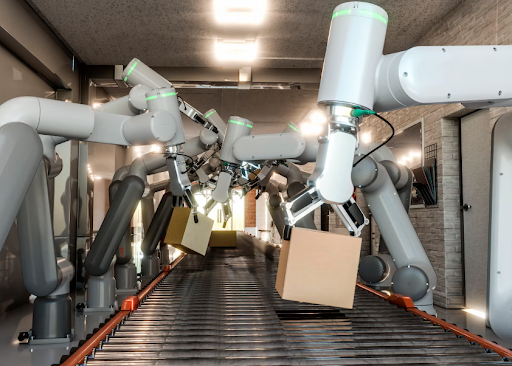
The use of robotics in warehouses improves performance by increasing throughput, reducing travel, improving order accuracy, strengthening workplace safety, and making operations easier to scale during demand changes. It automates repetitive material-handling tasks such as picking, sorting, transporting, replenishment, packing, and storage while allowing employees to focus on higher-value work.
The technology is also becoming a standard part of warehouse operations. About 102,900 professional service robots for transportation and logistics were sold globally in 2024, a 14% increase from the previous year, reflecting growing investment in robotic systems that move and handle goods inside warehouses.
This guide explains 14 measurable benefits of warehouse robotics, how different industries apply robotic systems, and the key metrics businesses should track to evaluate operational and financial returns.
14 Benefits of Warehouse Robotics
Some of the benefits of warehouse robotics are:
1. Increase warehouse productivity and throughput
Warehouse robotics increases productivity by reducing non-value-added travel and keeping work moving between storage, picking, packing, and shipping. Gains are strongest when routes, workstation demand, replenishment, and task release are coordinated as one system.
For instance, Amazon developed DeepFleet to improve travel efficiency across more than one million robots by 10%. Synkrato’s Digital Twin can similarly test whether congestion, task release, station capacity, or robot quantity is the actual constraint before a warehouse increases fleet size.
Robotics can improve throughput by:
- Bringing inventory to workers instead of sending workers through long pick paths.
- Interleaving putaway, replenishment, and picking tasks to reduce empty travel.
- Redirecting work when stations, aisles, or downstream processes become congested.
2. Improve order picking and inventory accuracy
Warehouse robotics improves order picking and inventory accuracy by verifying inventory at multiple points during execution instead of relying on a final check. Robots confirm the source location, selected item, and quantity, and destination tote or container, allowing errors to be identified before packing or shipping.
Since 2015, PUMA’s robotic fulfillment operations in Indiana and California have moved more than 50 million items while reporting 99% order accuracy. The result comes from connecting storage, retrieval, workstation design, software rules, and identity checks rather than relying on one final scan.
3. Reduce labor dependency and operating costs
Warehouse robotics reduces labor dependency by automating repetitive movement and stabilizing output when staffing changes. Measure the benefit as labor avoided per unit of growth, not only as positions removed.
Robotics also changes the skill mix: Amazon reports that advanced robotic sites require 30% more reliability, maintenance, and engineering employees.
Thus, robots can absorb work such as:
- Long-distance cart and tote movement.
- Repetitive pallet transport.
- Routine storage and retrieval.
- Scheduled inventory counting.
4. Speed up order fulfillment and shipping
Warehouse robotics speeds up order fulfillment by keeping work flowing and prioritizing orders based on operational needs. It helps to:
- Keep operators supplied with work
- Prioritize carrier cutoffs
- Balance packing workloads
- Redirect tasks during delays
PUMA’s US robotic operations have shipped more than 150,000 units per day and two million units per month during peak periods by aligning storage, workstation flow, and order priorities.
5. Improve warehouse safety and ergonomics
Warehouse robotics solutions create the greatest safety benefit in the heaviest, highest, lowest, and most repetitive parts of warehouse work. Removing these exposures can improve ergonomics without automating tasks that still require judgment.
Amazon’s Vulcan robot, introduced in 2025 in the US and Germany, can pick and stow about 75% of the item types held in its fulfillment centers. It handles rows approximately eight feet high and locations near the floor, reducing ladder use, bending, and awkward reaching.
6. Maximize warehouse storage capacity
Warehouse robotics increases capacity by using cubic space effectively and reducing manual travel aisles. For instance, PUMA’s AutoStore operation increased inventory capacity tenfold, storing 4.2 million units in 100,000 square feet. Density creates value only when ports, lifts, replenishment, and packing support the required output.
With this, capacity gains may come from:
- Denser bin or tote storage.
- Higher use of vertical space.
- Dynamic positioning of fast-moving inventory.
- Less floor area dedicated to picker travel.
7. Enable 24/7 warehouse operations
Warehouse robotics enables selected processes to continue after staffed picking shifts end. Robots can reposition inventory, complete replenishment, perform cycle counts, and stage work for the next shift without keeping every warehouse function fully staffed overnight.
IKEA shows how this works in practice. Its AI-powered drones conduct inventory checks while other warehouse activity continues, avoiding aisle closures for manual counting. By August 2024, IKEA had more than 250 drones operating across 73 locations in nine countries.
Thus, continuous operation still requires:
- Sufficient charging and battery capacity.
- Network, software, and power redundancy.
- Defined maintenance and recovery procedures.
8. Improve inventory visibility and traceability
Continuous robotic execution also creates a detailed record of inventory movement. Robots can confirm where the stock was collected, where it was delivered, when the movement occurred, and whether the task was completed.
This helps teams identify:
- Missing inventory.
- Incorrect locations.
- Unexpected empty positions.
- Unconfirmed moves.
- Quantity mismatches closer to the source.
However, the data must be connected with WMS, ERP, scan, image, and execution records. Otherwise, the warehouse may detect an exception without knowing whether it came from physical stock, inaccurate master data, or a failed robotic task.
For this, Synkrato’s AI Agents combine WMS, ERP, scan, image, and digital twin data to identify the operational impact of each exception.
9. Scale operations during peak demand
Warehouse robotics scales operations during peak demand by adding capacity without major infrastructure changes. Peak planning should evaluate:
- Robot density
- Charging demand
- Workstation queues
- Packing throughput
- Dock availability
Synkrato’s simulation environment applies the same principle by testing peak volume, failures, and operating rules before changes are introduced into the live warehouse. Likewise, DHL demonstrates this deployment advantage, stating that AMRs can be brought online in about 20% of the time required to recruit, hire, and train additional pickers.
10. Enhance customer satisfaction
Additional robotic capacity improves customer satisfaction only when it creates more complete and dependable orders.
Customers do not experience robot utilization directly. They experience whether inventory is available, the correct order leaves on time, and delivery promises remain reliable during demand peaks.
This connection is visible at Decathlon’s Setúbal facility in Portugal. After the Skyfleet automation program, the site increased daily order preparation from 57,000 to 114,000 orders. At the same time, it expanded the number of stores served from 41 to 73.
11. Build a more resilient supply chain
Reliable customer service also depends on continuing operations when part of the system fails. Warehouse robotics improves resilience when tasks can be rerouted around unavailable robots, blocked aisles, full workstations, or delayed equipment.
A resilient design can:
- Isolate failed robots without stopping the fleet.
- Redirect tasks to another route or workstation.
- Reprioritize urgent orders.
- Continue at a controlled rate during recovery.
These capabilities require shared traffic, charging, inventory, and priority rules. Without orchestration, separate robotic systems may continue moving while overall order flow remains blocked.
12. Deliver long-term return on investment
Warehouse robotics delivers ROI through higher throughput, labor avoidance, fewer errors, reduced damage, released space, lower overtime, and delayed expansion. The calculation must include the complete material flow rather than the robot alone.
Cardinal Health illustrates why downstream processes are important. Its Ohio and South Carolina centers use more than 750 linear feet of automated conveyor and five scanners to route nearly 800 boxes per hour. This example shows that faster storage or picking creates financial value only when scanning, labeling, conveying, and shipping can handle the resulting volume.
Thus, ROI should include:
- Integration and commissioning.
- Software, support, and maintenance.
- Downtime, spare parts, and technical labor.
- Financing and equipment replacement.
13. Reduce Onboarding and Training Time
The labor benefit of warehouse robotics extends beyond reducing travel. Guided robotic workflows can shorten onboarding by directing workers to the correct item, quantity, and destination instead of requiring them to memorize routes and location structures.
For example, DHL reports that assisted picking robots reduced worker training time by 80%. Faster onboarding is particularly valuable during seasonal hiring, new customer launches, and site expansion because employees can reach productive output sooner. It also reduces the time experienced workers spend training new employees.
For this, the system should provide:
- Clear pick-and-put instructions.
- Immediate confirmation and error prompts.
- Consistent workflows across shifts and languages.
14. Reduce Product Damage and Unnecessary Handling
Warehouse robotics reduces product damage by controlling speed, routes, container movement, and handoffs more consistently than manual handling. Goods-to-person systems also limit the number of touches before packing.
Damage should be measured separately from order accuracy because the correct item can still arrive crushed, scratched, contaminated, or incorrectly oriented.
Warehouses should track damage by SKU, container, robot, workstation, and process step to locate failures in handling, packaging, conveying, or packing. Synkrato’s Digital Twin can test layouts, pick paths, and slotting changes before deployment to identify unnecessary handling points.
Which Industries Benefit the Most from Warehouse Robotics?
Robotics in warehousing delivers the greatest value in complex, high-volume operations.
E-commerce and Retail
E-commerce warehouses process thousands of SKUs, unpredictable order profiles, frequent returns, and multiple daily carrier cut-offs. Continuous inventory movement, balanced picking workloads, and faster replenishment help maintain service levels without increasing labour at the same rate as order volume.
Third–Party Logistics (3PL)
3PL providers manage multiple customers with different inventory policies, service-level agreements, billing models, and seasonal demand patterns. Flexible automation allows resources to shift between customer accounts while maintaining inventory segregation, priority rules, and contractual service commitments.
Manufacturing
Manufacturing warehouses depend on precise material flow to support production schedules. Reliable line-side replenishment, component sequencing, and work-in-process movement reduce the risk of production interruptions caused by delayed or misplaced inventory.
Food and Beverage
These operations must balance product freshness, temperature-controlled storage, expiry management, and rapid inventory turnover. Consistent replenishment, controlled product rotation, and efficient handling in chilled environments help maintain both throughput and product quality.
Pharmaceuticals
This type of warehouse operates under strict regulatory and traceability requirements where every inventory movement must be recorded accurately. Validated workflows using AI agents, stronger chain-of-custody controls, and accurate lot, batch, and serial tracking support both compliance and operational efficiency.
Automotive
Automotive warehouses manage several production parts with highly variable demand and strict sequencing requirements. Coordinated movement of components, returnable containers, and production kits helps keep manufacturing schedules stable while reducing the risk of line stoppages.
How to Measure the Success of Warehouse Robots
Success should be measured by improvements across the entire warehouse, not by robot utilisation alone.
- Productivity and throughput: Track units, lines, cartons, or pallets per labor hour alongside queue time, robot travel, station starvation, replenishment delay, and constraint utilization.
- Order accuracy: Measure the perfect-order rate, including item, quantity, lot, serial, damage, documentation, label, and destination.
- Labor utilization: Track walking removed, manual touches, overtime, temporary labor, training, technical support, and exception time.
- Warehouse space utilization: Measure cubic utilization, inventory per square foot, access positions, port queues, and replenishment space.
- Cost per order: Include labor, maintenance, software, energy, consumables, support, depreciation, financing, downtime, and building cost.
- ROI and payback period: Test base, peak, downside, and failure scenarios, then track realized benefits monthly against the approved model.
How Synkrato Helps Businesses Maximize Warehouse Robotics Benefits
Synkrato helps warehouse teams determine where robotics will improve total flow before capital is committed. The platform creates a shared operating model across layout, labor, inventory, automation, and service outcomes.
- Maps receiving, storage, replenishment, picking, packing, and shipping constraints.
- Tests layouts, fleet sizes, task rules, peak demand, and equipment failures virtually.
- Connects warehouse data with operational scenarios and recommended actions.
- Measures throughput, utilization, congestion, travel, cost, and service performance continuously.
Book a demo with Synkrato to test where robotics can create measurable value in your warehouse before changing the live operation.
Conclusion
Warehouse robotics improves performance when it is designed around the flow of work. The strongest projects use robots to remove specific constraints, validate the design under peak and failure conditions, connect execution with the WMS, and measure results against a baseline.
That approach produces more than faster movement. It creates safer work, denser storage, more reliable fulfillment, better inventory control, and a stronger long-term return.
Frequently Asked Questions
What are the biggest benefits of warehouse robotics?
The main benefits are higher throughput, better accuracy, lower travel, safer handling, denser storage, stronger peak capacity, and more predictable fulfillment. The value is greatest when these gains improve the complete order flow rather than one isolated task.
How do warehouse robots improve warehouse efficiency?
Robots reduce empty travel, standardize handoffs, bring inventory to controlled stations, and create execution data. Synkrato can simulate how those changes affect queues, labor, and downstream capacity before deployment.
Is warehouse robotics suitable for small and mid-sized warehouses?
Yes, robotics is suitable when the warehouse has repeatable volume, costly travel, labor instability, or limited space. Modular AMRs and compact storage systems allow phased deployment, but integration, support, and peak utilization must still justify the investment.
What is the ROI of warehouse robotics?
ROI depends on volume, labor cost, utilization, accuracy, space released, maintenance, and downtime. Synkrato can compare alternative robotics scenarios against the operating baseline before capital approval.
Can warehouse robots integrate with a warehouse management system?
Yes. The WMS normally owns inventory and order logic, while fleet or execution software directs robotic work. Integration must cover task release, locations, confirmations, priorities, exceptions, and recovery status.
What challenges should businesses consider before adopting warehouse robotics?
The main risks are automating a poor process, weak data, inadequate peak testing, integration delays, vendor dependence, insufficient maintenance, cybersecurity, and unsafe human-robot interaction. Synkrato helps expose these issues through virtual testing before physical implementation.