Warehouse labor productivity improves when each paid hour produces more accurate, completed work with less walking, waiting, rehandling, and recovery from exceptions. The pressure is rising as U.S. warehousing and storage labor productivity increased only 0.1% in 2024, while average hourly earnings reached $26.85 in June 2026.
That makes small process losses expensive at scale. The strongest productivity gains come from changing how work is released, where inventory sits, how replenishment is triggered, and which repetitive movements technology absorbs. This blog covers ideas, technologies, metrics, and strategies to improve warehouse labor efficiency and productivity.
8 Ideas to Improve Warehouse Labor Productivity
The 8 best ideas to improve warehouse labor productivity remove travel, waiting, rework, and unnecessary handling before asking employees to work faster. Here are 8 ways to improve warehouse labor productivity:
1. Reduce travel with smart layout and slotting
Smart layout and slotting improve warehouse employee productivity when placement considers total handling effort, not only SKU velocity.
Factor picking, replenishment, congestion, and handling into location decisions. Key actions include:
- Optimize slotting: Use pick frequency, SKU affinity, cube, demand variability, and replenishment frequency.
- Group related items: Place products frequently ordered together along compatible picking paths.
- Improve facility signage: Standardize aisle, rack, bin, and zone labels to reduce search time.
In 2023, Amazon said Sequoia at its Houston, Texas, fulfillment center could store inventory up to 75% faster and reduce order processing time by up to 25% by bringing inventory to workers.
The same principle can work without goods-to-person automation. Synkrato AI Slotting uses inventory, demand, and order patterns to recommend locations that can reduce walking, congestion, and replenishment effort.
2. Upgrade picking strategies around the current constraint
Upgrade picking strategies by matching batch picking, zone picking, or wave picking to order mix and downstream capacity.
No single method works for every workload. Choose among:
- Batch picking: Combine orders with overlapping SKUs to reduce repeat trips.
- Zone picking: Keep workers within defined areas when travel is the main constraint.
- Wave picking: Time releases around carrier cutoffs and downstream capacity.
- Task interleaving: Assign putaway or replenishment work on return trips instead of allowing empty travel.
For example, releasing 2,000 more picks when packing is already constrained raises activity, not necessarily shipped output.
3. Trigger replenishment before it interrupts picking
Replenishment should respond to predicted pick-face demand and lead time rather than a static minimum quantity.
One stockout can stop a picker, trigger emergency replenishment, involve a supervisor, and create an exception. Build a pick-face risk window around:
- Expected consumption and open orders.
- Current pick-face inventory.
- Replenishment travel time.
- Aisle congestion and available replenishment labor.
4. Separate exception work from productive work
Exception minutes should be measured separately because units per hour can hide time spent fixing problems.
Track inventory not found, short picks, unreadable barcode scanner inputs, quantity mismatches, damaged goods, and blocked locations. Rank them by total labor minutes consumed, not frequency.
Mobile software and barcode scanning can reduce manual verification, but recurring errors should still be traced to their operational cause.
5. Reduce employee idle time by identifying its exact cause
Employee idle time decreases when warehouses identify and fix the specific delays that leave workers waiting between tasks.
Instead of one idle-time percentage, distinguish:
- Waiting for inventory or replenishment.
- Waiting for equipment, systems, or supervisor decisions.
- Waiting because downstream operations are full.
- Unproductive travel between assignments.
Synkrato AI Agents can use connected warehouse data to surface bottlenecks, workload changes, stockout risks, and opportunities to rebalance work before the end of a shift.
6. Design workstations around repeated motions
Warehouse ergonomics supports sustained productivity by reducing repeated reaching, bending, lifting, and turning. Amazon designed Sequoia workstations around the employee power zone, between mid-thigh and mid-chest, reducing repeated squatting and overhead reaching.
7. Cross-train staff around predictable workload transfers
Cross-train staff where labor demand regularly moves between warehouse processes rather than training everyone for everything.
Build a skills matrix covering receiving, putaway, picking, replenishment, packing, and exception handling. Match it against hourly demand forecasts.
If picking slows while packing becomes constrained, qualified workers can move before the queue grows. This targeted flexibility protects total throughput better than maximizing utilization within one department.
8. Manage labor cost per unit with output per hour
Labor cost per unit should be tracked with output, accuracy, travel, and exceptions to show whether warehouse workforce productivity is truly improving.
Use a focused scorecard:
- Units, lines, or orders per paid labor hour.
- Labor cost per shipped order.
- Travel minutes per task.
- Exception minutes per 1,000 transactions.
- Rework or error rate.
- Orders completed before carrier cutoff.
Before making physical changes, Synkrato Digital Twin can simulate layouts, workflows, and operating scenarios to determine whether a change reduces travel and labor requirements or simply shifts the bottleneck elsewhere.
How Technology Can Improve Warehouse Labor Productivity
Technology improves warehouse labor productivity by removing repetitive movement, physical handling, and routine decisions while keeping workers focused on higher-value tasks.
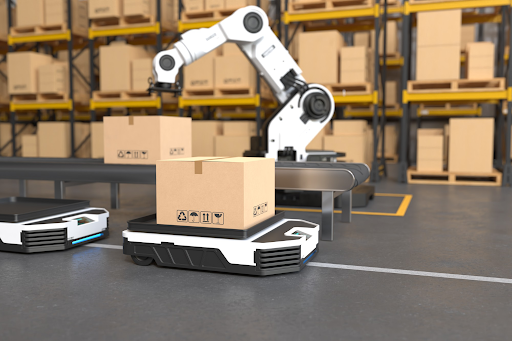
UPS shows the impact. At its Taoyuan International Logistics Center in Taiwan, autonomous mobile robots (AMRs) help with picking, packing, and inventory movement. These AMRs can double productivity, while orders can be processed and shelved about 40% faster.
However, the technology should match the specific labor constraint:
| Technology | How it improves labor productivity |
| Autonomous Mobile Robots (AMRs) | Move inventory between work areas, reducing labor spent transporting bins and cartons. |
| Goods-to-Person Systems | Bring inventory directly to workers, removing much of the walking and searching from picking. |
| Mechanical Lifts | Cobots, robotic arms, and lift-assist equipment handle heavy or awkward loads and reduce physical strain. |
| Warehouse Management Systems (WMS) | Prioritize tasks and coordinate orders, inventory, and equipment so labor is directed toward work that can move immediately. |
| Voice and Wearable Tech | Deliver hands-free instructions through headsets, wearable scanners, or smart glasses, reducing interruptions during physical tasks. |
| Real-Time Data Dashboards | Show queues, workload, and bottlenecks during the shift so managers can reallocate resources before delays grow. |
The same targeted approach is visible at DHL. In July 2025, DHL reported 2,000+ robots across the UK, Ireland, and EMEA, including 750+ assisted-picking robots across 18 sites. Its Stretch robots can unload up to 700 boxes per hour.
Before investing, Synkrato Simulation & Optimization can test automation and workflow scenarios to compare their impact on labor, throughput, and operational flow before implementation.
Common Mistakes That Reduce Warehouse Labor Productivity
The most common mistakes that reduce warehouse labor productivity create extra movement, delays, rework, or labor without increasing completed output.
Watch for these mistakes:
- Poor product slotting: Static slotting becomes inefficient as demand changes. Review locations as order patterns and SKU relationships shift.
- Aisle congestion: Overloading shared aisles, staging areas, or packing stations slows multiple processes at once.
- Ignoring vertical space: Poor use of cubic storage expands travel distances. Balance storage density with accessibility and retrieval effort.
- Using paper workflows: Delayed inventory and task updates force workers to make decisions using outdated information.
- No standard operating rules: Different methods for the same task create inconsistent output and make performance harder to compare.
- Skipping basic automation: Manual lookups and repetitive handling consume labor that could be used for higher-value work.
- Inadequate training: Training only for standard tasks pushes routine exceptions to supervisors and creates avoidable delays.
- Not tracking performance metrics: Units per hour can hide rework and queues. Track accuracy, labor cost, and completed orders alongside output.
- Poor shift scheduling: Daily staffing averages can leave too few workers during peaks and excess labor during slower periods.
- Rewarding utilization instead of flow: Keeping everyone busy can build work-in-process without increasing completed orders.
- Ignoring replenishment labor: Faster picking may simply transfer additional work to replenishment.
- Automating an unstable process: Automation can accelerate a poor workflow instead of fixing its underlying constraint.
The better test is whether labor cost per completed unit falls while throughput, accuracy, and service levels remain stable or improve.
Improve Warehouse Labor Productivity With Synkrato
Synkrato helps with warehouse productivity improvement by finding where paid labor time is being lost and turning those findings into operational improvements.
- Reduce unnecessary worker travel and product handling.
- Identify bottlenecks before they create labor delays.
- Improve labor allocation as workloads change.
- Test operational changes before disrupting live workflows.
- Track whether changes reduce labor costs while maintaining throughput and accuracy.
Move from measuring how busy workers are to improving how much productive work each labor hour delivers. Book a Demo to see how Synkrato can improve warehouse productivity.
FAQs
How can warehouse labor productivity be improved?
Warehouse labor productivity improves by reducing travel, waiting, replenishment interruptions, exception work, and unnecessary handling. Synkrato can support these improvements through AI Slotting, Digital Twin modeling, and operational analysis with AI Agents.
What is a good warehouse labor productivity metric?
A good primary metric is units, lines, or orders completed per paid labor hour, supported by labor cost per order, travel time, exceptions, and accuracy. Synkrato can help teams test operational changes against these measures.
How does warehouse automation improve labor productivity?
Warehouse automation improves labor productivity by reducing repetitive movement, handling, sorting, and routine decisions. This allows workers to focus on exceptions and higher-value tasks while increasing output per labor hour.
How can warehouses reduce employee idle time?
Warehouses can reduce idle time by separating waiting causes and correcting inventory, replenishment, equipment, workload, or downstream-capacity problems individually. Synkrato AI Agents can help identify bottlenecks and workload changes from connected warehouse data.