An inefficient warehouse layout increases travel, congestion, handling, and labor without a matching rise in order volume. Recurring bottlenecks, temporary staging, uneven workloads, and worker workarounds often reveal the problem even when shipping targets are still met.
These layout decisions can have a measurable impact on warehouse performance. A 2025 field study found that improving storage allocation reduced picking time by 8-12%. Retrieving items from higher rack levels took approximately 2 minutes, compared with 0.3 minutes at lower levels.
This blog highlights the signs of an inefficient warehouse layout, explains its operational impact, and shows when layout optimization becomes a business priority.
Why Warehouse Layout Problems Often Go Unnoticed Until Performance Declines
Small layout inefficiencies often remain hidden until changing workloads expose their impact on warehouse performance.
How Stable Operations Can Hide Inefficient Warehouse Flow
Warehouse layout problems often remain hidden because experienced employees compensate for poor warehouse flow. Alternative routes, temporary staging, labor transfers, and overtime help maintain output speed, which makes the layout appear efficient even as travel time and handling effort increase.
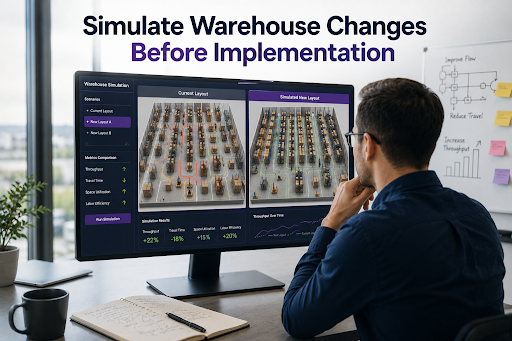
To uncover these hidden inefficiencies, Synkrato’s 3D digital twin visualizes warehouse flow and highlights layout constraints that traditional performance metrics often miss.
Common signs that stable operations are masking layout inefficiency include:
- Hidden Travel Time: Excessive walking and backtracking increase non-productive time.
- Adaptive Workarounds: Experienced workers rely on unofficial routes and manual fixes.
- Reactive Problem Solving: Overtime and additional labor compensate for layout problems instead of solving them.
- Emphasis on Vanity Metrics: High storage utilization hides poor operational flow.
Why Incremental Process Changes Fail to Expose Layout Issues
Warehouses often respond to performance problems with incremental process changes, such as relocating fast-moving SKUs, adding packing stations, widening aisles, or creating more staging space. While these band-aid fixes may improve one area, they rarely solve the underlying layout problem and often shift the bottleneck elsewhere, a process known as constraint migration.
Common reasons these changes fail include:
- The Space Illusion: Maximizing storage density often reduces picking speed and equipment movement.
- Localized Focus: Optimizing one area, such as packing, creates congestion in receiving, replenishment, or shipping.
- Lack of Data-Driven Slotting: Moving inventory without analyzing SKU velocity, order profiles, and material flow fails to eliminate bottlenecks.
The Hidden Cost of Layout Decisions Over Time
Warehouse layout problems often remain hidden because small inefficiencies gradually become part of normal operations. Common reasons include:
- Normalization of Deviance: Workers accept inefficient processes as normal over time.
- Incremental Degradation: Small layout changes gradually reduce warehouse flow without immediate impact.
- Tribal Knowledge: Experienced employees rely on personal knowledge instead of an efficient layout.
- Focus on Macro Metrics: Managers prioritize orders shipped over travel time, pick paths, and handling effort.
These delays quickly increase skyrocketing labor costs. In May 2026, the average U.S. warehousing wage was $26.76 per hour. If 50 employees each lose 18 minutes per shift, the warehouse loses about 15 labor hours, or $401.40 per day.
This is roughly $104,364 over 260 operating days, excluding overtime, benefits, equipment costs, and double handling. Monitoring order-to-ship time, travel paths, and slotting analysis helps identify these hidden costs early.
The Operational Symptoms That Point to Layout Inefficiency
Layout problems usually appear through measurable operational patterns long before service levels begin to decline.
Increasing Travel Time Without Higher Order Volume
Travel time should not increase when order volume and product mix remain unchanged. Key indicators include:
- Travel Distance per Order Line: Longer travel for similar workloads.
- Travel-to-Pick Ratio: More time travelling than picking.
- Deadheading: Workers or equipment frequently return empty after tasks.
- Cross-Zone Handoffs: Orders move through multiple zones before packing.
- Staging and Put-Away Delays: Inventory remains in temporary staging, delaying retrieval.
Even automated warehouses prioritize travel optimization. In 2025, Amazon reported that its AI system is expected to reduce robotic fleet travel time by 10% across 300+ facilities, which highlights that movement should be treated as a controllable operational variable.
These operational indicators support warehouse travel time optimization by identifying unnecessary movement before it affects throughput and labor costs.
Recurring Congestion in High-Activity Warehouse Zones
When the same intersections or work areas repeatedly experience delays, the problem often lies in directional conflict, shared resource dependencies, or poor flow sequencing.
Monitor indicators for congestion, such as:
- Queue Duration: Time workers or equipment spend waiting to access a process.
- Aisle Occupancy: Frequently blocked aisles reduce operational flexibility.
- Directional Conflict: Opposing equipment and pedestrian traffic disrupt movement despite adequate aisle width.
- Shared Resource Bottlenecks: Multiple processes competing for the same conveyor, dock, or work area.
Walmart’s redesigned perishable distribution centers demonstrate this value of coordinated warehouse flow. In 2024, Walmart more than doubled storage capacity, processing volume, and cases processed per hour in its U.S. perishable distribution centers. It combined 80-foot automated storage with coordinated storage, retrieval, sequencing, and outbound handling rather than simply adding more inventory.
Uneven Work Distribution Across Picking Areas
Uneven work distribution occurs when picking zones process similar order volumes but require different levels of effort. Order counts alone do not reflect workload because task complexity varies across warehouse zones.
Monitor indicators such as:
- Task Complexity: Compare lines per order, item size, weight, and handling requirements.
- 90th-Percentile Task Time: Identifies consistently slow routes that average task times often hide.
- Equipment Dependency: Measure zones requiring specialized equipment or additional handling.
- Workload Imbalance: Compare pick efficiency against replenishment burden to identify overloaded areas.
Balancing workload across zones improves labor utilization and prevents one high-activity area from becoming a recurring operational constraint.
Why Traditional Layout Assessments Miss the Real Problem
An effective warehouse layout performance assessment should measure operational flow, constraints, and material movement rather than storage utilization alone.
Focusing on Space Utilization Instead of Operational Flow
Traditional layout assessments often rely on static metrics instead of evaluating how work actually moves through the warehouse. Common limitations include:
- Storage Occupancy Focus: High storage utilization is treated as layout efficiency.
- Limited Operational Flow Analysis: The movement of inventory, equipment, and workers is overlooked.
- Capacity Imbalance: Storage capacity is measured without evaluating flow or processing capacity.
- Hidden Performance Losses: Warehouses can utilize 90% of their storage space yet still experience bottlenecks, longer cycle times, and higher operating costs.
Evaluate layouts by balancing storage capacity, flow capacity, and processing capacity rather than storage utilization alone. In 2024, U.S. warehousing capital input increased 4.8%, while output rose only 0.2% and labor productivity 0.1%, showing that adding resources cannot replace end-to-end flow analysis.
Treating Individual Zones Instead of the Entire Warehouse System
Traditional layout assessments often evaluate warehouse zones independently instead of analyzing the complete operational system. This isolated approach creates replenishment bottlenecks, downstream delays, and ripple effects, where improving one area reduces the performance of another.
Focus on system-wide indicators such as:
- Replenishment Bottlenecks: High-demand zones require constant restocking, disrupting adjacent operations.
- Downstream Delays: Completed work waits at consolidation because downstream processes cannot keep pace.
- Ripple Effect: Local layout changes increase total order cycle time across the warehouse.
- End-to-End Flow Design: Assess receiving, storage, picking, packing, and shipping as one connected workflow.
Amazon’s 3-million-square-foot fulfillment center in Shreveport, Louisiana, uses its Sequoia inventory system to coordinate 30+ million items across storage, picking, packaging, and outbound operations. In 2024, Amazon reported up to 25% faster fulfillment processing and a targeted 25% improvement in peak cost-to-serve, highlighting the benefits of an end-to-end warehouse system.
Relying on Outdated Warehouse Design Assumptions
Traditional warehouse layouts are often based on assumptions that no longer reflect modern operations, such as static SKU velocity, fixed product locations, predictable demand, or one-size-fits-all material flow. Today’s order profiles, returns, promotions, and direct-to-consumer fulfillment require layouts that adapt continuously rather than relying on historical patterns.
Modern assessments should consider:
- Demand Volatility: Products can shift from slow- to high-velocity within days.
- Channel-Specific Order Profiles: Different fulfillment channels require different warehouse flows.
- Order Affinity and Handling Constraints: Inventory should be positioned based on how products move together, not just annual volume.
- Current Inventory Locations: Layout decisions should reflect real-time inventory positions instead of static warehouse drawings.
The Business Impact of an Inefficient Warehouse Layout
A poor layout affects more than walking distance. It limits throughput, increases labor consumption, and makes growth harder to manage.
Lower Throughput Despite Operational Improvements
An inefficient warehouse layout limits throughput even after investments in labor, automation, or process improvements. Long travel paths, congestion, and poor SKU placement create bottlenecks that reduce overall warehouse performance.
Common impacts include:
- Walking can account for 55% of a picker’s time.
- Congestion in picking, replenishment, or shipping slows the entire warehouse.
- More labor, overtime, shipping delays, and picking errors reduce profitability and customer satisfaction.
- Tight turns and insufficient rack-end clearance force forklifts and AGVs to slow down or reposition before completing each movement.
- Poorly positioned pickup points, buffers, or workstations leave conveyors, robots, and packing equipment waiting for inventory.
- Damaged goods, quality checks, and problem orders routed away from the main workflow take longer to resolve and release.
To improve throughput, prioritize ABC slotting, dynamic slotting, and digital twin simulation. Synkrato’s 3D digital twin helps warehouses visualize material flow, identify bottlenecks, and validate layout changes before implementation.
Rising Labor Costs Caused by Unnecessary Movement
An inefficient warehouse layout increases labor costs by creating motion waste through excessive travel, multiple handling, and congestion.
Key operational impacts include:
- Fast-moving Class A inventory stored far from shipping increases travel distance.
- Products may require 7-10 touches instead of an efficient 5, increasing handling time.
- Longer pick paths increase overtime, worker fatigue, and the risk of accidents.
- Blind corners and intersecting equipment routes may require supervisors or spotters to coordinate safe movement.
- Poor slot heights and workstation positioning increase bending, reaching, twisting, and lifting during routine tasks.
- Employees spend additional time moving damaged items, resolving problem orders, and returning inventory to the normal fulfillment flow.
To reduce unnecessary movement, optimize pick paths, improve slotting optimization using WMS data, and better utilize vertical space.
Reduced Warehouse Scalability During Business Growth
An inefficient warehouse layout makes growth more expensive because capacity does not scale with demand.
Common signs include:
- Picking can account for about 50-55% of warehouse labor costs, causing operating costs to rise faster than business growth.
- Capacity constraints increase missed shipping deadlines, and 78% of shoppers are unlikely to return after a poor delivery experience.
- Congested work areas increase picking errors, returns, and replacement shipments.
- Poor cubic space utilization and improper separation of bulk and pickable inventory reduce usable warehouse capacity.
- Static layouts cannot efficiently support seasonal peaks, flash sales, or expanding sales channels.
Performance Plateaus Despite Continuous Improvement Initiatives
When continuous improvement initiatives stop delivering measurable results, the warehouse layout often becomes the limiting factor. Process improvements deliver limited results until structural constraints are addressed through data-driven warehouse redesign.
Common indicators include:
- Training, automation, or paperless workflows fail because the physical layout remains unchanged.
- Product locations are not updated as demand, seasonality, or SKU velocity changes.
- Warehouse utilization above 85% capacity reduces working space, increases cross-traffic, and limits operational flexibility.
- Traffic conflicts continue despite repeated process improvements.
- Poor inventory organization increases search time, mis-picks, and customer dissatisfaction.
Optimize Your Warehouse Layout with Synkrato
Successful warehouse layout optimization strategies combine operational data, flow analysis, and continuous evaluation to improve throughput and scalability. Synkrato helps warehouses make data-driven layout decisions that improve operational performance before costly physical changes are made.
With Synkrato, warehouses can:
- Identify layout bottlenecks before they impact throughput.
- Reduce unnecessary travel, congestion, and handling.
- Improve labor productivity and warehouse capacity.
- Optimize inventory flow as SKU velocity and order profiles change.
- Test layout improvements virtually before implementation.
- Scale operations without unnecessary labor or facility expansion.
Book a demo to discover how Synkrato can improve your warehouse layout and operational flow.
FAQs
How does Synkrato identify warehouse layout inefficiencies?
Synkrato analyzes operational data such as inventory movement, travel patterns, order flow, labor activity, and warehouse constraints to evaluate warehouse layout performance. It identifies bottlenecks, congestion, unnecessary travel, and inefficient inventory placement that reduce overall warehouse efficiency.
Why can warehouse performance decline even when operational processes remain unchanged?
Warehouse performance can decline as SKU profiles, order complexity, and demand patterns change. Even if operating procedures remain the same, an outdated layout increases travel, congestion, replenishment, and handling, reducing overall efficiency.
Can Synkrato evaluate warehouse layout performance using operational data?
Yes. Synkrato uses operational data to evaluate warehouse layout performance. This helps businesses measure material flow, identify constraints, compare layout scenarios, and make data-driven decisions before implementing physical changes.
Why do congestion problems often indicate layout issues rather than staffing shortages?
Recurring congestion usually results from inefficient warehouse flow, poor inventory placement, shared traffic routes, or inadequate staging capacity. Adding more workers often increases congestion instead of improving throughput when the underlying layout remains unchanged.
How does Synkrato help businesses prioritize warehouse layout optimization opportunities?
Synkrato identifies the areas that have the greatest impact on throughput, labor productivity, and inventory flow. It allows businesses to prioritize layout improvements based on operational data rather than assumptions.
Can warehouse layout inefficiencies increase operating costs without reducing throughput immediately?
Yes. Experienced employees often compensate for poor layouts through additional walking, manual workarounds, overtime, or temporary staging. While throughput may initially remain stable, labor costs, handling effort, and operational complexity continue to increase over time.