Robotic fulfillment centers are built to increase speed and scale. Yet in practice, many operations see throughput plateau even after significant automation investments.
Robots do not create efficiency on their own. Rather, they execute work based on how the system is designed. When inventory placement, order patterns, and task allocation are misaligned, robots spend a disproportionate amount of time moving, waiting, or idling instead of executing productive work.
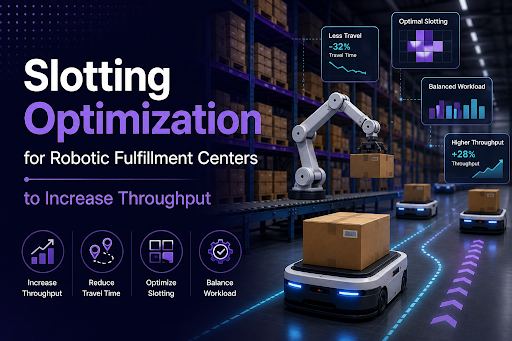
In this environment, throughput is governed by cycle efficiency or how quickly robots can complete a full task cycle, including retrieval, movement, and delivery. Slotting optimization for robotic fulfillment centers to increase throughput becomes the mechanism that aligns inventory placement with robotic behavior.
This blog explores how slotting optimization reduces unnecessary travel, improves task density, and ensures that robotic systems operate at their intended capacity.
Why Throughput Declines in Robotic Fulfillment Systems
Robotic systems fail to deliver expected throughput not due to hardware limitations, but due to misalignment between inventory placement, demand patterns, and task execution. As variability increases, these misalignments amplify cycle inefficiencies, reducing effective output despite available capacity.
Inefficient SKU Placement Increasing Robot Travel Cycles
In robotic warehouses, work is executed through movement cycles. A cycle includes retrieving inventory from storage, transporting it across the warehouse and delivering it to a workstation or the next process
Throughput depends on how many of these cycles can be completed per hour. When high-demand SKUs are placed far from access points or across fragmented locations, robots are forced into longer movement paths. This increases cycle time.
Unlike human workers, robots do not dynamically adapt routes beyond predefined logic. This means poor placement does not remain localized. This is why slotting optimization for robotic fulfillment centers directly impacts performance.
Suggested Read: Micro Slotting Optimization for Ecommerce to Reduce Picking Time
Imbalance Between Demand Patterns And Robotic Task Distribution
Robotic systems rely on task orchestration, which is the allocation of tasks across a fleet of robots. Ideally, tasks are distributed evenly so that all robots operate at similar utilization levels.
Studies reveal that multi-robot systems experience significant performance degradation due to traffic congestion, deadlocks, and coordination delays as robot density increases.
However, e-commerce demand is uneven. Certain SKUs or zones generate a disproportionate share of tasks.
This creates:
- Congestion in high-demand zones, where robots compete for access
- Idle time in low-demand zones, where robots wait for tasks
The result is reduced overall throughput, even if total robotic capacity remains unchanged. Robotic warehouse slotting optimization for throughput improvement addresses this by redistributing demand through better SKU placement, balancing workload across the system.
Underutilization of AS/RS, AMRs, and Goods-to-Person systems
Robotic fulfillment centers typically combine multiple automation systems:
- AS/RS (Automated Storage and Retrieval Systems): High-density systems that store and retrieve inventory
- AMRs (Autonomous Mobile Robots): Robots that transport goods between locations
- Goods-to-Person (GTP): Systems that deliver inventory directly to pick stations
In AS/RS environments, storage assignment has a direct impact on retrieval time and system throughput, reinforcing that placement defines performance. Throughput depends on how these systems operate as a coordinated flow. Underutilization occurs when:
- AS/RS faces retrieval bottlenecks for high-demand SKUs
- AMRs’ queue due to uneven task distribution
- GTP stations remain idle waiting for inventory
These are symptoms of misalignment between inventory placement and system demand, making slotting optimization for robot-based order fulfillment essential for maintaining flow.
Slotting as a Throughput Control Layer in Robotic Warehouses
In robotic environments, slotting directly influences how work moves through the system. It acts as a control layer that shapes robot travel, task sequencing, and workload distribution, making it a primary lever for improving cycle efficiency and overall throughput.
Aligning SKU Positioning With Robotic Picking And Retrieval Logic
Robotic systems operate based on retrieval logic:
- How inventory is accessed
- How tasks are sequenced
- How robots navigate the warehouse
If SKU placement does not align with this logic, robots follow inefficient movement patterns, increasing travel time and waiting time. Effective slotting ensures that inventory is positioned in a way that supports how robots actually execute tasks, improving cycle efficiency.
By combining real-time digital twin modeling with AI-driven slotting, Synkrato enables warehouses to achieve continuous alignment between inventory placement and robotic execution.
Suggested Read: Micro Slotting Optimization for 3pl Warehouses to Reduce Labor Costs
Reducing Travel Distance Through Demand-Driven Slot Allocation
In robotic systems, travel time is the largest component of cycle time.
Cycle time typically includes travel time (movement between locations), handling time (pickup and drop-off), and waiting time (queues and access delays).
Among these, travel time is the most influenced by slotting decisions. Demand-driven slotting continuously adjusts SKU placement based on SKU velocity (how frequently an item is picked), order patterns (which SKUs are picked together), and zone-level workload.
| Slotting Approach | Behavior | Throughput Impact |
| Static slotting | Fixed placement based on historical data | Travel distance increases over time |
| Demand-driven slotting | Dynamic placement based on real demand | Reduced cycle time and higher throughput |
Slotting Intelligence for Robotic System Performance
Throughput improvement in robotic systems depends on how intelligently slotting adapts to demand and execution patterns. This requires moving beyond static placement to a data-driven approach that continuously aligns SKU positioning with robot behavior and workload dynamics.
Suggested Read: Micro Slotting Optimization for High Sku Warehouses to Improve Pick Efficiency
SKU Velocity-Based Placement For Faster Robotic Access
In robotic systems, placing high-velocity SKUs closer to access points reduces repeated travel cycles. Since these items are picked frequently, even small reductions in travel distance compound into significant throughput gains.
Order Clustering To Optimize Robotic Task Density
A key concept in robotic efficiency is task density. Low task density results in long travel distances for a few tasks and fragmented execution across the warehouse.
High task density allows multiple tasks to be completed within shorter movement paths and better utilization of each robotic cycle.
Order clustering improves task density by aligning SKU placement with common order combinations. When frequently co-ordered items are stored closer together, robots can complete more work per cycle. This is a critical lever in robotic warehouse slotting optimization for throughput improvement.
Zone Balancing To Distribute Robotic Workload Efficiently
Robotic warehouses are divided into zones, each with a defined capacity and workload.
- Capacity: Number of robots or tasks a zone can handle
- Workload: Number of tasks generated in that zone
Imbalance occurs when the workload exceeds capacity in certain zones while others remain underutilized.
Slotting optimization redistributes SKUs to align workload with zone capacity, improving overall system efficiency and supporting slotting optimization to reduce robot idle time in warehouses.
Integration with Robotic Execution Systems
Slotting decisions cannot operate in isolation. Their impact is realized only when synchronized with execution systems that control task allocation and robot behavior, ensuring that placement strategies translate into real operational improvements.
Synchronization With WES/WCS For Real-Time Task Orchestration
Robotic warehouses operate on layered systems:
- WES (Warehouse Execution System): Determines what tasks should be executed and in what sequence
- WCS (Warehouse Control System): Executes those tasks by controlling robots and equipment
Slotting decisions must align with both layers. If slotting changes are not reflected in WES/WCS, tasks may still be assigned inefficiently, and robots may not benefit from improved placement.
Effective slotting optimization for robotic fulfillment centers requires synchronization between inventory placement and execution logic.
Suggested Read: Dynamic Slotting Optimization for High Volume Warehouses to Reduce Picking Time
Dynamic Slot Adjustments Based On Robot Queues And Workload Signals
Robotic systems continuously generate operational signals such as robot queue lengths, iIdle time and zone-level workload.
Dynamic slotting uses these signals to adjust inventory placement in near real time.
| Signal | What It Indicates | Slotting Response |
| High queue length | Congestion | Redistribute high-demand SKUs |
| High idle time | Underutilization | Increase task density in zones |
| Uneven workload | Imbalance | Rebalance SKU placement |
This creates a system where slotting evolves with operational conditions.
AI and Simulation for Continuous Throughput Optimization
As system complexity increases, static optimization approaches fail to keep pace with changing demand and workload patterns. AI and simulation enable continuous evaluation and adjustment of slotting decisions, ensuring that throughput improvements are sustained over time.
Simulation Models To Validate Slotting Strategies Before Execution
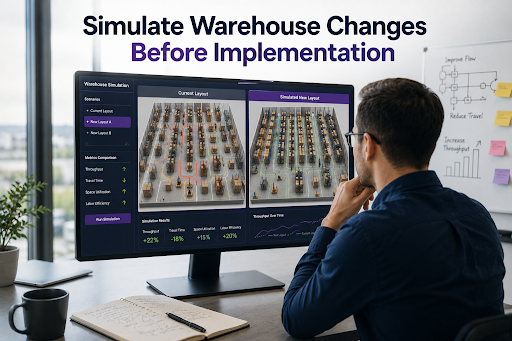
In robotic environments, even small changes can disrupt system flow. Simulation provides a controlled environment.
- Creates a controlled virtual environment where slotting changes can be tested without affecting live robotic operations.
- Allows different slotting strategies to be executed in a modeled workflow to see how robots, paths, and tasks respond under each configuration.
- The system then measures cycle time and throughput impact to understand how changes influence overall operational speed and output efficiency.
- Highlights bottlenecks in robot movement, task sequencing, or zone congestion that may not be visible in static planning or real-time execution.
AI-Driven Optimization For Real-Time Slotting Adjustments
AI enables continuous slotting optimization by analyzing SKU velocity changes, order patterns, and robot performance data.
Instead of periodic updates, slotting becomes a real-time adaptive system, essential for slotting optimization for robot-based order fulfillment. Synkrato operationalizes this by integrating simulation and AI agents with live warehouse data, allowing teams to validate slotting decisions and adapt dynamically as robotic conditions evolve.
Suggested Read: Dynamic Slotting Optimization for Ecommerce Warehouses to Improve Fulfillment Speed
When Slotting Optimization Becomes Critical
Slotting becomes a critical lever when operational complexity outpaces the system’s ability to maintain efficiency. This typically occurs during scale or when performance improvements stall despite increased automation capacity.
Scaling Robotic Operations With Increasing SKU And Order Volume
In robotic fulfillment, scale does not increase linearly—it compounds system complexity. As SKU count grows, three structural changes occur:
- Movement complexity increases: Robots must navigate a larger number of storage locations, increasing average path variability. This reduces routing efficiency because optimal paths become less repeatable.
- Task fragmentation rises: Orders are spread across more SKUs and locations. Instead of completing multiple picks within a tight movement radius, robots execute dispersed tasks across the warehouse.
- Retrieval predictability declines: With more SKUs and shifting demand patterns, it becomes harder to anticipate which zones will generate workload, leading to uneven robot distribution.
Throughput Plateau Despite Automation Investments
A throughput plateau typically indicates that the system has reached a coordination limit, not a capacity limit. In robotic environments, throughput depends on how well three elements are aligned: Inventory placement, task orchestration, and robot movement.
When these are misaligned, increasing automation produces diminishing returns. This usually shows up in the following pattern:
| Observed Symptom | Common Assumption | Actual Constraint |
| Robots frequently queue at pick locations | Insufficient robot capacity | High-demand SKUs concentrated in limited zones |
| Robots show high utilization but low output | Need for faster robots | Long travel cycles due to poor slotting |
| Idle robots in parts of the warehouse | Overcapacity | Uneven workload distribution across zones |
Robotic warehouse slotting optimization for throughput improvement resolves this by redistributing demand through SKU placement, enabling robots to operate in shorter, more efficient cycles.
Implementation Approach for Robotic Fulfillment Optimization
Effective slotting optimization requires a structured approach that aligns data, system behavior, and execution workflows. Without this alignment, even well-designed strategies fail to deliver consistent throughput improvements.
Identifying High-Impact SKUs and Robotic Zones
Not all SKUs contribute equally to throughput. For example, in most e-commerce operations:
- A small percentage of SKUs drives the majority of picks (high-velocity SKUs)
- Certain zones handle disproportionate workload due to SKU concentration
The goal is to identify:
- SKUs with the highest retrieval frequency
- Zones with the highest robot traffic and queue formation
By focusing on these high-impact areas, slotting optimization delivers measurable improvements quickly, rather than diffused gains across the system.
Aligning Slotting Logic With Robotic Workflows
Slotting decisions are only effective if they align with how robots actually execute tasks. This requires understanding three operational layers: Retrieval logic, movement logic, and task sequencing.
Suggested Read: Dynamic Slotting Optimization for 3pl Operations to Reduce Labor Costs
Phased Rollout With Continuous Performance Monitoring
In robotic environments, changes propagate quickly. A poorly executed slotting update can disrupt flow across the entire system. A phased approach minimizes this risk.
Phase 1: Baseline Measurement
Establish current performance across key metrics:
- Cycle time (time per robotic task)
- Throughput (tasks completed per hour)
- Robot utilization (active vs idle time)
- Travel distance per cycle
Phase 2: Targeted Slotting Adjustments
Focus on:
- High-velocity SKUs
- Congested zones
- Low task density areas
Changes are applied incrementally to isolate impact.
Phase 3: Performance Validation
Measure how changes affect:
- Travel reduction
- Queue length
- Task completion rates
Phase 4: Iterative Optimization
Slotting is not a one-time exercise. It must evolve with:
- Demand shifts
- SKU changes
- Operational conditions
Turning Robotic Capacity into Real Throughput with Synkrato
Robotic fulfillment centers are built for scale, but their performance is ultimately constrained by how efficiently work is structured across the system. Adding more robots increases capacity. It does not guarantee higher throughput.
Synkrato addresses this gap by introducing a decision-intelligence layer on top of existing robotic infrastructure, connecting WMS, WES, and WCS into a unified operational model that continuously optimizes how robots move, retrieve, and execute tasks.
- 3d digital twin of robotic operations
- Cycle-level simulation & scenario testing
- AI-driven slotting optimization
- Robot-aware task density optimization
- Real-time integration with wes/wcs
- Queue and congestion intelligence
- Adaptive slotting based on live workload signals
Are your robots operating at full capacity or constrained by how work is structured? Book a Demo with Synkrato to identify and eliminate these bottlenecks using real-time optimization and simulation.
Suggested Read: Real Time Slotting Optimization for High Sku Environments to Improve Efficiency
FAQs
Why does warehouse throughput drop even after automation is implemented?
Automation improves speed of execution, but throughput can still suffer if system-level planning is weak. Common issues include inefficient slotting, poor SKU distribution, congestion in robot pathways, and unbalanced order loads. Even advanced robotics can’t compensate for suboptimal warehouse layout and decision logic.
How does slotting optimization improve robotic fulfillment performance?
Slotting optimization reduces unnecessary robot movement by placing high-demand SKUs in faster, more accessible locations. This improves pick rates, minimizes congestion, and increases overall system efficiency for AMRs and AS/RS by ensuring robots spend more time executing tasks rather than traveling.
What impact does SKU placement have on AMR and AS/RS efficiency?
SKU placement directly determines how efficiently robots can complete pick and putaway tasks. When frequently ordered items are placed closer to pick stations, robots travel shorter distances and complete more cycles per hour. Poor placement leads to longer routes, higher energy use, and reduced throughput.
How does slotting optimization reduce robot travel time and idle time?
By aligning SKU placement with demand patterns, slotting optimization minimizes long-distance travel and reduces congestion in high-traffic zones. This allows robots to complete tasks faster and reduces idle time caused by waiting, rerouting, or bottlenecks.
What data is needed for effective slotting optimization in robotic warehouses?
Key inputs include order history, SKU velocity, demand variability, storage constraints, pick frequency, and real-time order flow. Synkrato uses this data to simulate warehouse behavior and recommend optimal slotting configurations using AI and digital twin modeling.
Can slotting optimization improve ROI on warehouse robotics investments?
Yes. Better slotting increases throughput without requiring additional robots or infrastructure. By improving robot utilization and reducing wasted travel time, warehouses can process more orders with the same resources. Synkrato enhances ROI by continuously optimizing slotting strategies through simulation and AI-driven decision modeling.
How does AI improve slotting decisions in robotic warehouse environments?
AI analyzes real-time and historical data to dynamically adjust slotting strategies based on demand shifts, order patterns, and SKU correlations. Instead of static layouts, AI enables adaptive slotting that evolves with operational conditions. Synkrato applies AI and digital twin simulation to continuously refine warehouse layouts for maximum efficiency.
What KPIs should be tracked to measure improvements in throughput?
Important KPIs include orders processed per hour, robot travel distance per order, order cycle time, pick accuracy, dock-to-stock time, and robot utilization rate. Tracking these metrics helps identify how slotting and layout changes impact overall warehouse performance, especially when using optimization systems like Synkrato.