Warehouse efficiency does not break under volume. It breaks under SKU complexity. As SKU count increases, inventory becomes harder to position correctly, not because space is limited, but because demand becomes less predictable at a location level. This shifts the operational problem from storage to movement efficiency.
In this context, static and periodically updated slotting strategies fail to maintain alignment between inventory placement and actual demand. What appears optimal in planning quickly becomes inefficient in execution.
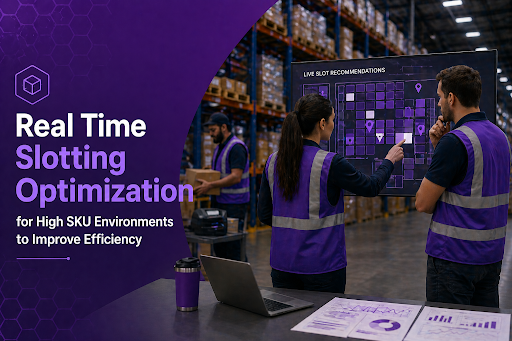
This blog explores how real-time slotting optimization for high SKU environments to improve efficiency addresses this by turning slotting into a continuous decision system.
Why High SKU Warehouses Struggle to Maintain Efficiency at Scale
High SKU environments introduce a form of operational complexity where small inefficiencies multiply across thousands of decisions. The system becomes harder to predict, harder to stabilize, and increasingly sensitive to misalignment between inventory and demand.
Suggested Read: Micro Slotting Optimization for Ecommerce to Reduce Picking Time
SKU Proliferation Leading to Fragmented Storage and Reduced Accessibility
As the SKU count increases, inventory is distributed across more locations. It is fragmentation, where related items are no longer spatially aligned.
In practical terms:
- Frequently picked SKUs may be stored away from high-access zones
- Related SKUs may be separated across distant locations
This reduces accessibility, which is the ease with which inventory can be retrieved within minimal movement. The result is a consistent increase in search time and travel distance per pick, even when inventory is available.
Demand Variability Disrupting Traditional Slotting Stability
In high SKU environments, SKU velocity behaves less like a stable trend and more like a fluctuating signal.
| Traditional Slotting Assumption | High SKU Environment Reality |
| Demand changes gradually | Demand shifts are frequent, sudden, and uneven |
| SKU velocity remains relatively stable over planning cycles | SKU velocity fluctuates continuously based on orders, promotions, and seasonality |
| Placement decisions remain valid for long planning windows | SKU importance changes faster than slotting updates can respond |
| Slotting is updated periodically based on historical trends | Slotting requires continuous adjustment driven by live demand signals |
This creates a lag where placement reflects past demand, not current demand. Over time, this misalignment becomes a primary source of inefficiency. Slotting optimization for high SKU variability warehouses addresses the gap.
Increasing Pick Complexity Due to Multi-Line, Multi-SKU Order Profiles
Pick complexity increases when orders require more unique SKUs from more locations. A typical high SKU order introduces multiple pick points across the warehouse, reduced overlap between orders, and less predictable movement paths.
This leads to path fragmentation, where each order follows a different route, reducing the ability to optimize movement across tasks. At this stage, efficiency cannot be solved through routing alone. It requires restructuring where inventory is placed, which is where real-time slotting for high SKU environments becomes critical.
Suggested Read: Micro Slotting Optimization for 3pl Warehouses to Reduce Labor Costs
Hidden Inefficiencies Caused by Static and Periodic Slotting
Most warehouses rely on slotting updates performed at fixed intervals. The issue is that these approaches assume a relatively stable system, while high SKU environments are continuously changing.
Inability to Respond to Real-Time Changes in SKU Velocity
SKU velocity is dynamic. A product that is slow-moving today may become high-demand tomorrow due to promotions, seasonality, or external demand signals.
Inability to respond to real-time changes in SKU velocity leads to persistent misalignment between demand and placement. Since static or periodic slotting relies on historical averages, it updates SKU positions with a delay, often after demand patterns have already shifted.
As a result, high-velocity SKUs remain in suboptimal locations while low-velocity items continue occupying prime picking zones. Over time, this increases movement per pick and raises overall handling effort per unit.
Mismatch Between Inventory Positioning and Actual Order Demand
Slotting often optimizes individual SKUs, but picking efficiency depends on how SKUs are combined within orders. This creates a structural mismatch:
- SKUs may be optimally placed individually
- But inefficiently placed relative to each other
For example, two SKUs frequently ordered together may be stored far apart, increasing travel distance for every order containing both. This is a core limitation that real-time warehouse slotting for SKU velocity optimization addresses by incorporating order-level relationships into placement decisions. This enhances inventory management at scale.
Suggested Read: Micro Slotting Optimization for High Sku Warehouses to Improve Pick Efficiency
Real-Time Slotting as a Continuous Decision System
Studies consistently show that system-wide optimization delivers better outcomes than improving isolated components, which is why slotting must align with overall execution flow rather than individual SKU efficiency. Instead of treating placement as a periodic planning activity, real-time slotting treats it as a continuous optimization problem.
Slotting Driven by Live Inventory, Order Flow, and SKU Behavior Signals
Real-time slotting operates on three continuously updated inputs:
- Inventory state: Where each SKU is located and in what quantity
- Order flow: What is being picked now, and what is expected next
- Execution signals: How work is moving through the warehouse (density, congestion, delays)
These inputs are used to answer a single question: Where should each SKU be placed right now to minimize total system effort over the next cycle?
Synkrato enables this by combining real-time data pipelines with AI and simulation, ensuring slotting decisions remain aligned with actual warehouse conditions.
Dynamic Reallocation of SKUs Across Forward and Reserve Locations
Warehouses typically separate storage into:
- Forward locations: High-access areas for frequent picking
- Reserve locations: Bulk storage for replenishment
The challenge is that forward space is limited and must be continuously reassigned. Real-time slotting treats forward space as a dynamic resource, not a fixed allocation.
| Slotting Approach | Placement Logic | Limitation |
| Static | Fixed SKU positions | Degrades as demand shifts |
| Periodic | Scheduled updates | Lags behind real demand |
| Real-time | Continuous reallocation | Maintains alignment |
This ensures that high-demand SKUs are consistently positioned for efficient access.
Suggested Read: Dynamic Slotting Optimization for High Volume Warehouses to Reduce Picking Time
Decision Logic Behind Real-Time Slotting Optimization
Research shows that storage assignment decisions directly influence retrieval time and throughput, reinforcing that placement strategy is a primary determinant of system performance. Real-time slotting is governed by multiple competing factors. Optimizing one in isolation often creates inefficiencies elsewhere, so decisions must balance system-wide impact.
Continuous Evaluation Of SKU Velocity And Demand Fluctuations
Velocity is treated as a time-sensitive signal, not a static classification. Recent demand is weighted more heavily, allowing the system to respond to short-term changes without overreacting to noise.
Order Clustering and SKU Affinity Influencing Slot Positioning
SKU affinity refers to how often items are ordered together. When high-affinity SKUs are co-located, Travel distance per order decreases, and pick density increases
This shifts optimization from SKU-level to order-level efficiency.
Balancing Pick Density, Travel Distance, and Zone Workload
Three variables define movement efficiency:
| Variable | Trade-off |
| Pick density | Higher density may increase congestion |
| Travel distance | Lower distance may overload zones |
| Zone workload | Balancing may increase travel |
Real-time slotting continuously balances these to optimize overall throughput.
Incorporating Congestion Patterns into Slotting Decisions
Congestion emerges when too much activity is concentrated in a zone.
- The system continuously tracks zone-level activity signals such as pick frequency, queue buildup, and movement density.
- These signals are used to detect early-stage congestion, where demand concentration exceeds a zone’s processing capacity.
- When congestion thresholds are crossed, the system identifies SKUs contributing most to zone load imbalance, especially high-frequency or flexible items.
- It then recalculates placement decisions to determine alternative, lower-load zones for those SKUs.
- Selected SKUs are redistributed across underutilized zones to balance workload across the warehouse.
- This reduces pressure on congested zones while improving utilization of idle capacity elsewhere.
- The outcome is a self-balancing flow system, where slotting actively prevents bottlenecks instead of reacting after delays occur.
Core Efficiency Levers in High SKU Environments
Real-time slotting to improve warehouse efficiency is driven by reducing unnecessary movement and increasing the proportion of productive work within each pick cycle.
Increasing Pick Density Within Optimized Zones
Pick density measures how much work is completed within a given movement range. Higher density means more picks are completed with less travel. Real-time slotting improves density by co-locating frequently co-ordered SKUs and prioritizing high-velocity SKUs in forward zones.
This allows multiple picks to be completed within localized areas, reducing movement overhead.
Reducing Cross-Zone Travel Through Intelligent SKU Placement
Cross-zone movement introduces transition delays and increases variability. By aligning SKU placement with order patterns, real-time slotting keeps pick paths localized and reduces unnecessary transitions. This improves both speed and consistency.
Synchronizing Replenishment with Real-Time Demand Signals
Replenishment ensures forward locations remain stocked with high-demand SKUs. Real-time slotting integrates replenishment by predicting depletion based on demand and triggering replenishment proactively
This prevents disruptions in picking workflows and maintains system flow.
Suggested Read: Dynamic Slotting Optimization for Ecommerce Warehouses to Improve Fulfillment Speed
Measurable Business Impact and ROI
The impact of real-time slotting optimization for high SKU environments is a reduction in total system effort required to fulfill demand.
In high SKU warehouses, most cost is not in picking itself, but in the movement, rework, and coordination overhead surrounding each pick. Real-time slotting reduces this overhead by continuously correcting misalignment between inventory placement and demand. The result is not just faster execution, but a system where each unit of movement produces more output.
Reduction in Picking Time and Overall Travel Distance
Research shows that in most warehouse environments, travel alone can account for up to half of total picking time, making distance reduction the single most effective lever for improving cycle efficiency. Picking time is governed by two structural variables:
- Average distance between consecutive picks
- Number of unique locations visited per order
High SKU environments inflate both. Orders pull from more dispersed locations, and pick paths lose continuity. Real-time slotting improves this by reshaping spatial relationships between SKUs. Instead of optimizing individual SKU placement, it minimizes expected path length across actual order combinations. This leads to two measurable changes:
- Pick paths become shorter and more repeatable
- Movement between distant zones is reduced
Over time, this reduces not only average picking time but also variance in picking time, which is critical for predictable throughput.
Increase in Pick Rate and Warehouse Throughput
Pick rate is often treated as a labor metric, but it is fundamentally a function of system design. A picker’s output per hour is constrained by how much of their time is spent on:
- Productive actions (picking, scanning)
- Non-productive actions (walking, searching, waiting)
Real-time slotting increases pick rate by shifting this ratio.
| Component of Pick Cycle | Before Real-Time Slotting | After Real-Time Slotting |
| Productive time | Lower | Higher |
| Travel time | High | Reduced |
| Path variability | High | Stabilized |
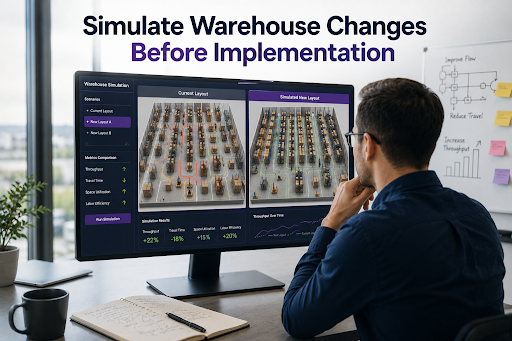
Synkrato applies a digital twin to model real-time warehouse states, allowing slotting decisions to be continuously tested and adjusted against live demand, inventory distribution, and movement constraints.
Suggested Read: Dynamic Slotting Optimization for 3pl Operations to Reduce Labor Costs
Implementation Approach for High SKU Warehouse Environments
Real-time slotting requires aligning data, systems, and operations into a continuous warehouse optimization loop.
Prioritizing High-Impact SKUs and Critical Picking Zones
Focus on areas where optimization delivers maximum impact, such as high-velocity SKUs, high-traffic zones, and frequently co-ordered products
Enabling Real-Time Data Integration Across Warehouse Systems
Real-time slotting decisions are only as accurate as the data they rely on. Three categories of data must be continuously synchronized:
- Inventory state: Location, quantity, and availability
- Demand signals: Active orders, incoming order patterns
- Execution signals: Pick rates, queue buildup, zone activity
Effective implementations ensure that slotting decisions reflect the current operating state, not an averaged or lagged version of it.
Phased Rollout with Continuous Performance Tracking and Refinement
Slotting directly affects physical workflows, so large-scale changes must be controlled. A phased approach reduces risk while allowing the system to learn from real behavior.
| Phase | Objective | Outcome |
| Baseline | Identify inefficiencies | Establish benchmarks |
| Pilot | Apply to select zones | Validate impact |
| Expansion | Scale across the warehouse | Increase efficiency |
| Continuous | Adapt to demand | Sustain performance |
Synkrato: Turning Slotting into a System-Level Efficiency Lever
Real-time slotting optimization for high SKU environments closes this gap by turning placement into a continuous, system-driven decision. Instead of reacting to inefficiencies after they appear, the system continuously minimizes them by aligning SKU position with demand signals, order behavior, and execution conditions.
Synkrato extends this approach by integrating real-time data, AI-driven decision logic, and simulation into a unified layer on top of existing warehouse systems. This enables:
- Continuous SKU reallocation based on live demand and velocity shifts
- Order-level optimization using SKU affinity and clustering signals
- Forward and reserve location balancing driven by actual usage patterns
- Congestion-aware placement to maintain flow across zones
- Simulation-backed validation of slotting decisions before execution
The result is a warehouse that operates with structural efficiency, where movement is intentional, placement is adaptive, and throughput scales without proportional increases in labor or complexity.
Are you optimizing slotting or letting inefficiencies accumulate between updates? Book a demo with Synkrato and eliminate that gap with continuous, demand-driven slotting optimization.
Suggested Read: Slotting Optimization for Robotic Fulfillment Centers to Increase Throughput
FAQs
How do I know if my warehouse efficiency is impacted by high SKU complexity?
The clearest signal is a divergence between volume and effort. If order volume remains stable but travel distance, pick time, or variability increases, it indicates that SKU complexity is introducing inefficiency into movement and placement. Platforms like Synkrato help surface this by mapping SKU behavior to actual movement patterns, making it easier to identify where complexity is driving excess labor effort.
What is the difference between static, dynamic, and real-time slotting?
The difference lies in how quickly placement responds to change. Static slotting assumes stability, dynamic slotting updates periodically, and real-time slotting continuously adjusts based on current demand, inventory state, and execution conditions. Synkrato enables real-time slotting by combining live data with simulation, allowing you to validate placement decisions before applying them on the floor.
How does real-time slotting improve picking efficiency and throughput?
It reduces the total movement required to fulfill orders by aligning SKU placement with actual demand and order patterns. This increases the proportion of productive work within each pick cycle. With Synkrato, this alignment is continuously refined using execution feedback, ensuring that efficiency gains are sustained as demand shifts.
What type of warehouse operations benefit the most from real-time slotting?
Operations with high SKU counts, frequent demand shifts, and multi-line orders benefit the most, as these conditions create the highest level of placement–demand misalignment.
What data is required to enable real-time slotting decisions?
Effective decisions require synchronized visibility into inventory location, SKU demand patterns, order composition, and execution signals such as zone activity and congestion. Platforms like Synkrato unify these inputs into a single decision layer, ensuring slotting recommendations are based on real-time operational context rather than isolated data points.
What data is required to enable real-time slotting decisions?
Effective decisions require synchronized visibility into inventory location, SKU demand patterns, order composition, and execution signals such as zone activity and congestion.
What KPIs should be tracked to measure efficiency improvements?
Metrics that reflect structural efficiency are most relevant, including: Pick density (work per movement), average travel distance per order, cycle time per pick, and throughput per labor hour
Can real-time slotting reduce picking time and labor costs significantly?
Yes, but the reduction comes from eliminating unnecessary movement and improving task structure, not from accelerating individual actions. The gains are systemic rather than incremental.
What are the challenges in implementing real-time slotting?
The primary challenges are ensuring real-time data accuracy, aligning slotting decisions with operational constraints, and integrating the system into existing workflows without disrupting execution.