Labor costs in 3PL warehouses rarely increase due to a single issue. They rise from multiple small inefficiencies repeated across every shift, aisle, and order.
In multi-client environments, where SKU mix, order patterns, and demand variability change continuously, even minor inefficiencies in SKU placement significantly increase picker travel time, reduce productivity and inflate cost per order.
Labor is the single largest cost component in warehouse operations, typically accounting for 50-70% of total warehousing spend.
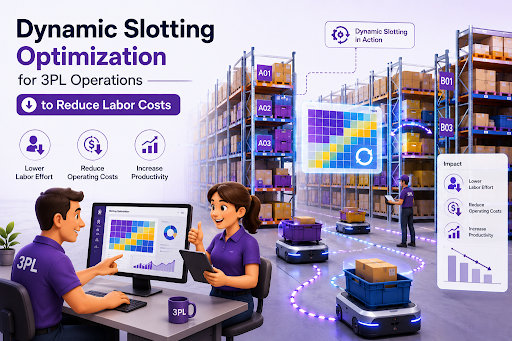
This blog explores how dynamic slotting optimization addresses this by continuously aligning SKU placement with real-time demand, reducing unnecessary movement and improving labor efficiency at scale.
Suggested Read: Micro Slotting Optimization for Ecommerce to Reduce Picking Time
Why 3PL Labor Optimization Problems Often Stem From Slotting Decisions
In most 3PL operations, labor cost is treated as a workforce problem- headcount, productivity, or shift planning. In reality, a significant portion of labor inefficiency originates upstream in slotting decisions.
How Poor Slotting Decisions Create Hidden Labor Waste
Labor waste in warehouses is rarely visible as idle time, it is embedded within execution.
Poor slotting creates inefficiencies such as:
- Extended pick paths due to suboptimal SKU placement
- Low pick density from dispersed high-frequency items
- Increased replenishment movement caused by poorly positioned forward locations
- Higher exception handling due to inconsistent workflows
These inefficiencies do not appear as isolated failures but as small increments of wasted effort across every order. At scale, they significantly increase cost per order without triggering obvious operational alarms.
Why Travel Time Is Often Misdiagnosed as a Staffing Problem
Travel time is the largest component of picking effort. However, it is frequently treated as a labor productivity issue rather than a layout problem.
Adding labor may temporarily improve throughput, but it does not reduce the distance required to complete each pick. As order volumes increase, the same structural inefficiencies persist, leading to diminishing returns on labor investment.
In most cases, excessive travel time is not a labor issue but a structural outcome of poor slotting. When SKU placement is misaligned with actual demand, frequently picked items are not positioned for quick access. The absence of product affinity clustering further fragments pick paths, while static layouts fail to adapt as order patterns evolve, collectively increasing movement and reducing picking efficiency.
Unless these root causes are addressed, labor costs continue to scale with volume.
Labor Imbalance Across Zones During Demand Spikes
Demand spikes are uneven, concentrating workload in specific zones. Without real-time balancing, some zones become overloaded while others remain underutilized, increasing overtime, delays, and overall labor cost.
Suggested Read: Micro Slotting Optimization for 3pl Warehouses to Reduce Labor Costs
Dynamic Slotting Levers That Directly Reduce Labor Costs
Research from McKinsey shows that operational improvements in warehousing can reduce costs by over 30%, highlighting the scale of opportunity when inefficiencies in movement, layout, and execution are addressed systematically.
Dynamic slotting operates through multiple coordinated levers, each targeting a specific source of inefficiency. Rather than relying on a single optimization action, it enables continuous repositioning of high-demand SKUs based on live order data, ensuring that frequently picked items remain easily accessible as demand shifts.
Real-Time SKU Reallocation Based on Client Demand Changes
Real-time SKU allocation data helps you reduce travel distance during peak periods, allowing pickers to move more efficiently through the warehouse. It also improves overall pick efficiency by aligning SKU placement with real-time order patterns.
This is a core driver of real-time slotting optimization in warehouse operations.
Adaptive Slotting for Multi-Client Inventory Mix
Adaptive slotting in multi-client environments works by aggregating SKU velocity and order patterns across all clients, rather than segmenting inventory by ownership. The system continuously evaluates combined demand signals, such as pick frequency, co-picking relationships, and zone-level activity to determine which SKUs deserve placement in high-access locations.
Instead of fixed, client-dedicated zones, space is dynamically allocated based on relative movement intensity, with high-velocity SKUs prioritized for forward or high-throughput areas. At the same time, SKU affinity data is used to cluster frequently co-picked items, while zone balancing logic redistributes placement to prevent localized congestion.
This mechanism ensures that high-access zones are utilized by the most operationally critical inventory at any given time, reduces unnecessary cross-zone movement, and increases pick density by aligning physical layout with actual order behavior.
This significantly improves 3PL warehouse slotting optimization efficiency.
Auto Clustering of High-Frequency Pick Combinations
Auto clustering of high-frequency pick combinations works through a set of coordinated mechanisms that go beyond simple proximity placement:
- Co-picking pattern analysis: The system analyzes historical and real-time order data to identify SKUs that are frequently picked together within the same order lines, forming affinity groups based on actual picking behavior rather than static categorization.
- Affinity scoring and grouping: Each SKU pair or cluster is assigned an affinity score based on how often they appear together. High-affinity groups are prioritized for co-location to maximize the probability that multiple picks can be completed within a single movement path.
- Spatial clustering optimization: Based on these affinity groups, SKUs are positioned within the same aisle, bay, or zone to minimize traversal between picks. The system balances clustering benefits with space constraints and SKU velocity to avoid over-concentration.
- Dynamic re-clustering based on demand shifts: As order patterns evolve, clustering is continuously recalibrated. New SKU combinations are identified and repositioned, ensuring that clustering remains aligned with current demand rather than outdated patterns.
- Pick path compression: By physically grouping co-picked SKUs, the system reduces path fragmentation, enabling more linear and predictable pick routes, especially in multi-line orders.
- Interruption and backtracking reduction: Clustering minimizes the need for pickers to revisit zones or switch aisles mid-order, reducing interruptions and improving picking rhythm.
It is a critical lever to reduce warehouse labor costs in 3PL environments.
Dynamic Forward Pick Area Optimization
Forward pick zones are continuously optimized based on SKU velocity and real-time demand, ensuring:
| Optimization Focus | Operational Impact |
| High-frequency SKU accessibility | Frequently picked items remain within high-access zones, reducing retrieval time per pick |
| Picking cycle speed | Shorter travel paths and better SKU positioning enable faster, more consistent picking cycles |
| Dependence on reserve storage | Improved forward placement reduces replenishment frequency and reliance on reserve locations |
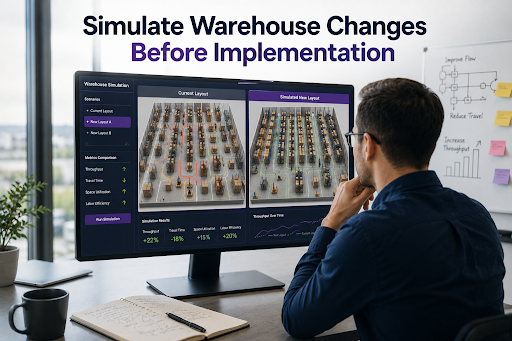
Platforms like Synkrato add a decision-intelligence layer above the WMS using a 3D digital twin of the warehouse. This allows teams to simulate slotting changes, test scenarios, and validate labor impact before execution.
Suggested Read: Micro Slotting Optimization for High Sku Warehouses to Improve Pick Efficiency
Minimizing Labor Effort Through Continuous Slotting Adjustments
Continuous slotting adjustments ensure that warehouse layouts evolve in line with changing demand patterns. Instead of reacting after inefficiencies occur, dynamic slotting proactively minimizes effort by maintaining optimal SKU positioning and reducing unnecessary movement by improving execution efficiency across all operational cycles.
Reducing Picker Travel Distance in Real Time
Travel distance is the most controllable cost lever in picking operations. Studies show that optimized slotting and layout strategies can reduce walking distance by up to 50%, directly lowering labor cost per order. You are not optimizing for distance once, you are preventing it from increasing over time.
Continuous slotting ensures that:
- High-velocity SKUs remain in proximity to packing and dispatch zones
- Product affinity is preserved as order combinations evolve
- Pick paths remain compact even as demand patterns shift
Without this, pick paths expand silently, and productivity loss compounds across thousands of order lines daily.
Preventing Zone Overload and Idle Labor
Labor imbalance is not just a scheduling issue but a slotting problem. In multi-client or multi-SKU environments, demand concentrates unevenly. If slotting does not adapt, you create structural bottlenecks where certain zones absorb disproportionate pick volume while others remain underutilized.
Continuous slotting redistributes demand at the source by repositioning SKUs based on real-time pick frequency and congestion signals. This reduces:
- Localized queue build-ups: By redistributing these SKUs across multiple accessible locations, continuous slotting spreads the workload, reducing bottlenecks and keeping flow consistent.
- Idle labor in low-activity zones: Repositioning SKUs based on real-time demand ensures that work is more evenly distributed, allowing labor capacity across zones to be utilized more effectively instead of remaining underused.
- Dependence on reactive labor reallocation: Continuous slotting minimizes this need by structurally balancing workload at the source, so labor is already aligned with where demand occurs.
The result is a more stable throughput profile without increasing headcount.
Aligning Slotting with Wave and Batch Execution
Picking strategies fail when slotting and execution logic operate independently. Batch and wave picking rely on high pick density and predictable sequencing. If SKU placement does not reflect how orders are grouped, you increase touches per order and reduce picks per hour.
Continuous slotting ensures that frequently co-picked SKUs are physically clustered and batch paths remain linear and interruption-free. Also, wave releases align with the spatial layout, not just the order priority.
Synkrato’s AI Agents enable this alignment by continuously analyzing order patterns and SKU relationships to optimize placement decisions before execution.
Given that picking accounts for a significant portion of total warehouse labor cost, even marginal improvements in pick efficiency translate into significant cost reduction.
Reducing Friction Across Interdependent Workflows
Most labor inefficiencies originate at workflow boundaries, not within individual tasks. When slotting ignores downstream processes, it creates replenishment delays due to inaccessible forward locations, staging congestion from uneven order completion rates, and increased coordination overhead between teams.
Continuous slotting aligns placement decisions with end-to-end flow, ensuring that picking, replenishment, and staging operate as a synchronized system. For you, this means fewer exceptions, fewer manual interventions, and more predictable cycle times.
Data Signals Required for Dynamic Slotting in 3PL
Effective dynamic slotting depends on accurate and continuous data inputs that reflect real-time warehouse conditions. Without reliable signals across demand, movement and execution, slotting decisions become reactive. A strong data foundation ensures that optimization efforts remain precise, scalable and aligned with actual operational requirements.
Client-Wise SKU Velocity and Order Variability
Accurate SKU velocity tracking across clients ensures slotting reflects real demand, not static averages. In 3PL environments, velocity varies by client, order behavior, and time, so placement decisions must account for these differences to remain effective.
Picks per SKU indicate handling intensity and determine which items require high-access locations. Order frequency by client adds context, ensuring SKUs tied to high-volume or priority clients are positioned appropriately, even if overall velocity appears low. Seasonal demand patterns capture shifts driven by promotions or peak cycles, preventing layouts from becoming outdated.
Together, these inputs enable SKU velocity-based slotting that continuously aligns placement with actual demand across clients.
Suggested Read: Dynamic Slotting Optimization for High Volume Warehouses to Reduce Picking Time
Real-Time Order Inflow and Demand Spikes
In high-volume 3PL environments, the demand volatility is constant rather than occasional. The ability to respond dynamically to these fluctuations ensures that warehouses maintain consistent service levels while avoiding inefficiencies caused by delayed or misaligned slotting decisions. Dynamic slotting relies on live order data and demand signals.
| Capability | How It Works in Practice | Operational Impact |
| Immediate response to demand changes | Live order inflow continuously updates SKU demand signals, triggering slotting adjustments as soon as pick frequency or order mix shifts | Prevents lag between demand change and warehouse response, maintaining consistent service levels |
| Faster SKU repositioning | High-velocity SKUs are automatically moved (or reassigned virtually) to forward or high-access locations based on real-time pick activity | Reduces travel distance and keeps frequently picked items within optimal reach |
| Reduced delays during peak periods | During demand spikes, slotting redistributes high-demand SKUs across zones and locations to avoid concentration in a single area | Minimizes congestion, stabilizes throughput, and prevents bottlenecks during peak operations |
Zone Utilization and Congestion Data
Zone utilization and congestion data act as real-time control signals for slotting decisions. Instead of reacting to bottlenecks after they occur, slotting systems use inputs such as picks per hour by zone, traffic density, and queue times to identify where workload is concentrating.
This allows inventory to be repositioned proactively, preventing congestion, balancing activity across zones, and maintaining consistent throughput in 3PL warehouse slotting optimization.
Labor Productivity Metrics
Slotting effectiveness must be measured using labor KPIs. These include:
- Picks per hour: Measures how many items a worker picks in an hour, indicating picking speed and efficiency.
- Cost per order: Calculates the total labor cost required to process a single order from pick to ship.
- Travel time per pick: Tracks the average time spent moving between picks, highlighting layout and slotting efficiency.
These metrics ensure continuous improvement and cost control.
Suggested Read: Dynamic Slotting Optimization for Ecommerce Warehouses to Improve Fulfillment Speed
Executing Dynamic Slotting Without Operational Disruption
While dynamic slotting improves efficiency, its execution must be carefully controlled to avoid operational instability. In 3PL environments with continuous workflows, every slotting decision must balance responsiveness with execution consistency, ensuring that improvements do not disrupt picking accuracy, workforce coordination or service levels.
Trigger-Based Slotting Updates Instead of Fixed Cycles
Trigger-based execution ensures that slotting decisions are driven by actual operational changes rather than predefined schedules. This reduces lag between demand shifts and warehouse response, enabling faster adaptation and more efficient use of labor resources.
Dynamic slotting replaces scheduled updates with trigger-based actions such as demand spikes or congestion thresholds.
This enables faster and more accurate slotting decisions.
Limiting Unnecessary SKU Movements to Control Labor
Every re-slotting action is a labor task, such as moving inventory, updating locations, and potentially disrupting active picks. When changes are too frequent or low-impact, they add operational noise instead of improving efficiency.
Effective systems apply impact-based decisioning, triggering re-slotting only when it meaningfully reduces travel distance, improves pick density, or relieves congestion. Movements are governed by thresholds and executed in controlled batches, often aligned with replenishment cycles or low-activity windows.
This ensures slotting improves continuously without increasing labor overhead or disrupting workflow stability.
Synchronizing Slotting Decisions with WMS and Workforce Planning
Once slotting is connected to execution systems, the focus shifts from alignment to control and adaptability. This is where most warehouses either gain flexibility or get stuck with rigid layouts that can’t respond to change.
Synchronizing slotting decisions with WMS means:
- Exception handling and overrides: Slotting plans shouldn’t break when reality deviates. The system must allow supervisors to override locations or picking logic without disrupting overall flow.
- Wave and batch compatibility: Slotting needs to support how orders are released (waves, batches, or continuous flow), ensuring that item placement complements picking strategies rather than conflicting with them.
- Replenishment synchronization: Fast-moving SKUs placed in prime locations must be backed by timely replenishment triggers, or you create empty pick faces and forced workarounds.
- Zone balancing over time: As demand shifts, slotting should continuously rebalance workload across zones to prevent new bottlenecks from forming.
- Feedback loops from execution data: Actual picking performance, congestion points, and delays should feed back into slotting logic, making it a continuously improving system.
Synkrato’s AI slotting recommendations enable seamless integration between slotting intelligence and execution systems.
Suggested Read: Real Time Slotting Optimization for High Sku Environments to Improve Efficiency
Measuring Labor Cost Reduction and Productivity Gains
In 3PL operations, performance tracking directly ties to client SLAs, billing models, and profitability. The focus moves beyond standard KPIs to how consistently and predictably the system performs across multiple clients and demand patterns.
What needs to be tracked instead:
- SLA adherence by client or order type: Measures whether optimized slotting actually improves on-time dispatch across different service commitments.
- Labor cost variability across accounts: Identifies whether certain clients, SKUs, or order profiles are disproportionately consuming labor despite optimized placement.
- Re-slotting frequency and stability: Tracks how often slotting changes are required, helping balance between optimization gains and operational disruption.
- Pick density (lines picked per travel zone): Evaluates how effectively slotting increases picks within a confined area, reducing unnecessary movement without explicitly measuring distance again.
- Impact on peak vs non-peak performance: Ensures slotting strategies hold up during demand spikes, not just under average conditions.
Common Mistakes That Increase Labor Costs in 3PL Slotting
Most slotting strategies fail not because the logic is wrong, but because they don’t hold up under real operational pressure. In 3PL environments, where multiple clients, fluctuating demand, and shared resources collide and small missteps quickly compound into labor inefficiencies.
Studies indicate significant productivity gaps between actual warehouse performance and optimal benchmarks, largely driven by layout inefficiencies and excessive movement within picking operations.
Where things typically break down:
Over-optimization without operational feasibility
Slotting models often assume ideal conditions, but ignore real constraints like aisle congestion, shared pick paths, or equipment limitations, leading to layouts that look efficient on paper but slow down execution.
Disconnect between slotting and replenishment flow
Prime locations are assigned to fast movers, but replenishment capacity isn’t adjusted accordingly, resulting in empty pick faces, urgent refills, and additional labor movement.
Ignoring interdependence between workflows
Slotting decisions are made in isolation without considering their impact on picking, packing, staging, or dock operations, shifting bottlenecks instead of removing them.
Lack of prioritization across competing workloads
In multi-client environments, slotting doesn’t always account for which orders matter most at a given time, causing labor to be consumed on low-priority tasks while high-priority orders wait.
Static zoning in a dynamic demand environment
Fixed zones fail to adapt as SKU velocity shifts, leading to uneven workload distribution and localized congestion.
No feedback loop from floor-level execution
Slotting strategies are rarely updated based on actual picker behavior, delays, or congestion patterns, which means inefficiencies persist even when data exists to fix them.
Suggested Read: Slotting Optimization for Robotic Fulfillment Centers to Increase Throughput
Conclusion
Labor cost reduction in 3PL warehouses comes from eliminating execution inefficiencies, not reducing headcount. Static slotting creates a mismatch between inventory placement and real-time demand, leading to longer travel paths and unstable productivity.
Dynamic slotting addresses this by continuously aligning SKU placement with order behavior. Platforms like Synkrato enable this shift by combining real-time data, simulation, and AI-driven decision-making.
Are inefficiencies compounding before your system can respond? Book a demo with Synkrato to turn slotting into a predictive, continuously optimizing process, driving consistent efficiency even in high-variability environments.
FAQs
What is dynamic slotting in 3PL operations?
Dynamic slotting in 3PL operations is the continuous optimization of SKU placement based on real-time demand, order patterns, and warehouse conditions. Instead of relying on periodic updates, it ensures that inventory locations stay aligned with actual picking requirements. Platforms like Synkrato enable this by analyzing live data and simulating slotting decisions through a digital twin before execution.
How does dynamic slotting reduce labor costs?
Dynamic slotting reduces labor costs by minimizing picker travel distance, improving pick density, and balancing workload across zones. This leads to higher picks per hour and lower cost per order. With systems like Synkrato, these improvements are sustained through continuous recalibration of SKU placement based on real-time demand signals and execution feedback.
What is the difference between static and dynamic slotting?
Static slotting relies on historical data and fixed update cycles, making it slow to respond to demand changes. Dynamic slotting continuously adjusts placement based on real-time conditions, ensuring layouts remain aligned with current operations. Advanced platforms such as Synkrato enhance this by combining real-time data with simulation capabilities, allowing you to validate slotting changes before implementing them.
How often should slotting be updated in 3PL warehouses?
Slotting should not follow a fixed schedule. It should be updated based on triggers such as demand spikes, SKU velocity shifts, or congestion thresholds. In high-volume environments, this may happen daily or even intra-day. Synkrato supports trigger-based slotting by continuously monitoring operational signals and recommending updates only when they deliver measurable impact.
What data is required for dynamic slotting optimization?
Dynamic slotting requires real-time data such as SKU velocity, order inflow, pick frequency, zone congestion, and labor performance metrics. These inputs ensure that slotting decisions reflect actual warehouse conditions. Platforms like Synkrato unify these data streams and convert them into actionable slotting recommendations aligned with execution constraints.
Can dynamic slotting improve warehouse productivity?
Yes, dynamic slotting improves productivity by reducing travel time, increasing picks per hour, and optimizing pick paths. It allows warehouses to handle higher volumes without increasing labor. With Synkrato, productivity gains are further enhanced through continuous optimization and feedback loops that refine slotting decisions based on real execution data.
What tools are used for dynamic slotting in 3PL?
Dynamic slotting uses warehouse management systems (WMS), analytics platforms, and AI-driven optimization tools. While WMS platforms execute placement, advanced systems like Synkrato act as a decision layer, using digital twin modeling and AI to continuously optimize slotting, simulate outcomes, and guide execution.
Is dynamic slotting suitable for multi-client warehouses?
Yes, dynamic slotting is especially effective in multi-client 3PL environments where demand variability is high. It enables continuous optimization across different SKU profiles and order behaviors. Platforms like Synkrato support this by optimizing across combined demand signals, ensuring efficient space utilization and balanced workload distribution across clients.