
E-commerce fulfillment leaders face a consistent challenge: picking time continues to dominate operational costs and throughput constraints, often accounting for up to 60% of total warehouse expenses. As SKU counts rise and order variability increases, traditional slotting approaches fail to deliver consistent efficiency gains.
In this blog, we’ll explore micro slotting optimization for E-commerce to reduce picking time, speed up fulfillment, and improve overall warehouse efficiency. You’ll gain practical insights and proven techniques, along with how Synkrato enables teams to apply these strategies at scale without major disruption.
Why Picking Efficiency in E-commerce Is Often a Slotting Problem
Picking time often becomes the biggest operational bottleneck in e-commerce warehouses as order volumes grow and complexity increases. To understand why this happens, let’s break down the key factors driving inefficiencies:
How Poor SKU Placement Increases Travel Time
Poor SKU placement is one of the biggest drivers of excessive travel time in e-commerce warehouses. Even with the right inventory mix, inefficient positioning of SKUs forces pickers to cover more ground than necessary.
As catalogs expand and demand becomes uneven, fast-moving and slow-moving SKUs often get intermixed across locations. This leads to fragmented storage patterns where high-frequency items are not concentrated in easily accessible zones.
The result:
- Lower pick density per aisle
- Increased travel distance per order
- Reduced batching efficiency
Without continuous SKU-level optimization, warehouses end up optimizing for storage convenience rather than picking speed – creating a persistent drag on productivity.
Why Order Variability Breaks Traditional Pick Paths
E-commerce order patterns are highly dynamic, shaped by promotions, seasonality, and constantly changing customer preferences. With average ecommerce orders containing 2–4 items, even small inefficiencies in SKU placement can disrupt picking flow.
Traditional pick-path strategies assume stable demand and predictable item sequences. In reality, fluctuating order combinations force pickers into inefficient movement patterns:
- Zigzagging across aisles
- Frequent backtracking
- Low pick density per route
- Inefficient batch grouping
As variability increases, predefined paths quickly become suboptimal. What looks efficient on paper breaks down in execution, leading to longer pick times and inconsistent performance.
Suggested Read: Micro Slotting Optimization for 3pl Warehouses to Reduce Labor Costs
How Static Slotting Creates Hidden Picking Delays
Many warehouses rely on static slotting strategies, where SKU placement is updated infrequently based on historical data or fixed rules. While this approach is easier to manage, it fails to keep up with the dynamic nature of e-commerce demand.
As demand patterns shift, previously optimal placements become inefficient, but the system doesn’t adapt fast enough. This creates hidden delays that are difficult to detect but costly at scale.
At the execution level, these inefficiencies show up as:
- Fast-moving SKUs placed in low-accessibility locations
- Increased dwell time at the bin level
- Slower handling due to poor SKU orientation or bin depth
Because these delays occur at the micro level, they often go unnoticed in high-level metrics, but they compound across thousands of picks, significantly impacting overall throughput.
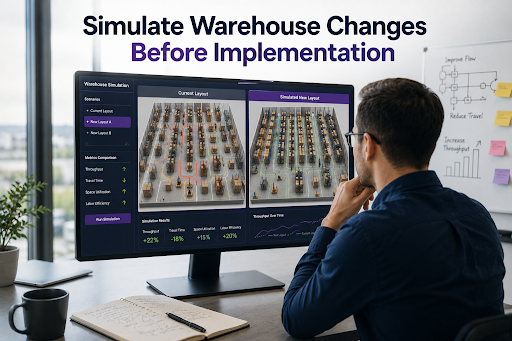
In complex warehouses, simulation-driven optimization lets teams test slotting scenarios, assess travel and congestion, and confidently choose the most efficient setup.
Why Traditional Slotting Fails Dynamic E-commerce Fulfillment
Traditional slotting strategies were designed for stable, predictable warehouse environments where demand patterns changed gradually. In contrast, e-commerce fulfillment operates under constant variability—frequent demand shifts, high SKU turnover, and dynamic order behavior.
As a result, approaches that rely on periodic updates and fixed rules struggle to keep up. What once worked as a structured method for organizing inventory now becomes a source of inefficiency in fast-moving operations. To understand why, it’s important to look at where traditional slotting falls short.
Traditional Slotting Was Not Built for Changing SKU Velocity
Traditional slotting relies on historical data snapshots to determine SKU placement, often updated at fixed intervals, such as weekly or monthly. This assumes that SKU velocity remains relatively stable over time.
In e-commerce, demand can shift rapidly due to:
- Promotions
- Flash sales
- Seasonal spikes
- Sudden changes in customer preferences
As slotting updates lag behind these changes, high-velocity SKUs are often left in suboptimal locations during peak demand periods. This mismatch leads to:
- Increased travel time for frequently picked items
- Congestion in poorly optimized zones
- Slower overall picking performance
Instead of aligning with current demand, traditional slotting is always reacting to past behavior.
Fixed Slotting Logic Increases Backtracking
Most traditional slotting systems use fixed logic, grouping SKUs by category, size, or storage requirements. While this creates organizational consistency, it often ignores how items are actually picked together.
In e-commerce operations, order composition is highly variable, and frequently, co-ordered SKUs may be stored far apart. This disconnect forces pickers into inefficient movement patterns.
Common outcomes include:
- Repeated aisle visits within the same pick run
- Backtracking to previously skipped locations
- Non-linear and fragmented pick paths
These inefficiencies compound over time, significantly increasing travel distance and reducing pick rates.
Suggested Read: Micro Slotting Optimization for High Sku Warehouses to Improve Pick Efficiency
Why Micro Slotting Solves Problems Legacy Slotting Misses
Traditional slotting methods struggle in dynamic e-commerce environments because they rely on static placement rules and infrequent updates. Micro-slotting solves this by introducing a granular, adaptive approach to SKU placement that continuously aligns with real picking behavior and demand changes.
What is Micro-Slotting?
Micro-slotting is a data-driven approach to inventory placement that optimizes SKU positioning at the bin and pick-face level. Instead of relying on broad zone-based decisions, it focuses on the exact locations where picking activity occurs.
It uses real-time and continuously updated data, such as:
- SKU velocity
- Order patterns
- Co-picking relationships between items
Based on these inputs, micro-slotting dynamically adjusts SKU placement to reduce travel time, improve pick density, and streamline picker movement.
Instead of relying on fixed rules, micro-slotting optimizes based on:
- Live SKU velocity and demand patterns
- Actual order correlations between items
- Bin-level accessibility and handling efficiency
This enables warehouses to position high-impact SKUs more effectively, reduce unnecessary movement, and maintain efficient pick paths even as conditions change.
Rather than being a one-time optimization exercise, micro slotting functions as a continuous improvement system, aligning warehouse layout with real-world picking behavior.
Core Micro Slotting Levers That Reduce Picking Time
Micro slotting improves warehouse efficiency by strategically positioning inventory to reduce unnecessary movement and speed up order picking. To see how this translates into operational gains, let’s explore the core levers that make it work:
Velocity-Based SKU Placement (Fast vs. Slow Movers)
Velocity-based slotting prioritizes placing high-demand SKUs in the most accessible locations while assigning slower-moving items to distant or less frequently accessed zones. It ensures pickers spend less time walking and more time fulfilling orders.
Advanced implementations:
- Use rolling demand windows (7–30 days)
- Segment SKUs into velocity tiers dynamically
- Reassign locations based on real-time throughput
High-velocity SKUs should be placed:
- Near dispatch zones
- Within minimal reach zones
- In high-density pick clusters
This directly supports efforts to reduce picking time in warehouse operations without increasing labor.
Co-Occurrence Slotting (Frequently Bought Together SKUs)
One of the most impactful strategies in micro slotting optimization for e-commerce to reduce picking time is co-occurrence slotting. The strategy organizes SKUs that are often purchased together in proximity. This reduces repeated aisle traversal and improves multi-item order efficiency.
Here’s how it works:
- Order line item relationships: SKUs that frequently appear together in the same order are placed close to each other to minimize back-and-forth movement during picking.
- Basket-level SKU combinations: Analysis of full cart patterns helps group complementary products in nearby locations for faster multi-item order fulfillment.
- Purchase frequency correlations: Historical buying data is used to identify recurring product pairings and optimize their physical proximity in storage.
While this approach is straightforward in theory, execution at scale is far more complex. Executing this at scale requires a decision intelligence layer that converts order patterns into optimal SKU placement. Synkrato adds an AI-driven decision layer that enables dynamic clustering of co-occurring SKUs.
Placing frequently co-ordered SKUs together helps:
- Reduce aisle traversal
- Fasten multi-item order picking
- Improve batch picking efficiency
- Shorten the overall order cycle time
Correlation-based slotting can reduce travel time by up to 30% in dense pick environments.
Golden Zone Optimization for Faster Picking
The golden zone refers to shelf areas between waist and shoulder height, where picking is fastest and least physically taxing. Optimizing ergonomic reach zones can improve picking productivity by 25% while significantly reducing worker fatigue.
Prioritizing high-velocity SKUs in this zone improves speed and reduces fatigue. Optimizing this zone involves:
- Allocating high-frequency SKUs within reach zones
- Minimizing bending and stretching
- Reducing fatigue-induced slowdowns
This improves:
- Pick speed consistency
- Worker productivity
- Error reduction
Golden zone strategies are a key component of SKU-level slotting optimization, especially in manual picking environments.
Forward Pick Area Optimization
Forward pick areas act as buffer zones for high-demand products closer to packing stations, reducing travel from bulk storage areas. This setup ensures quick access during peak order periods.
Optimization strategies include:
- Slotting Analysis: Continuously evaluate SKU velocity and order frequency to position high-demand SKUs within forward pick zones effectively.
- Optimize Replenishment: Implement demand-driven replenishment triggers to prevent stockouts while minimizing excess inventory in forward pick locations.
- Dynamic SKU Allocation: Adjust SKU placement within forward pick areas based on real-time demand shifts and short-term order trends.
- Space Utilization Balancing: Allocate forward pick space proportionally based on SKU velocity to maximize pick density and minimize congestion.
- Pick Face Standardization: Standardize bin sizes and layouts to improve accessibility, reduce search time, and ensure consistent picking speed.
Forward picking reduces travel distance and improves pick density, resulting in faster order fulfillment cycles.
Designing Faster Pick Paths Through Micro Slotting
Designing efficient pick paths is central to micro slotting optimization. In high-volume environments, even minor inefficiencies in movement patterns can significantly impact throughput. Let’s break down the key path optimization strategies:
Reducing Travel Distance with SKU Clustering
SKU clustering groups products based on order co-occurrence, demand similarity, and velocity alignment. This approach increases pick density within localized areas.
Advanced clustering models use:
- Order Co-Occurrence Analysis: Identifies SKUs frequently purchased together using basket-level data to create high-density, logically grouped pick zones.
- Velocity Segmentation Models: Classifies SKUs into dynamic velocity tiers, ensuring fast movers are clustered to minimize travel across dispersed locations.
- Heatmap-Based Demand Mapping: Uses pick frequency heatmaps to position high-activity SKUs within compact zones, improving route efficiency and accessibility.
- Affinity Scoring Algorithms: Quantifies SKU relationships using correlation scores to optimize proximity placement and reduce fragmented pick paths.
SKU clustering is typically designed based on:
- Historical order patterns and basket composition
- SKU velocity and demand variability
- Product attributes such as size, handling, and storage compatibility
- Warehouse layout constraints and zone accessibility
This structured approach delivers measurable benefits, including:
- Reduced travel distance per pick cycle
- Higher picks per hour due to improved density
- Lower congestion through balanced SKU distribution
- More efficient pick path optimization for warehouse performance
As a result, SKU clustering becomes a core driver in micro slotting optimization for e-commerce, enabling faster and more predictable fulfillment operations.
Eliminating Backtracking and Redundant Movement
Backtracking and redundant movement are among the most underestimated inefficiencies in warehouse picking. They typically occur when SKU placement does not align with actual pick sequences, forcing pickers to revisit aisles or zones.
In high-SKU environments, even small routing inefficiencies multiply across thousands of orders, significantly increasing total travel time.
Advanced micro slotting strategies eliminate this by:
- Sequence-Aligned SKU Placement: Arrange SKUs based on actual pick sequence patterns to enable smooth, continuous flow without revisiting previous locations.
- One-Directional Pick Path Design: Structure aisles and zones to support unidirectional movement, minimizing cross-traffic and eliminating reverse travel.
- Zone Dependency Reduction: Reposition high-frequency SKUs to reduce cross-zone picks, ensuring orders can be fulfilled within fewer zones.
- Order Profile-Based Slotting: Align SKU placement with dominant order types (single-line vs. multi-line) to reduce unnecessary route deviations.
Backtracking is often a result of a misaligned e-commerce warehouse slotting strategy, where SKU placement is optimized for storage rather than picking flow.
Implement Synkrato’s simulation-driven optimization to dynamically refine pick paths and eliminate backtracking, improving overall warehouse efficiency at scale.
By integrating micro slotting in warehouse systems, operations can ensure:
- Continuous forward picking movement
- Reduced aisle re-entry and congestion
- Higher route predictability and consistency
This directly improves warehouse efficiency and plays a critical role in reducing picking time at scale.
Balancing Workload Across Picking Zones
Uneven workload distribution is a hidden constraint in high-volume fulfillment environments. When SKU demand is concentrated in specific zones, it leads to picker congestion, idle time in low-activity areas, and inconsistent throughput.
This imbalance directly impacts warehouse performance, even when overall slotting appears efficient. Micro slotting addresses workload imbalance through:
- Demand-Based SKU Redistribution: Reallocate high-frequency SKUs across multiple zones to distribute pick volume and prevent localized congestion.
- Zone-Level Pick Density Optimization: Balance picks per zone by aligning SKU placement with order frequency, ensuring a consistent workload across the floor.
- Parallel Picking Enablement
Structure SKU placement to allow simultaneous picking across zones, reducing bottlenecks in high-demand areas. - Dynamic Zone Reconfiguration
Adjust zone boundaries and SKU allocation based on real-time demand shifts to maintain balanced operations.
Imbalanced zones often result from a static e-commerce warehouse slotting strategy, where SKU placement does not evolve with demand patterns.
By implementing micro slotting, operations can achieve:
- Reduced congestion in high-traffic zones
- Improved labor utilization across teams
- Stable picks per hour across shifts
This balance is essential to consistently reduce picking time, especially in large facilities with parallel picking workflows and fluctuating order volumes.
Suggested Read: Dynamic Slotting Optimization for High Volume Warehouses to Reduce Picking Time
Data-Driven Micro Slotting Execution Framework
Micro-slotting optimization requires a continuous, data-driven approach along with periodic adjustments. It must align SKU placement with demand, order patterns, and operational constraints. In high-SKU environments, intuition is insufficient; structured analytics drive effective slotting and sustained efficiency gains.
Analyzing Order and SKU Velocity Data
The foundation of effective micro slotting in warehouse systems lies in granular data analysis.
Key inputs include:
- SKU velocity (units picked per day or week)
- Order line frequency and basket size
- SKU co-occurrence patterns across orders
Advanced analysis techniques involve:
- ABC/XYZ segmentation for demand variability
- Time-windowed velocity tracking to capture short-term trends
- Heatmaps to visualize pick frequency across locations
This analysis enables warehouses to align slotting decisions with actual picking behavior, rather than static assumptions.
Identifying High-Impact SKU Relocation Opportunities
Not all slotting changes generate equal value. The goal is to prioritize high-impact SKU movements that deliver measurable reductions in picking time.
High-impact SKU movements include:
- Fast movers in low-access zones
- Frequently co-ordered SKUs are stored apart
- SKUs causing pick path deviations
A structured prioritization approach includes:
- Ranking SKUs based on pick volume and frequency
- Mapping current vs. optimized travel paths
- Evaluating effort vs. impact for each relocation
- Prioritizing quick wins with immediate ROI
- Scheduling changes to avoid operational disruption
This targeted strategy ensures that e-commerce warehouse slotting improvements are both efficient and scalable.
Measuring Picking Time Improvements
Without measurement, slotting optimization cannot be sustained. A robust framework includes continuous tracking of performance metrics. Key KPIs include:
- Picks per hour
- Travel distance per order
- Order cycle time
- Labor productivity
Synkrato enhances this execution framework by closing the loop between measurement and action, turning SKU and order data into simulation-driven slotting decisions that reduce picking time and improve warehouse efficiency.
Suggested Read: Dynamic Slotting Optimization for Ecommerce Warehouses to Improve Fulfillment Speed
Scaling Micro Slotting in High-SKU Ecommerce Environments
Scaling micro slotting in high-SKU ecommerce environments requires balancing agility with stability to ensure consistent picking efficiency even as demand and inventory change. To achieve this at scale, warehouses must focus on adaptability without creating operational disruption:
Handling Demand Fluctuations and Seasonality
E-commerce demand is inherently volatile, driven by promotions, flash sales, and seasonal spikes. Static slotting models fail under these conditions.
Advanced micro slotting in warehouse environments addresses this through:
- Rolling demand windows to capture recent SKU velocity trends
- Event-driven slotting adjustments for peak periods
- Dynamic reclassification of SKUs based on short-term demand shifts
This ensures that high-demand SKUs remain in optimal pick locations during peak periods, supporting efforts to reduce picking time even under fluctuating workloads.
Maintaining Slotting Efficiency with SKU Changes
High-SKU ecommerce operations constantly deal with:
- New product introductions
- SKU discontinuations
- Variants and replacements
Without governance, these changes lead to slotting inefficiencies and fragmented layouts.
A robust e-commerce warehouse slotting strategy includes:
- Rule-based slotting for new SKU onboarding
- Predictive velocity assignment for new products
- Reserved buffer zones for high-churn categories
This approach ensures that SKU-level slotting optimization remains consistent despite ongoing catalog changes, preserving pick efficiency.
Suggested Read: Dynamic Slotting Optimization for 3pl Operations to Reduce Labor Costs
Avoiding Frequent Re-slotting Disruptions
While dynamic slotting is necessary, excessive re-slotting can disrupt operations and reduce short-term productivity. Common risks include:
- Increased Labor Effort and Operational Overhead
Frequent SKU relocation increases labor dependency and diverts resources from core picking activities. This reduces short-term productivity and creates execution fatigue. To mitigate this, warehouses prioritize high-impact SKU movements only and use threshold-based triggers for re-slotting.
- Temporary Pick Path Disruptions
Constant slotting changes alter established pick paths, causing confusion and slowing down pickers. This impacts pick consistency and increases error rates. Structured slotting cycles and clear communication of updated layouts help maintain consistency in pick execution.
- Inventory Misplacement and Accuracy Issues
Frequent movement of SKUs increases the risk of misplacement, leading to inventory inaccuracies and delayed order fulfillment. To reduce this risk, operations implement real-time inventory tracking and validation checkpoints during re-slotting execution.
- System and Process Misalignment
If slotting updates are not synchronized with WMS configurations, it creates mismatches between physical and system locations. This leads to confusion and inefficiencies in picking operations. Integrated system updates and real-time synchronization between slotting tools and WMS maintain alignment.
Suggested Read: Real Time Slotting Optimization for High Sku Environments to Improve Efficiency
Common Mistakes That Increase Picking Time
Small missteps in slotting strategy can quietly add significant delays to picking operations, especially in fast-moving ecommerce environments. Let’s look at the most common mistakes that can lead to an increase in picking time:
Over-focusing on Velocity and Ignoring Order Patterns
Relying only on SKU velocity can lead to suboptimal placement if frequently co-ordered items are stored far apart. This increases picker travel despite high-demand items being easily accessible.
High-performing warehouses combine:
- Velocity data
- Order co-occurrence analysis
- Pick sequence optimization
This integrated approach strengthens pick path efficiency, reduces travel time, and improves overall throughput.
Static Slotting in Dynamic Ecommerce Operations
Ecommerce environments are constantly evolving, but static slotting fails to keep up with changing demand patterns. This results in:
- Misaligned SKU placement
- Increased travel distance
- Poor handling of seasonal or promotional spikes
- Lack of continuous optimization
Implementing micro slotting in warehouse systems with periodic recalibration ensures continuous SKU alignment with demand and stable picking performance.
Suggested Read: Slotting Optimization for Robotic Fulfillment Centers to Increase Throughput
Ignoring Bin Accessibility and Constraints
Even with the right SKUs in the right zones, poor bin-level placement can slow down picking. Accessibility constraints often go unnoticed but significantly impact speed and ergonomics.
Common issues:
- Deep or hard-to-reach bins increasing retrieval time
- Poor SKU orientation within pick faces
- Overcrowded bins causing handling delays
- Inaccessible locations outside ergonomic reach zones
- Mismatched bin sizes for SKU dimensions
Effective SKU-level slotting optimization considers:
- Ergonomic reach zones
- SKU dimensions, weight, and handling characteristics
- Pick face design and accessibility requirements
- Bin depth and configuration based on pick frequency
Ignoring these factors leads to hidden inefficiencies that increase pick time.
Bringing Intelligence to Micro Slotting with Synkrato
Micro slotting becomes significantly more powerful when driven by real-time data and intelligent decision-making. Synkrato brings advanced analytics and automation together to continuously optimize SKU placement, helping warehouses reduce picking time without constant manual intervention.
Key Capabilities
- Digital Twin for Warehouse Slotting: Creates a virtual replica of warehouse operations to test slotting strategies without disrupting live fulfillment processes.
- AI-Driven Slotting Recommendations: Uses real-time data on SKU velocity, order patterns, and constraints to generate precise, bin-level slotting decisions.
- Simulation & Optimization Engine: Runs multiple slotting scenarios to identify the most efficient configurations for reducing travel distance and improving pick rates.
- Continuous Slotting Intelligence: Monitors operational data and dynamically updates slotting recommendations to maintain alignment with changing demand patterns.
- End-to-End Pick Path Optimization: Aligns SKU placement with actual order flows to eliminate inefficiencies and improve warehouse efficiency.
Still relying on static slotting? Connect with Synkrato to implement intelligent slotting strategies that adapt to demand and maximize warehouse productivity.
Suggested Read:
FAQs
What is micro slotting in e-commerce warehouses?
Micro slotting in e-commerce warehouses refers to optimizing SKU placement at a granular level, including bins and pick faces. It uses real-time data, order patterns, and SKU behavior to improve accessibility, reduce travel distance, and enhance overall picking efficiency in high-SKU environments.
How does micro slotting reduce picking time?
Micro slotting reduces picking time by aligning SKU placement with order behavior, clustering frequently picked items, and minimizing travel distance. It improves pick path continuity, eliminates backtracking, and increases pick density, enabling faster and more efficient fulfillment operations.
What is the difference between slotting and micro slotting?
Traditional slotting focuses on assigning SKUs to zones or racks based on general rules like velocity. Micro slotting goes deeper by optimizing bin-level placement using detailed data, ensuring precise positioning that improves accessibility, pick speed, and overall warehouse efficiency.
How is dynamic slotting different from micro slotting?
Dynamic slotting involves continuously updating SKU placement in response to changing demand patterns. Micro slotting focuses on granular placement optimization. When combined, dynamic slotting ensures adaptability, while micro slotting ensures precision, together enabling highly efficient and responsive warehouse operations.
What data is required for micro slotting optimization?
Micro slotting optimization requires SKU velocity data, order history, pick frequency, and co-occurrence patterns. It also considers SKU dimensions, storage constraints, and warehouse layout data. These inputs enable accurate placement decisions that align with real picking behavior and operational requirements.
How often should warehouse slotting be updated?
Slotting updates depend on demand variability and operational scale. High-volume ecommerce warehouses typically update slotting weekly or bi-weekly, with more frequent adjustments during peak periods. Controlled, data-driven updates help maintain efficiency without disrupting ongoing picking operations.
Can micro slotting reduce labor costs?
Yes, micro slotting reduces labor costs by improving pick efficiency, increasing picks per hour, and minimizing travel time. It enables better workforce utilization, reduces idle time, and lowers labor required per order, making operations more scalable without proportional increases in staffing.
What tools are used for warehouse slotting optimization?
Warehouse slotting optimization uses WMS systems, AI-recommended slotting tools, digital twin environments, and advanced analytics platforms. Modern solutions combine AI and simulation capabilities within digital twins to generate data-driven recommendations, enabling continuous micro slotting optimization and improved pick path efficiency across warehouse operations.