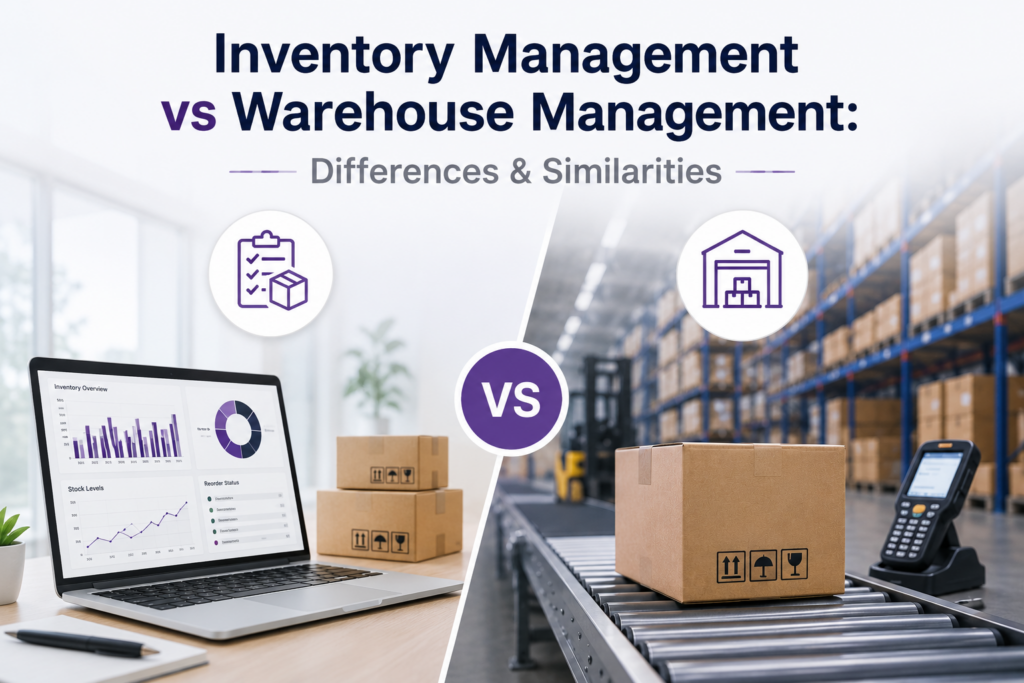
Inventory management vs. warehouse management is a comparison between stock planning and warehouse execution. Inventory management focuses on stock visibility, replenishment, forecasting, and inventory positioning, while warehouse management focuses on how goods move through the facility through receiving, storage, picking, packing, and shipping.
Inventory management and warehouse management are becoming more connected as businesses adopt technologies that unify inventory visibility, forecasting, warehouse execution, automation, and operational planning.
In this blog, we will explain the key differences and similarities between inventory management and warehouse management, where the two overlap, and the best practices businesses use to improve operational visibility and execution.
Suggested Read: Inventory Management Kpis
Key Differences Between Inventory Management and Warehouse Management
The difference between inventory management and warehouse management comes down to planning versus execution. Inventory management helps businesses decide how much stock they need and where it should be available, while warehouse management ensures inventory moves through the warehouse accurately, efficiently, and on time.
| Aspect | Inventory Management | Warehouse Management |
| Definition | Manages stock availability, replenishment, inventory value, and demand planning across the business. | Manages physical warehouse operations like receiving, storage, picking, packing, shipping, labor, and equipment. |
| Focus | Focuses on what inventory is available, where it is located, and when it should be replenished. | Focuses on how inventory moves through the warehouse efficiently and accurately. |
| Key Processes | Forecasting, reorder planning, inventory allocation, cycle counting, and stock tracking. | Receiving, putaway, slotting, picking, packing, shipping, replenishment, and dock management. |
| Scope | Covers inventory across warehouses, stores, factories, and supply chain networks. | Primarily focused on warehouse or distribution center operations. |
| Complexity | Driven by demand fluctuations, lead times, supplier performance, and inventory costs. | Driven by labor, warehouse layout, storage density, automation, and order movement. |
| End Users | Used by supply chain planners, procurement teams, finance teams, and inventory controllers. | Used by warehouse managers, supervisors, fulfillment teams, and logistics operators. |
| Automation & Integration | Uses ERP, forecasting tools, inventory optimization platforms, and AI demand planning systems. | Uses WMS, barcode/RFID systems, robotics, conveyors, voice picking, and warehouse automation tools. |
| Additional Features | Includes safety stock planning, inventory aging, reorder alerts, and multi-location visibility. | Includes directed putaway, labor tracking, wave picking, slotting optimization, and exception handling. |
| Tools Used | Inventory management software, ERP, forecasting engines, and supply chain planning systems. | WMS, WES, scanners, robotics, labor systems, and warehouse simulation tools. |
| Outcome | Improves inventory accuracy, stock availability, working capital, and demand response. | Improves fulfillment speed, warehouse productivity, order accuracy, and operational efficiency. |
Synkrato helps businesses connect inventory visibility with warehouse execution through AI-driven operational intelligence, real-time visibility, and smarter warehouse decision-making.
Suggested Read: What is Virtual Warehousing
Similarities Between Inventory Management and Warehouse Management
Inventory management and warehouse management support different operational areas, but they rely on many of the same processes, technologies, and business goals.
Optimization
Both inventory management and warehouse management reduce waste, improve stock visibility, and lower operational costs. Inventory management minimizes stockouts, excess inventory, and slow-moving products. On the other hand, warehouse management improves storage utilization, labor efficiency, picking paths, and inventory flow inside the facility.
The greatest operational improvements usually happen when inventory planning and warehouse execution work together through connected data, forecasting, and automation. AI-led distribution operations can reduce inventory levels by 20-30% through better inventory positioning and replenishment planning. They can also lower logistics costs by 5–20% by improving coordination across warehouse and distribution workflows.
Technology Integration
Both functions rely heavily on connected technologies to improve visibility, tracking, and operational accuracy. Inventory and warehouse teams use ERP systems, WMS platforms, barcode scanning, RFID tags, automation tools, and real-time dashboards to reduce manual errors and improve decision-making.
As inventory planning and warehouse execution become more interconnected, businesses are increasing investments in technologies that unify operations across the supply chain. About 55% of supply chain leaders are increasing technology and innovation investments, while 60% plan to spend more than $1 million, and 19% plan to invest more than $10 million. The focus is shifting toward integrated operations rather than isolated systems.
Synkrato’s AI agents support this shift by turning warehouse and inventory data into conversational, real-time operational insights and recommendations.
Suggested Read: Warehouse Inventory Management
Customer Satisfaction
Customers mainly notice whether products are available, shipped on time, and delivered accurately. Inventory management helps ensure the right products are available at the right locations, while warehouse management ensures orders are picked, packed, and shipped correctly.
Large retailers are investing heavily in technologies that improve both inventory positioning and warehouse execution at the same time. Walmart’s grocery network modernization reflects this shift. The company is building high-tech perishable distribution centers supported by over 500,000 square feet of automation per site. These facilities can store double the number of cases and process more than twice the volume of traditional perishable distribution centers.
Accuracy as a Priority
Accuracy is critical in both warehouse management and inventory management functions because inventory records and warehouse execution depend on reliable data. Both processes track where products are stored, monitor stock movement, and use cycle counting to verify that physical inventory matches system records.
Even a small inventory error can create larger warehouse issues. If inventory is shown in the wrong location, warehouse teams lose time searching, orders may be delayed, and replenishment decisions become unreliable. To prevent this, businesses use barcode scanning, RFID tracking, and continuous inventory verification to maintain accurate stock visibility.
Suggested Read: What is Warehouse Mapping
Interconnected Processes
Receiving updates inventory records, putaway determines storage location, replenishment depends on stock demand, and picking and shipping reduce available inventory in real time. This level of coordination becomes even more critical in automated warehouse environments where inventory visibility and execution systems must stay continuously synchronized.
DHL Supply Chain reached 500 million picks using autonomous mobile robots across 35 sites, with the last 100 million picks completed in just 154 days. That level of scale depends on synchronized inventory data, warehouse execution systems, labor coordination, and automated task management working together.
The Overlap Between Warehouse Management and Inventory Management
Inventory management and warehouse management overlap most in planning, execution, and operational decision-making. Forecasting, inventory positioning, warehouse capacity, labor planning, and order fulfillment all depend on connected data and coordinated workflows.
Demand Forecasting
Demand forecasting affects both inventory planning and warehouse operations. Forecasts influence what inventory should be purchased, where it should be stored, and how warehouses prepare labor and storage capacity. Poor forecasting can lead to stockouts, overstocks, warehouse congestion, and inefficient picking workflows.
Key areas influenced by demand forecasting include:
- Safety stock planning and replenishment timing
- Labor scheduling during seasonal demand spikes
- Warehouse space allocation for fast-moving inventory
Suggested Read: Warehouse Planning
Supply Chain Planning Software
Supply chain planning software helps businesses decide how inventory should be distributed across warehouses, stores, and fulfillment channels. Warehouse systems then execute those plans through receiving, storage, picking, and shipping operations.
The overlap becomes critical when planning decisions fail to consider warehouse constraints like storage density, labor availability, or dock capacity.
Connected planning systems help businesses:
- Balance inventory across multiple fulfillment locations
- Improve coordination between planning and warehouse execution
- Reduce delays caused by warehouse bottlenecks
- Support faster response to demand fluctuations
Cross-Functional Collaboration
Inventory teams often focus on stock availability, while warehouse teams prioritize labor efficiency, space utilization, and operational flow.
Cross-functional collaboration improves decision-making by connecting demand planning, procurement, warehouse operations, finance, and customer teams. Stockout discussions, for example, may involve inventory availability, supplier delays, warehouse capacity, and customer impact at the same time.
Strong collaboration helps businesses:
- Align inventory decisions with warehouse capacity
- Improve communication during disruptions or delays
- Reduce operational silos across departments
- Respond faster to fulfillment and replenishment issues
- Improve overall supply chain visibility and execution efficiency
Suggested Read: Warehouse Management System Cost
Best Practices for Optimized Inventory Management & Warehouse Management
Businesses achieve stronger inventory visibility and warehouse performance when planning, execution, data access, and operational flexibility work together across the supply chain.
Encourage Effective Communication
Strong communication helps inventory and warehouse teams respond faster to disruptions, delays, and operational risks:
- Share visibility into demand changes, supplier delays, labor shortages, and warehouse constraints
- Align inventory planning with warehouse capacity and replenishment workflows
- Review stockout risks, aging inventory, and order backlogs through shared operational discussions
Democratize Data
Operational data should be accessible across teams so decisions can be made faster and with better accuracy:
- Give teams access to real-time inventory, warehouse, and fulfillment data
- Improve visibility into labor productivity, stock movement, and exception queues
- Remove data silos between planning, warehouse, procurement, and finance teams
- Focus on decision-ready insights instead of increasing dashboard complexity
Minimize Undesirable Stock Situations
Reducing stock inefficiencies requires connected inventory planning and warehouse execution:
- Prevent stockouts, overstocks, obsolete inventory, and misplaced goods
- Avoid storing slow-moving inventory in high-value picking locations
- Improve replenishment speed and inbound processing during supply disruptions
- Use AI and automation to improve forecasting and inventory optimization workflows
- Align warehouse capacity with inventory demand instead of only reducing stock levels
Stay Adaptable and Flexible
Inventory and warehouse operations must adjust quickly to changing business conditions and fulfillment demands:
- Adjust safety stock levels based on demand volatility and seasonality
- Re-slot fast-moving inventory before peak demand periods using Synkrato’s AI slotting recommendations
- Simulate layout or automation changes before operational rollout
- Use AI agents and control towers to identify operational risks early
Synkrato Gives You Full Visibility into Your Warehouse and Inventory
Synkrato connects inventory visibility with warehouse execution to help businesses make faster and more accurate operational decisions.
- 3D Digital Twin: Simulate warehouse layouts, slotting strategies, and automation scenarios before operational changes
- AI Slotting Recommendations: Optimize inventory placement to reduce congestion, travel time, and replenishment delays
- AI Agents & Enterprise Mobility: Improve real-time visibility across inventory, labor, receiving, picking, and shipping workflows
Book an appointment with Synkrato to improve inventory visibility, warehouse execution, and operational decision-making with AI-driven warehouse intelligence.
Suggested Read: Benefits of Warehouse Management System
FAQs
Why are inventory management and warehouse management often confused?
Inventory management and warehouse management work closely together because both deal with stock visibility, movement, and order fulfillment. Synkrato connects both inventory management and warehouse management functions through AI-driven operational intelligence, by helping businesses manage inventory planning and warehouse execution in one connected environment.
Can a business use inventory management without a warehouse management system?
Yes, businesses can manage inventory without a WMS, especially in smaller operations. However, as warehouse complexity increases, Synkrato helps extend traditional inventory systems with real-time warehouse visibility, AI recommendations, and connected operational workflows.
How does warehouse management support inventory accuracy?
Warehouse management improves inventory accuracy through receiving controls, barcode scanning, cycle counting, and real-time inventory tracking. Synkrato strengthens this further with Enterprise Mobility and AI-driven visibility that help reduce picking, putaway, and replenishment errors.
What challenges occur when inventory management and warehouse operations are disconnected?
Disconnected systems can create stockouts, overstocks, delayed orders, warehouse congestion, and unreliable inventory records. Synkrato helps eliminate these gaps by turning warehouse data into real-time recommendations, automations, and operational insights.
How can Synkrato help businesses optimize both inventory management and warehouse operations?
Synkrato connects inventory visibility with warehouse execution through AI Slotting Recommendations, simulation tools, and operational intelligence. Businesses can optimize inventory placement, labor allocation, and warehouse workflows before making physical changes.
Why do businesses struggle with inventory accuracy even after implementing warehouse systems without platforms like Synkrato?
Many warehouse systems track transactions but lack predictive visibility and connected decision-making. Synkrato adds AI-driven recommendations, digital twins, and real-time operational intelligence that help businesses identify bottlenecks, test process changes, and improve inventory accuracy continuously.
What operational improvements can Synkrato support beyond traditional inventory and warehouse management systems?
Synkrato supports improvements across slotting, warehouse layout planning, labor efficiency, inventory visibility, replenishment workflows, and operational simulations. Its AI agents and digital twin technology help businesses make faster and more informed warehouse decisions using real-time operational data.