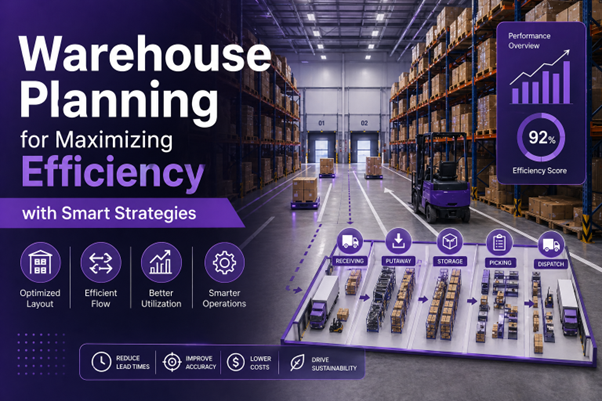
Warehouse planning has shifted from static layout design to a continuous, data-driven system that controls how space, inventory, labor, and workflows perform in real time. Efficiency is defined by how smoothly inventory flows through the warehouse with minimal delays, touches, and decision gaps.
Further, modern planning focuses on orchestrating movement and adaptability, ensuring layouts, storage, and processes align with changing demand, SKU behavior, and operational constraints. The goal is to reduce friction across execution while maintaining flexibility for growth and complexity.
In this blog, we will cover the key strategies and approaches required to maximize warehouse efficiency through smarter planning.
Why Warehouse Planning Is Essential for Operational Efficiency
Warehouse planning directly determines how efficiently space, labor, inventory, equipment, and technology operate together, impacting capacity, cost, speed, safety, and scalability.
- Maximizes Storage Space: Warehouse planning increases usable capacity without expanding real estate by improving slotting, storage allocation, and space visibility. AI-driven tools unlocked 7-15% additional warehouse capacity in 2024, while a logistics provider achieved ~10% capacity increase using a digital twin without adding space.
- Reduces Handling Costs: Warehouse planning lowers handling costs by reducing travel distance, minimizing touches, and aligning equipment with inventory movement. Having said that, labor productivity in warehousing grew only 0.1% in 2024 after a 4.4% decline in 2023, even as labor input increased 0.5% in 2024.
- Improves Order Fulfillment Speed: Warehouse planning improves fulfillment speed by structuring faster inventory flow across receiving, storage, picking, and dispatch. In 2024, only ~20% of North American warehouses were automated, yet 70% of supply chain executives plan to invest around $100 million in automation within five years.
- Enhances Workplace Safety: Warehouse planning enhances safety by reducing congestion, controlling movement, and separating people from equipment. About 2.5 million nonfatal workplace injuries were reported in the USA in 2024, with 946,290 days away, restricted, or transferred (DART) cases driven by overexertion and repetitive motion.
- Supports Scalability: Warehouse planning supports scalability by enabling facilities to handle volume growth without constant redesign. It led to 84.5% utilization in 2024, with ~85% in early 2026, close to expansion thresholds. This means inefficient layouts can quickly create bottlenecks.
Suggested Read: Inventory Management Kpis
Key Factors in Warehouse Planning
Warehouse planning decisions are driven by a combination of location, flow design, capacity strategy, and operational readiness. These factors determine whether a warehouse can execute efficiently under real demand conditions, not just in design assumptions.
1. Location Strategy and Network Positioning
The warehouse location defines the speed and cost of the entire supply chain, not just internal operations. A well-positioned facility reduces transit time, improves service levels, and minimizes dependency on expedited shipping or excess inventory buffers.
- Proximity to customers reduces delivery lead times and last-mile costs
- Access to suppliers improves inbound consistency and reduces variability
- Connectivity to highways, ports, and logistics hubs enables faster distribution
A strong location strategy shifts efficiency upstream, reducing pressure on warehouse execution.
2. Inventory Flow and Movement Design
The warehouse location defines the speed and cost of the entire supply chain, not just internal operations. A well-positioned facility reduces transit time, improves service levels, and minimizes dependency on expedited shipping or excess inventory buffers.
- Proximity to customers reduces delivery lead times and last-mile costs
- Access to suppliers improves inbound consistency and reduces variability
- Connectivity to highways, ports, and logistics hubs enables faster distribution
A strong location strategy shifts efficiency upstream, reducing pressure on warehouse execution.
3. Space Utilization and Storage Strategy
Storage planning must balance density with accessibility, as maximizing capacity alone can increase travel time and slow execution, while underutilized space drives up costs.
Effective storage design uses high-density systems to expand capacity within the existing footprint, leverages vertical space to unlock unused cubic volume, and incorporates flexible configurations that adapt to changing SKU profiles and demand patterns. The objective is to ensure that storage decisions enable faster movement and smoother operations, rather than creating constraints.
Suggested Read: What is Virtual Warehousing
4. Operational Efficiency and Technology Enablement
Technology connects planning decisions with real-time execution. However, its effectiveness depends on how well it is aligned with physical layout and workflows.
Warehouse Management Systems act as the execution backbone by coordinating tasks, tracking inventory, and enforcing process logic. Automation tools improve consistency in repetitive operations, while integrated systems ensure that data flows accurately across all stages.
Effective planning ensures that technology enhances operations rather than compensating for poor design. Synkrato acts as a decision intelligence layer over the existing WMS to enable real-time visibility, AI-driven slotting, and data-backed flow optimization.
5. Workforce Availability and Capability
Labor planning influences how reliably operations can scale and sustain performance.
- Access to a stable and skilled workforce supports consistent execution
- Role design must align with operational complexity and system usage
- Training and adaptability become critical as automation and systems increase
A well-planned warehouse ensures that workforce capability matches operational demands.
6. Safety, Compliance, and Operational Control
Safety and compliance are not separate considerations; they directly impact operational stability and performance. Poorly designed environments increase disruptions, while well-planned ones enable predictable execution.
Clear movement zones, controlled interactions between people and equipment, and adherence to safety standards reduce risk and improve efficiency. Secure handling and traceability also ensure that inventory remains protected and compliant across all stages.
Suggested Read: Warehouse Inventory Management
Warehouse Layout & Floor Plan Strategies
Warehouse planning strategies should enable fast inventory movement, clear functional zoning, safe operations, and scalable expansion without disrupting ongoing workflows.
- Assess Available Space
Warehouse layout planning starts with evaluating both usable space and physical constraints, not just total floor area. Key factors include ceiling height, column spacing, dock positions, load capacity, and equipment movement requirements. Usable space must exclude offices, fire lanes, staging buffers, and utility zones to reflect actual storage capacity.
- Optimize Aisle Widths
Aisle widths should be set based on equipment type, traffic intensity, and pick frequency to balance storage density with operational flow. Wider aisles improve movement and reduce congestion, while narrower aisles increase capacity but require tighter control and specialized handling. Misaligned aisle design slows movement, creates bottlenecks, and reduces overall throughput.
- Define Storage Methods
Storage methods matching SKU characteristics, demand patterns, and picking requirements lead to efficient access and space use. High-velocity items need easily accessible forward pick locations, while bulk or slow-moving inventory can be stored in denser configurations. Poorly chosen storage methods increase handling effort, disrupt replenishment, and limit usable capacity even in full warehouses.
- Separate Inbound & Outbound Areas
Separating inbound and outbound operations reduces congestion, prevents inventory mix-ups, and improves process flow. Inbound zones should support receiving, inspection, and staging, while outbound zones should enable picking, packing, and dispatch. Overlapping these functions increases delays and operational friction.
- Plan for Future Expansion
Warehouse layouts should be designed for scalability before capacity limits are reached. A flexible layout allows for increased volume, additional SKUs, automation integration, and process changes without major disruption. This includes reserving vertical space, enabling modular storage zones, and designing aisles compatible with future equipment such as AMRs or conveyors.
Suggested Read: What is Warehouse Mapping
Common Challenges in Warehouse Planning
Warehouse design and planning challenges arise when space, inventory, safety, technology, and scalability are managed in isolation instead of as an integrated operating system.
- Poor Space Utilization
Warehouses may appear full due to poor slotting, excess inventory, underused vertical space, or mismatched storage methods. This leads to longer travel times, congestion, and inefficient use of prime locations.
- Inventory Mismanagement
Inventory mismanagement happens when physical stock and system data are misaligned, causing stockouts, overstocking, and delays. Common issues include incorrect locations, poor labeling, and inconsistent updates.
- Safety Hazards
Safety risks increase when warehouse layouts create congestion, unclear movement paths, and poor separation between people and equipment. Issues like blocked exits, blind spots, and mixed traffic reduce both safety and productivity.
- Technology Integration Issues
Technology fails when systems are implemented without aligning layout, processes, and data. Planning must ensure digital readiness by standardizing location data, defining mobile workflows, and aligning system triggers with physical operations.
- Scalability Concerns
Scalability issues arise when warehouses cannot adapt to increased volume, SKU growth, or operational complexity. Short-term fixes like temporary storage or ad hoc adjustments create long-term inefficiencies.
Suggested Read: Warehouse Management System Cost
Best Practices for Effective Warehouse Planning
Effective warehouse planning relies on continuous optimization through data analysis, system integration, automation alignment, standardized workflows, and periodic layout improvements.
- Conduct a Space Utilization Analysis
Warehouse space planning and utilization analysis identify whether warehouse capacity is used efficiently or wasted due to poor allocation. It goes beyond occupancy to measure cube utilization, pick density, aisle congestion, staging overflow, and dock performance.
- Implement a Warehouse Management System (WMS)
A WMS improves planning by connecting inventory, workflows, labor, and order execution into a single decision layer. It enables directed putaway, real-time tracking, barcode validation, replenishment triggers, and optimized picking. However, its effectiveness depends on structured location data, defined workflows, and clear process rules.
- Adopt Automation Where Possible
Automation should be deployed to solve specific operational bottlenecks such as excessive travel time, slow picking, or inconsistent throughput. Technologies like AMRs, AS/RS, conveyors, and voice systems improve efficiency when aligned with inventory flow and layout design.
- Standardize Processes & Workflows
Standardization ensures consistent execution across all warehouse operations, reducing errors and variability. Core workflows, including receiving, putaway, picking, replenishment, packing, and returns, should follow defined procedures supported by digital validation where possible.
- Regularly Review & Update Warehouse Layouts
Warehouse layouts must evolve with changes in SKU velocity, order patterns, and operational complexity. Regular reviews should assess travel paths, storage efficiency, dock utilization, and picking performance. Misalignment between current demand and original layout design often leads to congestion and delays.
Suggested Read: Inventory Management vs. Warehouse Management
The Role of Warehouse Planning in Supply Chain Optimization
Warehouse planning improves overall supply chain performance by increasing accuracy, reducing lead times, lowering costs, and minimizing operational waste across the network.
- Improving Order Accuracy & Reducing Lead Times
Clear inventory placement, standardized workflows, and system-driven validation reduce picking errors and improve order accuracy.
Faster lead times come from uninterrupted inventory flow across receiving, storage, picking, and dispatch, enabling predictable and efficient fulfillment.
- Enhancing Cost Reduction & Efficiency
Lower costs result from eliminating excess movement, repeated handling, and inefficient space usage. Operational efficiency improves when workflows are aligned, ensuring smooth handoffs between receiving, picking, packing, and dispatch while reducing idle time.
- Supporting Sustainability & Waste Reduction
Reduced movement, optimized storage, and efficient material flow lower energy consumption and operational waste. Better layout design also minimizes product damage, supports reverse logistics, and delays expansion, improving both cost efficiency and environmental impact.
How Synkrato Can Help Optimize Your Warehouse Planning
Synkrato improves warehouse planning by turning warehouse data into real-time, simulation-driven decisions across layout, inventory, and execution.
Key capabilities include:
- Better planning decisions through simulation: A 3D digital twin allows teams to test layout changes, slotting strategies, and automation scenarios before physical implementation.
- Faster optimization with AI-driven insights: AI slotting and scenario modeling improve inventory placement, reduce travel time, and identify bottlenecks early.
- Stronger execution on the floor: Mobile, no-code workflows enable real-time updates, guided tasks, and higher accuracy in picking, putaway, and cycle counting.
- Proactive decision-making from data: AI agents convert warehouse data into actionable insights, helping teams respond quickly to changes and improve overall efficiency.
Take the guesswork out of warehouse planning. Request an appointment to see how Synkrato helps you turn data into faster, smarter operational decisions.
Suggested Read: Benefits of Warehouse Management System
FAQs
What is warehouse planning, and why is it important?
Warehouse planning defines how space, inventory, workflows, and resources are structured to ensure efficient operations. Synkrato enhances this by enabling data-driven decisions through digital twins and AI-powered optimization.
Why do modern warehouses struggle without intelligent planning systems like Synkrato?
Without intelligent systems, warehouses rely on static layouts and delayed data, leading to inefficiencies and poor decision-making. Synkrato solves this by turning real-time data into actionable insights and simulations.
What are the key elements of warehouse planning?
Key elements include space allocation, inventory flow, equipment alignment, and workforce planning. Synkrato strengthens these through AI slotting, simulation, and real-time visibility.
What makes Synkrato’s approach to warehouse planning different from traditional methods?
Traditional planning is static and reactive, often relying on manual adjustments and historical data. Synkrato uses digital twins, AI agents, and simulation to enable predictive and scenario-based decision-making.
How does warehouse planning improve operational efficiency?
Effective planning reduces travel time, handling effort, and process delays while improving accuracy and throughput. Synkrato enhances this with AI-driven recommendations and optimized workflows.
Why is Synkrato useful for improving long-term warehouse scalability and planning accuracy?
Scalability requires flexible layouts and accurate forecasting of demand and operations. Synkrato enables this through scenario simulation, digital twins, and predictive analytics.
What factors should be considered in warehouse planning?
Key factors include space utilization, SKU velocity, workflow design, safety, and technology integration. Synkrato helps evaluate these factors using real-time data and AI-powered insights.