Warehouse automation trends in 2026 are shifting from isolated machines toward intelligent, connected systems that sense conditions, predict constraints, and change execution in real time.
The pressure is economic as well as operational. The average hourly earnings in U.S. warehousing and storage reached $26.76 in June 2026, up from $25.55 in July 2025. Meanwhile, about 102,900 transportation and logistics service robots were sold worldwide in 2024, up 14%.
This blog covers the 15 warehouse technology trends shaping 2026, their applications, business impact, best-fit operations, and problems they solve.
1. Real-Time AI Decision Intelligence Is Moving Warehouse AI From Prediction to Intervention
Real-time AI decision intelligence is moving warehouse AI from prediction to intervention by evaluating what is happening now and determining what should change next.
This shift is already producing measurable value. In Mexico, by July 2025, Walmart’s self-healing inventory had automatically redirected excess stock and generated more than $55 million in savings. The result shows why AI is moving closer to execution instead of remaining a planning tool.
Synkrato’s AI Agents can analyze connected warehouse data to surface bottlenecks, investigate operational exceptions, and recommend actions using natural-language queries.
For warehouse teams, that changes the operating model in several ways:
- Primary use
- Reprioritize work when order-cutoff risk changes.
- Reroute inventory when shortages or overstocks emerge.
- Business impact
- Shorter exception-to-action cycles.
- Less supervisor time spent reconciling dashboards.
- Earlier correction of inventory and workflow imbalances.
- Best for
- High-volume operations with intra-shift demand variability.
- Key problem solved
- Static rules cannot respond to changing floor conditions.
- Real-time data often arrives faster than humans can evaluate it.
2. Warehouse Execution Systems Are Becoming the Central Nervous System of Automation
Warehouse execution systems are becoming the central nervous system of automation by connecting and coordinating storage, picking, robots, conveyors, and workstations.
At Scentsy’s 160,000-square-foot Meridian, Idaho facility in 2025, a Dematic WES coordinates an AutoStore system with 20,800 bins, 100 robots, 16 carousel ports, and two conveyor ports. The operation increased picking capacity from 300 to 450 units per hour.
Operationally, WES changes where optimization occurs:
- Primary use
- Sequence work across multiple automation subsystems.
- Balance queues between storage and picking stations.
- Adjust task release to downstream capacity.
- Business impact
- Higher utilization of installed automation.
- Fewer bottlenecks caused by locally optimized equipment.
- Best for
- Multi-technology facilities.
- Operations where peaks shift constraints between processes.
- Key problem solved
- Islands of automation cannot optimize total warehouse flow.
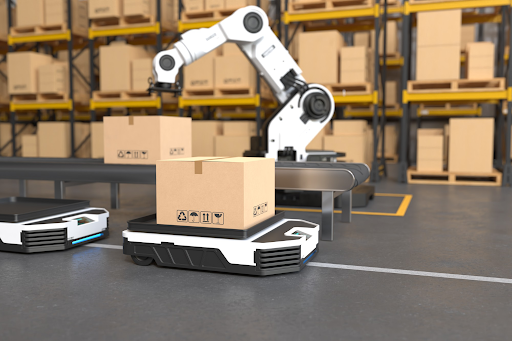
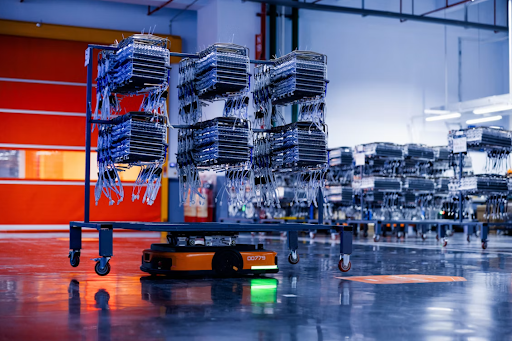
3. AI-Orchestrated AMRs Are Turning Mobile Robots Into Coordinated Fleets
AI-orchestrated AMRs are turning mobile robots into coordinated fleets by adjusting routes and missions based on congestion, priorities, and available capacity.
The scale of adoption supports that transition. 102,900 transportation and logistics service robots were sold worldwide in 2024, up 14% year over year. As fleets expand, orchestration becomes more important than individual robot speed.
The strongest applications focus on variable material flow:
- Primary use
- Change transport missions as queues move.
- Divert loads around congestion or unavailable stations.
- Business impact
- Scale transport without extending fixed conveyor networks.
- Reduce non-value-added employee walking.
- Add capacity incrementally.
- Reallocate robots between workflows as demand changes.
- Best for
- Brownfield warehouses with changing process routes.
- Key problem solved
- Fixed transport paths are costly to redesign.
- Uncoordinated AMRs can create their own traffic constraints.
4. Robots’ Build Is Extending Automation Into Variable Case Handling
Robots’ build is extending automation into variable case handling through AI-driven vision systems, adaptive vacuum or soft grippers, and better motion planning for less predictable carton arrangements.
DHL demonstrates how quickly this is moving into production. Stretch robots reached up to 700 cases unloaded per hour across deployments in North America, the UK, and Europe by May 2025, while DHL agreed to deploy more than 1,000 additional units globally.
For inbound and outbound operations, the implications are broader than unloading:
- Primary use
- Depalletize mixed-SKU inbound loads.
- Automate trailer case unloading.
- Build or feed outbound pallets.
- Business impact
- Extends automation into previously manual dock processes.
- Creates more continuous flow into conveyors and sortation.
- Best for
- Case-intensive retail, consumer goods, parcel, and 3PL operations.
- Key problem solved
- Cartons rarely arrive in repeatable orientations.
- Traditional robotic cells depend heavily on structured loads.
5. Autonomous Forklifts Are Closing the Manual Gap Between Receiving and Automated Storage
Autonomous forklifts are closing the manual gap between receiving and automated storage by moving pallets into and out of automated systems without relying on manual transport.
Walmart addressed this handoff after a 16-month pilot by deploying 19 autonomous forklifts across four U.S. high-tech distribution centers in 2024. At its Brooksville, Florida facility, one associate could direct a FoxBot to achieve three times the previous manual unloading output.
The technology is most valuable where pallet movement is predictable but frequent:
- Primary use
- Connect dock unloading directly with AS/RS induction.
- Run repeatable pallet-transfer missions.
- Business impact
- Higher pallet flow per operator.
- Reduced forklift travel exposure.
- More continuous inbound automation.
- Best for
- Pallet-heavy retail and distribution centers.
- Facilities already using automated storage.
- Key problem solved
- Manual pallet handoffs restrict otherwise automated flows.
6. Plug-and-Play Flexibility Is Making Modular AS/RS Easier to Scale
Plug-and-play flexibility is making modular AS/RS easier to scale by allowing robots, bins, ports, and capacity to be added independently as warehouse requirements grow.
At cargo-partner’s Vienna, Austria, 3PL operation in 2026, AutoStore delivered 75% lower storage-space requirements, 50% faster picking and storage, and 50% less employee travel.
Modular automated storage and retrieval systems (AS/RS) therefore change several design decisions:
- Primary use
- Replace low-density legacy racking.
- Expand storage without enlarging the building.
- Increase ports or robots separately from storage.
- Business impact
- Phases CapEx with demand.
- Increases usable storage density.
- Best for
- SKU-dense operations with constrained real estate.
- Key problem solved
- Fixed systems can overbuild capacity.
- Conventional racking reserves substantial space for travel.
7. Digital Twins Are Moving Automation Testing Ahead of Physical Deployment
Digital twins are moving automation testing ahead of physical deployment by allowing warehouses to test designs, workflows, capacity, and potential changes in a virtual environment first.
PepsiCo’s deployments delivered a 20% throughput increase, identified up to 90% of potential issues before physical modification, achieved nearly 100% design validation, and supported estimated 10–15% CapEx reductions.
With Synkrato’s 3D Digital Twin, teams can model layout, labor, material flow, and automation scenarios before making changes to the live warehouse.
That makes simulation useful well beyond visualization:
- Primary use
- Test automation interactions before installation.
- Stress-test seasonal layouts and peak workloads.
- Business impact
- Reduce commissioning rework.
- Expose hidden capacity before buying equipment.
- Compare alternative automation investments.
- Validate control logic earlier.
- Best for
- High-CapEx redesigns and multi-system automation programs.
- Key problem solved
- Physical facilities are expensive places to discover design errors.
8. Easier Programming Is Reducing the Engineering Cost of Flexible Robotics
Easier programming is reducing the engineering cost of flexible robotics by using low-code configuration, reusable templates, and teach-by-demonstration to simplify robot setup and reconfiguration.
ABB’s AppStudio, launched globally for OmniCore robot and cobot users in January 2025, uses drag-and-drop interfaces and reusable templates that can reduce setup time by up to 80%. Universal Robots also introduced Teach Mode in April 2025, allowing paths and smart skills to be recorded through demonstration.
The operational value comes from reducing dependency on external specialists:
- Primary use
- Reconfigure robot paths.
- Build reusable workflow templates.
- Teach new movements through demonstration.
- Business impact
- Faster changeovers.
- Lower engineering effort for smaller automation changes.
- Best for
- Operations with frequent SKU or process changes.
- Teams without large robotics-engineering departments.
- Key problem solved
- Flexible robots become rigid when every change requires custom programming.
9. Robotics-as-a-Service Is Making Automation Capacity Financially More Flexible
Robotics-as-a-Service is making automation capacity financially more flexible by shifting some robot deployments from large upfront equipment purchases to subscription, leasing, or usage-based models.
That model is gaining traction, as RaaS for transportation and logistics robots grew 42% worldwide in 2024. The growth matters because technology risk increasingly influences automation ROI alongside labor savings.
RaaS changes both deployment and financial planning:
- Primary use
- Add temporary or incremental robot capacity.
- Validate emerging automation before fleet-scale purchase.
- Business impact
- Reduces upfront CapEx.
- Aligns cost more closely with deployed capacity.
- Limits exposure to rapid technology obsolescence.
- Best for
- Seasonal or uncertain-growth operations.
- Key problem solved
- Long payback assumptions can delay otherwise viable automation.
- Ownership transfers technology and utilization risk to the warehouse.
10. Sustainability Focus Is Making Energy per Fulfillment Action an Automation KPI
Sustainability focus is making energy per fulfillment action an automation KPI by expanding ROI measurement to include robot power consumption, charging infrastructure, equipment density, and carbon impact.
AutoStore currently specifies 100 watts of operating power for an R5 robot and states that 10 operating robots consume less energy than one vacuum cleaner, while regenerative technology returns energy to the battery.
That expands the automation scorecard beyond labor and throughput:
- Primary use
- Track energy by a robot or automated process.
- Optimize charging around workload.
- Measure energy or carbon per fulfillment action.
- Business impact
- Controls operating costs as robot fleets grow.
- Reduces supporting electrical infrastructure.
- Best for
- Large, multi-shift automated facilities.
- Key problem solved
- Higher automation should not create proportional energy growth.
11. Autonomous Inventory Drones Are Turning Cycle Counts Into Continuous Verification
Autonomous inventory drones are turning cycle counts into continuous verification by allowing inventory locations and quantities to be checked while warehouse operations continue.
IKEA provides a scaled example. By August 2024, more than 250 autonomous drones were operating across 73 IKEA locations in nine countries. Their AI-based navigation also allows stock checks to run alongside warehouse employees rather than requiring aisle closures.
This changes how inventory integrity is maintained:
- Primary use
- Verify high-bay pallet locations.
- Capture inventory evidence without lifts or manual scans.
- Business impact
- More frequent discrepancy detection.
- Less aisle disruption.
- Lower physical counting effort.
- Faster correction of location errors.
- Best for
- Large high-bay pallet warehouses.
- Key problem solved
- Periodic counting finds errors long after they occur.
12. Automated Right-Sizing Is Extending Automation From Picking Into Packaging
Automated right-sizing is extending automation from picking into packaging by using machine learning and order dimensions to determine how each order should be packed.
In North American fulfillment centers during 2025, Amazon’s automated packaging machines helped avoid 288 million single-use plastic bags. Beginning in the same year, it also installed systems in European fulfillment centers that produce custom-sized boxes and paper bags in real time.
The technology changes downstream fulfillment in several ways:
- Primary use
- Right-size cartons to actual order dimensions.
- Automate bag or box creation.
- Link packing directly with labeling and shipping.
- Business impact
- Reduces void fill and material use.
- Prevents packing from constraining automated picking.
- Best for
- E-commerce and parcel operations.
- Facilities with highly variable order cube.
- Key problem solved
- Manual packing can become the new bottleneck after picking is automated.
13. Predictive Maintenance Is Moving Warehouse Automation From Scheduled Service to Condition-Based Intervention
Predictive maintenance is moving warehouse automation from scheduled service to condition-based intervention. It identifies equipment deterioration and failure risks from operating data before they disrupt automated flows.
At DrinkPAK’s Fort Worth, Texas, facility in 2026, Siemens integrated diagnostics and status monitoring with automated pallet-movement systems specifically to minimize downtime and enable predictive maintenance. The broader DrinkPAK North American network batches, fills, warehouses, and distributes beverages at speeds of up to 3,000 cans per minute.
That shifts maintenance decisions toward asset condition:
- Primary use
- Detect abnormal equipment behavior.
- Prioritize service using live diagnostics.
- Business impact
- Fewer surprise failures.
- Better maintenance-labor allocation.
- Longer productive asset time.
- Best for
- Automation-dense operations with tightly linked processes.
- Key problem solved
- Calendar-based maintenance can service healthy assets.
- Emerging failures may develop between scheduled inspections.
14. Multi-Vendor Interoperability Is Reducing Dependence on Proprietary Robot Ecosystems
Multi-vendor interoperability is reducing dependence on proprietary robot ecosystems by enabling warehouses to coordinate robots from different vendors, generations, and fleet-control systems.
The industry’s standards layer is catching up. VDA 5050 Version 3.0 was released in March 2026 for communication between mobile robots and central master-control systems. Meanwhile, ISO 21423 entered the publication stage on July 21, 2026, covering communications and interoperability among industrial AMR systems from different vendors.
Synkrato can bring data from WMS, ERP, automation, and other warehouse systems into a connected decision environment, helping teams analyze operations without relying on isolated data sources.
This development changes the long-term automation architecture:
- Primary use
- Exchange missions across heterogeneous AMRs.
- Standardize robot status and availability data.
- Connect fleet managers with enterprise resources.
- Business impact
- Reduces custom integration work.
- Preserves vendor choice as fleets expand.
- Best for
- Large multi-vendor robot environments.
- Facilities adding new robot classes over time.
- Key problem solved
- Proprietary interfaces can turn every robot addition into another integration project.
15. Human-Robot Collaboration Is Shifting Automation Toward Task-Level Work Design
Human-robot collaboration is shifting automation toward task-level work design by assigning individual activities according to whether movement, dexterity, judgment, or exception handling is the dominant requirement.
The approach is becoming more sophisticated: by November 2025, Agility Robotics’ Digit humanoid had moved more than 100,000 totes in commercial operations at a facility.
The strongest designs therefore optimize the division of work:
- Primary use
- Give robots repetitive transport and transfer work.
- Keep judgment-heavy exceptions with employees.
- Business impact
- Automates useful portions of a workflow without requiring full autonomy.
- Reduces repetitive physical handling.
- Makes existing human-designed infrastructure easier to reuse.
- Best for
- Variable workflows where full robotic autonomy remains uneconomic.
- Key problem solved
- End-to-end automation can be unnecessarily complex.
- Human capability is wasted when employees mainly perform repetitive movements.
Synkrato Supports Smarter Warehouse Operations by Connecting Decisions, Simulation, and Execution
Synkrato connects warehouse data, AI, simulation, and execution so teams can evaluate operational changes before implementing them.
- Digital Twin: Model layouts, equipment, labor, and material flow in 3D.
- Simulation & Optimization: Compare automation, capacity, labor, and process scenarios.
- AI Slotting: Recommend inventory locations based on demand, velocity, and operational constraints.
- AI Agents: Analyze connected warehouse data to identify bottlenecks and recommend actions.
- Enterprise Mobility: Create no-code mobile workflows for warehouse processes.
- Enterprise Labeling: Automate and standardize labeling across facilities.
Book a demo to see how Synkrato can help you simulate, optimize, and automate warehouse operations with the latest warehouse automation technology trends.
FAQs
What are the latest warehouse automation trends in 2026?
The latest warehouse automation trends in 2026 include agentic AI, intelligent orchestration, AMRs, physical AI, autonomous forklifts, modular AS/RS, digital twins, RaaS, and software-defined automation. Synkrato supports several of these through AI-driven simulation and decision intelligence.
What is the biggest trend in warehouse automation?
The biggest warehouse automation trend is the shift from isolated automation toward AI-coordinated operations that continuously optimize people, inventory, and machines. Synkrato applies this approach through AI Agents, digital twins, simulation, and operational recommendations.
How is AI changing warehouse automation?
AI is changing warehouse automation by predicting bottlenecks, optimizing robot movement, improving robotic handling, and recommending operational actions from real-time data. With Synkrato, AI recommendations can also be simulated before changes reach the warehouse floor.
Will warehouse automation replace workers?
Yes, warehouse automation is more likely to shift work away from repetitive movement and handling toward supervision, maintenance, quality, and decision-making. Synkrato can simulate labor and automation scenarios so teams can evaluate the operating impact before implementation.