Warehouse throughput optimization without adding labor is achievable when operational constraints are identified and resolved before expanding the workforce. Improving process synchronization, reducing delays, and balancing capacity across warehouse workflows often generate greater throughput gains than simply increasing headcount.
As order volumes grow and fulfillment expectations become more demanding, many distribution centers add workers, yet throughput still reaches a plateau because underlying process inefficiencies remain unresolved.
In this blog, we will cover the key factors limiting warehouse throughput and the strategies to improve capacity without increasing workforce size.
Why Throughput Stops Improving Even When More Labor Is Added
Throughput stops improving even when more labor is added because labor is only one component of warehouse performance. When operational bottlenecks remain unresolved, additional workers simply encounter the same delays, congestion, and workflow interruptions, limiting overall productivity. This is why warehouse throughput optimization strategies increasingly focus on system constraints instead of workforce size.
Labor Is Often Misidentified as the Primary Constraint
Staffing shortages are the most visible operational issue, while the underlying bottlenecks remain hidden. In many warehouses, delays are caused by workflow inefficiencies, inventory movement, replenishment gaps, or process dependencies rather than an insufficient workforce.
Warehouse execution contains dozens of hidden dependencies:
| Operational Area | Hidden Constraint |
| Receiving | Dock scheduling delays |
| Storage | Slotting imbalance |
| Picking | Long travel distances |
| Replenishment | Late inventory availability |
| Packing | Uneven workload distribution |
| Shipping | Carrier synchronization gaps |
Each dependency influences the next activity. Without coordinated operational planning, warehouses can incur 9-11% higher operating costs, highlighting the inefficiencies of optimizing isolated processes. This explains why organizations seeking to increase warehouse throughput without hiring more staff increasingly invest in identifying operational constraints before expanding workforce capacity.
Process Dependencies Limit Throughput Growth
Every warehouse function relies on the timely completion of the previous one. When one process slows, delays spread across downstream operations, reducing overall warehouse throughput even if individual teams remain productive. Common examples include:
- Receiving delays postpone replenishment.
- Replenishment delays create stockouts in picking locations.
- Picking interruptions increase waiting time at packing stations.
- Packing delays create shipping congestion.
- Shipping bottlenecks increase dock utilization.
Manual, uncoordinated warehouse processes can increase lead times and operational waste. A study found that eliminating workflow inefficiencies reduced warehouse lead time by 41.4%, highlighting the impact of poor operational synchronization. The challenge becomes even greater during promotional events, seasonal demand peaks, or rapid SKU expansion.
According to research, the long tail of low-demand SKUs makes inventory movement harder to predict and significantly complicates planning and space utilization. These system dependencies represent one of the largest obstacles to warehouse operational efficiency improvement.
Local Productivity Gains Fail to Improve Overall Warehouse Performance
Increasing efficiency in one area does not remove bottlenecks elsewhere. When other operational functions remain constrained, higher picking rates simply shift congestion to downstream processes instead of improving overall warehouse throughput. For example, a warehouse increases picker productivity by 18% through revised picking routes.
Unfortunately:
- Packing capacity remains unchanged.
- Shipping windows stay fixed.
- Dock congestion increases.
- Order queues become longer.
- Cycle times remain unchanged.
Gartner recommends that supply chain leaders prioritize end-to-end planning and integrated decision-making over functional optimization, noting that disconnected planning creates misalignment and reduces resilience. Consequently, warehouse process optimization for higher throughput requires organizations to evaluate operational flow across the complete fulfillment network instead of measuring departments independently.
The Operational Constraints That Restrict Warehouse Throughput
Most throughput limitations originate from operational imbalances rather than workforce shortages. Delays between warehouse functions, uneven resource allocation, and inefficient inventory movement collectively restrict order flow long before labor capacity is fully utilized.
Flow Interruptions Between Warehouse Functions
Flow interruptions between warehouse functions reduce throughput because delays in one process disrupt every downstream operation. When transitions between receiving, storage, picking, packing, and shipping become inconsistent, overall warehouse performance declines even if individual departments continue operating efficiently.
Each interruption introduces waiting time into the fulfillment process. Unlike equipment failures, these delays often remain hidden because individual departments continue meeting their local performance targets. However, the warehouse as a whole experiences declining throughput.
Resource Imbalances Across Critical Work Areas
Resource imbalances across critical work areas reduce warehouse throughput because uneven capacity creates bottlenecks across interconnected operations. When one function operates above or below its required capacity, the imbalance spreads throughout the warehouse, limiting overall throughput and operational efficiency.
Common indicators of resource imbalance include:
| Warehouse Function | Operational Impact |
| Receiving | Inventory waits before putaway |
| Putaway | Replenishment delays increase |
| Picking | Idle labor waiting for stock |
| Packing | Orders accumulate before shipment |
| Shipping | Dock queues extend loading times |
According to the 2023 Warehouse/DC Operations Survey, 71% of organizations are improving warehouse processes to reduce operating costs, indicating that workflow optimization delivers greater value than simply adding labor.
As SKU assortments grow and fulfillment models become more complex, maintaining balanced operational capacity becomes one of the most effective warehouse throughput optimization strategies available.
Bottlenecks Created by Inefficient Inventory Movement
Inefficient inventory movement creates warehouse bottlenecks by increasing travel time, delaying replenishment, and slowing order fulfillment. When inventory does not move efficiently between storage, picking, and shipping, warehouse throughput declines regardless of labor availability. Several factors commonly create inventory movement bottlenecks:
- Long replenishment travel distances.
- Multiple handling steps for the same inventory.
- Poor synchronization between receiving and putaway.
- Overstocked reserve locations.
- Frequent emergency replenishments.
- Congested transfer aisles.
Travel-related activities account for approximately 50% of total order-picking time, making inefficient inventory movement one of the largest contributors to lower warehouse throughput and higher labor costs. Delays in one area create cascading effects throughout replenishment, picking, packing, and shipping, ultimately limiting warehouse operational efficiency improvement across the entire network.
Why Increasing Labor Alone Rarely Solves Throughput Challenges
Increasing labor temporarily raises available capacity but does not eliminate the operational constraints limiting warehouse performance. Unless workflow inefficiencies are addressed, additional employees eventually encounter the same delays, resulting in diminishing productivity and higher operating costs.
The Diminishing Returns of Workforce Expansion
Workforce expansion delivers diminishing returns once operational constraints replace labor as the primary bottleneck. Fixed capacity, workflow delays, and equipment limitations reduce productivity gains over time.
According to research, organizations using AI in supply chain and inventory management most frequently reported revenue increases of more than 5%, showing that data-driven operational improvements create measurable value without relying solely on workforce expansion.
How Congestion Reduces Labor Productivity
Warehouse congestion reduces labor productivity by increasing travel time, waiting, and workflow interruptions. A 2023 study found that congestion and travel-time variability reduce operational efficiency, making congestion reduction essential for increasing warehouse throughput without hiring more staff.
Why System Constraints Continue to Limit Performance
System constraints continue to limit warehouse performance because overall throughput depends on the weakest operational process. Identifying and continuously optimizing these bottlenecks is essential for warehouse process optimization for higher throughput, as workforce expansion alone cannot sustain long-term productivity gains.
The Business Conditions That Enable Higher Throughput Without Workforce Growth
Higher warehouse throughput without workforce growth becomes achievable when operations are synchronized, unnecessary movement is eliminated, and capacity is balanced across interconnected workflows. Organizations that rely on isolated functional improvements instead of end-to-end execution can miss out on up to 30% gains in operational performance and efficiency, according to McKinsey.
Better Synchronization Across End-to-End Warehouse Operations
Better synchronization across end-to-end warehouse operations improves throughput by reducing delays between connected workflows. When receiving, replenishment, picking, packing, and shipping operate independently, disruptions in one process create downstream congestion and reduce overall warehouse efficiency. Synchronization also improves several critical warehouse KPIs simultaneously:
| KPI | Operational Benefit |
| Order cycle time | Faster order completion |
| Picks per hour | Higher labor productivity |
| Throughput stability | Fewer operational disruptions |
| Dock utilization | Improved outbound efficiency |
| Labor cost per order | Lower operating expenses |
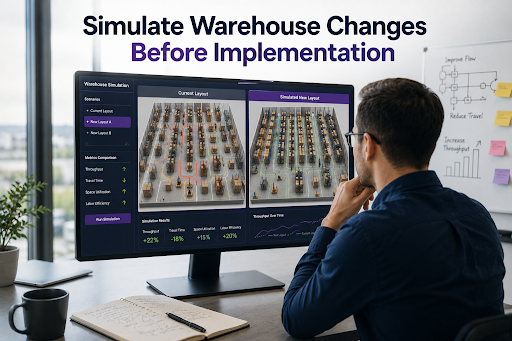
This is where Synkrato Digital Twin becomes valuable. Rather than relying on historical reports, its digital twin environment models warehouse operations before changes are implemented.
Eliminating Non-Value-Adding Movement and Waiting Time
Eliminating non-value-adding movement improves warehouse throughput by reducing unnecessary travel, waiting, and inventory handling. These improvements help organizations increase warehouse throughput without hiring more staff.
- Optimize SKU Placement: Reduce picker travel distance.
- Reduce Emergency Replenishments: Prevent workflow interruptions.
- Eliminate Inventory Touches: Speed up order fulfillment.
- Improve Order Sequencing: Minimize waiting between workflows.
A 2024 study found that an optimized storage assignment policy reduced picker travel distances by up to 56% compared with traditional storage layouts, significantly improving picking efficiency in high-volume warehouses.
Synkrato AI Slotting Recommendations continuously analyze SKU velocity and storage utilization to recommend optimal slotting, supporting warehouse process optimization for higher throughput.
Balancing Operational Capacity Across Warehouse Processes
Warehouse throughput depends on balanced execution across receiving, storage, replenishment, picking, packing, and shipping, not just increased capacity in one area. Synkrato’s AI Agents continuously monitor execution data, detect workload imbalances and emerging bottlenecks, and surface actionable insights in real time. This continuous operational intelligence improves warehouse throughput, resource utilization, labor utilization, fulfillment SLA adherence, and overall warehouse operational efficiency while reducing congestion and operational variability.
When Throughput Optimization Becomes a Strategic Business Priority
Throughput optimization becomes a strategic priority when business growth begins to exceed operational capacity. Rising labor costs, expanding SKU portfolios, and delayed expansion decisions indicate that operational redesign will deliver greater returns than workforce growth.
Order Growth Begins to Outpace Operational Capacity
As order growth begins to outpace operational capacity, warehouses experience longer fulfillment cycles, inventory congestion, and declining on-time shipping performance. Synkrato Simulation & Optimization enables teams to evaluate operational scenarios, validate trade-offs, and optimize AI-driven execution strategies before implementing physical warehouse changes, improving warehouse operations while reducing execution risk.
Labor Costs Increase Faster Than Throughput
Labor costs rising faster than throughput often indicate inefficient workflows rather than a labor shortage. McKinsey reports that digital and analytics-enabled productivity improvements can increase manufacturing throughput by 10-30% and labor productivity by 15-30%, reducing the need for continuous workforce expansion. Synkrato Enterprise Mobility connects warehouse teams with real-time operational insights, enabling faster task coordination, quicker issue resolution, and more efficient execution on the warehouse floor.
Warehouse Expansion Is Considered Before Operational Optimization
Many organizations consider warehouse expansion before optimizing existing operations, leading to unnecessary capital investment. Improving inventory flow, workload balancing, and warehouse execution can increase warehouse throughput and unlock existing capacity.
Optimize Warehouse Throughput Before Capacity Becomes the Constraint
Sustainable warehouse growth depends on making better operational decisions, not simply adding more labor. Knowing how to improve warehouse throughput without adding labor requires continuous optimization of workflows, inventory movement, and operational decision-making rather than relying solely on workforce expansion.
With Digital Twin and AI Agents, warehouse leaders can replace reactive decision-making with continuous operational intelligence, optimize warehouse throughput, and improve operational efficiency without unnecessary workforce expansion. Book a demo with Synkrato today to build a smarter, more efficient warehouse operation.
FAQs
How does Synkrato help increase warehouse throughput without adding labor?
Synkrato Digital Twin enables warehouse leaders to simulate operational changes before implementation, helping identify bottlenecks, evaluate workflow dependencies, and validate improvement strategies. This reduces execution risk while improving throughput, labor utilization, and order flow without requiring additional headcount.
Why does warehouse throughput plateau even after increasing labor?
Throughput usually plateaus because labor is no longer the primary constraint. Bottlenecks such as replenishment delays, congestion, inventory movement, equipment capacity, or workflow imbalances limit overall performance. Until these operational constraints are addressed, adding employees results in diminishing productivity and higher labor costs.
Can Synkrato identify the operational constraints limiting warehouse throughput?
Yes. Synkrato AI Agents continuously analyze warehouse execution data to identify emerging bottlenecks, workload imbalances, process delays, and operational risks. Instead of relying on historical reports, warehouse leaders receive timely operational intelligence that supports faster, data-driven decision-making across the facility.
Why do some warehouses achieve higher throughput with the same workforce?
High-performing warehouses focus on operational synchronization instead of workforce size. They continuously optimize inventory flow, reduce unnecessary travel, balance workloads, and eliminate process delays. This system-wide approach allows existing teams to process significantly more orders without increasing labor requirements.
How does Synkrato improve warehouse throughput using operational intelligence?
Synkrato’s simulation & optimization allows organizations to compare multiple operational scenarios before implementing changes. Combined with AI slotting recommendations, warehouse teams can optimize slotting strategies, improve inventory flow, reduce travel distance, and maximize throughput using AI-driven decision support rather than manual analysis.
What are the early signs that warehouse throughput is constrained by operational inefficiencies?
Common indicators include rising overtime, increasing labor cost per order, longer order cycle times, growing congestion, declining picks per hour, inventory movement delays, and inconsistent SLA performance. Synkrato’s enterprise labeling also helps maintain standardized labeling processes across warehouse networks, reducing execution inconsistencies that can affect downstream fulfillment and overall throughput.