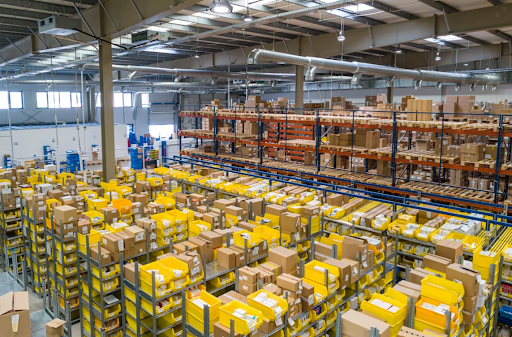

AI forecasts warehouse labor needs by predicting process-level workload, converting that workload into labor hours, and updating the plan as demand and operating conditions change.
Therefore, a useful forecast goes beyond order volume. It connects order lines, task times, inventory, labor availability, automation capacity, congestion, and external demand signals. The goal is to determine where labor will be needed, for how long, and under which workload conditions.
This blog covers the data, forecasting logic, adjustments, productivity measures, controls, and workflows behind AI labor forecasting.
How to Use AI to Forecast Labor Needs (Step by Step)
AI can be used to forecast labor needs by establishing reliable data and productivity baselines, defining the forecast period, predicting workload, and converting that demand into role- and shift-level labor requirements. Actual performance then feeds back into the model to improve future forecasts.
1. Bring Operational Data Together
Bring operational data together from WMS, LMS, HRIS, and planning systems. Gather and clean data by aligning timestamps, definitions, and missing records so inconsistent inputs do not distort the forecast.
2. Build Task-Level Productivity Baselines
Build task-level productivity baselines from historical completion times and labor hours for picking, receiving, replenishment, packing, and other processes. These baselines provide a realistic starting point for converting expected work into required hours.
3. Identify Upcoming Workload Drivers
Identify upcoming workload drivers using historical sales data, order patterns, promotions, seasonality, cycles, trends, and relevant external factors. Separate recurring patterns from one-time events that could otherwise distort expected demand.
4. Forecast Labor Demand by Role and Shift
Forecast labor demand by role and shift after defining the forecast period and selecting an appropriate time-series or machine learning model. Estimate required hours by process, shift, or zone to prevent overly broad forecasts and forecast drift.
5. Account for Workforce Capacity and Constraints
Account for workforce capacity and constraints by applying attendance, available skills, certifications, shift limits, equipment dependencies, and other operating rules. This converts theoretical labor demand into the capacity the warehouse can realistically deploy.
6. Turn Forecasts Into Actionable Staffing Plans
Turn the baseline forecast into a staffing plan, then create adjusted forecasts for low, expected, and peak-demand conditions. Test how different staffing levels affect capacity before committing labor to a shift.
7. Compare Forecasts With Actual Labor Requirements
Compare forecasts with actual labor requirements using labor-hour variance and forecast accuracy metrics such as MAPE. Synkrato’s Enterprise Mobility can connect real-time warehouse execution with planned activity, supporting forecast-versus-actual comparisons.
8. Continuously Improve the Forecast
Continuously improve the forecast by creating a feedback loop between predicted and actual workload, labor hours, and productivity. Retrain or recalibrate the model as operating conditions change, while keeping a human in the loop for exceptions and material staffing decisions.
What Data Does AI Need to Forecast Labor Demand?
AI needs historical operational records, real-time activity metrics, and external environmental inputs to forecast labor demand accurately. Together, these data streams help models predict workload and translate it into hourly, shift-level, and role-specific staffing needs.
A strong AI warehouse labor forecasting dataset includes:
- Demand data: Order lines, units, cube, order type, service level, release time, inbound volume, promotional demand, and sales and transaction data that indicate expected volume changes.
- Process data: Pick, pack, receive, putaway, replenish, stage, and load times, including engineered labor standards and historical task-time distributions.
- Inventory data: SKU location, stock availability, velocity, replenishment demand, product affinity, and expected shortages.
- Workforce data: Scheduled headcount, historical schedules & hours, productivity, employee data such as certifications and availability, skill matrices, and historical absenteeism rates.
- Operational data: Automation uptime, dock appointments, queue depth, travel distance, congestion, equipment capacity, and foot traffic patterns within the facility.
- External signals: Calendar factors, weather forecasts, local events, holidays, and transportation disruptions that can change demand or workforce availability.
For example, Unilever combined weather data with AI forecasting and improved forecast accuracy by 10% in Sweden in 2025. Its 100,000 AI-enabled freezers across a 60-country cold chain also provide near-real-time demand signals.
Similarly, Synkrato’s AI Agents can connect ERP, WMS, digital twin, scan, and image data, giving planners a broader operational dataset for analyzing workload and bottlenecks.
How AI Adjusts Labor Plans for Changing Demand
AI adjusts labor plans for changing demand by detecting gaps between planned and actual warehouse conditions, then recalculating labor requirements during the shift. This turns the original staffing plan into a rolling forecast rather than a fixed schedule.
A useful measure is remaining workload ÷ remaining effective capacity. It shows whether the available team can finish outstanding work within the remaining operating window.
AI can then make several adjustments:
- Early warnings: Detects when backlog growth, slower throughput, absences, or equipment disruptions are likely to create a capacity gap.
- Dynamic reallocation: Moves qualified workers between receiving, replenishment, picking, packing, staging, and shipping as bottlenecks shift.
- Automated matching: Assigns available workers according to the skills and certifications required by the emerging workload.
- Overtime optimization: Estimates whether existing capacity can recover the backlog before recommending additional hours.
- Compliance integration: Checks breaks, maximum working hours, and other scheduling constraints before recommending changes.
- Preference weighting: Considers worker availability and shift preferences when several reassignment options can meet demand.
- Priority adjustment: Protects urgent orders or shipping cutoffs while lower-priority work is rescheduled.
This adaptability becomes important when labor availability changes unexpectedly. In June 2026, 171,000 U.S. transportation, warehousing, and utilities employees quit, representing a 2.4% monthly quits rate. As a result, AI labor planning needs to account for usable capacity, not just scheduled headcount.
How AI Forecasting Improves Labor Planning and Productivity
AI forecasting improves warehouse labor planning and productivity by shifting operations from reactive scheduling to predictive intelligence. This helps warehouses use available labor more efficiently while protecting throughput and service levels.
The impact can be measured through:
- Workload forecast error: Uses WAPE or another volume-weighted measure to compare predicted and actual workload by process and forecast horizon.
- Labor-hour forecast error: Measures the difference between forecasted labor hours and hours ultimately required for completed work.
- Forecast bias: Identifies persistent underforecasting that increases overtime or overforecasting that creates excess capacity.
- Reduced idle time: Measures whether closer alignment between workload and staffing lowers paid time without productive work.
- Optimized workflows: Evaluates whether labor analytics and inventory positioning reduce travel, touches, and other nonproductive activities.
Importantly, productivity assumptions must change as warehouse capacity changes. For example, Unilever’s Mannheim distribution center expects new layer-picking automation to increase peak picking capacity by 50% in 2026 and generate more than €1 million in annual savings. AI workforce forecasting for warehouses should therefore adjust when process capacity changes.
Similarly, Synkrato’s AI Slotting Recommendations can account for SKU placement and pick-path efficiency, helping planners refine travel-time assumptions in labor forecasts.
How Synkrato Helps Forecast Warehouse Labor Needs
Synkrato helps forecast warehouse labor needs by connecting expected workload with actual warehouse conditions and checking whether the proposed labor response can work operationally. This turns a headcount estimate into a decision that can be checked before execution.
Teams can use that workflow to:
- Build labor plans around expected process-level workload.
- Compare low, expected, and peak-demand scenarios.
- Test labor movement between zones before a live shift.
- Check whether congestion or replenishment will limit expected productivity.
- Compare staffing changes with other operational responses.
- Reassess the plan as warehouse conditions change.
This creates a tighter loop between forecasting, capacity planning, scenario testing, and execution, helping teams make stronger labor decisions before adding headcount or changing staffing levels.
Book a demo with Synkrato to see how AI-driven warehouse intelligence can support smarter labor planning.
FAQs
How does AI forecast warehouse labor needs?
AI forecasts warehouse labor needs by predicting process-level workload and converting units, lines, pallets, or tasks into required labor hours. It can then update those hours using demand, labor availability, productivity, congestion, and equipment conditions.
How can Synkrato help forecast warehouse labor needs with AI?
Synkrato can help forecast warehouse labor needs with AI by connecting operational data with workload analysis and scenario testing. Teams can compare labor allocations and expected outcomes before making staffing changes in the live warehouse.
What data is needed for AI-powered warehouse labor forecasting?
AI-powered warehouse labor forecasting needs order, task-time, inventory, workforce, automation, congestion, equipment, and external-demand data. Synkrato’s AI Agents can connect several of these operational signals so workload analysis reflects current warehouse conditions.
How does Synkrato use data to support warehouse labor forecasting?
Synkrato uses connected warehouse data and operational context to support workload analysis and labor decisions. Its AI and simulation capabilities help teams identify bottlenecks, compare staffing scenarios, and reassess plans when operating conditions change.
How accurate is AI for forecasting warehouse labor demand?
AI forecasting accuracy depends on data quality, forecast horizon, process stability, and model design. Accuracy improves when models use current operational data and are regularly recalibrated as demand patterns, workflows, and warehouse conditions change.
Can Synkrato help warehouses plan labor for changing demand?
Synkrato can help warehouses plan labor for changing demand by testing labor shifts and other responses against expected warehouse conditions. This lets teams adjust capacity while considering congestion, workload movement, and downstream constraints before execution.