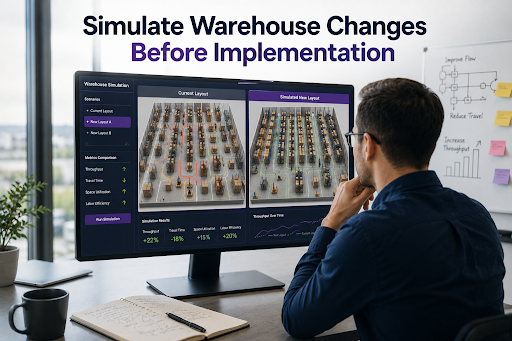
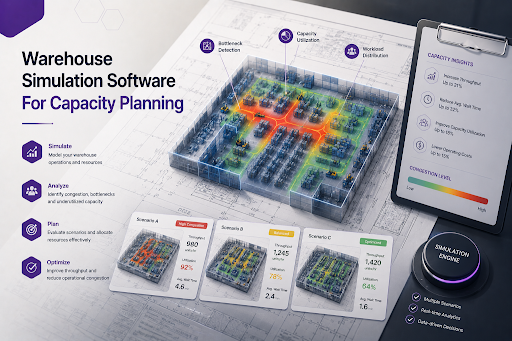
As modern fulfillment becomes more complex, warehouse simulation software for capacity planning is increasingly being used to identify congestion risks before they appear in live operations by testing how inventory, labor, equipment, and workflows interact under different capacity conditions.
Studies indicate that warehouses can improve productivity by 20–30% through better process design and flow optimization, highlighting the value of understanding congestion drivers before they affect performance.
This blog explores how warehouse simulation identifies hidden capacity constraints, why congestion develops before capacity limits become visible, and how simulation-led planning supports long-term flow stability.
Why Congestion Problems Often Begin Before Capacity Limits Are Visible
Congestion usually starts before a warehouse appears “full.” It forms when labor, storage, equipment, dock doors, replenishment cycles, and pick paths begin competing for the same operating capacity at the same time. Warehouse simulation tools for congestion reduction help identify these early pressure points before they show up as missed SLAs or stalled throughput.
How Hidden Capacity Constraints Trigger Queue Formation
Queues often form when one workflow consumes capacity faster than the next workflow can absorb it. A pick zone may still have open space, but if replenishment, labor availability, or staging capacity is constrained, work starts accumulating upstream.
| Hidden Constraint | Queue Formation Mechanism |
| Limited replenishment capacity | Pickers wait for forward stock availability |
| Dock-door saturation | Finished orders queue before carrier handoff |
| Labor imbalance | Work accumulates in overloaded zones |
| Narrow travel paths | Movement slows before storage capacity is exhausted |
Why Congestion Risks Emerge Before Performance Breakdowns Appear
Congestion risk becomes visible first through small flow signals, not major failures. These include rising dwell time, longer travel paths, more replenishment interruptions, slower zone recovery, and inconsistent pick rates.
Suggested Read: Warehouse Simulation Software for 3pl Logistics to Optimize Throughput
How Interdependencies Amplify Localized Constraints
A localized constraint rarely stays local. When one aisle, dock, replenishment zone, or labor pool slows down, adjacent workflows absorb the delay. For example, late replenishment can reduce pick density, which slows packing, increases staging pressure, and delays outbound release.
Why Traditional Capacity Planning Often Misreads Congestion Drivers
Traditional capacity planning assumes congestion occurs only when a warehouse approaches a physical or labor limit.
In practice, congestion often develops much earlier through workflow interactions, resource competition, and uneven workload distribution. This is why warehouses can experience persistent bottlenecks even when utilization levels appear acceptable on paper.
Why Static Capacity Assumptions Fail Under Demand Volatility
Most planning models rely on average order volumes, average labor productivity, and expected inventory profiles. The problem is that warehouse operations rarely operate under average conditions.
During peak periods, changes in order mix, SKU velocity, and replenishment frequency can alter workload distribution significantly.
For example:
- A 15% increase in order volume may create a 40% increase in work for a specific pick zone.
- Fast-moving SKUs can generate localized congestion even when overall warehouse utilization remains stable.
- Labor demand often concentrates in a few operational areas rather than increasing uniformly across the facility.
According to Deloitte, supply chains increasingly struggle with volatility because traditional planning models are designed around stable assumptions rather than dynamic operating conditions.
How Conventional Planning Misses Propagation Effects
Traditional capacity planning often evaluates warehouse functions independently. Receiving, storage, replenishment, picking, packing, and shipping are analyzed as separate processes, even though they operate as a connected system.
| Initial Constraint | Downstream Impact |
| Replenishment delays | Lower pick productivity |
| Dock congestion | Increased staging pressure |
| Labor shortages in one zone | Workload spillover into adjacent areas |
| Storage congestion | Longer travel paths and slower replenishment |
As a result, planners may identify the visible bottleneck while missing the conditions causing it.
Suggested Read: Warehouse Simulation Software for Ecommerce Fulfillment to Improve Order Accuracy
Why Incremental Adjustments Often Leave Congestion Risks Unresolved
Many organizations respond to these constraints by adding labor, expanding storage, or modifying schedules. These actions may reduce immediate pressure but often leave the underlying constraint unchanged.
A common example is adding pickers to a congested zone. Picking capacity increases, but replenishment, staging, or packing capacity remains unchanged. The bottleneck simply moves elsewhere in the workflow.
This is one reason organizations increasingly use warehouse simulation for labor and space capacity planning. Synkrato’s simulation and optimization solution helps evaluate whether a proposed adjustment removes the root cause or merely redistributes congestion across the operation.
Stress Modeling for Diagnosing Congestion Formation Risks
Instead of assuming operations will behave as expected, warehouse simulation software for capacity planning tests how capacity limits emerge, how bottlenecks propagate, and where congestion is most likely to develop under real operating conditions.
Simulation of Capacity Failures Before They Escalate
Congestion typically develops through small imbalances that compound over time, such as replenishment delays, uneven workload distribution, or localized storage constraints.
Instead of asking whether capacity is sufficient, simulation evaluates:
- Demand surges to identify queue formation in high-volume zones
- Labor shortages that can lead to delayed task completion
- SKU velocity shifts that might impact slotting pressure and travel
- Dock volume spikes that cause staging and outbound congestion
This allows planners to identify failure points before throughput, service levels, or labor productivity begin to deteriorate.
Modeling System Response to Improve Planning Decisions
Warehouse performance is determined by how the entire system responds to changing conditions, not by the performance of individual processes.
A warehouse may maintain acceptable utilization levels while still experiencing congestion because resource interactions change under load.
For example:
- Faster picking can overwhelm packing capacity.
- Additional storage locations can increase replenishment travel.
- Increased dock throughput can create staging bottlenecks.
Using capacity planning software for warehouse flow optimization, organizations can model these responses before implementing operational changes.
Risk Conditions Traditional Capacity Logic Often Misses
Traditional planning models often focus on utilization while overlooking interaction effects that influence warehouse flow.
Commonly missed risk conditions include:
- Capacity consumed by replenishment rather than picking.
- Labor concentration in a small number of operational zones.
- Inventory growth that increases travel without increasing throughput.
- Slotting decisions that unintentionally create traffic density.
These risks frequently emerge long before utilization metrics indicate a problem.
Control Responses That Influence Congestion Stability
Congestion stability depends on how quickly organizations detect flow disruptions and respond before queues spread across connected workflows. Warehouse simulation for labor and space capacity planning helps evaluate which control actions, response timings, and workload adjustments are most effective for maintaining throughput stability under changing operating conditions.
Workload Rebalancing Decisions Affecting Flow Stability
Congestion often develops when workloads become concentrated in specific zones while capacity remains underutilized elsewhere.
Effective rebalancing decisions may include:
- Inventory repositioning
- Dynamic labor allocation
- Slotting optimization
- Task prioritization
The goal is not simply to reduce utilization in one area but to maintain stable flow across the broader operation.
Suggested Read: Warehouse Simulation Software for Layout Planning to Improve Picking Speed
Response Timing as a Driver of Congestion Outcomes
Congestion recovery is rarely linear. Once queues begin accumulating, downstream processes must handle both the current workload and the backlog already in the system, increasing recovery time and resource requirements.
A replenishment delay addressed during its early stages may have minimal impact. The same delay addressed after congestion spreads across picking, staging, and outbound operations can require significantly more labor and disrupt throughput for an entire shift.
This is where warehouse simulation tools for congestion reduction create value. By modeling response timing under different operating conditions, organizations can identify the intervention windows where corrective actions deliver the greatest operational benefit.
Adjustment Logic Supporting Better Capacity Control
Effective capacity control depends less on adding resources and more on understanding which operating conditions warrant action.
Rather than reacting to utilization levels alone, leading organizations establish control thresholds around:
| Control Signal | Potential Response |
| Rising queue duration | Rebalance workload across zones |
| Growing travel time | Reposition inventory or labor |
| Increasing replenishment latency | Adjust replenishment priorities |
| Sustained staging congestion | Modify release schedules |
Combined with Synkrato’s AI Agents, these thresholds help teams distinguish between normal operational variation and conditions likely to create persistent congestion.
Capacity Thresholds That Define Long-Term Congestion Stability
Long-term congestion stability depends on identifying the operational thresholds where workload growth begins to outpace warehouse capacity.
Capacity planning software for warehouse flow optimization helps organizations monitor these thresholds, evaluate emerging constraints, and determine when process changes, resource adjustments, or simulation-led planning become necessary to maintain stable warehouse flow.
Indicators That Existing Capacity Logic Has Reached Limits
Congestion usually reveals itself through recurring operational friction before performance metrics collapse.
Common indicators include rising queue duration, increasing travel time, frequent labor reallocation, recurring staging congestion, and persistent replenishment delays. These patterns often indicate that existing planning assumptions no longer reflect operational reality.
Conditions Requiring Simulation-Led Capacity Planning
Simulation-led planning becomes necessary when congestion is influenced by system complexity rather than a single capacity constraint.
Common examples include:
- High-SKU environments where inventory growth changes travel patterns faster than layouts can adapt.
- Multi-channel fulfillment operations where different order profiles compete for the same resources.
- Automation-heavy facilities where throughput depends on interactions between labor, equipment, and inventory flow.
- Rapid network expansion where changes in one operational area affect performance elsewhere.
In these environments, spreadsheets and static forecasts struggle to capture how decisions propagate through the operation. Warehouse modeling software for storage capacity planning helps organizations evaluate alternative capacity strategies before implementation, reducing the risk of introducing new bottlenecks while solving existing ones.
Suggested Read: The Theory of Constraints in Warehousing and How Synkrato Solves Bottlenecks
Factors Supporting Sustainable Congestion Reduction
Sustainable improvements typically come from improving system behavior rather than continuously adding capacity.
The most important factors include:
- Accurate operational data improves model reliability.
- Inventory positioning reduces unnecessary travel.
- Cross-functional planning improves resource coordination.
- Continuous simulation reveals emerging constraints earlier.
- Dynamic slotting improves flow stability as demand changes.
Organizations combining these capabilities with Synkrato AI Slotting Recommendations and simulation-driven planning are often better positioned to reduce congestion without increasing labor requirements or facility footprint.
Conclusion
Warehouse simulation software for capacity planning helps organizations move beyond reactive bottleneck management by identifying hidden constraints, testing alternative operating strategies, and evaluating congestion risks before they affect performance.
Book a demo with Synkrato to reduce congestion and improve flow stability with simulation, digital twins, and AI-driven warehouse intelligence.
FAQs
How can simulation reveal hidden tradeoffs between resource utilization and congestion risk?
Simulation shows how higher resource utilization can increase congestion risk under changing operating conditions. A warehouse may improve utilization rates while simultaneously reducing recovery capacity, increasing queue formation, travel time, and workflow instability during demand surges or labor disruptions.
Why do congestion issues often persist even after warehouse capacity expansion efforts?
Congestion often persists because the original constraint remains unresolved. Adding storage space, labor, or equipment may increase capacity in one area while leaving bottlenecks in replenishment, staging, picking, or outbound workflows unchanged. Simulation helps identify the true source of congestion before investments are made.
How can simulation evaluate the impact of process-priority rules on congestion formation?
Simulation tests how order-release logic, replenishment priorities, and task sequencing rules affect warehouse flow. By modeling alternative scenarios, organizations can identify whether priority decisions improve throughput or unintentionally create queues, workload imbalances, and downstream congestion.
What role does operational variability play in long-term congestion instability?
Operational variability changes how capacity is consumed across the warehouse. Demand fluctuations, labor availability, SKU velocity shifts, and replenishment delays can gradually create uneven workload distribution. Over time, these variations increase congestion risk even when average utilization appears stable.
How can simulation assess whether scheduling decisions may create downstream flow restrictions?
Simulation evaluates how labor schedules, release timing, and workload sequencing affect connected workflows. A scheduling change that improves one process may overload another. Modeling these interactions helps organizations identify downstream flow restrictions before they affect throughput or service performance.
Can simulation quantify the cumulative effect of minor execution delays on congestion escalation?
Yes. Simulation can measure how small delays in replenishment, picking, staging, or transportation accumulate across the operation. While individual delays may appear insignificant, their combined effect can increase queue duration, reduce throughput consistency, and accelerate congestion formation.
How does simulation support validation of alternative capacity strategies before operational changes are made?
Simulation allows organizations to test capacity strategies in a virtual environment before implementation. Teams can compare labor models, storage configurations, inventory positioning strategies, and workflow changes to understand their impact on congestion, throughput, and resource utilization before introducing operational risk.
What factors determine whether simulation outputs are reliable enough for capacity planning decisions?
Reliable simulation outputs depend on accurate operational data, realistic process logic, validated assumptions, and representative workload scenarios. The quality of the model determines the quality of the insights, making data integrity and operational accuracy critical for effective capacity planning decisions.